❈ ❈ ❈
Ten Defense Ministers Walk into a Room in China…
Pepe Escobar
The defense ministers of all 10 members of the Shanghai Cooperation Organization (SCO) met last week in Qingdao, in China’s Shandong Province.
That, in itself, is the stuff drama is made of. Not only because it was a warm-up for the main SCO annual summit later this year in Tianjin with heads of state. But mostly because on the same table we had top BRICS members Russia, China, India and Iran, plus Pakistan; an Indian defense minister visiting China for the first time in five years and facing his Pakistani counterpart after their latest serious exchange of fire; and the Iranian minister closely consulting with Beijing immediately after the Israel–Iran ceasefire kabuki orchestrated by POTUS.
If that was not intriguing enough, the SCO meeting in Qingdao took place almost simultaneously with the NATO summit in The Hague.
Pakistani Defense Minister Khawaja Muhammad Asif cut to the chase, remarking how, unlike NATO, the SCO can “further peace in this region.” China’s Defense Minister Dong Jun stressed that the SCO plays the role of a “stabilizing anchor.”
The now-fragmented (thanks to US President Donald Trump) collective west has no idea what the SCO is all about. The SCO is a 25-year-old multilateral organization, founded a few months before 9/11, and consists of 10 full member states, two observer nations, and 14 dialogue partners: nearly half of the world’s population, from Eastern Europe (Hungary) all the way to the Indian Ocean and the Pacific Rim.
The SCO is not an Asian NATO – as in an offensive military alliance, and it doesn’t want to be; rather, in a quintessentially Chinese formulation, it prefers to affirm itself as a “giant ship of security.”
Initially conceptualized to fight against what the Chinese define as “three evils” – terrorism, separatism, and extremism – the SCO has seriously evolved into a mechanism of economic cooperation. Its latest round table at the St. Petersburg Economic Forum less than two weeks ago, for instance, was hosted by SCO Secretary-General Nurlan Yermekbayev, moderated by the ultra-experienced Sergey Katyrin, president of Russia’s Chamber of Commerce and Industry, and focused on the challenges of creating a common SCO logistics, financial and energy infrastructure.
This panel moderated by Alexey Gromyko, director of the Institute of Europe of the Russian Academy of Sciences and with the secretary of the Union State (Russia–Belarus) Sergey Glazyev as the main speaker, intertwined the SCO with the Eurasia Economic Union (EAEU), debating what is the role to be played by the post-Soviet space in the emerging multipolar economy.
So the SCO today promotes not only joint counterterrorism drills and intelligence sharing, but also economic cooperation fine-tuned to the cultural expectations of different civilizations. It’s a multipolar organism by definition.
Strategic partners Russia–China get on board
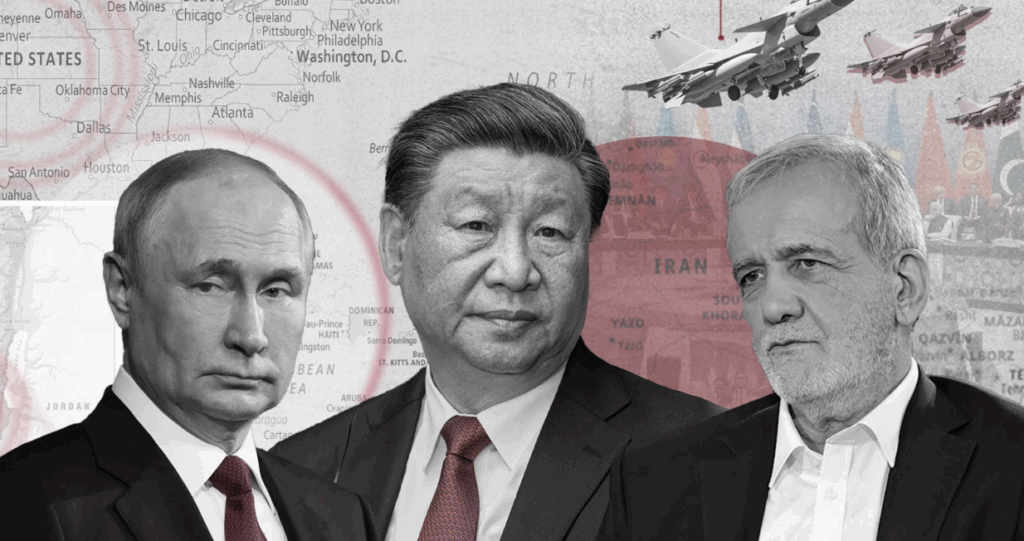
The heart of the matter in Qingdao had to evolve around what can be called the Primakov triangle – a nod to former Russian prime minister Yevgeny Primakov who envisioned a post-Soviet, autonomous Russian powerhouse in a new multipolar order. Today, we see that prescience in a “RIC” composed of Russia, Iran, and China, and not India: These three independent civilizational states are, at the moment, the top three actors advancing the complex Eurasia integration process.
Russian Defense Minister Andrey Belousov met privately with Chinese Defense Minister Dong Jun, as well as with Iranian Defense Minister Aziz Nazirzadeh. At the SCO table, Belousov did not mince his words.
He said that US and Israeli attacks on Iran breach the UN Charter and international law; he confirmed that Moscow had proposed to broker a de-escalation; and he re-emphasized that “the role of international institutions designed to ensure global stability has fallen to an unacceptable level.”
Belousov also stressed all 10 Ministers’ top headache: that “terrorist ideologies” and “transit of militants” continue to spread from West Asia to Afghanistan.
On Ukraine, Belousov was quite predictable; Russia is steadily advancing, and Kiev resorts to “terror tactics” as it contemplates doom. None of the players at the SCO table would dream of contradicting him.
So, where was India amidst all this action? Well, refining its shopping list. Defense Minister Rajnath Singh personally asked Belousov for urgent upgrades to the Su-30MKI and much faster delivery of the remaining S-400 Triumf. These are part of a hefty $5.43 billion deal; three units have been delivered, and the next two will arrive by early 2026.
These S-400s were instrumental during Operation Sindoor – India’s mini-war against Pakistan.
Immediately after Trump’s Israel–Iran “ceasefire” kabuki, Tehran approached Beijing to examine buying options for a substantial batch (at least 40) of Chinese J-10CE fighters (the export version of the J-10C). These negotiations, by the way, have been going on for at least 10 years.
From an Iranian point of view, in terms of low cost and availability, the J-10C might be a better option than the Russian MiG-35s and Su-35Es (the export version of the Su-35S). But it’s important to remember that the Su-35 and the J-10C represent two different classes of jet fighters. Nothing prevents Iran’s Islamic Revolutionary Guard Corps (IRGC) from buying both – a case of interacting strategic partnerships.
Diplomatic sources confirm that Iran already has Su-35s. It is unclear how many, but certainly more than two. Russia is more than ready to sell up to two squadrons. Each squadron would have 12, so a total of 24 jets.
The consensus in Moscow is that Iran will step up simultaneous purchases of top-of-the-line Russian and Chinese fighter jets. And certainly air defense, as in Russian S-400s. The drama that unfolded in the past two weeks goes way beyond the artificial and superficial debate on whether Tehran lacked help from its close, strategic Russian–Chinese allies.
While the IRGC wants those fighter jets after the painful lessons of Israel’s 12-day war, it needs most of all to fine-tune its internal counter-intelligence and insurgency apparatus. A substantial amount of punishment suffered by Iran came from domestic saboteurs who launched drones, planted bombs, and surveyed high-value targets to be murdered.
We want war against Russia and China
Now compare all these Eurasian interactions in Qingdao with what happened in The Hague. Essentially, after being blackmailed by the appalling NATO Secretary-General Mark “Hello Daddy” Rutte, the European Union (EU) decided to allocate a whopping €650 billion (approximately $695.5 billion) of funds it doesn’t have to buy US weapons to declare war on Russia – and later China.
That brings us to the five percent kabuki. For every NATO member to spend five percent on offense, with their combined debt already exceeding 80 percent of GDP, they would need to nearly triple the €325 billion (approximately $381.2 billion) they spent on weapons in 2024, thus reaching nearly one trillion euros.
EU citizens with a brain can easily do the math: There will be a non-stop orgy of “cost-cutting,” tax hikes, and disappearing social benefits to finance the weaponizing. And stealing €300 billion (approximately $351.75) of Russian assets won’t help, because that won’t cover even a one-year increase.
All ministers at the SCO table in Qingdao knew that NATO was at war with Russia, and then China does not even qualify as a lousy Monty Python sketch. Russia already has 13,000 missiles and counting, and will soon be able to produce up to 300 hypersonic Oreshniks a year – more than enough to paralyze every single port and airport in Europe.
It was quite intriguing to observe Russian President Vladimir Putin’s immediate follow-up to what was discussed at the SCO in Qingdao. Cue to the Eurasia Economic Union (EAEU) forum in Minsk, at which Putin said, “thankfully, the situation in the Middle East is stabilizing. The longstanding conflict between Israel and Iran is, thanks to God’s grace, now behind us.”
Or, maybe not, if statements of Israeli officials are anything to go by. Still, for the Russian president, what always matters most is geoeconomics. At the forum, Putin highlighted the EAEU’s preferential agreements with Vietnam, Singapore, and Serbia, plus an imminent agreement with the UAE, saying: “Mutually beneficial relationships with countries across Eurasia, Africa, and Latin America are actively advancing.” Not to mention further cooperation with the BRICS, the Commonwealth of Independent States (CIS), ASEAN, the African Union, and, of course, the SCO.
And just as the ministers were leaving Qingdao, it was officially confirmed: Iran ditched the American GPS system for China’s Beidou. Talk about a sharp, bold move in the tech war chessboard. Next step: to snatch all those Su-35s and JC-10CEs.
(Pepe Escobar is a columnist at The Cradle, editor-at-large at Asia Times and an independent geopolitical analyst focused on Eurasia. Since the mid-1980s he has lived and worked as a foreign correspondent in London, Paris, Milan, Los Angeles, Singapore and Bangkok. He is the author of countless books. Courtesy: The Cradle, an online news magazine covering the geopolitics of West Asia from within the region.)
❈ ❈ ❈
France Seeks a Role in Iran Situation
M.K. Bhadrakumar
On July 1, did you hear the crunching sound of ice cracking on the frozen lake of Russia-France ties? President Vladimir Putin’s decision to take a phone call on that day from his French counterpart Emmanuel Macron, for the first time since September 2022, signifies that the western narrative to ‘erase’ Russia in the proxy war in Ukraine has comprehensively unravelled.
That narrative, aimed at casting an enemy image of Russia, was pivoted on a bizarre thought process that Kremlin intended to invade Europe, but now it serves no purpose as the principal protagonists of the proxy war in the collective west — US, UK, France and Germany — realise that the war has been irretrievably lost and it is about time to move on.
The first sign of it appeared at the recent G-7, NATO summits last month. Following up on the tiding from the NATO Summit, Putin has since green lighted a Russian-American Summit in the near future, something that President Trump has been seeking.
Now, it is Macron’s turn to synchronise his watch. There are rumours that German Chancellor may follow Macron’s footfalls very soon.
Evidently, Putin and Macron see the need to re-engage to bring Russian-French ties to a new normalcy. There is growing realisation that Russia’s demand to negotiate a security architecture for Europe, which was one of the core demands of the Kremlin while opting for the special military operations in Ukraine in February 2022, is showing signs of slowly, steadily gaining traction with Trump. He is unilaterally begun relaxing some financial sanctions on Russia which would also mean that he is taking control of European Union’s reckless moves on Russia. May be this surmise is looking beyond the curve, but it is only logical.
From the Russian readout of the Putin-Macron conversation, it emerges that the discussion devolved upon two topics — the critical Middle East situation and the Ukraine war. The two-hour long discussion certainly went beyond an in-depth exchange.
The Russian readout adopts a positive note on the whole that apropos the Middle East situation at least, despite the past discord and acrimony, the two countries may find convergence in regard of the Iran situation in the wake of the US strike insofar as they “bore a particular responsibility for upholding peace and security” in West Asia as permanent members of the UN Security Council “as well as for preserving the global non-proliferation regime.”
Significantly, the two leaders “noted that respecting Tehran’s legitimate right to develop peaceful nuclear technology and continue fulfilling its obligations under the Treaty on the Non-Proliferation of Nuclear Weapons, which includes cooperating with the IAEA, was crucial.” This is a steady Russian position with which France seems to concur.
The conversation was timely because the E-3 [France, Britain and Germany] now have to notify to the UN Security Council if they intend to invoke the so-called ‘snapback mechanism’ to reimpose the sanctions regime on Iran [on the plea that Iran has violated the provisions of the JCOPA] as the 2015 accord itself is set to expire in October. Time is running out.
The peculiarity of the ‘snapback mechanism’ is that it is immune to veto by any permanent member (in this case, Russia or China.) Ironically, this unusual idea was the brainwave of the Russian negotiators as a guarantee to Europeans that Iran intended to observe in letter and spirit the JCPOA during the ten-year period ahead till October this year.
The US is no longer qualified to invoke the JCPOA and it is a tough call for E-3 in today’s circumstances as Iran may altogether quit the Nuclear Non-Proliferation Treaty [NPT] if push comes to shove so that it is no longer answerable to the UN.
The wording of the Russian readout — “for preserving the global non-proliferation regime” — is an indication that Russia and France have an abiding interest in Iran continuing as an NPT member. The big question is, are we getting a glimpse of a possible solution to the problem based on some sort of flexibility on the part of the US to concede Iran’s right to enrich uranium?
Such a possibility cannot be ruled out although Israel won’t give up on its maximalist stance that Iran should not have any rights to enrich uranium, no matter the NPT.
The bottom line is that Russia and France have underscored the imperative of “settling the crisis around Iran’s nuclear programme and any other differences arising in the Middle East exclusively via political and diplomatic means.” Putin and Macron have an understanding to “maintain contact in order to coordinate their stances if necessary” in the current volatility where there are moving parts.
Interestingly, on the day before the conversation with Putin, Macron had a call with Iranian President Masoud Pezeshkian where he expressed concern over Tehran’s decision to suspend cooperation with the International Atomic Energy Agency.
As regards the Ukraine war, Russian and French positions remain miles apart. That is only to be expected. Putin is unlikely to shift, as the wording of the readout emphatically states. Anyway, Russia counts on the US as its principal interlocutor . And the disclosure that the US arms supplies for Ukraine have virtually stopped is a powerful signal to Europeans to rethink on their own commitments.
Macron finds himself at a loose end, as never before in recent years. The Franco-German axis no longer works in the European Union. Macron has drawn close to the UK PM Keir Starmer but the latter himself is grappling with withering criticism within the Labour Party that his excessive involvement in Ukraine has been at the cost of neglect of domestic issues. Labour Party now trails behind Nigel Farage’s populist Reform UK in opinion polls.
At any rate, Starmer has given up on the crazy idea of a “coalition of the willing” to carry on with the Ukraine war even without the US. That leaves Macron in the lurch in the middle of nowhere, with Trump keeping him at arm’s length. On the sidelines of the G-7 Summit, Trump publicly ridiculed Macron. There are incipient signs that France is already beating the retreat on Ukraine war. Putin understands all this, but he didn’t show it.
Putin and Macron go back a long way. But they seem to have decided to forget that as recently as in March they were calling each other names.
(M.K. Bhadrakumar is a former Indian diplomat. Courtesy: Indian Punchline, Bhadrakumar’s blog.)
❈ ❈ ❈
The North Atlantic Treaty Organisation’s Hallucinations
Vijay Prashad
By the end of the annual meeting of the North Atlantic Treaty Organisation (NATO) in The Hague in June 2025, it became clear that everything was about money. In fact, the final communiqué was perhaps the shortest of any NATO meeting – only five points, two about money and one to thank the Netherlands for hosting the summit. The Hague Declaration was only 427 words, whereas in the previous year, the Washington Declaration was 5,400 words and ran to 44 paragraphs. This time, there was not the granular detail about this or that threat, nor the long and detailed assessments of the war in Ukraine and how NATO supports that war without limit (‘Ukraine’s future is in NATO’, the alliance said in 2024, a position no longer repeated in the brief statement of 2025). It was clear that the United States simply did not want to permit a laundry list of NATO’s obsessions. It was instead the US obsession that prevailed: that Europe increase its military spending to compensate for the US protective shield around the continent.
Having agreed to increase their military spending to 5% of their Gross Domestic Product (GDP), the European states have created a series of problems for themselves.
The first problem is that they would have to invent the money out of their tight budgets. To raise their military expenditure to 5% of GDP would require them to reduce their social spending – in other words, to deepen the austerity policies that are already in place. In Germany, for instance, 21.1% of the population faces the risk of poverty or social exclusion. The German government, led by Chancellor Friedrich Merz, has pledged €650 billion over the next five years to the military – an amount even the Financial Times finds to be ‘staggering’. To get to 5% of GDP, Germany, for instance, will have to raise about €144 billion per year out of reallocating budgets (austerity) and increased borrowing (debt); raising taxes is unlikely, even if these are regressive Value Added Taxes on consumption.
The second problem is that despite the disbursement of money to the military, Europe simply does not have the production lines ready to roll out tanks and missiles at the required pace. Unlike the United States, Europe began to deindustrialise its military sector after the fall of the Soviet Union in 1991. It will now have to spend considerable sums of money just to recover its industrial potential. Over the past few years, European military industrial firms have struggled to meet the needs of Ukraine, with the European Union unable to meet the one million artillery shells requirement in 2024. Rheinmetall, meanwhile, is only able to produce 150 Leopard 2 tanks per year, far below what European companies built during the Cold War and far below the needs of a European army if it must be on the battlefield against Russia. Neither the Eurofighter Typhoon nor the Dassault Rafale fighter jets can be produced quickly. Procurement offices across Europe are slowed down by European Union regulations and customs requirements. No rapid growth of the military will be possible.
The 5% of GDP number is more public relations than reality.
Threats
The Hague Summit Declaration says that the Euro-Atlantic alliance faces ‘profound security threats and challenges’. Who threatens the Euro-Atlantic? The only adversary named in the Declaration is Russia. But around the time that the NATO members met in The Hague, US President Donald Trump spoke with Russian President Vladimir Putin about de-escalation in Ukraine and ending the tensions around Europe, and the Istanbul Talks continued among the various parties involved in ending the war. If there is a ceasefire in Ukraine and if Russia and Europe agree on certain security guarantees, then what is the 5% of GDP increase in military spending about?
Even if Russia ends the war in Ukraine, there are several other concerns that the NATO members have insisted define their increase in military spending. For instance, the NATO member states in Europe have allowed their military facilities to deteriorate, which from a peace standpoint is acceptable but not from one that anticipates war (the military lobby in Europe has especially pointed to the continent’s laxity around cyberattacks and weaponised Artificial Intelligence – although how rebuilding barracks will help with this is unclear). The Baltic states have sounded the alarm against a potential Russian invasion, while the instability around Iran has alerted Europe to dangers near its borders. These are some of the reasons given by war intellectuals in Europe for the necessity of increased military spending.
But by far the most important reason has nothing to do with Europe’s borders or with threats to Europe: China. In NATO’s Strategic Concept 2022, it considered China to be ‘a systemic challenge to Euro-American security’. But in what way is China a threat to Europe? The United States sees China as its main rival, not in military terms, but in terms of the economic dominance of the US-based multinational corporations. Europe’s countries have only benefited from Chinese investments, such as through the Belt and Road Initiative (BRI). Of the 44 countries in Europe, 29 have signed up to the BRI – most of these countries are in Europe’s east, and two-thirds of European countries have signed Memoranda of Understanding with China for trade and development. Italy departed from the BRI in December 2023, but the other countries remain committed to the BRI project. Of the thirty-two NATO member states, twelve have an agreement with China to be part of the BRI or some other major project (Albania, Bosnia & Herzegovina, Bulgaria, Croatia, Czechia, Greece, Hungary, Montenegro, North Macedonia, Poland, Portugal, and Türkiye). That these states are reliant upon China’s economic buoyancy shows that they are not threatened by China, which begs the question of what threat NATO sees in China.
The habit of austerity and war grips the NATO governments, while the Global South has committed itself to peace and development. It is striking how anachronistic The Hague Declaration sounds when placed alongside the slogan of the 17th BRICS Summit in Rio de Janeiro (Brazil) in July 2025: Inclusive and Sustainable Global South (Sul Global Inclusivo e Sustentável).
NATO has no real threats, only expensive hallucinations.
(Vijay Prashad is an Indian historian, editor, and journalist. He is a writing fellow and chief correspondent at Globetrotter. He is an editor of LeftWord Books and the director of Tricontinental: Institute for Social Research. He has written more than 20 books, including The Darker Nations and The Poorer Nations. His latest books are On Cuba: Reflections on 70 Years of Revolution and Struggle (with Noam Chomsky), Struggle Makes Us Human: Learning from Movements for Socialism, and (also with Noam Chomsky) The Withdrawal: Iraq, Libya, Afghanistan, and the Fragility of US Power. Courtesy: Globetrotter, a project of Independent Media Institute, a nonprofit organization that educates the public through a diverse array of independent media projects and programs.)