Compiled by: Editors
Dwarfing Donald Trump’s D.C. parade, at least five million people, including tens of thousands of unionists, turned out for massive “No Kings Day” protests nationwide on June 14 in response to what many deem as the president’s drive to destroy democracy with his dictatorial actions. The estimated crowd of only 50,000 at the military parade dwindled further in the evening as rain showers forced the cancellation of the air show by fighter jets.
The crowds peacefully marching and rallying to protect immigrants and save democracy were two-and-a-half times the projections by No Kings Day organizers, who had expected two million.
Indivisible.org and the Teachers/AFT led the organizing for what may well have been the largest ever nationwide protests. Other sponsors included the Communications Workers, the Postal Workers, retirees of New York City’s AFSCME District Council 37, the Federal Unionists Network, Federal Workers Against DOGE, the Labor Campaign for Single Payer, and the United Electrical Workers.
Those unions and union-allied groups, plus Al Sharpton’s National Action Network, the Progressive Democrats of America, and others, marched and rallied in more than 2,000 locations across the country.
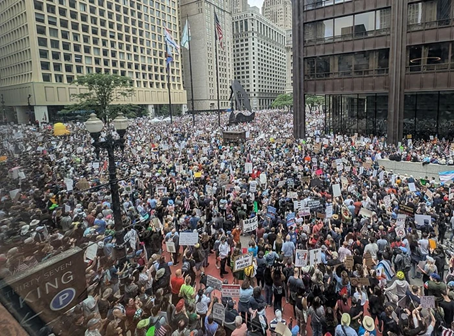
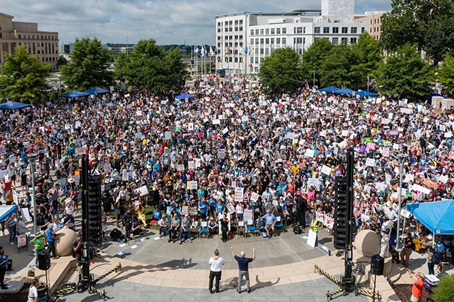
The crowd in Chicago filled Daley Plaza shoulder to shoulder and surrounded the Civic Center on all four sides, filling those streets, too, and stretching for blocks adjacent to them in all four directions.
Turnouts like that led Teachers/AFT President Randi Weingarten to laud “the scale, power, and the solidarity of this movement.”
The millions of marchers in the morning and afternoon dwarfed Trump’s military parade down D.C.’s Constitution Avenue in the evening. He demanded 250,000 people, but got fewer. Capping off the disappointment of the MAGA forces was Mother Nature, wielding a thunderstorm, grounding the Air Force jets that were supposed to provide pageantry at the end of the day.
Tanks, troop carriers, and 6,600 soldiers paraded. The tanks tore up city streets, leaving D.C. holding the bag for the cost of repairs. Thanks to the GOP Congress, D.C. has had its budget, all from local tax dollars, cut by $1 billion.
“Working people need our leaders in power to work for them. Wasting $45 million on a Trump birthday parade does nothing to help working families lower their costs, keep their health care, or pay their bills,” the AFL-CIO tweeted in support of the protest marches across the country. Two federation constituency groups, the Union Veterans Council and Pride@Work, also endorsed No Kings Day.
The AFL-CIO tweet, while true, did not mention Trump’s constant defiance of the laws, the U.S. Constitution, the courts, and Congress.
A major point of contention for the millions marching was his use of the Marines, the Immigration and Customs Enforcement (ICE) agents, and anyone else he could co-opt to repress dissent. The forces, often unidentified secret police, grab people from their cars, burst into schools, houses of worship, and hospitals and courts, then drag all of them off to detention centers near and far.
The Service Employees directly hit that point in a tweet. “We don’t just fight for better wages. Workers fight for democracy. We fight for our right to organize, to vote, to be heard. When we lift and strengthen our voices, we strengthen our democracy,” it said.
“We have to change the way we talk in this country. And part of that is how we create pluralism, not polarization,” AFT’s Weingarten said in a conversation with Al Sharpton of the National Action Network.
Trump’s stated reason for his parade was to celebrate the 250th anniversary of the founding of the U.S. Army, but many assert that his real reason was that June 14 is his birthday. It’s also Flag Day.
The call by protest organizers for peaceful marches was heeded as the people showed that millions in the streets can and did avoid confrontations with white supremacists and other racists, with the police, with ICE agents, and assorted others. The marchers kept the peace, but in several instances—tragically in Minnesota this weekend— some on the right did not.
In the Twin Cities, gunman Vance Boelter, disguised as a police officer, gained entry into the homes of two Democratic state legislators and their spouses that morning, before marches began. Both lawmakers, like the peaceful “No Kings Day” marchers, support the U.S. Constitution and the rights of migrants to the U.S. to live freely and peaceably here.
Boelter murdered former State House Speaker Melissa Hortman and her husband, Mark, and severely wounded State Sen. John Hoffman and his spouse, Yvette. Yvette Hoffman is a union member with Education Minnesota, the state’s joint AFT-NEA affiliate.
In Salt Lake City, Arturo Gamboa pulled out an AR-15 semi-automatic assault rifle. Police and security wounded him, but not before the spray of bullets killed a bystander during the No Kings Day march there.
Elsewhere, despite some arrests, marchers were peaceful, even while the ICE agents, Marines, and National Guard Trump sent to Los Angeles a week ago again shot tear gas at crowds. Denver police warned marchers not to block an interstate highway. When some tried, the police fired pepper balls and arrested five people. An estimated 20,000 marched there.
Protestors March Under Wide Range of Slogans
Protestors nationwide championed various causes in their signs and chants, decrying attacks on trans people, cuts to social programs like Medicaid that working people rely on, the United States supplying the bombs and political support for Israel’s ongoing genocide in Gaza, book bans and prohibitions against teaching about systemic racism, and the takeover of government by billionaires. But the main messages in New York City, Chicago and Los Angeles were about defending immigrants from ICE abductions that have torn families apart, and the defense of democracy, including the right to due process, political speech and dissent.
“The fight is hitting too close to home,” says Gladys, a 12-year public school teacher who requested to use only her first name, when asked why she participated in the New York rally. “A lot of our [immigrant] students are very scared.” She says absence rates at her school have been high.
“As a teacher, I feel like I’m a mom to all of these kids,” Gladys continues. “Citizens, people that are permanent residents — my own family members — are also scared. And I think that’s what’s different now, like there are no laws that are being followed, and it’s just not fair.”
Among the protesters in Chicago was Rep. Jesus “Chuy” Garcia, D-Ill., a progressive and pro-worker lawmaker who represents a heavily Latino district. “We join with the American people to take our country back. The rally and demonstration [are] for democracy and the rule of law and to end the attacks on so many people who are being targeted…against their constitutional rights. This is Flag Day,” he said, “and we don’t allow kings in America. Today we’re showing the power of our people united in resistance for democracy.”
“We’re in a situation that is a crisis that is deepening every day, with weaponization of the military against people, with the kidnapping and disappearing of our neighbors, with the stealing of our resources to give to billionaires,” Kathy Tholin, board chair of Indivisible Chicago, told WBEZ public radio.
“And this is an opportunity for Chicago to say, ‘No, we don’t have kings in this country. We don’t want chaos and cruelty. And we don’t want this country to be in the service of billionaires,’” Tholin noted.
“What we saw in Chicago on No Kings Day was a great showing of solidarity with immigrant workers,” says Jorge Mújica, an organizer with the workers’ center Arise Chicago. Mújica highlighted the importance of marchers, many of them white, lifting the banner of solidarity with immigrants as Trump stokes fear through provocations like the brazen, sweeping and coordinated raids in Los Angeles that began on June 6.
“I saw tourists joining us — no signs, no political T-shirts, just people coming to visit our beautiful city and willing to march with us while on vacation because we are all tired and fed up with what’s going on in our communities,” says Marcelina Pedraza, a member of United Auto Workers Local 551 at Ford’s Chicago Assembly Plant.
Tahtebah Gonzalez, a worker leader with the Union of Southern Service Workers who rallied in Atlanta, was inspired by the Los Angeles protestors the previous weekend who stood up to local law enforcement and federal agents to oppose the raids, facing down tear gas and flash-bang grenades.
“The city of Los Angeles is fighting for their community,” he says. “Families are being torn apart. People are being taken from courthouses, their jobs and even schools. At the same time, public programs like Medicaid, SNAP and Social Security are also being targeted, affecting some of our most vulnerable communities.”
The Los Angeles crowd was diverse but predominantly people of Mexican and Central American descent, says Reverend Edgar Rivera Colón of the advocacy group Clergy and Laity United for Economic Justice. “My sense is that the rage, the sadness, the love and willingness to fight were palpable. The young people were ready for anything. I think we have the elementary building blocks for a popular rebellion that centers itself in self-defense in the most practical way: caring and militant vigilance for neighbors.”
“I was in clerical attire and I was shocked by how many people thanked me for being there and even asked me to bless them,” Colón adds. “One kid asked me to bless his gas mask.”
In Philadelphia, tens of thousands turned out to fill Benjamin Franklin Parkway. Keon Liberato, a high school social studies teacher and member of the Philadelphia Federation of Teachers, says he participated to model what he teaches in the classroom about self-determination and democratic rights.
“One thing I want to show students is that the way you actually enforce your rights is through collective action, and you actually have to put your body on line to make sure that you actually have those rights,” Liberato says. “It’s pretty clear that the seeds of fascism have been nourished pretty well in the United States. So I think that the only way to put a check against the damage is meeting fascism with mass democratic action.”
Liberato also noted that organized labor has an important role to play in resisting the actions of the Trump administration. “We know that when organized labor is defeated, it usually means open season for everybody else. They’re not done attacking organized labor and trying to dismantle what remains of working class organizations, and so this is actually, in my opinion, a little bit late to the game,” he says. “We should have been out doing a lot earlier. But, you know, here we are. We’re doing something, and hopefully we can build a movement.”
In Detroit, more than 5,000 people marched peacefully from Clark Park to the ICE headquarters downtown and then back.
Mayce, a recent high school graduate, told People’s World why she attended Detroit’s rally and march: “My parents. They’re immigrants. I’m a first-gen. I’m here for them to voice their rights. They’re pretty scared of the political climate going on. I’m trying to speak out for them.”
“It’s great. There were more people than I thought there would be. People even from Canada came out and showed up. I’ve seen, honestly, just a bunch of white people showing up [to support immigrants], which is amazing.” Mayce asked her parents not to attend because she didn’t want to risk having ICE grab them.
An attorney, who was active in the anti-apartheid movement, said marching this time “is necessary, really. We can’t just lie down and let this guy [Trump] do whatever he wants. There needs to be something done…I wish there were more people here. Everybody should get involved.”
Protests in Rural Heartland
Big urban centers were not the only places to see demonstrations on Saturday. Compared to previous mobilizations, the fight to defend democracy this time extended far deeper into the rural heartland of the country.
Even in so-called red states like Arkansas, there were demonstrations in places no one expected to see them. In Sebastian County, where Trump carried nearly 70% of the vote last year, more than 700 people lined the main avenue in Fort Smith urging people to, as one sign put it, “Unite against fascism.” More than a dozen more rallies were held around the state in small towns and cities.
Canadians March in Support
North of the border, there were also marches in several cities across Canada, especially those with sizeable American expat populations. Branded as “No Tyrants Day” rather than No Kings Day, so the public wouldn’t confuse the anti-Trump events as anti-King Charles III demonstrations, Toronto’s event saw hundreds of people converge on the U.S. Consulate before marching to Queen’s Park, the Ontario legislature.
One woman from New York, Susan, told the crowd she was upset when a work trip came up that would keep her from attending her local No Kings Day protest. “This is such an important day, I had to be in the streets wherever I happen to find myself,” she said, “so I’m so happy there is a march here in Toronto to stand up for democracy.”
Edward, a Canadian, said even though he’s not a U.S. citizen like many in the crowd were, he believed it was important to stand up against fascism wherever it arises. “Whenever the U.S. moves to the right, Canada and other countries often follow, so we have to stand together no matter what country we are in or where we are from,” he said.
No Kings in D.C, No Marines in L.A.
Back in the U.S., in Geneva, Ill., chants of “No kings in America” and “This is what democracy looks like” were joined by constant supportive honking from passing motorists and trucks. “People are mad, and people are ready to speak out,” Sharon Riggle, who leads Batavia-Aurora Area Indivisible, told the Chicago Tribune. “This is bigger than anything we’ve had before.”
The same thing happened in the close-in D.C. suburb of Chevy Chase, Md. No Kings Day organizers told their supporters to stay out of the central city, which in any case resembled an armed camp. Some 5,000 people headed to Alexandria, Va., while the boisterous Chevy Chase crowd of several hundred produced a cacophony of constant supportive honking and a blocks-long rush-hour-like traffic jam at the major intersection of Connecticut Avenue and East-West Highway.
“No Kings in D.C. No Marines in L.A.,” one Chevy Chase sign read. “Stop the bully,” another declared. “I’m out here out of general respect for the law, not a reality-show politician,” the sign-waving woman said. Another woman, a former teacher, wore a court jester’s hat and waved a sign declaring “The emperor has no clothes, no morals, and no shame.”
“Why are we letting billionaires with untreated mental illness and weak leadership skills wreck our country?” asked yet another sign in Chevy Chase. Her sign refers to Trump’s erratic judgment and former top Trump advisor and DOGE-head, Elon Musk.
“I can’t talk about this. It’s too painful,” she said.
One sign in Chevy Chase even proposed a deal involving Trump’s MAGAites and the migrants the president wants to evict from the country. “Will trade racists for refugees,” her sign said.
“We had a revolution to establish oversight over the government,” said retiree LoRe Alden. “The government is there to serve the people. But they’re turning it into a kleptocracy.”
One sign said simply, “I don’t have enough room on this sign” for all of Trump’s offenses. Another produced a long list: “Hands off my body. Hands off my choice. Hands off my job. Hands off our lives. Hands off our future. Hands off our money. Hands off our freedom.”
“ICE is better when it’s crushed,” another sign in nearby downtown Bethesda read. That protest drew around 200 people, massed in front of a building housing a Trump enabler: Fox-owned-and-operated local TV station WTTG.
No Kings Denver organizer Jennifer Bradley said 20,000 people attended the demonstration and marches through the city. Helicopter footage from 9News showed a column of marchers eight city blocks long. One marcher carried an effigy of Trump in a toilet with a plunger on his head. His sign read: “Dethrone Trump.” There were also No Kings Day marches even in rural red towns.
One marcher in Philadelphia dressed as Tom Paine. That Revolutionary War pamphleteer’s opening words were “These are the times that try men’s souls.”
And later in that same paragraph, Paine declared, “Tyranny, like hell, is not easily conquered. Yet we have this consolation before us: That the harder the conflict, the more glorious the triumph.”
A woman’s sign in Bethesda, Md., harkened back to opposition to the Indochina War. She changed a familiar chant of anti-war forces to “Hey, hey, Donald J., how many kids did you deport today?” The old chant, circa 1967, was “Hey, hey, LBJ, how many kids did you kill today?”
A second sign in Bethesda read “No free pass for Jan. 6 rioters,” referring to Trump’s mass pardon of the 1,500 indicted and convicted insurrectionists who stormed the U.S. Capitol—to keep him in office—almost four and a half years ago.
Labor
For the most part, unions didn’t mobilize members to participate in the No Kings protest as organized groupings. The American Federation of Teachers (AFT) was prominent in Philadelphia and the Service Employees International Union (SEIU) in California and the South. (In Los Angeles, an SEIU-organized music truck featured Ozomatli and an appearance by Tom Morello.) In New York City, the most organized groupings were PSC-CUNY, the Communication Workers of America and federal workers, who have been at the center of Trump’s efforts to destroy the labor movement.
Beating back those attacks will require “making the political cost too high to do certain things like the budget cuts pushed by Congress, and continually making it almost impossible for the president to keep the facade that he’s a competent ruler and that he could actually make the country better,” says Danny, an American Federation of Government Employees member at the New York City march who asked not to use his last name for fear of retaliation.
“We interact with every part of society, from child care, children’s health, public health, financial security for everyone,” Danny adds. “So it’s just recognizing the interconnectedness of everything and how we are part of the broader labor movement.”
“Authoritarian overreach is also really financial abuse of workers, New Yorkers, of people who need the social safety net,” says Jen Gaboury, first vice president of PSC-CUNY, comparing Trump’s budget cuts to a “big vacuum Hoover” swallowing up money and resources.
Carl Rosen, president of United Electrical, Radio and Machine Workers of America, says a new formation called Labor for Democracy brought together 15 national unions and hundreds of locals and regions to back the No Kings Day protests, recognizing “that the labor movement has a special role to play in defending democracy in our country.”
The next steps are already shaping up, and there’s lots that points towards a dynamic fusion of efforts, cascading in a genuinely democratic way.
The labor movement is escalating actions and experimenting with tactics. Labor for Democracy is gearing up to launch a political education program for rank-and-file union members. UNITE HERE Local 274 is teaming with the local AFL-CIO council to orchestrate a series of direct actions on June 18 in Philadelphia directed at Sen. Dave McCormick (R-Pa.) as part of an effort to persuade lawmakers to vote no on the so-called One Big Beautiful Bill. The bill has fractured Republicans, in a rare rebuke to Trump, because provisions like eligibility changes to Medicaid would cut healthcare coverage to nearly 11 million people. Labor unions and community groups will block traffic as part of die-in to symbolically show the devastating impact these cuts will have on thousands of working people if the bill passes.
The May Day Strong coalition, a nationwide network of unions and community organizations, is building towards Labor Day weekend actions as part of #SeptemberSolidarity, says Jackson Potter, vice president of Chicago Teachers Union, the powerful AFT local anchoring efforts to scale up labor’s fighting capacity and develop joint strategy alongside national education unions, federal unions, logistics workers and the AFL-CIO. Potter says the game plan is to shift the focus, amid the transition from summer to fall, “from a time of BBQs and beer to a sharp expression of workers defending our communities against the billionaire agenda hellbent on cutting healthcare, food for hungry children and school funding.”
“As a mass movement, we must ensure that Black leaders and strategists are at the forefront with their siblings to create the future we need,” says Potter. “We will seek to infuse targets into these marches to increase pressure on the wealthy corporations profiting from Trump’s demonization of Black and Brown communities and attacks on working families such as Tesla, Target, Family Dollar, Palantir and T-Mobile.”
Potter says the May Day coalition will also support SEIU’s push to defend immigrant and civil rights as part of the “Justice Journey” caravans, starting June 27, bringing labor and community together at key cities to protest outside detention centers with families sharing stories about how ICE’s cruel deportation sweeps have affected them.
“The actions [recently] suggest that the movement against authoritarianism is growing,” says author and labor scholar Stephanie Luce. “Not just in size, but in tactics. While the No Kings Day marches of over five million people were traditional marches, we also saw an increase in disruptive actions such as blocking ICE vehicles and shutting down highways, veterans getting arrested at the Capitol and Palestinian activists occupying Maersk headquarters in Manhattan. Organizers are stepping up the research on strategic targets, training on non-compliance and outreach to disenfranchised communities. It’s going to be a long fight, but the momentum is in the right direction.”
“Since Trump and his billionaires took office, we’ve seen his regime attack working people at every level,” added Faye Guenther, president of UFCW Local 3000, ahead of the No Kings protests. “This weekend gives us the opportunity to flood the streets to peacefully protest these outrageous attacks, but if we don’t use this opportunity to build lasting power, then we’re just blowing off steam. So as we’re out there marching, we also need to organize. Organize our co-workers, our fellow students and our neighbors. That’s how we build power to stop wannabe kings.”
Gabriel Fontes, a public school teacher in Brooklyn who joined Saturday’s march in New York, sees labor as one of the few forces with the necessary structural power to transform society. “Looking at examples of Chile or Czechoslovakia or Portugal, where my family’s from, we know that workers coming together and doing mass strikes is one of the only ways we can topple dictatorships, and so it’s really gonna take an organized workforce,” says Fontes, a member of the Movement of Rank and File Educators, a reform caucus of the United Federation of Teachers.
But while Saturday’s march fell short of a general strike, Fontes found it an important start to knitting together a movement around shared principles.
“I think a lot of us live very isolated lives,” he says. “So seeing thousands of people come out together with shared values and shared analysis of what the problem is helps us feel less isolated and more connected.”
❈ ❈ ❈
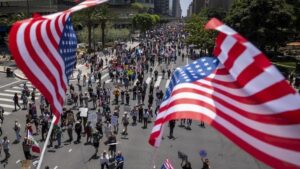
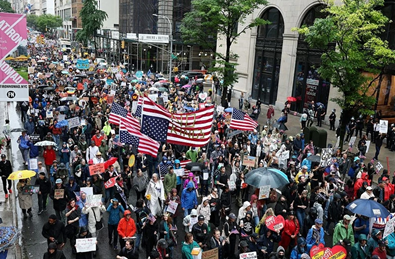
Here is a small sample of some of the massive crowds that turned out Saturday:
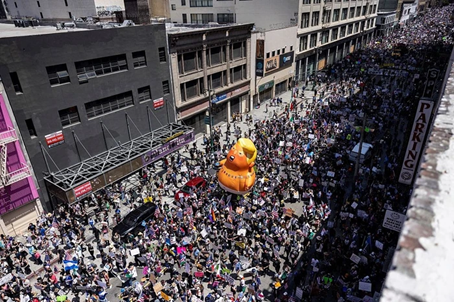
A 20-foot-tall balloon of US President Donald Trump in a diaper is seen among people taking part in a “No Kings” protest in Los Angeles, California, on June 14, 2025
Protesters gather at Daley Plaza holding placards and chanting slogans during a “No Kings” demonstration in Chicago, Illinois, on June 14, 2025.
People take part in a “No Kings” protest at Liberty Plaza in Atlanta, Georgia, on June 14, 2025.
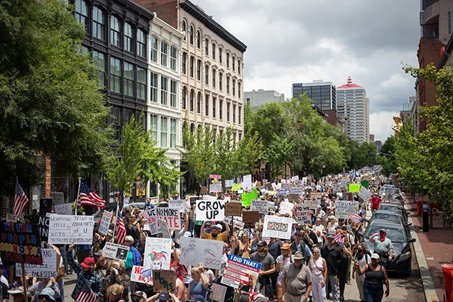
Protesters march during a nationwide “No Kings” rally in downtown Louisville, Kentucky, on June 14, 2025.
[Compiled by us from an article by Luis Feliz Leon in ‘In These Times’ and Mark Gruenberg & Cameron Harrison in ‘People’s World’. Award-winning journalist Mark Gruenberg is head of the Washington, D.C., bureau of People’s World. He is also the editor of the union news service Press Associates Inc. (PAI). Cameron Harrison is a trade union activist and organizer for the CPUSA Labor Commission. He also works as a Labor Education Coordinator for the People Before Profits Education Fund. Luis Feliz Leon is an associate editor and organizer at Labor Notes. Photographs are courtesy Common Dreams, a US non-profit news portal.]
❈ ❈ ❈
Hundreds of Thousands Form ‘Red Line’ Around The Hague
Common Dreams Staff
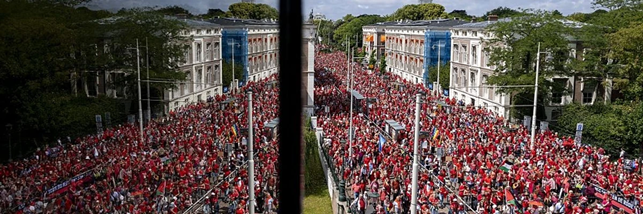
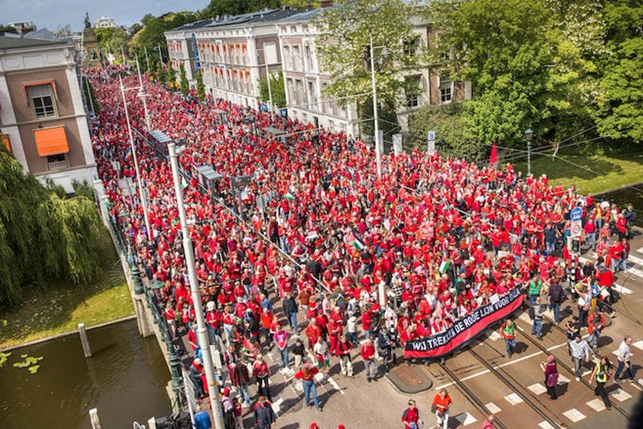
June 15, 2025: Hundreds of thousands of people dressed in red marched through the streets of The Hague on Sunday to demand more action against the “genocide” in Gaza.
NGOs such as Amnesty International, Save the Children, Médecins Sans Frontières (Doctors Without Borders), and Oxfam organized the demonstration, which ran through the city to the International Court of Justice. The protesters were all dressed in red, creating a “red line”.
Organisers described it as the country’s largest demonstration in two decades. Many waving Palestinian flags and some chanting “Stop the Genocide”, the demonstrators turned a central park in the city into a sea of red on a sunny afternoon.
“The Dutch cabinet still refuses to draw a red line. That is why we do it, for as long as necessary,” Marjon Rozema of Amnesty International Netherlands said in a statement.
Protesters walked a 5-kilometer loop around the city center of The Hague to symbolically create the red line that the government has failed to set.
[Common Dreams is a non-profit US news portal.]