❈ ❈ ❈
Micro Loans are Driving an Already Forsaken Population Further into Distress
Amitanshu Verma, Anirban Bhattacharya and Haripriya Harshan
Usharani had taken a bank loan five years ago. When we met her in February this year she was still repaying the loan in an effort to get back the jewels that she had left as collateral. Same is the case for Shobha who said that Non Banking Finance Companies (NBFCs) in particular were notorious – they took away bikes or any other vehicle if you missed instalments. This was in Vadakku Peyankuzhi village of rural Kamyakumari district in Tamil Nadu.
“I have taken loans from a gold finance company also and finally had to take a loan from MALAR to pay back that loan,” said Amutha as we gathered around a courtyard in Kulasekaram, another village we visited in course of our study. Others were nodding in agreement as she narrated her experiences with NBFCs. “MALAR was there before any of these microfinance institutions (MFIs). And MALAR will be there for a long after them. Others just come and go,” she added.
When it comes to formal banks, her complaint, which echoed in almost every village, was about the heavy paperwork that they demand. “Formalities are many with the banks, and are not something we can manage easily,” she said.
We were conducting a field based micro-study, comprising extensive interviews, group discussions and a survey, to understand the credit landscape around the Mahalir Association for Literacy Awareness and Rights (MALAR), a 30-year-old women’s collective in Kanyakumari. With its genesis in the literacy movement, MALAR has been an MFI which claims to prioritise socio-economic welfare over profit. The study, spanning nearly 2,900 survey respondents, gave us a glimpse of what is driving people towards micro-credit, and what they would be exposed to in the absence of an organisation like MALAR which has a uniquely progressive legacy.
Just like Usharani, a whopping 30% of the respondents in our survey said that they have taken loans to redeem their gold mortgage at another source of credit. This disturbing fact shows the penetration of private gold finance companies or NBFCs who are preying on the desperate economic conditions of the rural poor. There are instances of people having taken loans from multiple such sources and then having been driven to take their lives by recovery agents who are notorious for their tactics.
Who exactly needs such loans?
As women gathered at the verandah of a MALAR member at Paramankonam Theru one could hear the sounds of a few handlooms in the neighbourhood. It was largely a weaving village and while most families were struggling, a few had managed to set up a power loom at their homes. A few looms lay in disrepair and the neighbourhood seemed poor. This became apparent as we started speaking. “My husband works as a construction worker. I have two children, one weaves at home and the other works as a nurse in Coimbatore. I also do MGNREGA work in the village,” said Ajitha.
Sushila who has been part of MALAR for 23 years said she also has a loom at home for weaving and depend on the MGNREGA.
Rosemary is a widow and her elder boy is in the construction sector. She works as a MGNREGA worker as well.
This was the pattern in this village. The women’s husbands and older children were all working in neighbouring districts in construction or carpentry, or as security guards or welders, while they were surviving with weaving and the MGNREGA.
Then there is, Srikumari, whose elder son died by suicide and her younger son is a temporary worker in the electricity department. Her husband is in the construction sector and she has been taking up MGNREGA work whenever available.
These are the people for whom such micro-credits become a lifeline as they are not considered credit worthy by the formal banking system. The fact that nearly a quarter of the respondents in our survey had a family income of less than Rs 5,000 shows the danger of slipping into a debt trap if exposed to usurious practices. Nearly 63% of the respondents earn less than Rs 10,000 a month as family income. That is near about Rs 300 per day of family income. Nearly 84% of the respondents came from socially marginalised sections.
The Centre for Monitoring Indian Economy (CMIE) data shows that a vast part of India’s poor and low-income households are increasingly resorting to informal and more expensive sources of borrowing for their credit needs. Between 2018-19 and 2022-23, the number of borrowers from the economically weaker sections of society who borrowed from formal channels contracted by 4.2%. Recent trend also shows that while banks are growing more cautious about unsecured loans given the stricter regulatory oversight, the gap is being filled by NBFCs who are disbursing more and more personal loans. They usually cater to those who are otherwise unable to approach banks due to their weaker economic situation and inability to provide required collateral, including those in informal and unorganised work or self-employed. The latest Financial Stability Report shows that nearly 85% of the micro loans (i.e. loans under 50,000 rupees) are being met by NBFCs and fintech firms.
What are they taking loans for?
In our survey, 55% have indicated that education is one of their reasons. In a vastly unequal society, education clearly still remains one of the only social ladders for upward mobility and attracts aspirational investments. But there is one more reason – private schools charging higher fees that have taken over the education space. Vijayalaxmi, a senior executive committee member of MALAR says that “people spend beyond their means to send their children to private schools” and for this, they are willing to take one loan per year to just pay higher fees.
In Karuparai, as we gathered around a cow shed flanked by palmyra trees on one side and a small kitchen garden on another, we listened to Gita who has been a member of MALAR for 23 years. She said that when her mother was hospitalised, she had no money to even get her discharged after the treatment and buy follow up medicines. It is the medical loan from MALAR that came to her rescue. Medical expenses are the second largest reason for loans – 47% as per our survey. In the absence of adequate and quality public health services, medical expenses become one of the easiest traps to fall into indebtedness and in the absence of affordable credit, it can completely break the back of a family.
Our survey also suggests that the poor are largely taking loans for consumption needs and not so much for building assets or income generation – like when it comes to buying land (5.1%) or vehicles (6.7%). Again, compared to medical needs, education or wedding expenses, the loan uptake for economic activities is relatively less (9% for animal husbandry, 2.1% for enterprises, 4.8% for agriculture, and 4% for business).
If one looks at the latest Financial Stability Report, one finds that India’s household debt has been increasing in recent years and what is especially concerning is the fact that among the broad categories of household debt, it is the non-housing retail loans that form the bulk (54.9% of total household debt) which are mostly used for consumption purposes. The share of these loans has been growing consistently over the years, and their growth has outpaced that of both housing, agriculture and business loans, which is deeply concerning.
It is rather unfortunate that in a context of dwindling savings and stagnating wages, when the poor today are cash starved and are desperate for loans to make their ends meet, our credit apparatus and banking system seem to have forsaken them.
Predatory sources of credit
“The banks have too much process and paperwork that requires too many visits to a far away branch,” says Chellachi of Naagacode village. “In comparison, here in MALAR, we have a relationship of trust. We get loans whenever we need even in emergencies and no paperwork is needed.”
While financial inclusion in a substantive sense would have meant increasing public sector bank branches in rural areas and increasing rural credit, what we have witnessed off late is quite the opposite. While the nationalisation of banks had increased their share from a mere 18% in 1969 to close to 60% by the 1990s, it has once again been declining in recent years, reaching a mere 29%. Rural credit which used to be more than 50% in 1995 has come down to 38% by 2024 while urban and metropolitan credit has grown at its expense. This created fertile land for the mushrooming of private micro-lenders and NBFCs.
Mary from Nagacode said that many like her do not trust NBFCs. “We can’t rely on them as they can run away any time, we don’t know them. Also if we fail to pay the charge, then they double the interest rate. We prefer MALAR.” But then MALAR is an exception. The rule is predatory NBFCs and commercial micro-finance companies that charge exorbitant rates and practice inhuman recovery methods that involve humiliation, intimidation, public shaming, and breach of privacy. They often gain access to one’s phonebook to call relatives and colleagues and even access one’s gallery to distort private images and then blackmail with them. There are numerous instances of suicides owing to such tactics and the abysmal rates demanded by these creditors. As per a recent survey, we gather that 45% of users said that the rate of interest charged by loan apps was over 25% per annum; 10% got it at a 50-100% interest rate; and 20% at a whopping interest rate of 100-200%. The latest survey also found 61% complaining about extortion threats or data misuse.
In the latest ‘State of Microfinance in India’ report, the NABARD itself acknowledges that the waiver of a cap on interest rates for NBFC lenders is leading to exorbitant rates and pockets of indebtedness. The same has been echoed by the RBI on multiple occasions in recent years. The RBI governor has even said that the NBFCs are misusing the freedoms that they have been allowed.
But effectively, the policy landscape has only been opened up to allow for the mushrooming of these usurious practices affecting common people’s access to credit. In fact they are also being celebrated for their so-called impact on “financial inclusion”. So, when the RBI celebrates the rise in its Financial Inclusion Index to 67 this year from 64.2, we must qualify it with the experience of the countless people in our countryside whom we have forsaken in the hands of these modern day moneylenders.
Amid rising suicides and harassment, the fact that state governments of the likes of Tamil Nadu and Karnataka are making their own laws to curb the inhuman and illegal recovery practices of NBFCs is a welcome endeavour. But they face a massive roadblock in the way of legislating effectively due to the Supreme Court order in 2022 that puts NBFCs (that are under the RBI’s jurisdiction) outside the purview of state moneylending laws.
The onus thereby is on the Union government. But even a cursory look at the Banning of Unlawful Lending Activities (Draft) Bill shows that the government is only interested in a show of concern, not in an effective measure that may hamper the profitability of big corporates who aim to make a sizeable cut from people’s dire need of micro-credit. The Bill for all practical purposes is only restricted to authorising unregistered lenders. It shows no intent on regulating those already registered and indulging in usurious rates or driving people to take their own lives with their atrocious recovery tactics.
[Anirban Bhattacharya, Amitanshu Verma and Haripriya Harshan are associated with the Centre for Financial Accountability. Courtesy: The Wire, an Indian nonprofit news and opinion website. It was founded in 2015 by Siddharth Varadarajan, Sidharth Bhatia and M. K. Venu.]
❈ ❈ ❈
Debts to Death: How Microfinance Companies are Crushing the Poor in Bihar
Ritumbra Manuvie and Priti Hirawal
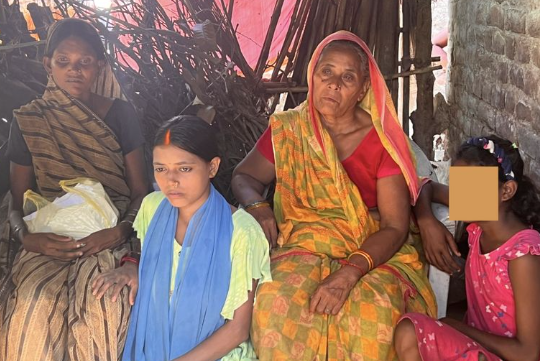
Patna: Mahanti Devi is inconsolable. It has been two months since her son Siyaram Sahu, a daily wage labourer died by suicide in the middle of an approximately 4mx3m room which served as his home and where he raised his family of four kids with his wife Titali Devi in Kab village, Paligunj circle, around 50 kilometres from Patna city.
Sahu’s family claims that he died because of the consistent pestering by the collection agent of the micro-finance company from whom Sahu’s wife took Rs 50,000 loan towards her daughter’s wedding. Now, approximately Rs 14,000 of this loan remains.
Recalling the fateful day, Titali Devi and her two daughters narrated how the collection agent came in the dead of night and started harassing the family for re-payments. Unable to do anything, Titali Devi ventured outside to see if she could borrow money from any neighbour who might be awake.
Meanwhile, the collection agent continued to abuse the family and threaten Sahu of dire consequence. At some point, Sahu asked the collection agent if he is unable to pay should he die by suicide, to which the agent responded in affirmative, the family says, adding that Sahu died while the collection agent was sitting just outside the door to their huntment.
Breaking down in tears, Tittali Devi mentions that the collection agent – whose name she does not know – ran away when he saw her husband dying by suicide, during those last moments. By the time the neighbours and family returned Sahu had died.
The ordeal of the family, however, did not end there. Its been two months since the suicide and neither have they been successful in extracting a copy of the post mortem report nor have they been able to file an FIR. Dainik Bhaskar Hindi is the only mainstream newspaper where the news was recorded as a footnote to the rally organised by the local MLA – Sandeep Singh – against micro-finance companies.
The tragedy of Sahu’s death is not an aberration. It is a symptom of the deep structural violence embedded within Bihar’s micro-finance economy – an economy that has grown in the name of women’s empowerment but now thrives on cycles of coercion, humiliation, and debt entrapment. Over the last decade, Bihar has emerged as one of India’s leading micro-finance markets. Yet the very women who were to be lifted out of poverty are being crushed by the weight of interest payments, social pressure, and the state’s withdrawal from welfare provisioning.
The Nitish Kumar government has long projected itself as a champion of women’s advancement. Schemes such as Jeevika Project, Jeevika Didis network, and the Mukhyamantri Nari Shakti Yojana have been showcased as models of participatory development – bringing women into the fold of financial inclusion, entrepreneurship, and local governance. In practice, however, these programmes have served as conduits for integrating poor women into debt-based markets, while transferring the risks of welfare onto their shoulders. Through self-help groups (SHGs) and micro-finance linkages, women are being encouraged to borrow, invest, and repay – often without meaningful protection against income shocks, health crises, or exploitative intermediaries.
In the case of Sahu’s family, the lender’s harassment was not an isolated instance of misconduct but part of a normalised practice of coercive recovery. Collection agents, many operating on commission, routinely resort to threats, social shaming, and nocturnal visits. The Reserve Bank of India’s own reports have noted the absence of effective grievance redressal mechanisms and the lack of regulatory oversight for non-banking financial companies operating in semi-urban and rural Bihar. Yet, government rhetoric continues to celebrate micro-finance as a celebration of women’s economic agency — obscuring the fact that such “agency” often operates under the shadow of debt and predatory interest rates ranging from 29-50%.
The ruling NDA government while mobilising women’s collective to absorb fiscal austerity has diluted the demand for redistribution. Women are told that taking loans is a pathway to dignity, that thrift and repayment are virtues, and that entrepreneurship will liberate them from dependence. The Jeevika Didis themselves are tasked with facilitating loan recovery, managing credit cycles, and enforcing repayment discipline among their peers. In effect, they become the soft arm of the state’s neoliberal apparatus, internalising the logic of responsibility and repayment as a measure of empowerment. When the burden becomes unbearable, as in the case of Titali Devi and her husband, the state disappears – leaving only the rhetoric of resilience.
This silence is not accidental. The micro-finance sector is politically embedded, sustained by a complex nexus of state endorsement, and private capital. While opposition leaders and women’s organisations periodically protest against coercive recovery practices, the state machinery treats these deaths as isolated tragedies rather than structural failures. The lack of FIRs, postmortem transparency, and media attention is itself a form of governance erasure – an erasure that ensures the continuation of debt-driven development.
If Bihar’s government is serious about protecting women, it must move beyond symbolism. It must recognise that the true measure of empowerment is not the number of women borrowers or SHGs, but the freedom from fear, harassment, and unpayable debt. What is needed is a re-politicisation of the development discourse – one that reclaims social welfare from the grip of micro-finance companies, restores accountability to state institutions, and affirms that dignity cannot be mortgaged for credit.
[Ritumbra Manuvie is an Assistant Professor at the University of Groningen, where she teaches Human Rights Law, and Post-colonial Theory. Priti Hirawal is a freelance journalist and documentary filmmaker based in Bihar. Courtesy: The Wire, an Indian nonprofit news and opinion website. It was founded in 2015 by Siddharth Varadarajan, Sidharth Bhatia and M. K. Venu.]