❈ ❈ ❈
Gen Z Uprising? Protests in Paraguay Against the Peña Government
Pablo Meriguet
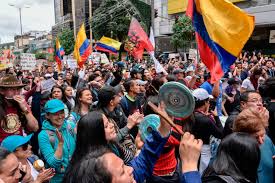
October 2, 2025: On September 28, hundreds of people took to the streets of Paraguay’s capital, Asunción, to protest the right-wing government of Santiago Peña (2023-present) and the national political structure in general.
The protest call was made on social media under the slogan “We are the 99.9%”, following several days of protests in the capital. According to the protesters, the Peña government continues to uphold a form of power based on corruption and neglects basic services, especially public health and the safety of the population.
Journalist Amado Arrieta told Peoples Dispatch: “What was demanded in the protests was an end to nepotism, an attempt to stop the advance of narco-politics, which has basically taken over the three branches of government, and more opportunities for young people. The children of politicians get the best jobs, sometimes without having the necessary skills.”
According to Transparency International’s 2024 Corruption Perceptions Index, Paraguay is one of the most corrupt countries in Latin America.
“Here in Paraguay, we are really asking for security, justice, and health in our country … [We reject] corrupt politicians who steal from the people right in front of them,” nursing student Jenifer González told EFE.
Many media outlets have portrayed the protest as a new example of resistance from what is known as “Generation Z”, that is, protesters born between the late 1990s and 2010, who are fed up with current politics and have already demonstrated in France, Nepal, Indonesia, Sri Lanka, and Bangladesh.
And while certain symbols were repeated, such as the enormous letters Z painted on walls and flags with images from the anime “One Piece”, the truth is that the mobilization included groups of different ages demanding an end to corruption, nepotism, and the interference of drug trafficking in all structures of the Paraguayan state.
However, it is also important to note the similarities in the mood of the protesters and the demands and symbols between the protests in Asunción and those that took place on the same day in Lima, Peru, where hundreds of people protested against the political establishment.
In this regard, analyst Leonardo Berniga told DW: “In this mobilization, there is an international identification with a population group that is extremely frustrated by the corruption, inequality, abuse of the law, and injustice that occur in Paraguay, and that coincide with demonstrations that have taken place in Nepal, Peru, and other countries … The mobilization shows that there is a politically aware youth, but one that is not represented in the electoral process.”
The government’s response: a witch hunt?
On the other hand, it is undeniable that there are also similarities between the responses of Dina Boluarte’s government in Peru and Santiago Peña’s government in Paraguay to the protests. Law enforcement agencies in both countries have shown that they are willing to disperse protesters as quickly as possible and that they can easily arrest those who are demonstrating.
Indeed, the police deployment in Asunción has surprised many. An estimated 3,000 police officers carried out operations against just a few hundred protesters, which shows the force with which the state wanted to act. According to the data, following the protests in Asunción, 10 people were injured and more than 30 were arrested.
In this regard, the Paraguayan Chamber of Deputies condemned what it called “police repression” against the protest: “We condemn the police repression exercised against citizens who demonstrated on Sunday, September 28, 2025, both before and during the demonstration, and against the demonstrators who were arrested during it … Throughout the demonstration, police officers revived the darkest period in national history: the dictatorship of Alfredo Stroessner (1954-1989).”
Arrieta is more cautious in his estimates of the number of protesters, although he also points to the large police presence: “At its peak, there were between 600 and 700 protesters. But before the protest, there was a campaign in the mainstream media that sought to instill fear in the population, suggesting that the Paraguayan March [a political crisis in 1999] in which many young people died would be repeated. Three thousand police officers were deployed, and almost 30 people were arrested. At night, according to reports, a ‘witch hunt’ began, in which anyone who happened to be in the area was arrested.”
Berniga similarly recounts: “There were police persecution operations in raids in which the security forces went out to hunt down demonstrators without a warrant, without records, without due process, detaining people for more than twelve hours, without the presence of a prosecutor, with clear examples of abuse of force.”
A long struggle by Paraguayan youth
But we must not forget the struggles that Paraguayan youth have waged over several decades, beginning with the resistance of many of them to the US-backed dictatorship of Alfredo Stroessner (1954-1989), one of the longest-lasting of the 20th century, in which more than 20,000 people suffered torture, executions, and/or disappearances.
In 1999, thousands of young people protested in the Paraguayan March, a political crisis that shook Paraguay’s nascent democracy, following the assassination of then-Vice President Luis María Argaña. According to some figures, a massacre left eight protesters’ dead and more than 700 injured. They were opposed to the government of Raúl Cubas, who would eventually resign as president.
In more recent years, young people protested in 2015 against irregularities reported at the National University of Asunción. In 2017, several protesters set fire to the Parliament building after a bill was passed allowing indefinite reelection.
And while different generations of young Paraguayans did not always share the same political ideology or objectives, it is important to emphasize their active and political nature in Paraguay’s recent history.
For now, it remains to be seen whether the September 28 protest was merely a spontaneous act that was controlled by law enforcement or whether, on the contrary, more people will join the new calls for action and unleash demonstrations like those seen in Peru, which are leading the government into a genuine crisis of legitimacy.
[Pablo Meriguet is a writer for Peoples Dispatch. Courtesy: People’s Dispatch.]
❈ ❈ ❈
Indigenous Resistance in Paraguay Forces Peña’s Government to Back Down
Pablo Meriguet
[October 4, 2025: For several days, various Indigenous communities have been mobilizing and protesting in Paraguay against recent decisions of the right-wing government of Santiago Peña. Peña hails from the Colorado Party, one of the oldest parties in Latin America, which, incidentally, was the political base of the dictatorship of Alfredo Stroessner (1954-1989), one of the longest-serving dictators in 20th-century history.
The protesters are demanding the resignation of the president of Paraguayan Institute of Indigenous Affairs (INDI) and the restoration of the institution’s headquarters.
On October 3, it was announced that this Indigenous struggle in Paraguay had been successful. The leaders of the protests said, “Our heroic resistance has paid off. Today, the first point of our demand was achieved: the dismissal of Ramón Benegas from the presidency of the INDI. Following this measure, we held a meeting with the new president of the INDI, Mr. Hugo Samaniego, to whom we reiterated our demands. The new president agreed to return INDI’s headquarters to Asunción, which will allow for the full reactivation of services to our brothers and sisters.”
In addition, the Indigenous organizations stated: “In light of this situation, we have decided to return to our communities and remain in permanent assembly, ready to take to the streets again if the commitment to reopen the INDI headquarters in Asunción, with all its services fully guaranteed, is not fulfilled. Once again, we have demonstrated the strength of our resistance and our struggle. Long live indigenous resistance! We continue to fight for life and dignity.”
However, the news has been silenced by the dominant national and international media, which have instead attempted to portray Paraguay as a country without significant social conflicts, even amid growing protests against the corruption of the Colorado Party. To better understand this moment of struggle, Peoples Dispatch spoke with Amado Arrieta, a Paraguayan journalist and member of the Popular Party.]
● ● ●
Peoples Dispatch: What was the political context of the Indigenous communities’ protest?
Amado Arrieta: The political situation in Paraguay is quite worrying. We are in a state of regression. In Paraguay, narco-politics has taken over the powers of the state. In the last elections, phenomenal fraud was reported, but the institution responsible for the elections did not allow the voting machines and the envelopes where the records were kept to be audited. There were many complaints. In this context, the conditions were created for the Colorado Party movement, called Honor Colorado and led by Horacio Cartes, to have an absolute majority in Parliament. The United States canceled Cartes’ visa and declared him corrupt, among other things, and he is now unable to leave the country. He is practically the president in the shadows. Santiago Peña worked with the company linked to the Cartes family and obviously follows Cartes’ orders to the letter. And the other factor is that the United States evidently reached an agreement with that political movement, and Santiago Peña obeys everything the United States orders him to do.
PD: And what hold does the Cartes group have on Paraguay?
AA: There is a monopoly of all businesses by this political group [Cartes]. They own practically all the gas stations. The large chains, supermarkets, and the most important media chains were acquired by Horacio Cartes. So there is no critical journalism. There are very few alternative media outlets that try to highlight the other Paraguay that is not seen in the mainstream media. In line with this, our organization, the Popular Party, has a citizen media outlet that is about to celebrate its 14th anniversary and is the only left-wing media outlet in the entire country: Radio TV Paraguay. There is a feeling of weariness and hardship among the people, among many people. And within this hardship and mistreatment, Indigenous communities suffer the most.
PD: Why did the Indigenous people protest on this occasion?
AA: INDI, the Paraguayan Institute for Indigenous Affairs, is the government agency responsible for addressing and trying to meet the needs of Indigenous peoples. One day, Santiago Peña decided to close its headquarters in Asunción and supposedly open departmental offices with the excuse that this would facilitate administrative procedures. What the government really wants to avoid is Indigenous people coming to Asunción [the capital of Paraguay], because they often come and stage protests and camp around the INDI headquarters for months. That is why it closed the office. In fact, the government changed the INDI headquarters: it abandoned the historic building where the office had always been located and moved it to a military barracks to prevent Indigenous people from camping there. But it didn’t work, because the Indigenous people closed all the roads around it.
PD: So they requested the reopening of their headquarters…
AA: The Indigenous mobilization began with the demand that the headquarters in Asunción be reopened, basically because all the institutions that can help meet the needs of the Indigenous peoples are in Asunción, not in the departmental capitals. So it makes no sense to open several departmental offices with the excuse that this will facilitate the process, because it is not true. After all, ultimately everything is resolved in Asunción. [The Indigenous people] met, I don’t know how many times, with the president and other government authorities to try to negotiate the reopening, but it was impossible. So the Indigenous mobilization hardened, and what they asked for in the first place was the reopening of the headquarters. [And now] they are calling for the removal of the current president. They are asking for more budget for land acquisition and an end to the evictions and violent abuses suffered by the communities.
The mobilizations lasted 11 days and closed roads in the departmental capitals. [At the protest sites] riot police, prosecutors, and governors appeared, trying to engage in dialogue and threatening to evict them from the roads to allow free transit, which is a constitutional guarantee, but so is mobilization and protest.
PD: Which Indigenous peoples protested?
AA: Basically, they are all Indigenous peoples from the western region, or Paraguayan Chaco, and the eastern region.
PD: What were the Indigenous peoples’ means of protest?
AA: They blocked roads. In some places, it was intermittent, meaning they would close the road for an hour and then open it for 30 minutes. But in other places, they closed the roads for four or five hours. It depends on where the Indigenous people are most numerous, so in those places the measures are also stronger. Some roadblocks last four or five hours and cause traffic jams stretching for miles. Consequently, there were protests against the roadblocks. Only after several days of protests did the media begin to talk about the mobilization, but they said that the Indigenous people were breaking the law and preventing free transit, always criminalizing the measures and never talking about the underlying problem, what the Indigenous people are asking for and demanding.
PD: What was the response of the Peña government?
AA: For several days, the government’s response was absolutely nothing. We have an almost dictatorial government that finds it difficult to engage in dialogue. Suffice it to say that Santiago Peña is currently in Brazil, where he went for two days. He cares little or nothing about what is happening. But the inconvenience caused by the protests, the hellish traffic jams, and the loss of time throughout practically the entire country forced him to engage in dialogue.
[Pablo Meriguet is a writer for Peoples Dispatch. Courtesy: People’s Dispatch, an international media organization with the mission of highlighting voices from people’s movements and organizations across the globe.]
❈ ❈ ❈
Peru: The Invented Country of Dina Boluarte
Geraldina Colotti
October 1, 2025: At the 80th UN General Assembly, Peru’s representative, Dina Boluarte, concluded her speech with the microphones turned off. Technical failure or intentional sabotage? Meanwhile, outside the Crystal Palace, Peruvians living in New York made their presence felt. Like many fellow immigrants in other countries, Peruvians living in the United States have not missed the opportunity to protest against what they consider not the president, but a “usurper” who has been ruling since December 7, 2022, following an “institutional coup” against teacher Pedro Castillo. The former president remains in prison, and the protesters, who have denounced the harsh repression suffered from 2022 to the present, held up photos of the more than 80 victims and called for Castillo’s release.
Other injured people—journalists and young protesters—have joined in Lima in recent days, following violent clashes with the police, who have harshly repressed the “Generation Z” movement’s demonstration. Young people who grew up in the digital age and organize themselves through virtual platforms have taken to the streets, raising cultural symbols such as the One Piece flag. The One Piece flag, or Jolly Roger, is the emblem of the protagonist of the Japanese manga and anime series of the same name, created by Eiichiro Oda. In the series, it is the symbol of the pirate crew led by Monkey D. Luffy. It signifies freedom, adventure, and rebellion against the established power of the world government, which considers pirates to be criminals.
However, the trigger was very specific: Law No. 32123, passed by Congress, which requires young people over the age of 18 to join an AFP or ONP. The acronyms AFP and ONP refer to the two main pension and social security management systems. The AFPs are the Pension Fund Administrators, and represent the individual capitalization pension system.
These are private companies that manage workers’ funds to obtain profits, investing them in financial markets (stocks, bonds, etc.) in order to generate “returns for future pensioners.” The risk, however, falls entirely on the worker. The final pension depends directly on the total amount of contributions made.
This system is the pillar of the neoliberal model introduced in the 1990s: the years of Fujimori, who paid the price to the International Monetary Fund by carrying out his “self-coup” with which, in 1992, he dissolved Congress and suspended the Constitution in order to introduce drastic neoliberal economic reforms and stifle the opposition with terror. Based on the (still persistent) idea that social security should be managed by the market to ensure greater efficiency and returns, Fujimori then merged the AFP with the public system. Until then, the National Pension System (SNP) had been in place, based on the principle of solidarity and distribution, in which all workers were included and where the contributions of active workers financed pensions.
It was established in 1973, during the Revolutionary Government of the Armed Forces, led by General Juan Velasco Alvarado (1968-1975). A nationalist and reformist government that unified the myriad of fragmented pension and social security funds that existed in Peru until then. However, in 1992, Fujimori created a specific entity, the ONP, to manage this system: to give Peruvian workers the illusion of being able to choose between two models of protection, when in reality it was to dismantle the public system and channel enormous private capital (workers’ contributions) into the financial sector.
Boluarte is following the same path, as she must respond to the same forces that put her in power, overthrowing Castillo, who was frowned upon by the oligarchies that run the country. Now, one of the hottest debates concerns the possibility of workers withdrawing part of their AFP funds, as happened during the pandemic, to cope with the crisis, but private companies are fiercely opposed.
The protests by young people, which have been joined by other sectors of society hit hard by neoliberal policies, are not only economic in nature; they are calling for Boluarte’s removal and the closure of Congress. The popularity of the “usurper” is at an all-time low, her government is rocked by accusations of corruption against Boluarte herself for owning expensive watches, and there is infighting among “backstabbers” ahead of the elections set for April 12, 2026. On that date, citizens will have to elect not only the president of the Republic, but also the vice presidents and deputies to Congress and the Andean Parliament for the 2026-2031 term.
Castillo will certainly not be able to compete, as his request for release from preventive detention has been definitively denied. What’s more, he risks facing even more serious charges, which carry decades of imprisonment. These charges could be brought by the same Provisional Supreme Judge (a magistrate who temporarily fills a vacant seat on the Supreme Court) who denied him his release.
The use of such legal artifices, such as the excessive prolongation of a provisional role, occupied by figures who are clearly more malleable, is one aspect of the rampant lawfare in Peru: that is, the use of the judiciary for political purposes. The abuse of the institutional mechanism of “presidential vacancy,” which allows Congress to declare the early end of the presidential term even on the basis of a vague definition of “moral incapacity,” has characterized the political scene, plunging it into chronic instability.
After removing the outsider Castillo, Congress, composed mainly of right-wing and center-right forces, has resisted all attempts by social protests to bring forward the elections. With the unpopular but useful Boluarte and maintaining the current Congress, the system aims to stabilize the economic model before facing a potentially unfavorable new electoral cycle.
Meanwhile, in a fragmented political landscape where the right wing is seeking a strong candidate, while forces calling for structural change are working to unite the various groups under a single anti-neoliberal platform, social and indigenous movements are gaining strength and voice.
Although they are not a political party, their mobilization (like that of “Generation Z”) aims to shift the balance of power. Their support will be essential for any alternative candidate: one who embodies opposition to the extractivist model imposed by transnational corporations and Lima’s comprador elite; who promotes the need for resource redistribution; and who promises a new Constituent Assembly to abolish Alberto Fujimori’s Constitution.
The crisis is not only institutional, but also reflects the inability of the Peruvian ruling class, in constant conflict between its various factions, to establish a stable hegemonic power bloc. For the popular forces, however, it will be a matter of taking stock of Castillo’s experiment, which despite its popular and rural origins failed because it did not manage to build a true worker-peasant hegemony based on solid political leadership, nor to break the institutional and economic control of the Lima elite.
Power thus passed to the technocratic and conservative bourgeoisie represented by Congress and Boluarte, much more presentable to those who pull the strings at the international level: repressive in their actions, but with a discourse full of democratic proclamations based on moderation and human rights—the same mask worn by Venezuelan coup leader Maria Corina Machado.
This was seen in New York, where Boluarte attended the event marking the 30th anniversary of the Fourth World Conference on Women, organized by the UN. During her speech, the leader presented herself as a victim of what she defined as “false information” and an alleged “ideology of hatred” that, according to her, seeks to discredit her.
Her speech at the UN General Assembly was widely criticized, both in Peru and internationally, as an exercise in cynicism and political hypocrisy, in contrast to the political and judicial reality in Peru. It seemed above all to be another attempt, after her participation in the inauguration ceremony of the new pope at the Vatican, to rebuild a politically presentable image at the international level. On the global stage, her speech focused largely on Peru, with the aim of projecting a false image of economic and institutional stability.
Regarding the central theme of the Assembly, namely the genocide in Palestine, she maintained an extremely vague and diplomatic tone, generically condemning violence and war. This approach stood in stark contrast to the strong explicit condemnation coming from Latin American socialist and progressive leaders such as the presidents of Colombia, Venezuela, and Cuba. Her speech reflected Boluarte’s dependence on and subordinate alignment with the Western political and economic interests that support the Zionist regime. She was very careful not to damage the economic ties that are crucial to Peruvian capital.
After Mexican President Claudia Sheinbaum—known for her pro-women’s rights stance—received Pedro Castillo’s lawyer, Guido Croxatto, on August 29, declaring that the former president had been unjustly imprisoned and that Boluarte was a usurper, the Peruvian Congress declared Sheinbaum persona non grata.
Peru has some of the highest rates of gender-based violence in the region. Peruvian women face significant segregation and precariousness in the labor market. In rural and Andean areas, they are the backbone of agriculture, but often do not own land and have limited access to credit and training, perpetuating poverty.
However, Boluarte, presenting herself as “Peru’s first female president,” wanted to appear as a model of female emancipation, praising women and their role in Peruvian and global society. In front of the Crystal Palace, meanwhile, immigrant women chanted “Out with the usurper,” pointing to her expensive Rolex watches (the subject of a corruption investigation) and holding up photos of the peasant and indigenous women she had ordered to be killed during the protests.
[Colotti is a journalist and writer. Courtesy: Resumen Latinoamericano, a newsletter whose focus is news and analysis coming primarily from Latin America by writers, researchers, and activists living there.]
❈ ❈ ❈
Peru: Amid Mass Protests, Congress Ousts De Facto President Dina Boluarte
Devin B. Martinez
October 10, 2025: In the early hours of Friday, October 10, Peru’s Congress overwhelmingly voted to remove President Dina Boluarte from office on the grounds of “permanent moral incapacity”. The emergency session was called to debate her impeachment amid the most recent wave of mass anti-government protests that have been escalating since September.
A shooting at a cumbia concert of one of Peru’s most popular groups, Agua Marina, on Wednesday sparked renewed anger and protests at the government’s inability to address systemic crime.
ABC News reports that 6,041 people have been killed this year alone, a significant increase from the last several years. Extortion, in particular, has spiked massively, with complaints totaling “15,989 between January and July, a 28% increase from the same period in 2024.”
Civilians and small businesses have been increasingly targeted by criminal groups, even for relatively small amounts of money. Transport workers have been a regular part of mobilizations in the Andean country in recent years because of the insecurity they face from extortionists while driving their routes.
Boluarte’s nearly three-year tenure has been marked by the surge in crime, corruption, scandals, and mass protests that plagued her from beginning to end. Protests were heavily repressed under Boluarte, leading to the deaths of dozens of Peruvians.
Possibly one of the most unpopular leaders in history, recent polls registered a 96% disapproval rating of Boluarte. Even more unpopular than the president, however, is the Congress that removed her from office.
“The Congress of the Republic, in this context, has been forced to remove Dina Boluarte from office due to the people’s discontent,” Peruvian sociologist Lucia Alvites tells Peoples Dispatch. She adds that the upcoming elections in April are a major factor in this outcome also.
“Congress now wants to distance itself from Dina Boluarte in order to contest the country’s elections,” Alvites says.
The Congress has been Boluarte’s “main ally, the main accomplice in human rights violations, has also legislated in favor of organized crime” amid surging violence and extortion in the country. Alvites suggests that the people will never accept someone so “complicit in the dictatorship” as Congress leader Jose Jeri, who was sworn in as interim president on Friday. A Congress leader is no different to the people because “the delegitimization of both Boluarte and the Congress” has been deeply consolidated by the discontent that has dragged on for years.
“They’re the same crap. Let’s mobilize for the country.”
The rise of Peru’s coup president
Boluarte, 63, assumed office after leftist President Pedro Castillo was removed from office in a coup d’état in December 2022, only a year and a half after winning a historic electoral victory. A rural schoolteacher, Castillo won the presidency on a campaign promising deep social reforms and a new constitution. However, he was never able to bring his program to fruition.
From the moment he assumed office, members of Peru’s elite and right-wing opposition parties began a series of unrelenting hostilities aimed at stopping Castillo’s reforms and removing him completely. Groups of former military personnel, allied with leading far-right politicians, began to openly call for the violent overthrow of Castillo. The right-wing in Congress attempted to impeach Castillo twice during his first year in office.
The political crisis escalated and finally broke in December 2022. When a congressional session planned to debate and vote on his dismissal, Castillo made a move to protect himself from the vote of the far-right body. He quickly announced the dissolution of Congress and the start of an “exceptional emergency government”. After his announcement, however, most of his cabinet resigned, paving the way for right-wing sectors to accuse him of trying to seize power illegally. His vice president at the time, Dina Boluarte, was sworn in as president while Castillo was arrested and charged with allegedly “breaching constitutional order”. The United States immediately and publicly rejected Castillo’s move and supported Boluarte’s appointment, pledging continued economic and military cooperation with Peru under her government.
[Courtesy: People’s Dispatch, an international media organization with the mission of highlighting voices from people’s movements and organizations across the globe.]
❈ ❈ ❈
Authoritarianism, Austerity, Repression and False Narratives: The Crisis in Ecuador
Pilar Troya Fernández
Daniel Noboa’s government in Ecuador is characterized by the implementation of neoliberal austerity policies dictated by the IMF, the violent repression of social protests, and a series of legal reforms aimed at increasing state authoritarianism, and aligning the country with U.S. foreign policy. All this is taking place amid an unprecedented security crisis.
The Security Crisis
During the first half of 2025, Ecuador recorded 4,619 homicides, setting a new historical record and representing a 47 percent increase over the same period in 2024. This figure makes the country the most violent on the continent. No one knows what the Phoenix Plan, implemented by the Noboa government since 2024, consists of, and it has not produced positive results. On the contrary, citizen insecurity has worsened. The constant states of emergency that have militarized the country have also failed to reverse the situation.
Austerity Policies
Re-elected in April 2025, Daniel Noboa has implemented a far-right program aligned with the demands of the IMF. In June, he dismissed 5,000 civil servants and merged four ministries. In the most serious case, environmental responsibilities were transferred to the Ministry of Natural Resources and Hydrocarbons, highlighting the government’s extractivist orientation. These measures represent the path toward the minimal state advocated by neoliberalism and respond to the conditions of the latest IMF loan.
On 12 September, Noboa withdrew the subsidy on diesel, whose price rose from $1.80 to $2.80 per gallon until December. Subsequently, the price would depend on a band system tied to international market prices. This measure triggered a national transport strike on 13 September, with transport workers quickly reaching an agreement with the government in exchange for subsidies, and subsequently the national strike called by the Confederation of Indigenous Nationalities of Ecuador (CONAIE) on 18 September, demanding the repeal of the measure, a reduction in the VAT from 15 percent to 12 percent, no mining, respect for prior consultation, and more investment in education and health. It should be noted that public hospitals are in precarious conditions, without medicines or supplies. The media reports that patients who required dialysis treatment died because they did not receive it.
Submission to the United States and Constitutional Reforms
On 03 June, the National Assembly, where the government has a majority, approved an amendment to Article 5 of the Constitution allowing foreign military bases. This amendment required the approval of the Constitutional Court and subsequently a referendum. On 05 September, the Constitutional Court rejected four of the eight questions that Noboa had sent for popular consultation and referendum, including this issue.
Authoritarian Laws and the Constitutional Court as the Last Bastion
In June 2025, the government managed to pass three new laws that were sent as economically urgent without actually being so: on Intelligence, National Solidarity, and Public Integrity. The progressive camp filed 23 constitutional challenges with the Constitutional Court because they violate rights related to children and adolescents, freedom of expression, intimacy, and privacy, among others. The Court provisionally suspended 16 articles of these laws, prompting a smear campaign organized by the government, which accused the Court of leaving the country defenseless against crime.
The National Solidarity Law sought to institutionalize the concept of “internal armed conflict” that Noboa used in a decree in January 2024. This implied: free use of the military in police operations; prior pardon for security personnel for potential crimes and human rights violations; criminalization of opposition organizations by classifying them as armed groups; and treatment of areas, movable and immovable property presumed to belong to criminal groups as military targets.
The Intelligence Law sought to intercept any communication without a court order, require information within two days without a court order, access personal data without a court order, reinstate confidential expenses (non-transparent discretionary funds), and incinerate documents rather than keep them on file.
On 27 September, the Constitutional Court definitively rejected two of the laws, the National Security Law and the Public Integrity Law, as flagrantly unconstitutional.
The Constitutional Court is the only state body that the Noboa government does not control. The National Court of Justice and the Attorney General’s Office have supported the government by implementing lawfare against the opposition, especially Rafael Correa’s Citizen Revolution party, while failing to investigate any of the signs of corruption in the current government. These include million-dollar contracts with companies owned by Noboa’s relatives, new mining concessions that also lead to his relatives, 48 generators purchased to provide electricity, of which 30 are not compatible with the Ecuadorian system, and the scandal of the contract with Progen for the electrical system, for which $149 million was paid without results, leaving open the possibility that last year’s 14-hour daily blackouts will be repeated.
Abuses, Protests, and Repression
On 16 September, in Cuenca, the country’s third largest city with 800,000 inhabitants, the largest environmental march in the country’s history took place: 100,000 people marched against the Loma Larga mining project in the Quimsacocha area, which would put water sources for agricultural and human use at risk. The project had been suspended by a local court for failing to comply with prior consultation and environmental requirements.
On 19 September, Noboa ordered the National Electoral Council, by decree, to organize a National Constituent Assembly without seeking the opinion of the Constitutional Court, which constitutes a violation of the Constitution and was interpreted as an attempted coup d’état. The Court admitted five constitutional challenges and the execution of the decree was blocked, although the CNE quickly launched the call for elections for the Constituent Assembly.
At the time of publication of this article, the national strike called by CONAIE continued after 20 days, with support in several cities, especially from students. Roadblocks, protests, and shutdowns are spreading throughout the country, but are strongest in the Sierra, where the indigenous movement is the main actor in the popular camp.
Tanks and military vehicles repressed the protests in the province of Imbabura, even firing on unarmed indigenous communities. The Minister of Government, Zaida Rovira, said that it was a humanitarian convoy ‘ambushed by terrorist structures.’ The convoy arrived without prior warning while all internet communication was interrupted, and there is no terrorist group linked to the incident. Efraín Fuérez was killed by the military in a nearby area. A Spanish journalist reporting from the area, Lautaro Bernat, was deported.
At least 100 people have been detained and 10 are missing. On 26 September, twelve detainees were sent to one of the maximum security prisons where a prison massacre had taken place the day before, killing 17 people. These massacres have been repeated even with prisons under military control since 2024. These people were falsely accused of terrorism and of having criminal records. The government has frozen the bank accounts of popular leaders and organizations without a court order, claiming without evidence that the strike is being financed by the Venezuelan drug trafficking organization, “Tren de Aragua”.
The former president of CONAIE, Leonidas Iza, leader of the 2019 and 2022 uprisings, suffered an attempt on his life by agents of the National Intelligence Directorate on 18 August 2025. Four children from a suburb of Guayaquil were tortured and extrajudicially executed by the military in December 2024. The level of authoritarianism is such that the U.S. State Department itself denounces it in a report that points to serious human rights violations in Ecuador between 2024 and 2025. International reports show that since 2024 there has been an increase in crimes of abuse of power in the execution of official duties, torture, forced disappearances, and extrajudicial executions.
Noboa’s response to the Constitutional Court’s rejection of the two laws was, on 30 September, to send a new urgent economic law to facilitate donations to the National Police and the Armed Forces.
There are no negotiations with the actors on strike. Faced with demands for more democracy and state investment, the government responds with austerity, increased repression, and a communication strategy that seeks to establish the false narrative that all protesters are criminals and/or terrorists. In line with this, on 08 October, the presidential guard, after attacking an indigenous demonstration in the province of Cañar, broke the windows of the presidential motorcade’s vehicles and then claimed that it was an attempt to assassinate the president. This would be the first time that an attempt has been made to assassinate a president by throwing stones at the presidential motorcade, which is protected by the military, police, and private security, who had been warned about the protest by the mayor days earlier.
[Pilar Troya Fernández is Ecuadorian, an anthropologist with a master’s degree in gender studies, and a researcher at the Tricontinental Institute for Social Research. She was an advisor to the National Secretariat of Planning, an advisor to the National Secretariat of Higher Education, Science, Technology, and Innovation, and Deputy Secretary General of Higher Education in Ecuador. She currently resides in Brazil. Courtesy: Globetrotter, a project of Independent Media Institute, a nonprofit organization that educates the public through a diverse array of independent media projects and programs.]
❈ ❈ ❈
Congress Overturns Milei’s Vetoes: Victory for Healthcare and Education
Tiago Ramírez Baquero
October 6, 2025: Dozens of desks block Puán Street, outside the Faculty of Philosophy and Letters at the University of Buenos Aires. Classes have moved from classrooms to the block between Valle and José Bonifacio streets in Caballito. Students take notes in their notebooks, type on their computers, pass around a mate, and consult each other with questions. Some professors give lessons through megaphones, and others scribble on blackboards. The scene is so natural that one can say that in Argentina, studying is also a form of protest.
Pablo Perazzi is the secretary general of Feduba, the UBA’s teachers’ union. He also holds a PhD in Anthropological Sciences and is a professor and researcher at CONICET, the leading academic body promoting scientific and technical research in Argentina. Perazzi shares his calculations, “Since Milei took office, teachers have lost 40 percent of our purchasing power. What does this mean? It’s as if, in the 18 months that the current government has been in power, six consecutive salaries have been taken away from us.”
The University Funding Law, 27,795, passed by Congress in August, proposes updating allocations according to cumulative inflation from 2023 to 2024 and adjusting salaries from December 2023 in line with the Consumer Price Index (CPI). On August 11, Bill 27,795 was submitted to the Chamber of Deputies, and on August 21, the Senate approved the law, which stipulates new funding for university education and the restructuring of teachers’ salaries.
However, on September 4, Milei vetoed it, invoking the “Basic Law”, signed in 2024, which allows Argentina’s executive branch to veto laws already approved by Congress. Milei’s veto, published in Decree 647/2025, states that “the promotion of a measure such as the current one, which disproportionately increases public spending without sufficient resources to cover said spending, generates a fiscal imbalance that undermines macroeconomic stability and, therefore, results in concrete harm to the population, especially the most vulnerable sectors.”
Healthcare Workers Defend National Disability Emergency Law
In recent weeks, patients with disabilities also took to the streets outside Garrahan Pediatric Hospital to defend the National Disability Emergency Law, which seeks to combat cuts to disability benefits and services, and reallocate funds for supplies, infrastructure, and salaries for doctors and residents.
The emergency at Garrahan Hospital and university funding cuts are connected. Javier Medina is a nurse who has worked at Garrahan Hospital for 24 years. He studied at the University of Buenos Aires and is also a teacher. “I owe my social advancement to public universities. I was born in a very poor area, and when I started studying, I sold candy and clothes to support myself,” Medina said. “After college, I started working at Garrahan Hospital in 2001, imagine that! In the midst of a crisis, but even then, I don’t remember my salary being as low as it is now with Milei.”
José Alonso, a doctor at Garrahan, says that he saw a movie as a teenager where tiny people entered someone’s body to perform brain surgery. He remembers it fondly: “I saw that movie and said I wanted to do the same thing. Today, I am a cardiologist thanks to the University of Buenos Aires, and here at Garrahan, I dedicate myself to performing surgeries that are as minimally invasive as possible.” Alonso speaks briefly, outside the hospital, while his colleagues organize for the march. He cannot join them; he must continue seeing patients.
Public Universities Under Milei
In April 2024, over 800,000 demonstrators blocked Buenos Aires, the UBA declared a budget emergency, and the government responded by ordering an audit for “unjustified overspending”. Ricardo Gelpi, UBA’s rector, stated at a press conference in October 2024 that an audit is an “attempt at intervention” by the government: the Higher Education Act 24,521 states that national universities have economic and financial autonomy. Gelpi continued, “We want to be audited as much as necessary, but within the framework of the laws and institutions. That is why we decided to go before the courts so that they can decide on the procedure within the current legal framework.”
Since Milei took office in 2024, there has been widespread uncertainty about the future of many public education institutions. According to Feduba, expenses at public universities have been reduced by 50 percent; occasionally, electricity is shut off to reduce costs.
But they also denounce that Milei, despite his “no money” policy, has increased the defense, security, and intelligence budget considerably, according to the Institute for Studies and Training, “This arbitrary and discretionary method of allocating budgetary resources has reduced funding for the education sector, and in particular for universities, to historic lows, reaching only 0.51 percent of GDP in 2025, after reaching 0.72 percent in 2023 and 0.85 percent in 2015.”
Juan Albín, Director of the Combined Artistic Languages Specialization at the National University of the Arts, says that in previous years, a consistent cohort of international students contributed to the richness and diversity of the study of Latin American art. “Half of those enrolled in the program came from other countries… from Colombia, Brazil, and Chile each semester. But since Argentina has become more expensive and the education budget has fallen, today I can say that there are perhaps one or two foreign students enrolled.”
Students acknowledge that morale is not high in their classes; their classmates are demotivated. Renata Veber, a 24-year-old philosophy student and leader, shared, “Milei’s defunding means fewer students in classrooms, the Progresar Program is frozen and has lost 70 percent of its purchasing power, and that scholarship drives many students.”
Hilén Ramírez, a fourth-year social communication student, says that the economic crisis has hit her female classmates the hardest. “I’ve seen that since Milei took office, a degree program with a large female population, such as social communication, now has many more male students. It seems unbelievable, but this aligns with Milei’s discourse against feminism. His libertarianism is sexist.”
Milei’s Vetoes Overturned
Milei is in the midst of his deepest political crisis: one of his trusted deputies, José Luis Espert, is accused of connections to drug traffickers; his sister Karina is suspected of corruption; he lost the legislative elections in the Province of Buenos Aires after La Libertad Avanza failed to obtain a majority—it received only 33.7 percent of the votes, while the Peronist Fuerza Patria obtained 47.2 percent.
The day before the vote in Congress, Milei gave a speech on national television about his 2026 budget, trying to sound hopeful: “The worst is over.” A day later, he suffered his second defeat in less than two weeks.
Once again, the president is using misinformation as a political weapon. On September 18, Milei shared a post on his X account stating, “Milei’s government allocated the most resources to universities,” but this is false, according to Chequeado and the expenditures published between 2002 and 2025.
The day before the vote on the veto in Congress, Pablo Perazzi of UBA’s teachers union was pessimistic: “We need two-thirds of the Chamber of Deputies to reject the veto, and I don’t think we’ll get it.”
But the next day, September 17, the streets of Buenos Aires were filled with the rhythm of soccer songs and popular chants. Silence fell as the votes were counted in Congress, and then, thousands of protesters shouted euphorically as if Argentina had scored a goal; the veto had been overturned.
September’s rejection of the veto on the university funding law received 174 votes in favor, 62 against, and two abstentions. Meanwhile, the National Emergency Disability Law at Garrahan Hospital received 181 votes in favor, 60 against, and one abstention.
On October 2, tensions were at a high: if the Senate upheld the vetoes, the vote in the Chamber of Deputies would be annulled and Milei would emerge victorious. Once again, workers and students gathered in a fenced-off square in front of Congress. Among them was Javier Medina, the nurse who had made it through UBA to work in a public hospital, dressed in white and chanting “Hands off!”.
The Senate ratified the vetoes rejected by the Chamber of Deputies.
For the first time in 22 years, Argentina’s Congress rejected a presidential veto. The last was in 2003, under Eduardo Duhalde. For now, Argentina affirms that democracy still works, despite Milei’s attempts to undermine it.
[Tiago Ramírez Baquero is a Colombian documentary photographer, artist, and journalist. He lives in Buenos Aires and covers social conflicts, inequality, economic crises, and culture. Courtesy: The North American Congress on Latin America (NACLA), an independent, nonprofit organization founded in 1966 to examine and critique U.S. imperialism and political, economic, and military intervention in the Western hemisphere.]