❈ ❈ ❈
The Dawn of a Better Day
Luis Feliz Leon
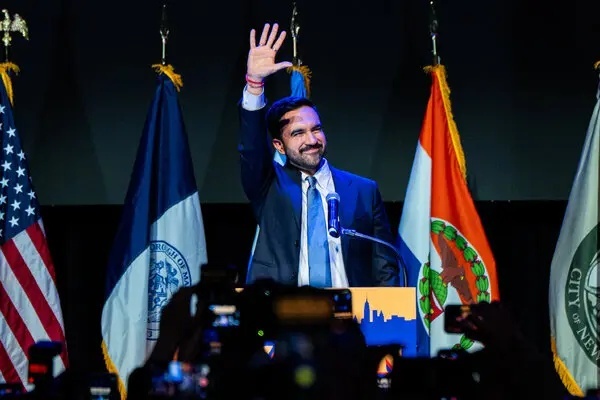
November 5, 2025: Zohran Kwame Mamdani, a Democratic Socialist and the Democratic nominee, will be New York City’s next mayor, after trouncing former Governor Andrew Cuomo in a primary and general election double whammy.
“The working people of New York have been told by the wealthy and the well-connected that power does not belong in their hands,” Mamdani told a roaring crowd at his victory party in Brooklyn.
“Fingers bruised from lifting boxes on the warehouse floor; palms calloused from delivery bike handlebars; knuckles scarred with kitchen burns—these are not hands that have been allowed to hold power. And yet, over the last 12 months, you have dared to reach for something greater. Tonight, against all odds, we have grasped it… We have toppled a political dynasty.”
But the fight is just beginning. “This is part of a lifelong struggle,” Mamdani told the campaign’s legions of volunteers in his closing message. “Not an electoral one. You have joined a movement for the rest of your life. Now, however you want to be a part of that movement is your decision, just as long as you continue to be a part of it.”
Leading call-and-response chants at the victory party, he called out: “Together, New York, we’re going to freeze the…” “Rent!” roared the crowd. “Together, New York, we’re going to make buses fast and…” “Free!” “Together, New York, we’re going to deliver universal…” “Childcare!”
“Let the words we’ve spoken together, the dreams we’ve dreamt together, become the agenda we deliver together,” Mamdani said.
“Zohran has the same expectation [to deliver] of a Tom Brady, a LeBron James, a Aaron Rodgers,” said yellow cabbie Kadir Gaurab on the eve of the election. “He’s a historic figure.”
Mamdani, a state assembly member from Queens and a stalwart of the Democratic Socialists of America, will be New York’s first Muslim mayor.
The 11,000-member New York City DSA spearheaded Mamdani’s massive canvassing operation, marshalling an army of 104,400 volunteers who knocked on 3 million doors. (Disclosure: I have canvassed for Mamdani’s election bid and I am a DSA member.) Two million New Yorkers cast a ballot in the election, a turnout number not seen in half a century, according to the Board of Elections.
Volunteers were galvanized by Mamdani’s relentless focus on the affordability crisis and principled stand against Israel’s unfolding genocide in Gaza. His platform includes a rent freeze for 2.5 million people living in rent-stabilized apartments, fast and free buses, city-owned grocery stores to lower the cost of food, free universal childcare starting at six weeks old, and building affordable housing.
But up until February, Mamdani was a statistical nonentity, polling at 1 percent in a tie with a hypothetical candidate “someone else.” “I always knew we could beat him,” Mamdani told a crowd of 13,000 last month while rallying with Vermont Senator Bernie Sanders and Representative Alexandria Ocasio-Cortez in Queens. “When we launched this campaign on October 23, one year and three days ago, there was not a single television camera there to cover it.”
‘It’s Very Refreshing’
Brian Levy, a city employee, librarian, and member of AFSCME District Council 37, says he backed Mamdani from the very beginning, but it was clear the campaign was struggling to break through. “I remember not being very optimistic about the Zohran campaign at all last November,” said Levy. “He’s talking about affordability, but I don’t know… If Cuomo enters the race, he’s toast. And the Democratic establishment ain’t behind him. There’s a lot of cards stacked against him.”
But by May, Mamdani’s longshot campaign was surging, maxing out the city’s public finance system and clinching key progressive endorsements. NYC DSA had learned from previous campaigns to spin milestones like reaching 25,000 volunteers into fresh momentum to go even further. Levy said the turning point came when Mamdani and Comptroller Brad Lander, who was also running in the mayoral primary, endorsed each other (the primary used a ranked-choice system where voters could rank more than one candidate), spurring left and progressive blocs of activists to consolidate instead of fracturing as they did in the last mayoral race.
Steve Beck, a retired District 37 member, said Mamdani’s victory is an example of coalition-building. Beck, who is 76, came into politics in the 1960s when the Democratic Party had “precinct captains and Democratic committee people in every neighborhood, in every building,” he said. “And now it’s nothing but chasing money. If you donate a little bit to a campaign, you get these endless emails.”
Shortly after Kamala Harris lost the presidential election to Donald Trump, Beck went to the local Democratic Party organization in Queens to see what he could do to volunteer. A woman came on the intercom, “and she says, ‘We’re not open to the public,’” he recalls. “Truer words were never spoken.”
At this point, he says, the Democratic Party is a hollow institution that can’t be called a party in any meaningful sense. “I get emails from the New York State Democrats, and you look at the list of meetings, and all it is is fundraisers. There are no meetings. And who holds meetings? The Democratic Socialists of America holds meetings. The Working Families Party holds meetings. Zohran has gone back to the old playbook of politics, which is canvassing and people on the street and people in the neighborhoods, and it’s very refreshing.”
From Beck’s perspective, it’s “very New York” to see a growing South Asian and Muslim voting bloc following in the footsteps of many immigrant groups that came before them. Their political reasoning: “If the Jews and Italians can do it, I can do it,” he says. “And that’s just completely typical, rather than being told to be afraid of each other. That’s what the wealthy always do, is trying to divide us from each other.
“So that’s the way I see it,” Beck said. “I’m a Jewish American. I’m very proud of that, and I don’t see anything to be afraid of from some kid from Uganda jumping into politics,” a reference to Mamdani’s place of birth. “He’s been wildly successful, I think, because he’s a really great candidate, and because he’s built a really great political machine.”
‘Focused on Immigrants and Workers’
Mamdani’s victory should put to rest the lie that workers are drawn only to simpleminded economic populism that casts social justice questions as distractions. In reality, workers are people with genders, identities, and religious beliefs that shape their relationships with each other and the world—and that’s part of what can spur them to action. “I am young. I am Muslim. I am a democratic socialist. And most damning of all, I refuse to apologize for any of this,” said Mamdani in his victory speech.
The campaign cut across ethnic and racial divides not by ignoring these differences but by building a unified political platform wrapped around good public services and a strong labor movement. “We can demand a government that makes our lives better,” Mamdani said. He appealed to the working class in its splendor of variety: “Thank you to those so often forgotten by the politics of our city, who made this movement their own. I speak of Yemeni bodega owners and Mexican abuelas. Senegalese taxi drivers and Uzbek nurses. Trinidadian line cooks and Ethiopian aunties.
“In this moment of political darkness, New York will be the light. Here, we believe in standing up for those we love, whether you are an immigrant, a member of the trans community, one of the many Black women that Donald Trump has fired from a federal job, a single mom still waiting for the cost of groceries to go down, or anyone else with their back against the wall. Your struggle is ours, too.
“And it’s about people like Richard, the taxi driver I went on a 15-day hunger strike with outside of City Hall, who still has to drive his cab seven days a week. My brother, we are in City Hall now.”
On the eve of the election, he walked the taxi line at LaGuardia Airport, canvassing drivers to vote, posing for photos, chatting with Bangladeshi, Senegalese, Algerian, and Indian workers. He greeted them in English, Arabic, Hindi, and Urdu. In the final stretch of the campaign, he released a GOTV video in Arabic, after recording others in Spanish, Urdu, and Hindi.
Bhairavi Desai, president of the New York Taxi Workers Alliance, says Mamdani won the trust of taxi drivers during their fight for debt relief and 15 days of hunger strike in 2021. “Members witnessed this humble state assembly member insist on being the last in line behind them to be checked by physicians during the hunger strike,” she said, “huddle in circles with them during campaign updates and strategy sessions, and introduce them by name to other elected officials.
“So of course drivers feel that Mamdani is one of their own. They see themselves reflected in a campaign focused on immigrants and workers, and they see Mamdani carrying the working class with him in every step he takes toward power.”
How Union Support Grew
Now Mamdani is a national name. He has found success by translating a broad agenda of affordability into a platform that can unite across various divides.
One of these divides was among the big unions. In the primary, only AFSCME District Council 37 (representing city workers), the Professional Staff Congress at the City University of New York (PSC-CUNY), and United Auto Workers Region 9A supported him. Most unions backed Cuomo.
“Much of the problems of the Democratic establishment are reflected in the union establishment,” says Desai. “The ‘endorsement industrial complex’ has pitted unions against each other, because each wants to be the first to place a winning bet on a candidate. Too many leaders in the labor movement think their power comes from being political kingmakers rather than from raising consciousness. With authoritarianism on the rise, unions cannot afford to fall back on zero-sum politics. It’s time for unions to reclaim their muscle by joining together across industries and affiliation to move candidates and platforms that serve the working class.”
The UAW was the first union to endorse Mamdani, after starting discussions among members last fall. Region 9A Director Brandon Mancilla says both members and leaders were excited about the candidate, bringing their arguments in favor of an endorsement through the union’s political council: “He’s been front and center at every single one of our fights, whether it’s in higher education at Columbia or at the Mercedes-Benz first contract rally.”
Then the union lobbied for Mamdani among other leaders at the NYC Central Labor Council. “We were proud to be the first union to endorse him, but we also got to work to make sure that it didn’t make us special,” said Mancilla.
More Than a Turnout Machine
After Mamdani won the primary with 56 percent of the vote, the Hotel and Gaming Trades Council, the New York State Nurses Association, and 32BJ SEIU, representing doormen and other building workers, united behind Mamdani.
Soon followed endorsements from many other unions. Among the biggest: 1199SEIU, the largest health care union in the country with 450,000 members in the Northeast; the United Federation of Teachers, the largest local in the Teachers union (AFT); Communications Workers (CWA) District 1; and the NYC Central Labor Council, representing 1 million workers from 300 unions.
The Laborers didn’t endorse Mamdani, but didn’t endorse Cuomo either. A source inside the union, who would only speak to me anonymously, reports signs of a gradual shift in thinking. Some members and leaders have begun to question the pay-to-play model of politics, where access and influence are based on financial contributions rather than shared values.
People are sick and tired of being a turnout machine for elections but sidelined when it comes to deciding the platform, this person said: “We should be electing people that are about us, not whenever they need us. What we used to think was extreme under Bernie is not that extreme, because people have gravitated to him.” For instance: “We’ve got to build affordable housing; we can’t just be building luxury homes.”
Tax the Rich
In office, the UAW’s Mancilla says, Mamdani should “continue building a working-class movement that not only supports his campaign agenda but actually empowers working people and puts them front and center of the politics of the city.”
The UAW is well-positioned to organize support for affordability measures statewide. “We’re going to have a common agenda going into the next legislative session in Albany to fight not just for Zohran’s priorities for the city that our members in the city really care about,” Mancilla said, “but some of those things, like childcare and the cost-of-living crisis, that all workers in places like Buffalo and Rochester and Ithaca all care about.”
A November Siena poll commissioned by Invest in Our New York found that 78 percent of statewide voters support taxing corporations and the wealthiest 5 percent to pay for universal childcare, affordable housing, and public transportation.
To fund his plans for free childcare and fast, free buses, Mamdani will need Governor Kathy Hochul and state legislators to tax the rich. When Governor Hochul rallied alongside Mamdani in Queens last month, the crowd of 13,000 chanted: “Tax the rich!” If the message wasn’t clear then, it’ll become louder amplified from the bully pulpit at City Hall. Unions and other grassroots organizations are already organizing to be the troops that win the agenda they voted for.
Mamdani can also use his profile to promote more workplace organizing, Mancilla says: “This is a great moment to get serious about organizing thousands of workers who want a union and don’t have one. This is a time to go on the offensive against bad employers, corporate greed, the concentration of wealth and power, and the disempowerment of working people in the city, in any industry.
“A lot of unions that are in deep fights right now, whether it’s us or the nurses or the taxi workers, or with fights to come, are going to see a shift in the political system,” Mancilla said “Number one, having a mayor that will actually speak out and be on their side. But also someone who’s willing to think creatively alongside them about what their priorities are, beyond their everyday struggles. It’s a really important moment for labor to come together across a common set of goals.”
‘We All Get to Be Free’
Midori Hills, a PSC-CUNY member who works at a nonprofit assisting immigrants to become citizens, was out canvassing November 2 in Queens. The last time she did voter turnout for a candidate was 2013. “The energy and enthusiasm around Zohran Mamdani has been really contagious,” she said, “and so it made me actually excited to vote, instead of voting because it’s what you’re supposed to do.”
Mamdani beat Cuomo even after the disgraced governor was bankrolled to the tune of $50 million by the wealthiest few. He’s heir apparent to the democratic socialism of Bernie Sanders and a throwback to a vision of municipal governance that serves the needs of working-class people in the style of 1934-1946 New York Mayor Fiorello La Guardia. La Guardia built the public subway system, the city’s first airport, hundreds of playgrounds, zoos, beaches, swimming pools, schools, and health centers, and thousands of units of public housing.
“We can be free and we can be fed,” Mamdani told supporters after his primary victory in June. Throughout his campaign he staked out a future of possibilities, blending the themes of civil and labor rights. To those under the spell of cynicism, he offered a jovial confidence in a better tomorrow, rooted in a fierce determination to take on the wealthy.
“When organized labor won the weekend, so that working people would have time to rest—that was power won, not given,” he said in a speech in October. “When those who came before us marched for voting rights and civil rights, they triumphed because they dared to dream, not because they were given permission by a political establishment content with the status quo. When millions of seniors were lifted from lives of poverty with Social Security, that’s because Americans were sick of a bad deal and wanted a new one instead. When we shake loose the shackles of small expectations, our city builds parks and hospitals, and we show the world that ambition and compassion are in fact intertwined.”
Mamdani has tapped into unifying ideals of equality, dignity, and freedom, connecting them to class. “For too long, freedom has belonged only to those who can afford to buy it,” he said in the final stretch of the election. “The oligarchs of New York are the wealthiest people in the wealthiest city in the wealthiest nation in the history of the world. They do not want the equation to change. They will do everything they can to prevent their grip from weakening.
“The truth is as simple as it is nonnegotiable: we are all allowed freedom,” he said. “Each one of us, the working people of this city, the taxi drivers, the line cooks, the nurses, all those seeking lives of grace, not greed—we all get to be free.”
Hands Off NYC
Still, “a politician can’t save us, so as great as Mamdani is, we will need to keep organizing to win his bold agenda,” said labor scholar Stephanie Luce, a PSC-CUNY member. “He will be facing a lot of pressure from billionaires and other politicians. That’s why a group of unions and community organizations came together to form a citywide alliance called the People’s Majority Alliance—to be ready to go into the streets, to lobby the city council and state legislature, and to keep up the organizing we need to bring a bold agenda into being.”
Among unions, this multiracial alliance includes Teamsters Local 804, the Committee of Interns and Residents (SEIU), PSC-CUNY, Stagehands (IATSE) Local 161, the Doctors Council SEIU, and the UAW.
According to the New York Post, a House Republican from Tennessee has been urging the Trump administration to investigate Mamdani’s citizenship and deport him. On November 3, Trump said “you really have no choice” but to back Cuomo for mayor.
There’s also the threat that Trump may send in federal agents and National Guard troops, as he has done to Chicago. This seems even more likely now that Mamdani has won office. To prepare against a possible occupation, unions and community groups have created the Hands Off NYC coalition. A recent webinar drew thousands of participants.
“NYC is doing just fine without masked goons kidnapping hardworking immigrants off our streets,” said Hae-Lin Choi, a political director for the CWA. “We don’t need them here, we don’t want them here, and every time they show up they’re going to get the same welcome they got on Canal Street,” a reference to coordinated immigrant worker defense after ICE agents deployed last month to terrorize street vendors in Chinatown.
“Trump’s troops have no business here,” Choi said. “Hands Off NYC is training thousands of New Yorkers to make sure we’re ready for whatever comes next.”
“So Donald Trump, since I know you’re watching, I have four words for you: Turn the volume up,” said Mamdani. (“AND SO IT BEGINS!” Trump wrote on Truth Social, confirming the assumption.)
“New York will remain a city of immigrants, a city built by immigrants, powered by immigrants, and as of tonight, led by an immigrant,” said Mamdani. “To get to any of us, you will have to get through all of us.
“And if we embrace this brave new course, rather than fleeing from it, we can respond to oligarchy and authoritarianism with the strength it fears, not the appeasement it craves. If anyone can show a nation betrayed by Donald Trump how to defeat him, it is the city that gave rise to him. And if there is any way to terrify a despot, it is by dismantling the very conditions that allowed him to accumulate power.
“The sun may have set over our city this evening, but as Eugene Debs once said, ‘I can see the dawn of a better day for humanity.'”
[Luis Feliz Leon is a staff writer and organizer with Labor Notes. Courtesy: Labor Notes, a media and organizing project in the USA that has been the voice of union activists who want to put the movement back in the labor movement since 1979.]
❈ ❈ ❈
Mamdani’s Victory is a Mandate to Fight the Cost of Living Crisis, Defend Immigrants and Stop Genocide
Ximena Goldman
The polls may have been predicting it for weeks, but that didn’t make Zohran Mamdani’s victory in New York City’s mayoral election any less monumental. After being vilified by Trump and the political establishment, who threw all manner of racist epithets at him and raised millions of dollars to thwart his campaign, his landslide victory represents a crushing defeat not only for Trump, but also for the Democratic Party establishment who millions perceive as being soft on the Far Right and going against the interests of the working class and oppressed.
The massive enthusiasm for Mamdani and the electoral victories of Democrats in states such as New Jersey, Virginia, and Georgia is, in the first place, a reaction against Trump. It is no secret that both Trump and the Democrats have very low popularity ratings. Though there is widespread agreement that both parties are rotten, the elections this Tuesday were a clear warning sign to an emboldened Trump who openly endorsed Cuomo and has repeatedly threatened to take measures against a potential “communist” leading City Hall in the biggest city in the United States. Part of the popularity of Mamdani, as one of the fresh faces betting on reinvigorating the Democratic Party and finding an electoral solution to stop Trump’s authoritarian advance, is that he is openly defiant of Trump rather than trying to emulate; Mamdani won with a promise to protect working-class immigrant and trans New Yorkers rather than throwing them under the bus.
New Yorkers came out in historic numbers to defy Trump, but this alone does not explain Mamdani’s decisive win. His victory must be understood through the lens of the powerful social force behind his campaign and political rise. More than 104,000 volunteers canvassed door-to-door for Mamdani. Many of them were organized by the Democratic Socialists of America who launched Mamdani’s run, but many more were not. The core of Mamdani’s support is made up of young people and workers across the five boroughs who see their own demands for better living, working, and education conditions reflected in Mamdani’s campaign. They have a deep distrust of the Democrats, but are eager to confront the Far Right and are increasingly open to anti-capitalist ideas.
This sentiment is replicated in cities and towns across the country; this is reflected not only in Mamdani’s win, but also the repudiation of MAGA candidates on the ballot in states like Virginia and New Jersey. In that sense, the elections represent not so much enthusiasm for the Democrats as much as widespread discontent with Trump’s second term.
This puts Mamdani’s win squarely in the middle of the crisis rocking the Democratic Party, which has lost much of its coalition of working-class voters and finds itself without a compelling vision to counter Trump’s offensive. Nothing is more representative of the different paths being proposed to address this crisis than by a member of the DSA defeating former Governor Andrew M. Cuomo in a rematch of June’s Democratic primary by about 10 points. New Yorkers soundly rejected Cuomo as a “MAGA Democrat” and as the representative of the corporate greed and inequality that have been characteristic of the way the Democrats have ruled the most expensive city in the United States.
Mamdani’s victory shows that the working class is eager to fight for its rights and that there is widespread support for policies the political establishment on both sides of the aisle tries to marginalize; millions of people are no longer content to hear another politician rail against Trump while taking up his talking points and policies, as did Cuomo and Republican candidate Curtis Sliwa. As some exit polls show, Mamdani not only won in neighborhoods populated by progressive young people with college degrees burdened with student debt, but also precarious workers in neighborhoods such as East New York, Brownsville, immigrant neighborhoods in Queens, and organized workers from a whole range of professions and industries.
In a victory speech in Brooklyn, Mamdani said that “we have toppled a political dynasty.” He thanked “those so often forgotten by the politics of our city […] I speak of Yemeni bodega owners and Mexican abuelas. Senegalese taxi drivers and Uzbek nurses. Trinidadian line cooks and Ethiopian aunties.” He spoke of empowering the working class, saying that “we won because we insisted that no longer would politics be something that is done to us. Now, it is something that we do.”
Mamdani’s victory sits uneasily in the Democratic Party fold; now that he will take office, the Democratic Party is forced to either turn its back on him and risk squandering its best chance at bringing voters back to the ballot box to challenge Trump, or it will try to integrate Mamdani into the establishment. This contradiction was on full display on Election Day. Several establishment Democrats came out on Tuesday night to celebrate the election victories as a sure sign of renewed faith in the Democratic Party; figures like Gavin Newsom and Hakeem Jeffries were careful to avoid speaking about Mamdani in an attempt to downplay his political ascent and its possible effect on the party.
Mamdani’s campaign reflected a deep sentiment against the city’s long-running political and business establishment. He has called for raising taxes on the super rich, making buses and child care free and freezing the rent for rent-stabilized apartments. These demands alone have awakened the fears of the owners of the city, from Wall Street to real estate developers, landlords, and bosses. Contrasting with the politics of the Democratic Party that has been complicit in the genocide in Gaza, Mamdani was the only candidate openly supportive of Palestine and outspoken against the genocide; even as the Zionist lobby raged against his campaign and threw accusations of antisemitism at him and his supporters, this did not stem the support for Mamdani’s campaign despite Mamdani himself walking back some of his criticism of Israel. This shows the deep break with the decades-long consensus on support for Israel in the United States that was present in the elections this year, a fracture that is unlikely to go away any time soon.
Election night is just the beginning for New York City’s self-styled democratic-socialist mayor. When he takes office in January 2026, Mayor Mamdani will not only face obstacles in city and state government (even from within his own party), but he will also have to face Trump and his threats of cutting funding to the city and deploying the National Guard.
In order to win the demands of millions of working class New Yorkers and to confront Trump and the Far Right, we need to organize — starting today — the social force that can fight for them against Trump’s threats to cut federal funding, new ICE raids, and perhaps even the threat of the National Guard. We need to build a powerful united front to fight in the streets and from our workplaces, one called by the unions and social movements. Rather than serving as a pressure campaign on city and state politicians, this unity in action must be organized from below, based on the self organization and agency of the working class and oppressed, our communities, and our neighborhoods.
Mamdani and his administration will negotiate with the eternal enemies of the working class and the oppressed. Our demands and the struggle against Trump cannot be subordinated to the compromises of the Democrats and these deals made at the top, behind the backs of the working class. The Democratic establishment will do everything possible to water down every disruptive aspect of Mamdani’s program; our struggle must be built independently of our class enemies to win our demands for a New York for the immigrants, trans people, students, and all workers who make the city run.
[Courtesy: Left Voice, a US socialist news site and magazine dedicated to fostering a sustained and strategic struggle against every form of capitalist exploitation and oppression.]
❈ ❈ ❈
U.S. Voters Hand MAGA a Big Defeat
Mark Gruenberg, John Wojcik and C.J. Atkins
All over the country Tuesday, voters poured into polling places to elect Democrats challenging the Trump agenda, particularly the failure of the billionaire-owned Trump administration to deliver on promises of an economy in which the people can afford the necessities of life. Also critically important to voters was the responsibility many said they had to come out and save democracy from the autocratic and fascist elements in control of the federal government in Washington.
Proving a campaign of progressive ideas—and hope—can beat fear, loathing, and loads of campaign cash, Democratic Socialist state legislator Zohran Mamdani convincingly won the New York City mayoral race.
“Eugene Debs once said, ‘I can see the dawn of a better day for humanity,’” Mamdani told supporters at in Brooklyn’s Paramount Theater. “For as long as we can remember, the working people of New York have been told by the wealthy and the well-connected that power does not belong in their hands. Tonight, against all odds, we have grasped it. The future is in our hands, my friends.”
Losses for Trump and MAGA nationwide
Trump, who had endorsed Cuomo, attributed the Democratic wins on Tuesday to the fact that he “wasn’t on the ballot,” inferring that if this were a presidential election year that he would have carried GOP candidates to victory. That and the government shutdown, he said in a Truth Social post, were “the two reasons that Republicans lost elections tonight.”
The president has previously threatened a military takeover of New York and renewed his promise to eliminate all federal funds to the city in the wake of a “communist” Mamdani triumph.
From coast to coast, though, Election Night was a disaster for the president and MAGA.
“Trump took a butt-whoopin’ last night,” Communist Party USA Co-chair Joe Sims said Wednesday morning. “I’m talking about a butt-whoopin’ up and down the street and around the corner—in New York, in Jersey, in Virginia, in sunny California.”
Sims said that democracy, change, and affordability won and that “racism, antisemitism, anti-Muslim bigotry, anti-immigrant hate, and the attempt to red-bait people” had all lost.
Right-wing losses Tuesday were indeed national in scale. In addition to the New York mayoral race, also extremely important were two off-year gubernatorial races, in Virginia and New Jersey. Both turned into Democratic routs.
In Virginia, protecting a woman’s right to an abortion, in the last state south of the Potomac River that still has it, was a key issue.
Former Rep. Abigail Spanberger, who moved left while in the U.S. House while her district did the same, beat Trump supporter Lt. Gov. Winsome Earle-Sears by 57.5%-42.3% in the Old Dominion. It was such a landslide that even the controversy-plagued Democratic Attorney General nominee Jay Jones unseated GOP incumbent Jayson Miyares, 53.1%-46.5%. And the State Senate went from 21-19 Democratic to a projected 10-seat majority.
That’s important because the Virginia legislature this year passed a congressional redistricting bill, along party lines. Such measures must pass in two consecutive years and then go before the voters in a referendum. Since legislatures from coast to coast are redrawing lines in the middle of the decade—prodded by Trump, who fears losing his slim U.S. House majority—that would give progressives and Democrats a chance to add a seat or two to their 6-5 Virginia margin.
Rep. Mikie Sherrill, D-N.J., the Democratic nominee there, made Trump a central issue in her campaign. It worked. She beat MAGA Republican Jack Ciattarelli, 56%-43%.
California votes to save democracy
Landslide support for California’s Prop 50 produced a 65% to 35% margin at the polls in a direct rebuke to Trump. California used a non-partisan redistricting commission to redraw the state’s congressional map after the 2020 census and it produced an enormous Democratic edge of 43-9.
But after Trump ordered Republican-ruled Texas to wipe out five Democratic districts Newsom got Prop 50 on the California ballot. Its map would flip at least three but possibly as many as five GOP seats.
Voters, including immigrants from Mexico, told reporters they braved the long lines at polling places because they had to do what they could to save freedom and democracy in America.
The California AFL-CIO, local central labor councils and many unions all backed Prop 50. They included the statewide affiliates of the Teachers, AFSCME, the Carpenters, the California Nurses Association, the state’s Pipe Trades Council, the National Union of Healthcare workers, the Service Employees, the United Domestic Workers, the United Farm Workers, and the United Food and Commercial Workers’ western states council.
“For 10 months, we’ve watched Trump go after federal workers, healthcare, infrastructure jobs, immigrants and everything labor stands for,” the state federation tweeted on X. “Enough is enough. With Prop 50 passed, now begins the work of electing people who will put Trump in check and stand up for the working class,” it joyfully concluded, looking towards next fall’s election.
Looking to 2026
Two other elections were also notable for worker activism, insurgent anti-establishment candidates, high turnout, and their future political impact.
The Pennsylvania AFL-CIO went all-out in retention races for three state Supreme Court justices, and all won. That preserves the court’s 5-2 progressive majority. Trump was indirectly an issue in that vote, where voters had to vote “yes” or “no” on whether to keep each judge. Had the three progressives been ejected, it would have given the GOP the power to rewrite and unbalance state election laws—important for 2026 and 2028.
In the Minneapolis mayor’s race, incumbent Jacob Frey led another Democratic Socialist—and Muslim-American—Omar Fateh, 42%-32%. Fateh won the local DFL (Democratic-Farmer-Labor) Party endorsement at its convention, but the state party forced a retraction and a switch to Frey. Both Minneapolis and St. Paul have ranked-choice voting, so the final outcome will depend on the second-choice (and lower) votes from the 26% who put other candidates first.
As in all elections, whether they’re won by progressives or right-wing reactionaries, the work of the labor and democratic movements doesn’t stop once the ballots are counted.
“The question now is what will happen next,” the CPUSA’s Sims said Wednesday morning, “and that depends on us.” He urged people to “continue fighting to build from the grassroots up. Join an organization. Get involved. Keep on fighting, keep the pressure on.”
[This article is an extract. Award-winning journalist Mark Gruenberg is head of the Washington, D.C., bureau of People’s World. He is also the editor of the union news service Press Associates Inc. (PAI). John Wojcik is Editor-in-Chief of People’s World. He joined the staff as Labor Editor in May 2007 after working as a union meat cutter in northern New Jersey. In the 1970s and ’80s, he was a political action reporter for the Daily World, this newspaper’s predecessor, and was active in electoral politics in Brooklyn, New York. C.J. Atkins is the managing editor at People’s World. He holds a Ph.D. in political science from York University in Toronto and has a research and teaching background in political economy and the politics and ideas of the American left. Courtesy: People’s World, a voice for progressive change and socialism in the United States. It provides news and analysis of, by, and for the labor and democratic movements.]
❈ ❈ ❈
The Election’s Big Winner: Socialism
Ed Rampell
Democratic candidates and causes won resounding victories across the board in Tuesday’s elections. California’s Proposition 50 to redistrict the Golden State in favor of Democrats overwhelmingly won, while Democratic contenders were catapulted into the governorships of New Jersey and Virginia. In the latter, the Democrats also picked up at least 10 seats in the House of Delegates, which was part of the nationwide trend of Democrats winning on the local, as well as statewide level.
This is largely because under our two-party electoral system, Americans have extremely limited choices, and voters mostly express themselves by voting against. Deranged, deluded President Trump may have contended on social media that the Republicans lost because he “wasn’t on the ballot,” but while this is literally true, the fact is, he was figuratively all over the 2025 elections, which was a referendum on the wannabe king and his disastrous reign. The electoral results are a total repudiation, rejection, and rebuke of Trump and his policies, as well as of the GOP at large, showing that the people really hate Trump and what he’s wreaking as he wrecks America (and the East Wing of the White House).
The exception to the notion that citizens mainly “vote against” in U.S. elections is the race for New York City’s mayor. Decisively winning with more than half the ballots in a three-way race in a high turnout contest, Zohran Mamdani’s campaign triumphed with the enthusiastic support of tens of thousands of door-knocking, phone calling, envelope stuffing volunteers who wore out their shoe leather pounding the pavements, in order to get their candidate elected. In Zohran’s case, ballot casters were voting for the state assemblyman to send him to City Hall.
Much has been made of Zohran’s ascendancy and popularity, which pundits have ascribed to his personal charisma, wit, TikTok panache, social media savvy, and so on. It’s true, that as the son of a noted movie director, Mira Nair, Zohran displayed an agile flair with 21st century mass communications. The 34-year-old’s youthfulness also inspired young urban voters, while being a Muslim also stimulated the support of New York’s rising South Asian population. The Uganda-born contender of Indian ancestry also generated hope for the city’s hundreds of thousands of beleaguered immigrants, especially at a time when they are besieged by the tyrannical tactics of Trump’s “ICE-tapo” jackbooted goon squad.
All of the above is true, but there’s one more important, overriding reason why the masses turned out and voted for him: Zohran is an unabashed socialist, who articulated some of the key components of a socialist program in order to solve and/or mitigate New York’s affordability crisis for most residents. In addition to advocating peace for Palestine, Zohran ran on an easy to understand, practical platform of freezing the rent for rent-controlled apartments, free buses, city-owned grocery stores, no-cost childcare, and other pro-working class measures. To pay for this, Zohran proposes to raise the taxes of the wealthiest New Yorkers and corporations in the world’s financial center.
A card-carrying, dues paying member of Democratic Socialists of America, Zohran’s candidacy was fueled by the DSA’s dynamic, dedicated organizing. At the top of his acceptance speech Tuesday night, Zohran quoted none other than Eugene V. Debs, proclaiming he can “see the dawn of a better day for humanity.” By quoting Debs, co-founder of the Industrial Workers of the World (the Wobblies) and the Socialist Party’s five-time presidential candidate, Zohran was clearly identifying himself as being in the socialist tradition and putting the ruling class on notice that a new sheriff was in town, even as he fired verbal shots at his fellow New Yorker, Queens-born and raised The Donald. Much to the consternation of the oligarchs and their apologists in the chattering class, Zohran was throwing down the gauntlet to the billionaires, declaring that the other side in the class war was now fighting back. “Turn up the volume!” he thundered.
Brooklyn-born Bernie Sanders, who more than anyone else has dusted off the word “socialism” and restored it to its rightful place in the contemporary lexicon of U.S. politics, understands the world historical importance of Zohran’s victory. “I consider the New York City mayor’s race enormously important, not just for New York City but as a very profound statement in terms of what’s happening all over this country,” the independent senator from Vermont told John Nichols in an interview for The Nation (https://www.thenation.com/article/politics/bernie-sanders-zohran-mamdani-interview-2/). “I think there is profound disgust at the political establishment. People want real change, and a strong victory on the part of Mamdani, I think, will inspire people all across our country to fight for that change… And that they can go beyond the old establishment politics.”
At the core of Mamdani’s mandate is socialism, which fights for the rights of the many against the privilege and power of the few by demanding a sweeping redistribution of wealth to reduce, if not end, inequality. Although taking a page from his despicable mentor Roy Cohn, Trump redbaited Zohran, labeling him a “communist,” the mayor-elect is not a revolutionary. Indeed, historically speaking, Mamdani is more of a “Menshevik” than he is a “Bolshevik.” He’s a reformer working within the electoral system who ran as the Democratic Party’s nominee. Zohran is basically a social democrat, advocating a welfare state similar to the system that existed during the heyday of Scandinavian socialism. (BTW, ever wonder why the Nordic nations are often rated among the world’s happiest countries? It’s largely because of their features of socialism that guarantee people free/affordable essential services and a decent standard of living.)
The real victor of the Nov. 4 election is socialism, which mayor-to-be Zohran Kwame Mamdani’s election has put back on the table of U.S. politics. And if his campaign woke up the city that never sleeps and has electrified the nation, as the midterm elections loom, get ready for the congressional campaign former Seattle City Council member, Kshama Sawant, who is now running for the House of Representatives as a self-described “revolutionary socialist” and “Marxist.”
The increasingly unpopular, autocratic, elitist Trump is a modern-day Marie Antoinette who – as federal workers go without paychecks; the destitute, including children, are deprived of food assistance; and immigrants face arrest and deportation – says to suffering people: “Let them eat ballrooms.” Buckle up your seatbelts, America, socialism is making a comeback and is aiming to be in the driver’s seat. Billionaires beware: It’s going to be a bumpy ride.
[Ed Rampell is an L.A.-based film historian/critic who co-organized the 2017 70th anniversary Blacklist remembrance at the Writers Guild theater in Beverly Hills and was a moderator at 2019’s “Blacklist Exiles in Mexico” filmfest and conference at the San Francisco Art Institute. Rampell co-presented “The Hollywood Ten at 75” film series at the Academy Museum of Motion Pictures and is the author of Progressive Hollywood, A People’s Film History of the United States and co-author of The Hawaii Movie and Television Book. Courtesy: CounterPunch, an online magazine based in the United States that covers politics in a manner its editors describe as “muckraking with a radical attitude”. It is edited by Jeffrey St. Clair and Joshua Frank.]