❈ ❈ ❈
Legislating the Platform Economy: A Win for Some, Silence for Others
Shipra and Harshil Sharma
India’s gig and platform economy has exploded recently. A BCG study estimates that the sector could potentially serve up to 90 million jobs and contribute up to 1.25% of India’s GDP in the long run.
Most of these jobs are precarious, lacking formal protections such as health insurance, provident funds, paid leave or pensions. Still, the platform workforce is relatively visible in urban India thanks to the nature of their work – from app-based drivers to delivery couriers – that touches the lives of millions of middle-class consumers every day, making their struggles a public issue.
Adding to this visibility, unions and collectives like the Indian Federation of App-based Transport Workers (IFAT) and the Telangana Gig and Platform Workers’ Union (TGPWU), have mobilised rapidly, bringing workforce issues into sharper public focus. IFAT alone now claims over 40,000 members, whereas TGPWU has about 10,000 members.
At the same time, the platform workers continue to challenge their “independent contractor” status in courts. Together, these have placed pressure on policymakers to act.
Policy momentum at the Union government level
In response, the Indian government has begun to respond with policy measures. The Code on Social Security, 2020 explicitly recognised gig and platform workers as a new category of worker, envisioning portable social security funds financed by contributions (via a cess) from aggregators. However, its rules have not yet been implemented due to industry and political pushback.
More recently, the Union budget 2025-26 announced sweeping measures: it promised identity cards, national registration and enhanced social security (including health coverage) for an estimated ten million gig workers. The government said it will register all gig workers in the e-Shram database (creating a universal account number) and extend them benefits like free medical insurance (Rs 5 lakh annual cover under PMJAY).
These steps mark an unprecedented commitment at the federal level to formally include gig workers in welfare schemes.
Emerging state laws
Even as the Union government deliberates, several states have already moved to legislate for gig workers. Rajasthan was first with its Platform-Based Gig Workers (Registration & Welfare) Act, 2023. Karnataka, Telangana and recently Bihar came out with their own legislations this year.
Table 1 below summarises key features of the four state laws currently in force or up for public deliberation.
Table 1: Key features of state gig worker legislation (Rajasthan, Telangana, Karnataka, Bihar)
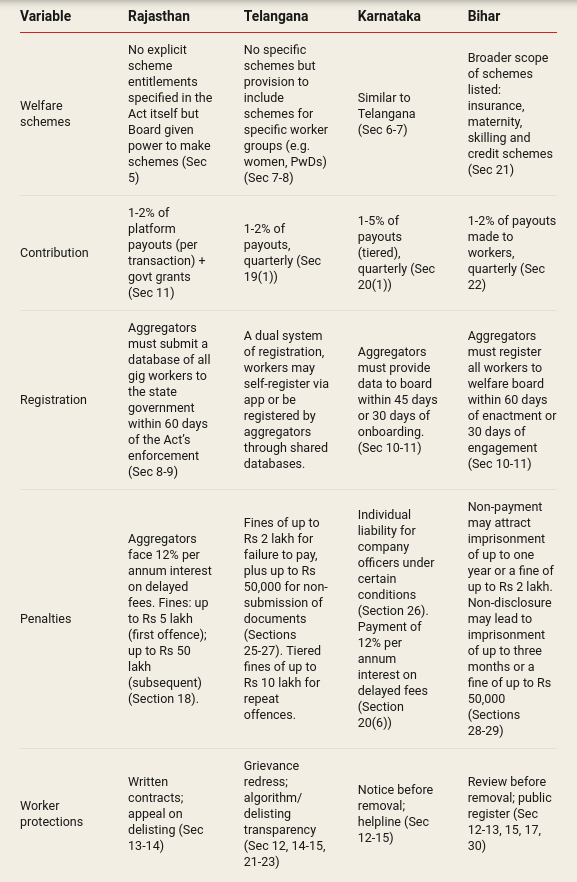
These nascent laws signal a notable shift. Each state Act or Bill goes beyond mere registration: they create statutory welfare boards, fund them through platform levies and lay out worker safeguards (contracts, grievance redress, etc).
This is a major change from previous labour laws, which largely excluded gig workers. Notably, no other informal sector, whether domestic workers, sanitation workers, waste-pickers or casual construction labour has received comparable legislative attention in recent years.
Why this focus on gig and platform workers?
Why are gig and platform workers suddenly at the centre of policy attention? Several factors help explain the surge in momentum and why it has eclipsed other labour sectors:
Urban visibility: Gig workers serve the everyday needs of urban consumers, from food delivery to ride-hailing. Their work is highly visible on city streets, making their precarity a constant public issue. When a driver or delivery person goes on strike or shares hardships on social media, middle-class users take notice.
This visibility is also tied to the fact that platform workers, particularly those who are geographically tethered, often come from an economic class that has assets invested in their work, such as a motorbike, a car or equipment.
Moreover, many gig workers in ride-sharing and delivery share demographic similarities with the urban middle class in terms of education and digital literacy, making their narratives more relatable to both consumers and policymakers.
In contrast, domestic workers, despite working directly in middle-class homes, lack organised platforms for collective action, while rural labourers remain geographically and socially distant from urban policy circles, rendering their struggles less immediately visible to those with decision-making power.
New business model – a ‘moving target’ for regulation: The app-based platform economy doesn’t fit neatly under old labour laws. Gig aggregator firms have no fixed factories or offices where inspectors can enforce traditional regulations. This mobility and digital nature made platforms a regulatory blind spot; hence the push to create new laws.
Notably, the Union government and states have framed these laws in consultation with the very aggregators they seek to regulate, a model unheard of in earlier labour legislation. Platforms have rapidly agreed (at least publicly) to social security levies, indicating their willingness to negotiate participation.
Unlike many other industries that emerged at different times across countries, these platform businesses appeared on the global stage almost simultaneously. This global convergence has also influenced India’s decision to take the initiative in framing laws for platform and gig workers
Funding mechanism (platform cess): Perhaps most crucially, gig platforms have created a new source of revenue for welfare: a small surcharge on each transaction. For example, under Rajasthan’s law, a 1-2% levy on platform payouts funds the gig workers’ welfare board.
This “consumer-funded” model – where costs are effectively passed to service users – is a breakthrough that states find attractive. It contrasts sharply with other sectors: no one has figured out a comparable cess for, say, domestic help or agricultural labour, who also need social security but lack a central billing system. Without an obvious revenue stream, governments have been reluctant to legislate for those sectors.
These factors explain why gig and platform workers, though still a small fraction of India’s workforce (NITI Aayog estimates ~7% of non-farm jobs by 2030) command outsized policy attention.
Their prominence in cities and the ease of collecting welfare levies via digital platforms mean that addressing gig workers’ issues also serves political and fiscal interests. Critically, it shows that who is visible and how revenue is collected can shape which labour struggles get addressed and which direction a movement can take.
Beyond the gig: other invisible workers
When the platform economy emerged, labour unions and workers grew anxious about a new category of workers who were not covered under any existing law. This created momentum that rightly pushed the country toward framing new protections for gig and platform workers. It is worth remembering that gig workers have, in effect, built these laws themselves through protests and petitions.
There was an urgent need for states to introduce legislation that could extend at least some provisions to this workforce. Even newly emerging jobs, such as data annotators in India, came to be included under gig economy laws. Though the extent of protection varies depending on specific work arrangements and location, it did offer some measure of relief to workers. On paper, the rapidly evolving legal framework now provides both Union- and state-level protections.
However, when compared to traditional informal workers, it is disheartening to see that, despite their decades of struggle, they have yet to receive the visibility and recognition they deserve. For decades, India’s millions of domestic workers, sanitation workers, waste-pickers and others have fought for labour rights, often with little success.
Unlike gig services, domestic work lacks a big corporate interface. There is no “domestic worker platform” charging customers 2% that can be tapped for welfare funds. Domestic workers’ unions remain small and dispersed, and governments have no ready mechanism (or revenue source) to support them.
In practice, this has led to an awkward situation: labour ministers and MPs announce the “first of its kind” gig welfare schemes, while long-standing demands for minimum wages or social security boards for workers who are providing services like domestic help go largely unanswered.
The new gig legislation is a welcome development, the first time so many unorganised workers are formally recognised by law. But it also underscores how uneven India’s social protection architecture remains.
As the 2020 Code on Social Security puts it, platform workers are now being included “outside of the traditionally defined ‘employer-employee’ relationship”. This expansion should be celebrated. Yet it must not lead us to forget that millions of other marginal workers exist in India’s vast informal economy. Just because domestic workers or sanitation workers don’t have a corporate platform behind them doesn’t mean they deserve less support.
Looking ahead
In sum, India is at an inflection point for labour rights. The gig and platform economy’s meteoric rise has forced policymakers to rethink old categories of work. After years of inertia, there is now a concrete blueprint (from Rajasthan to Bihar) for providing at least basic welfare to app-based workers. If implemented fully, this could alleviate some of the most glaring injustices like unreported deaths, accidents or hardships that families of gig workers currently endure without recourse.
However, the “gig-first” wave of legislation also raises critical questions. Why were platform companies and their customer interfaces the only ones privileged with a labour statute? Are we risking a divide between those who work for apps and those who work with smaller unknown businesses or serve on construction sites, simply because the latter lack an easy way to fund welfare?
Labour experts caution against drawing a hierarchy of deservingness among unorganised workers. The architecture being built for gig workers – registration, contributory welfare funds, grievance mechanisms – should be extended to all vulnerable sectors.
India’s recent legislative moves for gig and platform workers represent both progress and a challenge. They signal a growing recognition of 21st-century labour realities, yet also highlight the uneven playing field of policy attention. As these laws take effect, it will be imperative to ensure they deliver real protection, and that the lessons learned spur similar support for all informal workers who remain off the radar.
[Shipra is research analyst at the Institute of Social Studies Trust. Harshil Sharma is director of government relations, Indus Action. Courtesy: The Wire, an Indian nonprofit news and opinion website. It was founded in 2015 by Siddharth Varadarajan, Sidharth Bhatia and M. K. Venu.]
❈ ❈ ❈
The Political Economy of Gig Pensions
Shirin Akhter and C. Saratchand
Since 1991, the limited gains attained by working people in terms of social security, including pensions, have been whittled down by the joint actions of the Indian government and big business. Even government employees and teachers have been forcibly transitioned to the defined contribution-based National Pension System (NPS), where both the employee and the government make monthly contributions toward a retirement corpus whose terminal value is market-linked, from the defined benefit Old Pension Scheme (OPS).
A small number of private sector employees are part of the Employees Provident Fund, with regular monthly contributions from both employee and employer. Most workers in the private sector do not have access to either OPS or NPS with an employer contribution.
Therefore, when the Finance Bill 2025 of the Union government announced expanded investment options under NPS and opened the door for “platform-based participation”, it looked like an ideological shift in the Indian government’s approach to social security. However, this shift actually implied that the Indian government no longer provided even a modicum of social security. Instead, it now facilitates access to financial instruments which tend, at best, to have ambiguous consequences for post-retirement social security.
Barely a week later, Zomato and HDFC Pension announced a partnership to enrol “delivery partners” (since gig employers reclassify employees as partners to sidestep labour laws, which are themselves atrophying) into NPS. Over 30,000 workers reportedly registered within 72 hours. The collaboration was hailed as a milestone in “financial inclusion”, proof that even the most precarious workers could now plan for retirement. Yet beneath this celebratory language lies a deeper question: what kind of inclusion is this, and who does it leave behind?
For the gig workforce, which is denied formal labour contracts, insurance, or pension benefits, this initiative is a de facto acknowledgment that gig work is possibly work. India’s platform workers operate in a grey zone, visible to buyers in the gig economy but invisible by design to labour law. By purportedly integrating them into an established financial framework like NPS, the government and the corporate sector seem to be, at the very least, recognising their existence, but on what terms?
Gig workers are being seen as retail financial investors, with the “agency” to rationally undertake risky decisions on the basis of cost-benefit analysis, and not as workers who are rightfully entitled to defined benefit pensions and related social security measures.
The digital portability of NPS accounts, it is touted, allows workers to contribute from anywhere, across platforms and cities. This, it is claimed, is a crucial feature for a highly mobile and unorganised workforce, especially in the light of some private employers siphoning away employees’ retirement funds.
Drawing on the insights of behavioural economics, it is pointed out that automatic or app-linked deductions can nudge savings among those who otherwise live hand to mouth. For many delivery workers, it is avowed, even a small corpus could purportedly mean the difference between subsistence and destitution in old age.
If such defined contribution pension schemes are assumed to provide reliable social security, then the NPS expansion and Zomato–HDFC initiative may be seen as filling a gap. Actually, this initiative is an outcome of Hobson’s choice for policy. Since the entire trajectory of policy since 1991 has been about denuding the bargaining power of workers through various forms of informalisation, including gigification as one type of precarity, the social instability that this has given rise to requires a policy response, even if it is for the sake of maintaining appearances. That policy response recognises that formalisation through de-gigification is not desirable for capital and is, therefore, politically infeasible.
Instead, the rising reality of gig work is formally accorded acceptance and some policy gesture is proffered. This is at best a gesture, for a number of reasons. Among other things, it reflects a shrinking vision of social security, one that celebrates token financial participation, where the retirement corpus of gig workers is subject to uncertainty while eroding the principle of public responsibility for social security.
The first concern is that of a lack of universality. The new scheme targets a narrow, digitally visible stratum: delivery and ride-hailing workers (“partners”) attached to formal platforms. But India’s informal sector extends well beyond the gig economy. Domestic workers, sanitation workers, construction labourers, waste-pickers and street vendors, the precariat and petty producers more generally, remain untouched, even in terms of the policy gesture. Without platforms to mediate their participation (which unwittingly makes gig workers more visible in the social media sphere), the precariat and the petty producers are effectively written out of this new “inclusive” policy gesture.
The second concern is its purported voluntary nature, but without any responsibility from the gig employer and the government. Neither the gig employer nor the government contributes to the retirement corpus, which is expected to fund workers’ pensions in the future; the burden lies solely on the gig worker.
This transforms social security from a right into a risky choice. For most gig workers currently earning ₹400 to ₹600 a day, the prospects of consistent contributions into their retirement corpus are at best unrealistic. This policy gesture, unsurprisingly, formally presupposes stability in the lives of gig workers whose labour processes have been designed by the duo of government and capital, centrally around instability.
The third concern is the uncertainty, the incalculable risk, associated with linking a retirement corpus to private financial securities. The 2025 Finance Bill’s concurrent reform, allowing 100% equity exposure in NPS, deepens the financialisation of welfare and increases the supply of funds that financial firms can subject to their “prudential” asset allocation activities.
Gig workers with negligible savings are now encouraged (actually beguiled) to invest their meagre savings in ways that may go very awry, and this after deducting the remuneration of fund managers. In effect, the downside of the financial asset markets is being transferred from the state and gig employers to the gig workers.
The rhetoric of empowerment and collaboration between capital and government masks a quiet process of de facto undermining of social security. This undermining is through privatisation, but this is sought to be obscured through rewriting the social contract between the government and the working people in actuarial language that is calibrated to the taste of capital. After all, if the share of profits in aggregate income is given, then pension payments of any sort amount to a redistribution within the working and retired components of the working people.
Universal social security can only be based on modest increases of direct taxation, and that too only of wealth and inheritance of wealth of billionaires. This can be supplemented by obligatory contributions by employers to a fund administered by the government with a guaranteed floor rate of return, as is the case under the OPS.
The Rajasthan’s Gig Workers Act (2023) already offers some pointers in this regard about gig employer contributions that can be built upon and extended throughout the country.
If the proceeds of this fund are used, directly and indirectly, for enterprise investment in sensibly chosen public projects, then the resulting positive multiplier effect on aggregate income, investment and profits will yield enough tax revenue to make a universal system of social security, including a defined benefit pension for all, eminently feasible. Trade union representation on the board administering such a fund and its committees must be made mandatory so that social security is reliably based on meaningful participation.
Universal social security presupposes a dialectic between growth and redistribution that is fertilised by modest taxation of the uppermost echelons of capital. Until that happens through the exercise of authentic political agency by the working people, initiatives like the Zomato-HDFC venture will remain trifling gestures in a wider architecture of neglect.
[Shirin Akhter is Associate Professor at Zakir Husain Delhi College, University of Delhi. C Saratchand is Professor, Department of Economics, Satyawati College, University of Delhi. Courtesy: Newsclick, an Indian news website founded by Prabir Purkayastha in 2009, who also serves as the Editor-in-Chief.]