❈ ❈ ❈
Raids at Kashmir Times Office in Jammu; Editors Call it ‘Attempt to Silence’ Independent Media
The Wire Staff
20 November 2025: The State Investigation Agency (SIA) of Jammu and Kashmir Police raided the office of Kashmir Times in Jammu on Thursday (November 20), in what the outlet’s owners have termed as an “attempt to silence independent media”.
The police raid was condemned by the Committee to Protect Journalists, along with other media defenders and some political groups. It comes at a time when the newspaper’s print edition has largely ceased to exist, though it had scaled up its digital content production in recent months.
In a statement, the counter terrorism agency said that the media outlet’s office on Residency Road in Jammu was raided in connection with a case filed for “their involvement in criminal conspiracy with secessionist and other anti-national entities operating within and outside Jammu & Kashmir”.
However, the SIA statement didn’t specify the details of the FIR.
The agency said that Kashmir Times “was allegedly disseminating terrorist and secessionist ideology, spreading inflammatory, fabricated and false narratives, attempting to radicalise the youth of Jammu & Kashmir, inciting disaffection and separatist sentiments, disturbing peace and public order, and challenging the sovereignty and territorial integrity of India through print and digital content”.
However, Anuradha Bhasin, the executive editor of the daily, who has been reportedly named in the FIR, alleged that they were being targeted for “speaking truth to power”.
The outlet is run by Bhasin and her husband Prabodh Jamwal, also a senior editor there, and both are based out of the country. The agency said that it also carried out searches at the house of Jamwal, identifying him as the owner of the media outlet.
In a joint statement, they said that the SIA’s allegations were “designed to intimidate, to delegitimize, and ultimately to silence… independent media” in Jammu and Kashmir.
The agency claimed to have recovered a “revolver, 14 empty cases of AK-series weapon, three live AK rounds, four fired bullets, three grenade safety levers and three suspected pistol rounds (apparently)” besides digital devices and unspecified documents.
“All recovered items were seized in presence of executive magistrate following due legal procedures. These recoveries indicate possible unlawful possession and suspected linkages with extremist or anti-national elements, warranting further detailed investigation,” the agency said.
The daily was headquartered in Jammu but it also used to be published from Srinagar before 2019 when Jammu and Kashmir was a state.
However, its fortunes began to sink in the aftermath of the reading down of Article 370 when J&K lost its special status. Bhasin swayed towards activism by challenging the prolonged internet shutdown in the Supreme Court.
The author of A Dismantled State: The Untold Story of Kashmir After Article 370, which was recently banned by the J&K lieutenant governor’s administration along with 24 other books, her case led the apex court to uphold that internet can’t be restricted indefinitely even in the name of national security because it was crucial for freedom of expression.
Speaking with The Wire, Bhasin whose father and veteran J&K journalist Ved Bhasin founded the paper in 1954, said that their print edition had “largely ceased to exist” after the political developments and media curbs in Jammu and Kashmir post 2019.
“Our print edition was suspended in 2021-2022 after relentless targeting, but we continue to operate digitally,” she said.
The J&K government hands out hundreds of crores of rupees every year in the form of advertisements which is the major source of revenue for newspapers in the Union territory.
However, Kashmir Times is among several newspapers who have been blacklisted from receiving government advertisements without citing any reason in writing.
The SIA raid took place more than five years after the English daily was evicted in 2020 from its office in Srinagar’s Press Enclave “without any due process of law”, Bhasin had alleged at that time.
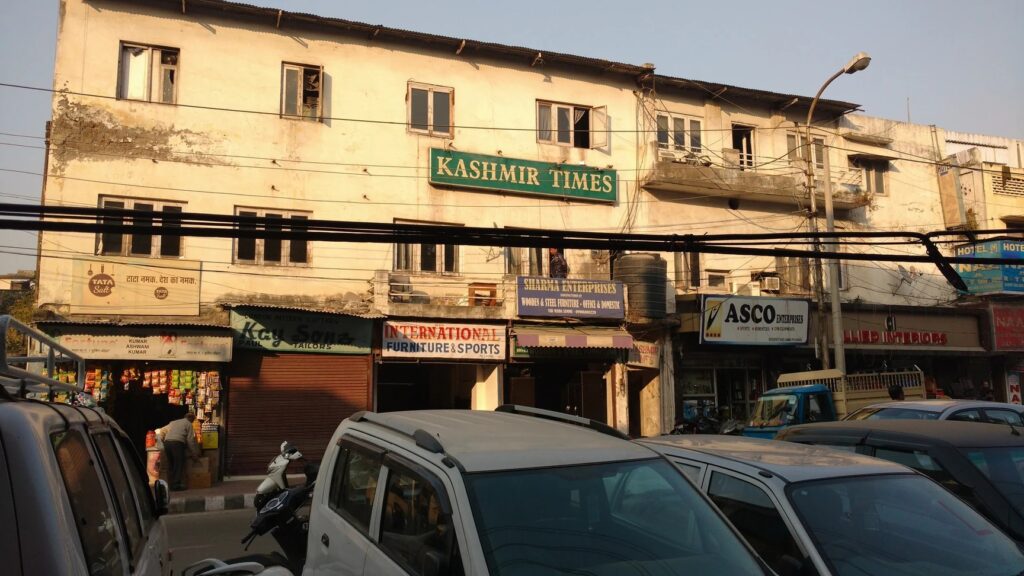
After the closure of the Srinagar office, the paper’s Jammu office was operating for a year or so out of a building in the old heritage city on the Residency Road which had been taken on lease from the government many years ago.
“We had applied for renewal of the lease agreement but it has been pending for years. The office was occasionally functional till 2021 after which it closed down,” she said.
A security guard linked to Kashmir Times has been reportedly detained in connection with the case.
Bhasin said that the paper has “stood as a pillar of independent journalism” which has “chronicled the region’s triumphs and failures with equal rigour”.
“We have given voice to communities that would otherwise go unheard. We have asked difficult questions when others remained silent. We are being targeted precisely because we continue to do this work. In an era when critical voices are increasingly scarce, we remain one of the few independent outlets willing to speak truth to power,” the joint statement said.
The statement urged the authorities to “immediately cease this harassment, withdraw these unfounded allegations, and respect the constitutional guarantees of press freedom”.
“We call on our colleagues in the media to stand with us. We call on civil society, on citizens who value their right to know, to recognise that this moment is a test of whether journalism can survive in an environment of increasing authoritarianism,” the statement said.
It added, “Journalism is not a crime. Accountability is not treason. And we will continue to inform, investigate, and advocate for those who depend on us. The state may have the power to raid our offices. But it cannot raid our commitment to the truth.”
[The Wire is an Indian nonprofit news and opinion website. It was founded in 2015 by Siddharth Varadarajan, Sidharth Bhatia and M. K. Venu.]
❈ ❈ ❈
Kashmir Times: A Jammu Newspaper That Stood Up for the Valley
Scroll Staff
On November 20, Jammu and Kashmir police’s Special Investigation Agency raided the defunct office of Kashmir Times newspaper in Jammu city in connection with a case registered against the media organisation.
The police said the case relates to the newspaper’s “involvement in criminal conspiracy with secessionist and other anti-national entities operating within and outside Jammu and Kashmir”.
During its searches at the organisation’s office, the police said they recovered “incriminating arms and ammunition” including a revolver, bullets and empty cases of fired bullets.
The police have accused the publication of “attempting to radicalise the youth of Jammu and Kashmir” and “challenging the sovereignty and territorial integrity of India through print and digital content”.
The newspaper, which ceased its print edition in 2021-’22 and is now a digital-only platform, has said that the action is “another attempt to silence us” and described the allegations as “baseless”.
The editors of Kashmir Times, Anuradha Bhasin and her husband Prabodh Jamwal, said that the office that was raided on Thursday had been “shut since the last four years and out of operation”. They are currently outside India.
“We have received no official intimation or statement to confirm the official actions,” the newspaper said in a statement on Friday afternoon.
While raids on newspaper offices in Jammu and Kashmir are not uncommon, the action against one of the oldest newspapers in the region has come as a surprise to many.
Not a propaganda arm
Kashmir Times has historically been considered an influential voice in Jammu and Kashmir’s media landscape.
Established in 1954 by Kashmiri journalist Ved Bhasin, Kashmir Times has been a chronicler of the region’s ups and downs. Bhasin, who died in 2015, had come into journalism through activism and student politics. He was also part of the civil society engagement on Kashmir between India and Pakistan.
Since it was led by an editor known for his belief in secularism, justice and democracy, Kashmir Times enjoyed credibility in the Valley, despite being a news outlet run out of Jammu, a region that was often opposed ideologically to Kashmiri sentiment.
The newspaper’s record of standing up to diktats from various actors in a conflict zone earned it a solid reputation. According to a former staffer, Bhasin refused to let his newspaper become a tool of government propaganda.
“Had Ved ji given in to the blackmail [from the government] … in 1990 and toed the official line, I believe Kashmir may not have recorded its history to the detail it now boasts of…,” the staffer said. “Any book that skips consulting KT [Kashmir Times] for the 1988-2002 era may not be history, I firmly believe.”
In 2010, the paper stopped getting central government advertisements from the Directorate of Advertising and Visual Publicity, an important source of revenue for many traditional print publications.
The scarcity of financial resources and lack of advertisements from successive governments led to a decline in the newspaper’s output of news and analysis.
Yet, the newspaper’s influence on the media industry was remarkable. Journalists who worked in Kashmir Times went on to work for major national and international publications.
Post-2019 crackdown
Ved Bhasin’s daughter, Anuradha Bhasin, carried her father’s legacy of activism when she challenged the Narendra Modi government in the Supreme Court in 2019.
Anuradha Bhasin petitioned the court against the widespread internet shutdown across Jammu and Kashmir after the Modi government on August 5, 2019, scrapped Article 370 of the Constitution that had guaranteed the erstwhile state a special status. Bhasin contended that the internet shutdown made journalism impossible and hurt the livelihoods of Kashmiris.
“The debilitating restrictions imposed through the complete shutdown on internet and telecommunication services, and severe curbs on the movement of photo journalists and reporters be immediately relaxed in order to ensure the freedom of the press and media,” said the petition filed on August 10, 2019.
Bhasin’s intervention led the court to direct the government to relax curbs on communication and internet services and be transparent about the restriction orders in Jammu and Kashmir.
In October 2020, the Lieutenant Governor administration of Jammu and Kashmir sealed the Srinagar office of the Kashmir Times. According to its editors, the office, which had been allotted to the newspaper in the early 1990s, had been sealed “without any explanation” by the government.
That was not the last government action the editors had to face.
In December 2022, Bhasin published A Dismantled State, a chronicle of events that took place after Jammu and Kashmir’s statehood was annulled in a single stroke by the union government.
In August, the Union territory administration decided to ban 25 books for peddling a “false narrative” and propagating “secessionist sentiment.” The list included was the book authored by Bhasin, the editor of Kashmir Times.
[Courtesy: Scroll.in, an Indian digital news publication, whose English edition is edited by Naresh Fernandes.]