❈ ❈ ❈
How Karnataka’s Farmers Successfully Challenged a Draconian Land Acquisition Process
A.R. Vasavi
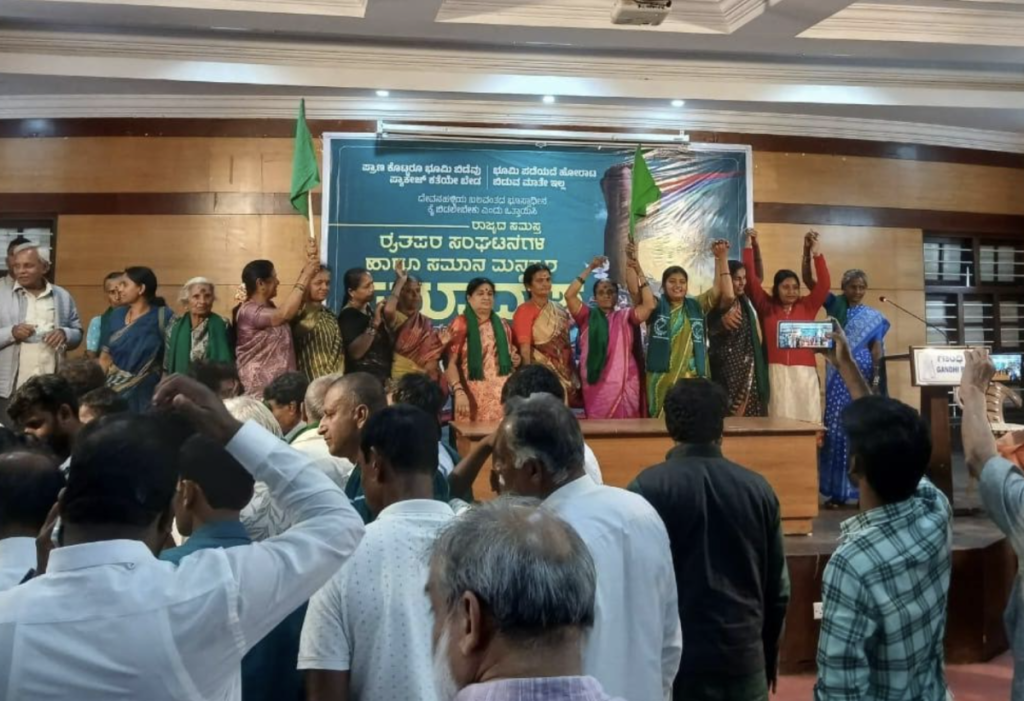
Submitting to a prolonged peaceful protest, Karnataka chief minister Siddaramaiah on July 15 rescinded the 2022 land acquisition notification to 13 villages near the Bengaluru international airport.
His final decision asserts the rights of farmers to their 1,777 acres of land, which the Karnataka Industrial Area Development Board (KIADB) had sought to acquire for the construction of an aeropark and allied industries. Since April 2022, farmers in the 13 villages in the Chanrayapatna-Devanahalli area had agitated peacefully against this notification. They held a ‘relay satyagraha’ continuously for nearly 1,200 days.
Forming a group called the Land Acquisition Resistance Committee, farmers had asserted their right to live on their land and to earn their living as farmers. A fertile red-soil tract, farmers grow not only the staple crop of ragi (finger millet) there but also a variety of vegetables and fruits. Some are also horticulturists. Dairy farms and pockets of sericulture combine to make for stable and sustainable livelihoods with youth accessing the booming metropolis for a variety of non-farm jobs.
Observing how land acquisition in the vicinity over the past years has rendered farmers bereft of meaningful livelihoods and lives, the Chanrayapatna-Devanahalli farmers questioned the need to uproot them from their ancestral land. Farmers questioned the KIADB’s land acquisition process and plans – especially the process of notifying the acquisition when most of the farmers did not want to relinquish their land. The Land Acquisition Act 2013 stipulated that authorities would need the consent of a minimum of 80% of residents to issue such a notification. Farmers also held several meetings with local political representatives and with government agencies and held fast to their beliefs despite the high-handedness of the authorities and often, law enforcement.
While campaigning during the 2023 assembly elections, Siddaramaiah, then in the opposition, had assured the farmers that the notification would be withdrawn. A final notification to acquire land in three villages, however, arrived after Siddaramaiah assumed power. This saw an intensification of the struggle and several civil society organisations under the umbrella of ‘Samyukta Horata Karnataka’ lent support to the farmers’ protest.
An all-India protest
When a large gathering – ‘Devanahalli Chalo’ – at Chanrayapatna on June 25 was violently disrupted by the police, the farmers and the supporters moved to the Freedom Park in Bengaluru and began protests there. On July 4, a meeting between the farmers and their representatives with the chief minister and government representatives ended with Siddaramaiah assuring them that a final decision would be taken on July 15.
Representatives from Samyukt Kisan Morcha had joined the protesting farmers. Its senior leader Darshan Pal noted that this protest would be supported by the SKM and all its branches across India, making it an ‘all-India struggle’. Multilingual film actor Prakash Raj lent support. Public letters were written by scholars and writers, calling for the need for balanced regional and industrial economic policies. On the eve of the final decision, a ‘Grama Sankalpa Samavesha’ was held in Chanraypatna where farmers vowed to continue their agitation and their bhoomi satyagraha – or land non-violence movement – if the government did not withdraw the notification.
In a picture similar to the culmination of the Nandigram-Singur movement against land acquisition in Bengal and the prolonged protests led by farmers near Delhi, this protest has shown how, despite the relegation of agriculture, land, and rural issues to the periphery of national planning and interests, it is farmers who are rising up to counter the alarming deceleration in the culture, structure and institutions of our democracy. The Chanraypatna-Devanahalli movement will go down in history as one such example of farmers’ resilience and courage against the depredations of a political system that speaks only the language of neo-liberalism. Yet, given the context and precedents of such movements, it may be wise to be cautious and to raise the flag against potential distortions and manipulative politics.
Cause for caution
While Nandigram-Singur led to the fall of the Communist Party of India (Marxist) and to the rise of Trinamool Congress as the ruling party, the processes of democracy and farmers’ rights, and a culture of consultative planning have not been assured in Bengal. The Samyukt Kisan Morcha and other farmers’ bodies stood and won against the draconian and undemocratic processes of foisting corporate interests in agriculture over that of farmers interests. Yet, despite conceding defeat, the BJP has continued a policy of corporatisation of agriculture by stealth and none of the concerns of farmers for remunerative prices, continued state support, and adequate allocation of funds have been attended to.
In all these cases, land and agriculture have been key issues and the failure of politicians and representatives to resolve them signal how the rights of a majority continue to be marginalised. In sum, a failure to consider, articulate and deploy alternatives for rural India – alternatives that go beyond the standard parameters of productivity, growth and the inevitable transition to urban-industrial areas and lives are missing. Farmers and rural citizens themselves need to consider and demand these new alternatives that can assure them a life and livelihood that can be led with dignity and democracy.
Siddaramaiah’s note in conceding to the farmers’ demands also shows the possibility of how land can still be made into part of the speculative economy that rules not only corporate interests but also that of our elected representatives. Although he called for a complete withdrawal of the acquisition notification, he went on to note that farmers who want to can sell their land at lucrative prices, and that the government will acquire such land as “for economic development, [the government will] need land to establish industries.”
“It is the government’s duty to facilitate this while also respecting the rights of landowners,” he said.
Although the chief minister conceded that the protests were part of the democratic process, his qualifying remarks indicated the failure of the government to seriously consider alternative policies that balance regional growth, rural-urban linkages, and provide a level playing ground for all citizens. The hegemony of the now global capitalist economy that strides on the uneven grounds of a largely rural-agrarian society make land the centrepiece of a chequered political-economy. Protests and struggles by farmers come at huge costs to farmers themselves. And each protest tells us that it is the resilience and strength of farmers that make possible these glimmers of hope of retaining our democracy.
[A.R. Vasavi is a social anthropologist based in Karnataka. Courtesy: The Wire, an Indian nonprofit news and opinion website. It was founded in 2015 by Siddharth Varadarajan, Sidharth Bhatia, and M. K. Venu.]
❈ ❈ ❈
Did the Karnataka Government Lose the Devanahalli Battle to Win the War?
Shivasundar
The Siddaramaiah-led Congress government in Karnataka was compelled to withdraw the final notification issued by the Karnataka Industrial Area Development Board (KIADB) to acquire 1,777 acres of fertile land for the second phase of its so-called aerospace park, as envisaged in the recently concluded Global Investors Meet. The move came thanks to the protracted and uncompromising struggles of farmers of 13 villages around Channarayapattna Hobli of Devanahalli Taluk near the Bengaluru international airport. The protest lasted for more than 1,197 days.
The struggle and the victory of Devanahalli’s farmers is historic on many counts. The farmers of the 13 villages withstood the threats and inducement, and have led what is probably one of the longest such battles in the recent past, in any country. That they did it against both the Bharatiya Janata Party and the Congress governments is a story in itself.
One must also note the rare unity and solidarity shown by different peoples’ movements, artistes like Prakash Raj and scholars who came together in support of the farmers and stood with them.
This compelled the chief minister to acknowledge the historic significance of the movement while declaring the withdrawal of the acquisition.
But many developments before and after the declaration of withdrawal hints at the fact that the sword of acquisition is still hanging. Even the chief minister’s statement while withdrawing the notification, which reasserted the industrial growth model based on high-tech and aerospace industries around Devanahalli, gives rise to serious concerns around how permanent this decision of the government is and how long the smile on the struggling farmers would last.
Reasons For Apprehension
Though the farmers’ demand in Devanahalli was specific – to cancel the acquisition of 1,777 acres of fertile agricultural land, that was done without their consent – the following principles were embedded within it:
- The belief that farmers are sovereign over their land, and seizing land without their consent is anti-democratic.
- A rejection of the government’s pro-corporate development model which prioritises foreign investment around Bengaluru, and instead an affirmation that a self-reliant, dignified, small-scale farming economy is also a legitimate and sustainable model of development.
- The understanding that destroying this economy would lead to increased unemployment and ruin livelihoods. Therefore, preserving and nurturing the existing agricultural economy is the real people-oriented development.
- Criticism that KIADB already holds thousands of acres unnecessarily and operates as a broker for corporate interests.
- The demand that if at all land must be acquired – from Bengaluru to Bidar, all irrigated or rain-fed regions – it should only be done with the consent of at least 80% of farmers, along with provisions for compensation, rehabilitation, and a proper social impact assessment, as mandated by the Land Acquisition Act of 2013 enacted by the Congress government.
Not a policy decision
Though the withdrawal of the Devanahalli land acquisition decision has brought relief to the farmers, Siddaramaiah’s press conference and the official statement provided afterward, repeatedly asserted that :
“…[W]ithdrawing the acquisition solely confined to these particular villages…and the same should not be sought in other places”.
But the LARR act of 2013, brought in by Congress-led UPA government in 2013 mandates consent of 80% of the affected people in every major land acquisition. Though the Siddaramaiah-led Congress government had been in power in Karnataka in 2013 as well, his government did not follow the farmer-friendly LARR Act of 2013, but continued with the draconian KIADB Act. The Narendra Modi government came to power in the Union government in 2014 made crucial amendments to dilute farmer-friendly clauses in the 2013 Act like the compulsory requirement of the consent of 80% of affected persons, compulsory social impact assessment, and a compulsory rehabilitation and resettlement plan. Many BJP governments in states adopted those Modi-made amendments.
But in Karnataka, the Congress-Janata Dal (Secular) government that came to power in 2018 also adopted the Modi-made amendments. The Siddaramaiah government which came to power in 2023 did not change it. Rather, it issued a final notification on the 1,777 acres of land in Devanahalli in April 2025, after the conclusion of the Global Investors Meet, for which the preliminary notification had been issued by the previous BJP government in 2022.
A false dichotomy
The saga of corporate-led development and land acquisition in Karnataka is thus a case of uninterrupted continuity, irrespective of the party in power.
It is not only this. The Eddelu Karnataka, a conglomeration of many progressive organisations who strived to defeat BJP by supporting and campaigning for the Congress in 2023 assembly and 2024 Lok Sabha elections, has, in a July 13 press statement, made a list of promises unkept by the Siddaramaiah government in last two years. It has also highlighted its failure to fulfil the promises it made, around the plank that it would break away from the BJP model of governance. They have sought to show how the Congress government only brought in some cosmetic changes with corporate interests largely undisturbed.
Thus, though the Congress wants to position itself as an alternative as a party of opposition at the national level, in Karnataka or wherever it is in government, it has fallen short of that.
It is clear to see that the dropping of the final notice for land acquisition of 1,777 acres in 13 villages did not stem from a change of heart or a change of development principle.
One must remember that Siddaramaiah, as an opposition leader in 2022, had made the promise of annulling the project. Caught between concerns over the Congress’s national image, the party’s government in Karnataka and its inherent class interests, the chief minister has made a careful choice.
Siddaramaiah declared on July 15:
“…Since Devanahalli is near Bengaluru and hosts the international airport, development is necessary for increasing everyone’s income in the state. New industries need land, and the government will acquire land to launch industrial projects…”
He also cautioned:
“…Some farmers have come forward, willing to give their land. The government will acquire such land, offer higher compensation and provide developed land in return.”
Here seems to lie the future strategy of the government. In fact, some hints to this end were given in the period between July 4 and 15, the 10 days’ time that the chief minister sought from the farmers to verify if there were any legal hurdles if the final notification was withdrawn.
In those 10 days, the minister for large industries, M.B. Patil went overboard claiming that many farmers were willing to part with land voluntarily. He also accused the struggling farmers of acting as proxies. Ironically, in the three years of continuous struggle, there had been no divergent voices. Suddenly, after this statement by the minister, a group of middlemen and real estate agents emerged, claiming to represent Devanahalli’s farmers who appeared to now be willing to sell their land if higher prices are offered.
Persuasions
Several developments following the Karnataka government’s July 15 announcement raise serious questions about the government’s long-term intentions.
Shortly after the scrapping of the land acquisition, the Andhra Pradesh government promptly invited the aerospace investment to relocate to its state.
In an interview with The Hindu’s political editor Nistula Hebbar two days after the Karnataka government’s announcement, the minister Pati said that the cancellation of land acquisition does not mean the end of the aerospace project.
He further said:
“….Out of the 1,700 acres that were earmarked, there are some people, with around 700 acres, who voluntarily came forward for land acquisition…This morning itself I had a meeting with officials from an aerospace company and things are still on.”
Notably, nowhere in the conversation does Patil state definitively that the government plans to offer alternative land elsewhere for the now-cancelled project. Instead, he repeatedly emphasizes that the required ecosystem for the aerospace industry exists only around Bengaluru’s airport, a clear indication that the area near Devanahalli remains central to the government’s plans.
Even when announcing the cancellation of land acquisition, the chief minister had clearly stated:
“…Those who are willing to give their land voluntarily will receive compensation above the market rate and 50% of developed plots”
In the same vein, he had also mentioned:
“…Devanahalli taluk is close to Bengaluru, and the international airport is located there… If industries are to be set up, the government must acquire land.”
Patil’s assertion stems from these assurances.
Losing a battle
Taken together, these carefully calibrated statements suggest that the government is positioning the Devanahalli episode as an exceptional, one-off compromise and not a precedent-setting victory for farmers or people’s movements.
Meanwhile, the Congress-led state government has been eager to reassure investors, promising that all incentives, including land, water, and subsidies, remain on offer at cheap rates.
While the BJP in the state through their communal MP Tejasvi Surya criticised the withdrawal, it later retreated. The BJP or the JDS had never appeared in the three-year-long struggle of the farmers. Meanwhile, their floor leader Bellad has asked the government to shift the aerospace corridor to his constituency and to the north of Karnataka so that the region sees development and jobs. This reinforces the narrative of development and jobs only through corporate-led efforts, which also posits the idea that agriculture and its dependents are a drag on the economy
Hence a bipartisan consensus is built to justify forceful acquisition of farmers’ lands for corporate-led development. This narrative will soon consider this historic victory of farmers a forced mistake in the development saga of the state.
The Congress government, by conceding defeat in Devanahalli, is trying to win the war, which is, in fact, one of development against farmers.
Thus, while the sword still hangs over the farmers of Devanahalli villages, people’s movements need to win the war of the development narrative to consolidate their victory.
It is also worth remembering that Devanahalli is the birthplace of Tipu Sultan, the anti-British warrior and farmers’ hero. His legacy remains a potent counter-narrative to colonial and corporatist forms of hegemony even today.
[Shivasundar is an activist and freelance journalist. Courtesy: The Wire, an Indian nonprofit news and opinion website. It was founded in 2015 by Siddharth Varadarajan, Sidharth Bhatia, and M. K. Venu.]