❈ ❈ ❈
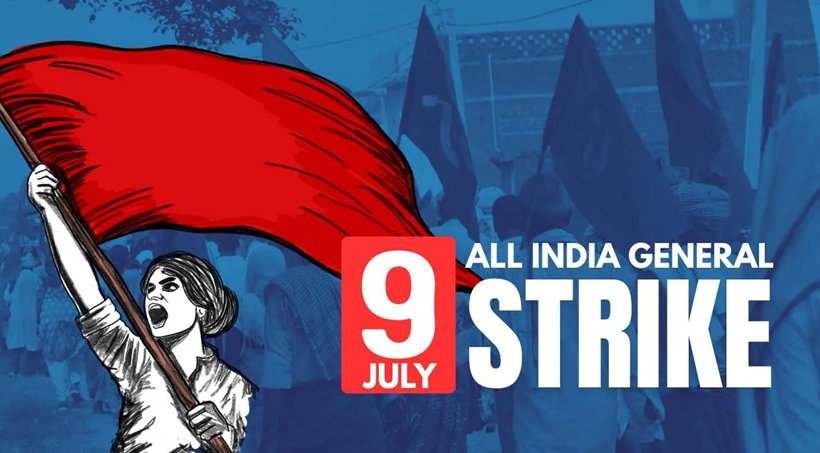
25 Crore Workers Made July 9 Nationwide Strike a ‘Grand Success’: Central TUs
Newsclick Report
Central trade unions and independent sectoral federations and associations on Wednesday congratulated more than 25 crore workers, agri labour and farmers for making the nationwide strike call against the government’s “anti-people” policies, “a grand success”.
In a statement, the joint platform said, “this is the beginning of the prolonged battle in the days to follow in the sectoral levels focussed on determined united resistance, again to culminate into a bigger national level heightened united action.”
The joint platform, apart from the many demands such as scrapping the labour codes, higher minimum wages, halt to privatisation, also condemned the “attack on the democratic rights” by the ruling regime as also “the attempt to de-franchise the migrant workers”, which is being “designed beginning with Bihar as immediate case.”
Full statement:
Congratulations to Workers, Farmers, Agri-Workers and the People at Large for the Grand Success of the Nationwide General Strike on 9 July 2025
Central Trade Unions
More than 25 crores participate in the Strike action/Rasta Roko/Rail Roko all over the country in the formal and informal sectors, in Government, Public sector enterprises, and industrial areas. There were very large mobilisations in rural India and also at block-sub-division levels by informal sector workers, agricultural labour and farmers and other sections of common people. Participation of students and youth was quite visible in many states. The ranks and file of Samyukt Kisan Morcha and joint front of Agricultural Labour Unions played significant role in the mobilisation in rural India
The workers and their unions in Coal, NMDC Ltd, other non-coal minerals such as iron-ore, Copper, Bauxite, Aluminium, Gold mines etc, Steel, Banks, LIC, GIC, Petroleum, Electricity, Postal, Grameen Dak Sevaks, Telecom, Atomic Energy, Cement, Port & Dock, plantations, Jute Mills Public transport, transport of various type in private sector, state government employees in various sectors/states and central govt employees in major areas like postal, income-tax, audit and others went on strike. The workers/employees in most of the Industrial areas in the country including in many MNCs joined the strike in a big way and organised processions. The defence sector employees held protest demonstrations for one hour in support of strike and joined office only after that as per their decision. The railway unions mobilised and participated in solidarity actions in. The unions in Construction, Beedi, Anganwadi, ASHA, Mid-Day Meal, and other Scheme workers, Fisheries, Domestic workers, Hawkers and vendors, Head-load workers,Home based piece rate workers and Rickshaw, Auto, Taxi were among those who participated in strike and joined Rasta Roko, Rail Roko at several places. The students, youth, women and social activists also participated in processions and dharna actions in many places. The common people supported these actions. The markets were closed at many places in response to Strike/Bandh call
There was Bandh like situation in many areas of the country like in the states of Puducherry, Assam, Bihar, Jharkhand Tamilnadu, Punjab, Kerala, West Bengal, Odisha, Karnataka, Goa, Meghalaya, Manipur etc. Reports of Partial bandhs were also received in many segments of Rajasthan, Haryana, Telangana,Andhra Pradesh etc. There was industrial and sectoral strike held in Madhya Pradesh, Maharashtra, Uttar Pradesh, Uttarakhand & Gujarat (the news from other states are still awaited).
Workers joined the strike action en masse throughout the country bravely confronting numerous intimidating and repressive actions and threats by the administrations, both of the Centre and many states and also the employers.
The strikers expressed their anguish against the anti-national policies of the Government to favour Indian and Foreign corporates and the international finance capital as against Public Sector Undertakings, Public services as well as against the small trade and businesses.The government through its policy of National Monetisation Pipeline(NMP)has put on sale the infrastructure, the natural resources and national assets which will jeopardize the self-reliant development of the country, posing threat to its Sovereignty. High time to oppose and fight these anti national policies, the agitators opined.
The people expressed themselves against the rising inequalities in the face of unprecedented price rise of essential commodities, rising unemployment and underemployment leading to desperation, increased suicides of casual labour and the unemployed youth.
The government has not been conducting Indian labour conference for last 10 years, violating international labour standards and continues taking decisions in contravention to the interest of labour force including attempts to impose four labour codes to favour employers in the name of ‘Ease of doing Business’.
The trade unions consider these labour codes as negation of the labour rights won over after struggle of 150 years from British Raj onwards. These codes negate our right to strike, make union registration problematic, de-recognition of unions easy, the process of conciliation and adjudication cumbersome, winding up labour courts and introducing tribunal for workers, overriding power to registrars to de-register unions, definition of wage being changed and the schedule of occupations for minimum wages applicability being abolished, Occupational Safety and Healthand Working Conditions code designed to put the right of safety of every worker and also rights and entitlements of workers in workplace in total jeopardy, the inspections exclusive putting the right of safety of every worker made in jeopardy, the inspections have been done away with and facilitators to facilitate employers is being brought, change in industrial code and its rule for increasing applicability-threshold from 100 to 300 would push out 70percent of industries out of the coverage of labour laws, the changes in factory act also would throw out substantial number of workforce from its coverage, giving the employers class wide discretionary powers to repress and exploit.
There is no labour protection, fixed term employment is fully devoid of labour law protection, unlimited apprenticeship and no compulsion of absorption is another way of exploitation, violation by employers being decriminalised whereas criminalization of trade union leader on the cards, the limit of contractor licence proposed to increase from 20 to 50, outsourcing and contractorization being made normal, recruitment of sanctioned posts not being done rather there is ban on new posts creation leading to rising unemployment, trend of appointments of retirees instead of regular employment to unemployed youth etc.
The unions are asking for immediate recruitments in the sanctioned posts lying vacant in all Govt departments and PSUs, creation of more jobs in industries and services, increase in days and remuneration of MGNREGA workers and enactment of similar legislation for Urban areas. But the government is busy imposing ELI scheme to incentivise employers instead, in order to subsidise their labour cost and informalize the workforce. In Government departments and in public sector, instead of providing regular appointments for youth, the policy to recruit the retirees on the one hand and appointing fixed–term/apprentices/trainees/interns in the core jobs on the other, is being brought as witnessed in Railways, NMDC Ltd, Steel sector, teaching cadres etc. This is damaging to the growth of the country where 65 percent population is below the age of 35 years and the numbers of unemployed is maximum in the age group of 20 to 25yrs. The government is making fraudulent claims on employment and provisions of social security. The existing social security schemes are being weakened and the attempts being made to bring private players into it.
The attack on the democratic rights as enshrined in Indian Constitution continues more vigorously by this ruling regime and now the attempt to de-franchise the migrant workers is being designed beginning with Bihar as immediate case. The misuse of constitutional bodies is rampant to suppress voices of opposition, the enactments in some states to control and criminalise mass movements is on the cards; the Public Security Bill in Maharashtra and similar enactments in the state of Chhattisgarh, Madhya Pradesh etc are the pointers. Now the attempts to snatch the citizenship is on the cards.
This is the beginning of the prolonged battle in the days to follow in the sectoral levels focussed on determined united resistance, again to culminate into a bigger national level heightened united action.
The unions in Delhi after taking out procession in industrial areas effecting strike held a public rally at Jantar Mantar, New Delhi which was addressed by National leaders of 10 Central Trade Unions Ashok Singh-INTUC, Amarjeet Kaur-AITUC, Harbhajan Singh-HMS, Tapan Sen-CITU, Rajiv Dimri-AICCTU, Lata Ben-SEWA, Chaurasia-AIUTUC, Jawahar-LPF, Dharmendra Verma-TUCC and R S Dagar-UTUC. The union leaders from ICEU and MEC, and leaders of AIKS and Agri-agriculture workers also addressed.
Statement issued by:
The platform of Central Trade Unions and Independent Sectoral Federations and INTUC, AITUC, HMS, CITU, AIUTUC, TUCC, SEWA, AICCTU, LPF, UTUC.
[Courtesy: Newsclick, NewsClick is an Indian news website founded by Prabir Purkayastha in 2009, who also serves as the Editor-in-Chief.]
❈ ❈ ❈
Tijmali Resistance Continues
Press Release, 28 June 2025
An Update of Events in Tijmali (Raygada-Kalahandi)
Dr Randall Sequeira and Ranjana Padhi
Since mid-2023, Adivasis and Dalits from Tijmali, Kuturumali, and Majhingmali—located in the Kashipur and Thuamul Rampur blocks of Rayagada and Kalahandi districts, respectively—have been actively resisting Vedanta’s proposed bauxite mining project in the region. Led by the Ma Mati Mali Surakhya Manch, the movement aims to safeguard people’s livelihoods—deeply tied to the forests, hills, and streams—as well as the broader environment and entire ecosystem they inhabit. Their resistance continues despite the company and the government employing not only coercive and repressive tactics, but also deceit and manipulation. This update of some main events between February to June outlines how those who struggle are facing incarcerations and loss of wage work as well as having to counter the divisive tactics engineered to cause rifts within the community.
- On 10 February, 2025, a massive rally of Ma Mati Mali Surakhya Manch took place in Bhawanipatna, the district headquarters of Kalahandi district. A memorandum was presented to the Collector demanding the cancellation of mining leases given to Vedanta and Adani for Sijimali and Kuturumali, respectively; acknowledgment of people’s clear opposition to the mining project at the two public hearings for environment clearance held by the OPCB in October, 2023; end of all police repression and withdrawal of fabricated cases; release of Kartik Naik, Hiramal Naik, Kumeswar Naik and Pabitra Naik languishing in jail; acknowledgment of the many gram sabha resolutions passed from 30 August to 4 September, 2024; and implementation of rights enshrined under FRA and PESA.
- In order to counter this rally, on February 15, there was a rally by pro-company people demanding development and mining in the regions. This was done by the support of mainstream political parties; the villagers who participated were from outside the project-affected areas of Tijmali. Its main aim was to demoralize the people in the struggle and let it known to the outside world that people want mining and industrialization. This is a well-established tactic often employed by companies.Such pro-company rallies have been staged twice before in October 2023 and in November 2014.
- On 1 January 2025, 10 villagers from Sunger Panchayat in Rayagada district and Talaampadar Panchayat in Kalahandi district filed a writ petition in the Odisha High Court stating that the 10 gram sabhas that the administration and company attempted to hold on 8 December 2023 with coercion using police force and company goons were illegal and fabricated. It is important to note that the administration claims these gram sabhas granted permission for the conversion of forest land to non-forest use. However, villagers lodged complaints at the Kashipur and Thuamal Rampur police stations on July 24 and 26, 2024, respectively. And the Collector in Rayagada had also been informed by the people of the fabricated gram sabhas. The police made these simple General Diary entries and did not begin any proceedings. The moot question is whether the police and administration would have remained silent and not registered an FIR if any complaint was made against the villagers by the company.
- Affidavits of 27 villagers annexed to the Writ Petition clearly state how the alleged Gram Sabha has been conducted through fraudulence and under coercion. Of the 27, 18 stated that their signatures have been forged. Of them, two villagers said that at that time they were not in the village but were in Ernakulum. The remaining 7 have stated in an affidavit that they were threatened that if they do not sign the gram sabha resolution, they would be beaten, detained and arrested. Under the fear of this threat by armed police, they were compelled to give their signatures. In other words, this Gram Sabha resolution was secured through fear and coercion, rendering it unreliable, as the consent was obtained in an atmosphere of intimidation. In the course of the hearing, the government officials from the state and the centre maintained that all rules and procedures had been followed. Notably, the court was unwilling to look into the matter of forged signatures. The constitutional Court did not give any direction to conduct an impartial enquiry into the allegation, which was the main point of the Writ Petition. But the Court directed the Union Government to take note of it and to take the people into confidence before granting clearance to Vedanta’s proposal by means of Gram Sabha or otherwise. The verdict was given on 5 March, 2025.
- After spending over six months in jail, the Odisha High Court granted bail to Kartik Naik and he walked free on 30 March. Similarly, Kumeswar Naik and Pabitra Naik were released on 31 May. And Hiramal Naik was released on 14 June 2025.
- However, the conditions under which bail was granted to Kumeswar Naik and Pabitra Naik in Odisha High Court are deeply concerning. One of the conditions states : “… the Petitioner shall clean the premises of the Kashipur Police Station in the morning hour (between 6.00 A.M. to 9.00 A.M.) for two months from the date of his actual release in the aforesaid case. The I.I.C of the Kashipur Police Station shall provide the cleaning article like broom, phenyl and other items to the Petitioner so that he can clean the said premises”. The same condition has also been imposed on Hiramal Naik who was granted bail by the District and Sessions Judge, Rayagada.
- On 26 July, over 86 concerned citizens wrote a letter to the Chief Justice, Odisha High Court and the Chief Justice, Supreme Court voicing their concerns in the matter of arbitrary bail conditions imposed by the Odisha High Court and Rayagada Sessions Court. The signatories included many lawyers along with civil and democratic rights activists, journalists, poets, writers and artistes. The letter stated that such arbitrary bail conditions cannot have the slightest correlation with the interest of justice, rather it amounts to travesty of justice. And that the imposition of such bail conditions by courts make it clear how they are not free from the prejudice against oppressed sections of our society. The signatories expressed concern that if such bail conditions become a judicial precedence, it will adversely affect the principle of right to bail, and likely to lead to more executive highhandedness. Also this approach may not only be construed as pre-trial punishment but also a part of retributive justice system. They appealed to the Supreme Court for the recall of the bail conditions by taking up the matter suo motto and to also consider framing pan-India guidelines on the matter of bail conditions.
- On 31 May morning, officials of the administration attempted going up on the road from Sagabari leading to the mine area. Villagers surrounded the team and refused to let them access the hill. The team was compelled to leave the area. Villagers see it as ruse to provoke the villagers since preparations were in full sway to observe Word Environment Day where a mass meeting had been planned at Sungerhaat square.
- On 3 June, Jaleswar Naik of Bantej, one of the leading members of Ma Mati Mali Surakhya Mancha was arrested by the Rayagada police. He had been beaten very badly before being produced in court. He was neither asked by the magistrate whether he had been tortured nor did he volunteer this information. It seems he had been warned by the police to remain silent about the physical torture.
- The next day, on 4June, around 150 villagers, mostly women, marched to Kashipur to enquire about Jaleswar’s sudden disappearance and arrest. Once again there was a confrontation with the police as over 250 police and paramilitary personnel stopped them on the way. Women tried to shield some of the male leaders and were beaten by lathis. In the scuffle that ensued, Ramakant Naik of Bantej and Sundarsingh Majhi of Kantamal were arrested. Many women were injured. Narangi Dei of Bondel was taken to the CHC Kashipur as her wrist was fractured. Nargi Dei of Kantamal also sustained a fracture but was too terrorised to go to the CHC. Ramakant Naik was beaten up as he was put into the police van. The police registered an FIR against 8 villagers and 100 other women and men under 8 sections of BNSS.
- On 5 June, the well-known environmentalist and anti-displacement activist Medha Patkar was stopped at Raygada Railway Station along with farmer leaders Lingaraj and Hara Bania and Human Rights activist Narendra Mohanty. All four of them were on the way to the World Environment Day event in Tijmali. They were illegally stopped by the police and then forced to return to Berhampur. Ma Mati Mali Surakhya Manch expressed its shock at the administration’s clampdown on celebrating World Environment Day. They were not only invited by Ma Mati Mali Surakhya Manch to participate in the World Environment Day celebrations, but had also come to express solidarity with the people’s resolve to protect the environment and safeguard their land from mining. A statement by concerned citizens expresses how this show of support was not acceptable to the administration.
- Soon, it was revealed in press that the district magistrate of Rayagada had issued an ex parte prohibitory order the previous day, i.e., 4 June, under Section 163 (3) of BNSS barring 24 persons from entering the district for a period of two months, without giving them an opportunity to explain their position. The order says, ‘their movement and presence in the district may lead to deterioration of law and order, disturb public peace and hinder the smooth conduct of administrative affairs and development process in the district’. Some names are of people who are domiciles of the Rayagada district itself, which implies that they would be externed from the district. It needs to be noted that under 163 of the BNSS a district magistrate has no jurisdiction of externment, and therefore, cannot prohibit a permanent resident from residing in their native place.
- To hasten the process of land acquisition, the Kalahandi administration issued a notice on 6 May for acquisition of 70 acres 50 decimal patta land in Tijmali village for the proposed bauxite mining project of Vedanta. There was a 60-day notice period for people to file in their objections. People got to know about the notice period almost a month later by which time there was heavy police deployment in the area making it difficult to go to the Tehsildar’s office.
- In the same manner, on May 23, the Tehsildar of Thuamal Rampur issued a notice for acquisition of over 23 acres of common land to be handed over to IDCO, Bhubaneswar for the creation of the Land Bank (for establishment industry and allied activities). On June 7, the villagers submitted a letter in response to the Tehsildar’s notice, affirming that generations have inhabited and cultivated the land, relying on a diverse range of crops and vegetables for sustenance. They emphasized that the land serves both communal and personal needs, and that their entire livestock—including cows, goats, and buffaloes—depend on the naturally growing grass for nourishment. Consequently, they argued that transferring the land to the Land Bank would disrupt their way of life and is therefore unacceptable. The villagers further stated that proceeding with the land transfer without convening a Gram Sabha violates established legal procedures. Indeed, no Gram Sabha has been held regarding this land acquisition. They emphasized the fact that, despite desperate efforts by the administration to accelerate the land acquisition process—including police presence and arrests—the proposed Vedanta project still lacks mandatory forest clearance from the Ministry of Environment, Forest and Climate Change (MoEFCC).
Friends, the struggle of Sijimali is at a critical juncture. Let us unite in this endeavor as villagers are braving the monsoon rains and guarding Tijmali day and night. The struggle against corporate capital and the struggle to protect the hills, forests and streams is not the struggle of the people of the affected area alone. Let us claim it as our own struggle to protect the people, environment and the entire habitat.
Have we forgotten
That wilderness is not a place,
But a pattern of soul
Where every tree, every bird and beast is a soul maker?
– Excerpt from the poem Wilderness by Ian McCallum
[Courtesy: Countercurrents.org, an India-based news, views and analysis website, that describes itself as non-partisan and taking “the Side of the People!” It is edited by Binu Mathew.]