José ‘Pepe’ Mujica: Obituary, and Article: ‘My Generation Made a Naive Error’
❈ ❈ ❈
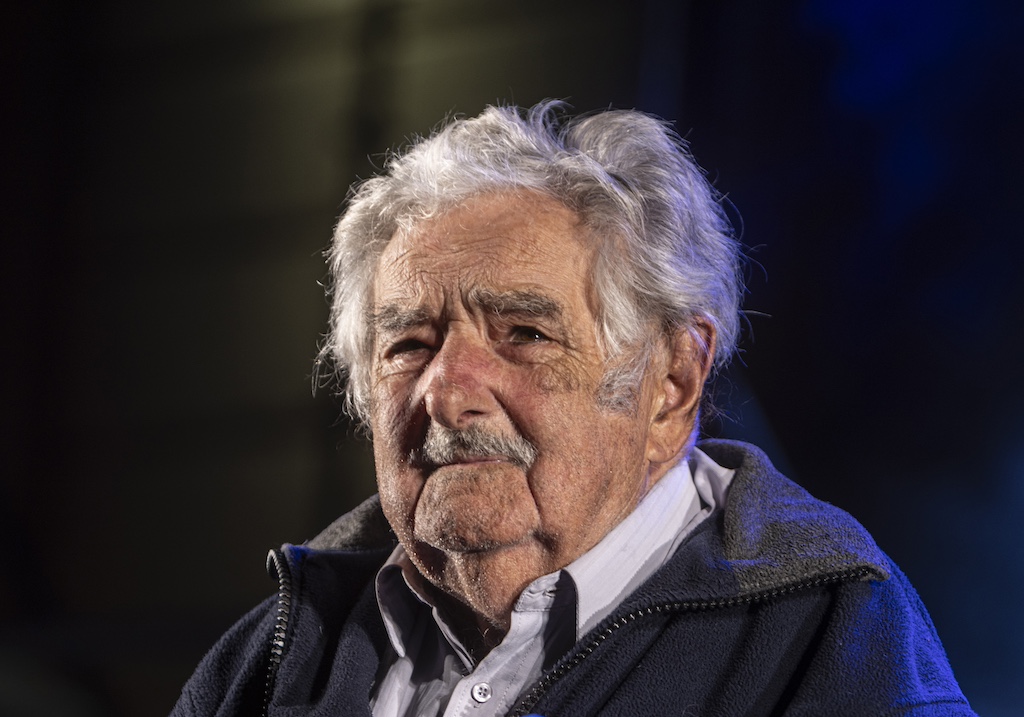
José ‘Pepe’ Mujica: The Revolutionary Who Never Surrendered His Ideals
Ali Abutalebi
In his condolence message on the occasion of the notable Uruguayan leader, José ‘Pepe’ Mujica, the Cuban President, Miguel Díaz-Canel, emphasised: ‘His extraordinary life recalls the dark era of Washington-backed military dictatorships’. This reminder is necessary to avoid the trap that the mainstream media’s rhetoric has prepared for progressive forces in the Global South.
After his passing away on May 13, Pepe has been celebrated merely as the ‘world’s humblest (or poorest) president’, by some media like BBC and Al Jazeera, but this simplistic narrative obscures a profound truth: beneath his austere lifestyle burned the unyielding spirit of a revolutionary who never abandoned his revolutionary principles. Unlike many former guerrillas who entered mainstream politics and diluted their principles, Mujica transformed his methods while keeping his essence intact.
From Armed Resistance to Political Leadership
Born in 1935 in Montevideo, Mujica joined the Tupamaros in the 1960s, an urban guerrilla movement that confronted Uruguay’s dependent capitalist regime. Inspired by the Cuban Revolution, the Tupamaros challenged capitalist structures through strategic operations against the comprador regime. Mujica’s unwavering commitment resulted in his imprisonment for nearly fifteen years, including extended periods of solitary confinement under inhumane conditions that would have broken lesser spirits.
The usual narratives try to tell us: ‘When democracy returned to Uruguay in 1985, Mujica and his comrades strategically shifted from armed struggle to electoral politics within the Broad Front (Frente Amplio) coalition’. What these narratives have tried to hide is that ‘Democracy’ was a result of Operation Condor’s defeat by grassroots struggles in which the guerrilla movement was a cornerstone. On the other hand, this transition represented not a rejection of revolutionary ideals but an evolution in tactics. Mujica consistently maintained that his guerrilla past required no apology, viewing it as a necessary response to state oppression and systemic injustice. He emphasised his lifelong dedication to transformative social change.
Revolutionary Governance
During his presidency (2010–2015), Mujica’s revolutionary ethos manifested in bold policy decisions. His administration conducted legal rectifications, not as moderate reforms but as radical assertions of sovereignty and people’s rights. His stance against neoliberalism was uncompromising: state power existed to serve the people, not enrich elites.
Mujica’s decision to donate 90% of his presidential salary to social causes and continue living in his modest farmhouse rather than the presidential palace embodied his belief that political leaders should share the material conditions of those they represent. This was not mere symbolism but revolutionary praxis – a deliberate rejection of the trappings of power. His criticism of consumerism was not a liberal gesture; he was deeply critical of neoliberalism and believed that preserving our planet would only be possible by stopping the insane consumption system that serves the Global North.
His foreign policy maintained an anti-imperialist edge, challenging multinational corporations and advocating for Latin American solidarity against global capitalism. In international forums, his speeches echoed revolutionary figures, offering searing critiques of consumerism and environmental destruction while calling for global solidarity among oppressed people. Additionally, mainstream media attempts to exaggerate and decontextualise his criticism of the Venezuelan government; meanwhile, they overlook his praise for the Chavista movement and recognition of Maduro’s efforts as Chavez’s legitimate successor in advancing the Bolivarian Revolution.
A Revolutionary Legacy
Mujica’s trajectory stands as a powerful counterexample to the narrative that entering state institutions necessarily corrupts revolutionary ideals. He demonstrated that one could wield political power without betraying the struggle that made such power possible.
For Mujica, the revolution never ended – it evolved to meet changing conditions. His commitment to justice, equality, and anti-imperialism remained uncompromised by his ascent to power, marking him as a genuine revolutionary who remained faithful to his principles until his final breath.
Mujica’s simplicity was not a retreat from revolutionary ideals but their fullest expression – a living embodiment of resistance against capitalist excess and a testament to the enduring relevance of revolutionary values in contemporary politics.
(Ali Abutalebi has been executive director of Mazmoon Books since 2005. He founded the Iranian Campaign for Solidarity with Cuba, collaborated with Urban Economy Forum as an independent researcher, and authored several articles for the Iranian press and political websites, mostly focused on Latin American progressive movements. Ali has published a book on Cuba titled Rest in Peace Ernesto. Courtesy: Globetrotter, a project of Independent Media Institute, a nonprofit organization that educates the public through a diverse array of independent media projects and programs.)
❈ ❈ ❈
‘My Generation Made a Naive Error’
José Mujica
My generation made a naive error. We believed that social change was only a matter of challenging modes of production and distribution in society. We did not understand the immense role of culture. Capitalism is a culture, and we must respond to and resist capitalism with a different culture. Another way to put this: we are in a struggle between a culture of solidarity and a culture of selfishness.
I am not thinking of culture that is sold, like professional music or dance. All that is important, of course, but when I speak of culture I am referring to human relations, to the set of ideas that govern our relationships without us realizing it. It is a set of unspoken values that determine the way in which millions of anonymous people around the world relate to each other.
Consumerism is part of that culture. It is an ethic needed for capitalism in its struggle for infinite accumulation. The worst problem for capitalism would be for us to stop buying or to buy very little. And this has generated the consumerist culture that envelops us. But a capitalist social system is not only property relations; it is also a set of unspoken values common to the society. These values are stronger than any army and they are the main force maintaining capitalism today.
My generation believed it was going to change the world by trying to nationalize the media and distribution, but we failed to understand that at the center of this battle must be the construction of a different culture. You cannot build a socialist building with bricklayers who are capitalists. Why? Because they are going to steal the rebar, they are going to steal the cement, because they are only looking to solve their own problems, because that is how we are formed. My generation, rationalist with a programmatic vision of history, did not understand that humans often decide with their guts and then their conscience constructs arguments to justify their decisions. We choose with our hearts, and here culture becomes a vital issue because it tempers our irrationality.
For example, what happened to our left leaders? Left leaders are sick and immersed in that same culture, and that is why their way of life is not a message coherent with their struggle. Look, they said I was poor when I was president, but they didn’t understand a thing! I am not poor. Poor is the one who needs a lot. My goal is to be a stoic. And the fact is that if the world does not learn to live with a certain sobriety, not to squander, not to waste, if it does not learn this soon, our world will not survive.
The lust for money incites us to keep on buying new things, but sustaining the life of the planet means that we must learn to live with what is necessary and not to squander our resources. Now, as you can see, this struggle is a cultural epic. We, the Left, must construct a line of thought that is different from the one we have.
This means throwing out our connection to capitalism. We ran out of creativity in terms of ideas. We wanted to do the same as capitalism, but with more equality. And in the end, this all has to do with what we consider to be the good life, the values that we can cherish in life, the things that we can aspire to. It means having a sense of limits. Nothing too much, as the Greeks used to say.
The Left must be faithful to another set of values, and that is why I insist on the problem of culture, on the problem of commitment and on the problem of valuing certain areas of life that capitalism does not value. There is much sadness in our societies even though they are full of wealth. We are an overfed people with societies choked by the amount of garbage we create. We infest everything, we buy things we don’t need and then we live in despair paying bills. We must propose another way of living! For me, the Left has to be more revolutionary than ever.
It means to live as you think. Otherwise we end up thinking as we live. The struggle is for a self-managing society, to learn to be our own bosses and to lead our common projects. These things will have to be discussed by a new left. I believe in the permanent existence of the Left, but it will not be the Left as it was. What it was is gone, has passed! The Left will have to be different because time changes. The only permanent thing is change.
I’m not going to suggest obstacles to the creation of new revolutionary programs. On the contrary! But I don’t have a magic formula. It seems to me that creativity must be encouraged, because we are in a world with an old left that lives too much on nostalgia, a left that finds it hard to realize why it failed and has great difficulty in imagining new ways forward. I believe that this is a time of much rehearsal, a lot of experimentation and creativity. And for that there are some parameters we can follow, because, as I said, my generation did not place enough emphasis on culture. I am referring to the culture inherent in the common and ordinary relationships that people have, which, under capitalism, now uses the events of daily life only to ensure further accumulation.
The culture in which we are embedded, in which we are surrounded, is functional only for the multiplication of individual profit. And that culture is much stronger than armies and military power and everything else, because that culture is determining the permanent relationships of millions of ordinary people all over the world.
And that is much stronger than the atomic bomb! So, to change a system without facing the problem of a change in culture is useless. We must build a new system and, in parallel, a new culture, a new ethic, because, if not, what we saw with the Soviet Union will happen again, where a revolutionary movement made a perfect 360 degree turn to be in the same place — but much worse! We have to learn from that defeat, right?
(Adapted from Surviving the 21st Century by Noam Chomsky and José Mujica, edited by Saúl Alvídrez, forthcoming from Verso in September 2025.)
(José Mujica was a Uruguayan revolutionary and statesman who served as president from 2010 to 2015. Courtesy: Jacobin, an American socialist magazine.)