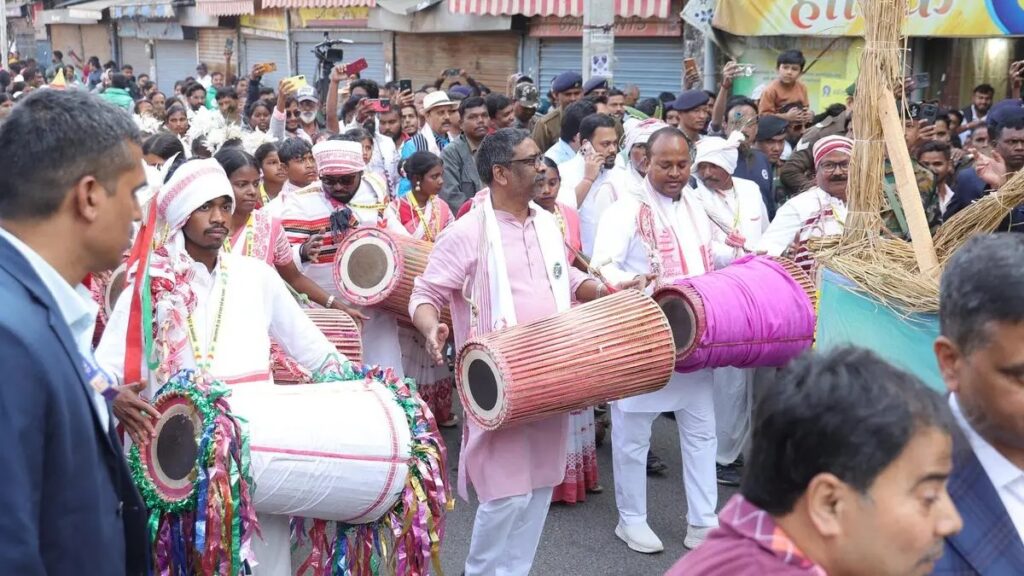
On November 15, Jharkhand celebrated its 25th birth anniversary with much fervour in the State capital, Ranchi, with Chief Minister Hemant Soren, in his third term, leading the silver jubilee celebrations that were marked by a cultural extravaganza and exhibitions showcasing Jharkhand’s developmental journey so far.
The day also marked the 150th birth anniversary of Jharkhand’s iconic tribal freedom fighter Birsa Munda, who gave the battle cry of “Abua dishum, abua raj” (our land, our rule).
However, even as the establishment pulled out all the stops to commemorate 25 years of statehood, especially with a dazzling “Jharkhand Jatra” parade, the question remains, Has Jharkhand succeeded in achieving its stated objectives?
Development and deprivation
While it is true that there is a construction boom in cities such as Ranchi, Dhanbad, Jamshedpur, Bokaro, Hazaribagh, Deoghar, Dumka, and Koderma, districts such as Chatra, Pakur, and West Singhbhum continue to have high rates of multidimensional poverty while others such as Godda, Gumla, Sahibganj, and Simdega rank low in human development and infrastructure.
There are pockets with limited or no access to clean drinking water and electricity—some of them quite close to Ranchi. The lack of irrigation facilities in districts such as Palamu and Latehar has resulted in low agricultural productivity, worsening deprivation in the region.
Rampant unemployment also ensures that Jharkhand is one of the key suppliers of domestic help and labour to Delhi, Maharashtra, Gujarat, and even some southern States.
Hardly a day passes without a report of the woes of Jharkhandi migrants. In 2023, the story of a maid tortured by employers in Gurugram shocked the nation, while the death of Vijay Kumar Mahato (from Dumri in Giridih) in a shootout in Jeddah, Saudi Arabia, on October 16 hogged the headlines this year. Earlier this year, the Delhi Police and the Jharkhand police, with the help of NGOs, rescued several minor girls from human traffickers and employers in Delhi.
A 2024 report in International Journal of Multidisciplinary Research and Development by Aditya Raj and Shubham Kumar of IIT Patna, said: “Jharkhand’s working-age population decreased by about 5 million between 2001 and 2011, with an average of 5 per cent of the working-age population migrating each year.”
Agriculture issues
According to the report, Jharkhand, without a robust irrigation system, is still a largely monocropped zone. Moreover, in the absence of options owing to a lack of development, people are without work half of the time. Since there are few regular jobs in rural areas, many rural residents, especially youngsters, migrate in search of more opportunities and income.
It said: “The region is still plagued by widespread poverty, unemployment, illiteracy, lack of development, and out-migration. Since its inception, the State has expanded significantly, but the growth hasn’t been distributed fairly.”
In November 2007 itself, just seven years after the State was created, Harivansh Narayan Singh, then the resident editor of the Prabhat Khabar newspaper, wrote: “Jharkhand is a failed State, chaotic and directionless… the biggest challenge of Jharkhand is corruption, which is the biggest impediment in the path to development.” Singh is currently a Janata Dal (United) MP and Deputy Chairperson of the Rajya Sabha.
Deep-rooted corruption
Corruption is indeed a serious issue, and the extent of the problem becomes clear when we consider the fact that three Chief Ministers of Jharkhand have been jailed in corruption cases.
The challenge continues even today. For instance, on May 6, 2024, the Enforcement Directorate recovered cash to the tune of Rs.30 crore in raids on some people close to the then Rural Development Minister, Alamgir Alam. Earlier, in December 2023, a sum of Rs.351 crore was recovered from the residence of former Rajya Sabha member and Congress politician Dhiraj Prasad Sahu.
In the past 25 years, there have been 12 Chief Ministers, and barring the 2014-19 period, the State has always had a tribal Chief Minister. But the lot of the tribal people has yet to improve.
Tribal woes
In many districts, tribal villages suffer from a lack of drinking water and regular supply of essential commodities from ration shops. Primary education schools and public health centres are dysfunctional, and corruption in the implementation of the Mahatma Gandhi National Rural Employment Guarantee Scheme has resulted in many poor people not getting work.
The State is rich in mineral resources such as coal, mica, iron ore, and copper and also produces bauxite, quartz, and asbestos. It accounts for 40 of the country’s mineral wealth, but that has not translated into development or improved the standard of living.
A data-driven analysis by Azim Premji University in 2024 of rural multidimensional deprivaton in Jharkhand pointed out that while 47.81 per cent of villages in India were multidimensionally deprived, the “corresponding figure for Jharkhand is much higher at 75.76 per cent”.
According to the paper, the average multidimensionally deprived village in Jharkhand is found lacking on about 9 out of 22 indicators.
Deprivation in Jharkhand does not have a spatial pattern unlike some other States with a high concentration of deprivation in particular regions. In Jharkhand, if the deprivation-hit Sahibganj is located in the tribal belt of the Santhal Pargana division, in the north-east of the State, Simdega and West Singhbhum belong to the South Chotanagpur and Kolhan divisions respectively, located in the south.
Water crisis
The State is also undergoing a serious water crisis, thanks to over-exploitation of groundwater resources that has also led to contamination. In an essay titled “Alleviation of Water Crisis in Jharkhand State of India”, published by International Journal of Engineering Research & Technology, T.N. Mishra, a retired Director of the State’s geology department, said that over-exploitation of ground water due to the rising population and negligence in conserving rain water have resulted in a serious water crisis in the State. As a result of its rocky terrain, the State loses about 80 per cent of the rainwater it receives to run-off.
According to him, “unplanned and unsustainable extraction” of groundwater has drastically reduced the yield of wells and borewells. Further, this over-exploitation has also resulted in the concentration of impurities such as fluoride, arsenic, and iron in various aquifers, causing health hazards to consumers.
The original demand for a “Greater Jharkhand” from activists sought the incorporation of 21 districts from Bihar, Madhya Pradesh, Odisha, and West Bengal. However, only the truncated version could become a reality. The creation of the new State served the political interests of both the Rashtriya Janata Dal (RJD) and the BJP. A smaller Bihar Assembly enabled the RJD to strengthen its hold in the State since that reduced its dependence on smaller partners, while the BJP, which fulfilled an election promise, found a new State where it could be a dominant force.
History of instability
For the first 14 years, the State was wracked by political instability, with nine governments and three spells of President’s Rule. Only two Chief Ministers, Raghubar Das of the BJP and Hemant Soren of the Jharkhand Mukti Morcha (JMM), have been able to complete a full term. Hemant’s father and JMM co-founder Shibu Soren was once Chief Minister for just 10 days. His second and third tenures lasted nearly five months each in 2005 and 2008. Politics was so fluid that for nearly two years, Madhu Koda, an Independent, occupied the Chief Minster’s seat. The past 11 years have been relatively stable.
Speaking to Frontline, Father Thomas Kavala, a prominent Jesuit priest and human rights activist, said that while there has been a general improvement in the overall infrastructure—such as the road network and the establishment of schools and colleges—and electricity has reached most of the villages, lakhs of Jharkhandis are still living in poverty.
According to him, powerful companies have appropriated the land, cleared the forests, and taken away minerals and natural resources. “People are being pushed out of their ancestral land illegally without even being informed or with their consent [being taken]. The owners of the land [farmers] have become landless labourers and are migrating to big cities and other States.”
Father Kavala, a long-time resident of Jharkhand, said: “Jharkhand became a reality after 50 years of struggle by the Adivasis and Moolvasis [original inhabitants]. They dreamed of a State where the Adivasis and the Moolvasis could develop according to their values of freedom, equality, and fraternity and in harmony with nature. They wanted their land, water bodies, and forest. Another sangharsh [struggle] or andolan [agitation] is the need of the hour.”
Land rights violated
The Chota Nagpur Tenancy Act, 1908, and the Fifth Schedule of the Constitution protect the land rights of the tribal population by prohibiting the transfer of land from tribal people to non-tribal people, but there are widespread concerns that these are being violated and that amendments and exceptions are being made to these laws so that tribal land can be handed over to corporates and outsiders.
There are also complaints that the Forest Rights Act, 2006, which recognises and vests forest rights in tribal communities and other forest-dwellers, and the Provisions of the Panchayats (Extension to the Scheduled Areas) Act, which seeks to provide self-governance to Scheduled Areas, are not being properly implemented.
Domicile status is another thorny issue. Various tribal organisations and rights groups have been demanding 1932 as the cut-off year to decide the domicile policy. Bowing to the demand, the Hemant Soren government passed the Jharkhand Definition of Local Persons and for Extending the Consequential, Social, Cultural and Other Benefits of such Local Persons Bill, 2022.
Domicile status
The Bill sought to make the land records of 1932 as the criteria to verify the State’s domicile and employment policy and also contained a provision for reserving grade II and grade IV government jobs for local residents.
Suman K. Shrivastava, a senior journalist who served as an adviser to Arjun Munda when he was Chief Minister, said that when the first State government headed by the BJP’s Babulal Marandi tried to bring a domicile law in 2002, violence erupted in Ranchi, Jamshedpur, Gumla, and Lohardaga.
“There were violent confrontations involving stone throwing, burning of vehicles, forceful bandhs, and police action. Several individuals sustained injuries and public property suffered extensive damage,” said Shrivastava, adding that Hemant Soren finally passed the Bill after 20 years, despite the Governor’s objections.
The Bill, however, is not yet law and awaits Presidential assent. According to him, for the past 25 years, Jharkhand’s attempts to define “local residents” have repeatedly collided with constitutional guarantees of equality, free movement, and citizenship.
According to Father Kavala, Jharkhandis are being divided and Jharkhandi unity is currently the greatest challenge.
Ahead of the November 2024 Assembly election, the BJP ran a polarising campaign centred on allegations of infiltration by Bangladeshi Muslims, their acquisition of tribal lands, and their marriages with tribal women, which it claimed was changing the demographics in the Santhal Pargana region.
The campaign was a first in the State’s electoral history. A PIL petition was even filed in the Jharkhand High Court alleging large-scale infiltration from Bangladesh in six districts: Dumka, Pakur, Deoghar, Jamtara, Godda, and Sahibganj.
BJP’s polarisation
Although the BJP lost the election, the deep schisms in society remain. In the months after the election results, recurring communal clashes in various parts of the State cast serious doubts on the strength of Jharkhand’s secular fabric deeply rooted in the State’s history of long-standing coexistence among tribal people, Sadans (a non-tribal group who are considered Moolvasi), Muslims, and Hindi-speaking settlers from Bihar and Uttar Pradesh, whose shared cultural traditions and mutual respect have sustained communal harmony for decades.
In an open letter addressed to leaders of all political parties on the occasion of the State completing 25 years, the Jharkhand Janadhikar Mahasabha, a civil society group, held the political class responsible for the current state of affairs. It also organised a “Jharkhandi Ekta Yatra” on November 15 in Ranchi to remind the people of the Jharkhand movement’s dreams.
Jharkhand’s silver jubilee was followed by Hemant Soren’s government completing one year in office on November 28, when the BJP released a “charge sheet” against the government, alleging rampant corruption.
Soren, on the other hand, handed out 8,792 appointment letters for government jobs to youths on the day and hit out at the opposition party’s charges.
Unconcerned with the continuing political slugfest, the people of Jharkhand continue to hope for a new dawn.
[Anand Mishra currently serves as Political Editor, Frontline. Courtesy: Frontline magazine, a fortnightly English language magazine published by The Hindu Group of publications headquartered in Chennai, India.]