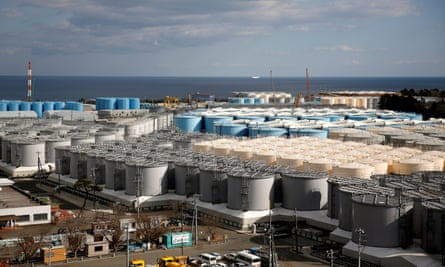
Nearly a decade after the 2011 Fukushima disaster, Japanese media reported Friday that the government has decided to release more than one million tonnes of treated radioactive water currently being stored at the nuclear plant into the Pacific Ocean, despite fierce opposition from fishermen and environmental advocates.
Nuclear energy policy expert Paul Dorfman called the Japanese government’s plan “an appalling environmental crime.”
While a formal announcement is expected to be made later this month, Japanese government officials have been considering this course of action for months.
Reuters noted that “the decision is expected to rankle neighboring countries like South Korea, which has already stepped up radiation tests of food from Japan, and further devastate the fishing industry in Fukushima that has battled against such a move for years.”
“I have a lot of compassion for the fishermen and other people who are making their living in the Fukushima Prefecture and around it who fear for their income at the moment this will take place,” Jan Haverkamp, a senior expert on nuclear energy policy at Greenpeace, told Al Jazeera on Saturday.
According to Al Jazeera, South Korea “still bans imports of seafood from the Fukushima region and has expressed concern” about Japan’s plans to release radioactive water into the Pacific Ocean.
“The economic reality for these fishermen is real,” said Michael Penn, president of the Shingetsu News Agency. “You can expect that their businesses will be damaged by [the perception of health risks] whether [the seafood] is safe or not safe.”
Tomohiko Taniguchi—a former business journalist, past special adviser to Japanese Prime Minister Shinzo Abe, and now a professor at Keio University—claimed that it is “a vast amount of treated water, no longer contaminated.” According to Taniguchi, “the only remaining radioactive material is tritium,” which he argued is a harmless substance that can be found naturally in water.
Haverkamp argued that there remains “a lot of uncertainty about the effects of tritium.”
“The moment that I hear the word ‘treated’ being used instead of ‘contaminated,'” he retorted, “I can’t think differently than this is a kind of newspeak.”
When asked why the Japanese government has decided to release the wastewater into the Pacific Ocean despite having other options, Taniguchi responded that “it is the easiest way.”
Given the lingering uncertainties about the effects of radioactive wastewater on human and environmental health, Haverkamp advocated for adhering to the precautionary principle, which he claimed “is not a problem at all,” since it is possible to store the water for a longer period of time while “continuing to search for better ways to treat this water… before it is released into, for instance, the ocean.”
(Article courtesy: Common Dreams, a non-profit US news portal.)