❈ ❈ ❈
Kashmir: Ink, Irony and Insecurity
Sreejayaa Rajguru
In the delicate scenario of democracy, literature bears witness but also wields a sword. If one is an observer of Indian politics, the Jammu & Kashmir Home Department’s announcement in August 2025 of a ban on 25 books that it classified as “seditious” was hardly shocking. It felt less spontaneous than a psychological act of governance: a panicked retreat into a shroud of national integrity. Yet the more we peered inside this literary purge, we understood that it was not just the ink the state feared on the page but the imagination, the inquiry, the unforgetting histories it mobilised.
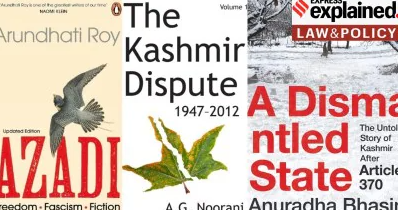
Many of the most respected names in Indian and global scholarship on this banned list are Arundhati Roy, A.G. Noorani, Sumantra Bose, and Victoria Schofield. These works are not incendiary pamphlets or flights of fancy calling for insurrection; they are scholarly texts, journalistic investigations, and political essays chronicling the long, tortuous, and too often tragic tale of Kashmir’s contemporary political identity. The overarching authority’s decision to ban their circulation and reader access was garbed in the usual threats to sovereignty and assertions that they promote terrorism. Yet, just the faintest breath of scrutiny reveals how predictable and uniform such proclamations are, and crumbles them effortlessly.
The legal rationale was provided under the new Bharatiya Nyaya Sanhita (BNS), 2023, which replaces the colonial Indian Penal Code (IPC). Among several offences invoked are Section 152 of BNS (forfeiture of publication with seditious matter) and Section 197 of BNS (promoting enmity between different groups). Some of these statutory instruments, which are merely brand new forms of old statutory systems based on colonial logic, have been used to imprison revolutionaries under British rule, when the same colonial understanding was a tool of the state’s power to repress. What is remarkable about this situation is that a state that is supposedly post-colonial is borrowing from colonial frameworks to police intellect and academic thought, repressing dissenting voices and constructing understandings of loyalty in its shallow terms. This raises an important question: Is it possible for a republic to flourish if it is afraid of its writers?
The political precariousness evident in this decision does not come from nowhere. Since the stripping of Article 370 in 2019, Kashmir has been relentlessly undergoing a campaign of narrative consolidation. Kashmir had once become a polyphony, full of voices (local leaders, poets, historians, international observers), has now been reduced to a monologue – all organized from the control room in Delhi where the script is singular, and any deviation is now “anti-national,” a term so often used that it has lost meaning altogether, its threat baritone is now an empty trumpet. In this one-note narrative environment, the banned books didn’t get banned because they caused violence, but because they transpired the state-managed illusion of ideological unity. They reminded readers that there is more than one story, more than one pain, more than one way to be patriotic.
For example, Arundhati Roy’s Azadi is a meditation on freedom – its ironies and contradictions and on how it has changed in the postcolonial Indian context. Her essays disassemble the machinery of nationalism, a critique that demonstrates how easily the language of liberation can be shaped into the discourse of repression. Noorani’s volumes of work are very legalistic and archival, presenting facts which would otherwise not be presented in popular histories. Both Bose and Schofield provide nuanced historical accounts, providing critical global viewpoints that cannot be subsumed by nationalistic propaganda. Banning works like this does not negate misrepresentation; it, in fact, instead fearfully erases difficult truths.
The government’s language in its public notice is telling. The books were said to promote “false narratives” and could “mislead youth”. The subtle suggestion is that Indian youth are not capable of critical inquiry—that they are “empty vessels” instead of minds with the aptitude to consider arguments and counter-arguments. This paternalism is anti-democratic, suggesting that exposure to intellectual ideas is dangerous, that questions are threats, and that dissent is disloyalty. But such a frame cannot persist in a real democracy. If a state needs to protect its citizens from books, perhaps it is not the books that are dangerous, but the delicate foundations of the state.
In India, book banning is not legally uncommon. Over the years, governments of various parties have banned books ranging from Salman Rushdie’s The Satanic Verses to the writings of Periyar, and even Ambedkar’s annotations to Hindu texts. Article 19(1)(a) signals an inherent right to free speech and expression in the Indian Constitution, but also immediately allows for reasonable restrictions under Article 19(2) on various grounds, including sovereignty and public order, decency, morality, and incitement of offence. The obscurity of what constitutes “reasonable” restrictions has allowed a succession of governments to utilize the clauses as a means for political purposes. The latest prohibitions in spirit will reference sovereignty as a government that is less weak, and more likely to prohibit what constitutes an ideological challenge to its practice as a government.
Today, the ideological project of the ruling party in India is based not just on electoral hegemony, but also on epistemic sovereignty and the ability to control what knowledge counts, what is worthy of being remembered, and what ought to be excluded from public discourse. In this context, the book ban is not simply an isolated event, but a part of an entire architecture of silence, like the arrest of journalists, the control of syllabi in universities, the manipulation of the press, the policing of social media users, etc. Everything converges on a stronghold of thought that allows for only the approved history, while the other is heresy.
However, repression of ideas is a paradoxical exercise. The more tightly a state represses ideas, the more those ideas slip out of its grasp. In our digital and disseminated age, a state may ban physical copies of books, but that is like trying to cage a shadow. PDFs are flying around in encrypted networks, scanned pages are going viral, and underground reading groups are thriving. Each act of censorship plants a seed of resistance in those minds. Each banned book becomes an open invitation, a forbidden fruit that is too ripe to ignore.
When a state engages in book censorship, it also lends legitimacy to the contents of those books. In banning literature, it short-circuits the author and promotes them to a martyr of thought, imposing legitimacy on the text as an important truth that has been repressed. The state (perhaps too, in its broader defense of Enlightenment values) does not understand this alchemy; its fear and violence only turn ink into fire. If the purpose was to suppress access, the outcome has done everything but that: curiosity multiples, and hunger for other stories intensifies.
Censorship is also an acknowledgment of defeat – A government that resorts to coercion and confiscation acknowledges its inability to win a battle of ideas through debate, dialogue, and reason, and thus has succumbed to force. A government unwilling to deal with critical questions questions its legitimacy. The secured do not silence; only the insecure are driven to amputate parts of the public discourse to control it. The face of that political insecurity is framed as a national interest. But just beneath that mask is something much more profound, a fear that if people are exposed to the cacophony of voices present in their histories, they may re-acquire the painful ability to pose inconvenient questions.
In Jammu & Kashmir, where the legacies of Partition, insurgency and militarization still haunt the shadows of the valleys, where truth occupies an unstable ground, where every narrative is a battle; every memory, a minefield, to recognize past pain; to humanize the other side is not to celebrate terrorism, so to reclaim empathy from the ends of the terror induced binaries of the state, and the multi-faceted reality of both their and our histories. The banned texts do just that; they aim to reinstate the complicated narrative that has been decimated to oversimplified slogan-based versions of our past. And accordingly, they will pay the price.
This episode also exemplifies the erosion of institutional independence. In a properly functioning democracy, it is the judiciary that holds the executive accountable. The Supreme Court’s constitutional benches have continually reaffirmed the sanctity of free expression. In Romesh Thappar v. State of Madras (1950), the Court opined that freedom of expression is the “cornerstone” of democratic governance. In S. Rangarajan v. P. Jagjivan Ram (1989), the Court observed that freedom of expression can only be suppressed when the situation becomes dangerous to the community and threatens public order in a similar manner to a spark igniting a powder keg. In this context, however, it does not seem as if the judiciary does not feels as if it can mount much opposition. The silence of the institutions is deafening, just like the government’s claims.
Perhaps the most tragic irony is the government’s fear of its citizens. The ban is not aimed at foreign foes or hostile spies, it is aimed at Indian readers. The state does not trust them with thought. It does not believe that its people can know the difference between fact and fiction, reason or rhetoric. It presumes a kind of intellectual helplessness, a populace too dumb to do anything but read the filtered truths of state-sanctioned textbooks. But the Indian citizen is not so easily fooled. The history of India is the history of ideas in revolution, in reform, in resilience. This nation was born in the pages of Gandhi’s Hind Swaraj, Ambedkar’s Annihilation of Caste, and Tagore’s Nationalism. To fear books now is to fear the very soul of India.
At the end of the day, a government that bans books communicates more than it suppresses. It communicates its fear, its ignorance, its fear of critics. It tells the world it is unable to be scrutinized, that it prefers to be erased to talk. Ideas are persistent. They will outlive governments. They learn to fly in silence. And in the absence of legitimacy, they continue to talk.
For Kashmir, for India, and the conscience of democracy, we should ask: what kind of nation do we become when we are frightened of our writers?
[Sreejayaa Rajguru is a law student with a keen interest in exploring the intersections of law, justice and societal issues. Courtesy: The Leaflet, an independent platform for cutting-edge, progressive, legal & political opinion, founded by Indira Jaising and Anand Grover.]
❈ ❈ ❈
In Kashmir, Bookshop Raids Follow No Laws, Books Seized are Available in Other States and Online
Hamaad Habibullah and Ishtayaq Rasool
Srinagar, Jammu & Kashmir: It was 13 February 2025, and business as usual for most booksellers in Srinagar’s commercial hub, Lal Chowk. A prominent bookseller and his staff had just finished lunch and were about to attend to their waiting customers when four men in civilian clothes walked in, holding a list of books.
They asked if those books were available.
“Before we could respond, they cleared the store of all customers and shut both the front and back doors. They said that they are from the police,” said W*, the bookstore owner, who asked not to be identified. “We were stunned and scared. Out of fear, we didn’t ask any questions and simply cooperated.”
They laid a sheet on the floor and ordered the staff to bring out every copy of the books on their list. “They said they had instructions from top authorities to seize all the listed books,” said W.
The seized books were written by the Islamic scholar Maulana Abul Ala Maududi, the founder of the pan-South Asia group Jamaat-e-Islami (JeI), whose Jammu & Kashmir (J&K) chapter was banned by the Indian government, in 2019, under the Unlawful Activities (Prevention) Act, 1967, for alleged “activities against the security, integrity and sovereignty of the nation” and “fuelling secessionism in Jammu and Kashmir”.
Maududi’s opposition to the political worldview of secularism and belief in political Islam has caused his writing to resonate with the secessionist movement in Kashmir. It has placed it at loggerheads with the state.
X*, another small bookseller in the city, raided by the police on the same day, said they seized the same books.
Both booksellers confirmed that the confiscated titles, all authored by Maududi, included Khilafat o Malukiyat (Caliphate and Monarchy), Fundamentals of Islam, Purdah (The Veil), Khutbaat (Sermons), and Towards Understanding Islam.
Police, following the raids, issued a statement that said, “Based on credible intelligence regarding the clandestine sale and distribution of literature promoting the ideology of a banned organisation, the police conducted a search in Srinagar, leading to the seizure of 668 books. Legal action has been initiated under section 126 of the BNSS.”
Section 126 (security for keeping the peace) in the Bharatiya Nagarik Suraksha Sanhita, 2023, deals with the likelihood of “a breach of the peace” or disturbances of “public tranquillity”.
Article 14 sought comment from the spokesperson of the J&K police via WhatsApp; from J&K police headquarters and the senior superintendent of police, Srinagar, via email on 29 April. We asked why the book stores were raided, how section 126 of the BNSS applies to this case, and their comments on the books in question being available online.
They did not respond. We will update this story if they do.
‘Wider Implication Is To Curb Freedom Of Speech’
Habeel Iqbal, a lawyer from South Kashmir’s Shopian district, questioned the purpose of such raids.
Iqbal said such censorship appeared pointless when the literature seized, deemed inflammatory or promoting supposedly undesirable ideologies, is openly available online.
“Its (the seizure of the books) purpose is something else—it is controlling the narrative,” said Iqbal. “The wider implication is to curb freedom of speech and expression.”
V*, a Delhi-based lawyer who practices in the Supreme Court, believed that there is no legal basis to seize a book not proscribed by the government.
He questioned the section under which the raids and seizures were conducted in Srinagar. “I don’t think the police can seize books under Section 126 of the BNSS, as claimed in their statement,” V said.
Explaining the prescribed procedure required for seizing books, he said, “The government can declare a book forfeited by issuing a notification under section 98 of the BNSS. Only after such a declaration may the police seize the book.”
Section 98 of the Bharatiya Nagarik Suraksha Sanhita, 2023, gives state governments “the power to declare certain publications forfeited and to issue search warrants”.
Soutick Banerjee, a Delhi-based lawyer, said such an act required an authorised ban on such literature.
“Unless the publication of a book has been banned under relevant provisions of law, by issuance of a reasoned order, there is no legal basis for the police to impose a blanket ban or seize books from the market,” he said
Banerjee said literature can only be seized if the State can establish a link to a previous illegal act or potential one.
“If there is no FIR which demonstrates a proximate link between the literature and any proximate chance or close and direct nexus to incitement of violence, then seizure of such books is an unreasonable restriction on the freedom of speech, thought and expression,” Banerjee said.
“Policing minds where there is no criminality has no place under the Indian constitution, whose fundamental rights apply equally to all states and union territories,” said Banerjee.
“Nobody Is Ever Quite Sure What Is Being Investigated’
Advocate Shahrukh Alam, a lawyer practising in the Supreme Court, said that authorities could always cite “national security” to raid book stores, investigate, and seize books. She said that everything can be included within the purview of national security, especially if it is “pre-emptive” or seeks to investigate a not yet fully formed conspiracy.
She said that such investigations could be “broad-based, as much of a roving inquiry, as intangible, and as nebulous as authorities would like them to be”.
“Nobody is ever quite sure what is being investigated, what is offensive, or cause for legal trouble,” Alam said. “Within the very broad-based mandate of national security matters, anything can be found to be suspect: Kashmiri students in Delhi, certain books and literature, social media posts, analysis of current policy, or criticism of the government.”
According to Alam, one can argue that this incident, which she referred to as “casting of a fishing net”, is “overbroad and arbitrary”, but the authorities cite security concerns, and courts often endorse their view.
Alam said that, at times, authorities proceeded based on an open-ended FIR based on intelligence reports about an unspecified conspiracy.
“The raid in a Srinagar bookshop was likely preceded by one such open-ended FIR, which may not have named the specific bookshop or the literature available there, but rather referred generally to some intelligence regarding the circulation of extremist material or ideologies,” said Alam. “That may have started a broad investigation, including raids.”
“If that’s the case, then the authorities would have a legal justification for the raid,” said Alam. “Yet what the police seize as ‘evidence of extremist ideology’ is always a little absurd, a little exaggerated.”
‘Chilling Effect On Expression’
India has had a long history of banning books. Lady Chatterley’s Lover, the 1928 novel by D H Lawrence, was banned for obscenity. Salman Rushdie’s The Satanic Verses was banned from being imported in 1988, for hurting religious sentiments.
The ban on Rushdie’s novel no longer stands.
Books have also been withdrawn from publication on the grounds of defamation.
Jitender Bhargava’s The Descent of Air India, originally published in 2013, was withdrawn by Bloomsbury in January 2014 after a defamation suit was filed by former Aviation Minister Praful Patel, yet it is currently available on e-commerce websites.
More recently, in November 2022, the Manipur government banned a book titled The Complexity Called Manipur: Roots, Perceptions and Reality, on the grounds that it contained “grossly misleading and scandalous” content that could ignite communal disharmony.
Limitations on writers’ freedom of expression are allowed on the following grounds of “reasonable restrictions” under Article 19(2) of the Constitution: the sovereignty and integrity of India, security of the state, friendly relations with foreign states, public order, decency or morality, contempt of court, defamation, and incitement of an offence.
Srinagar-based political scientist Noor Ahmad Baba said measures such as raids and book bans were unlikely to meaningfully restrict access to the targeted literature.
According to Baba, these actions aligned with the post-2019 policy framework in J&K, under which, he claims, “certain freedoms have been curtailed for security considerations.”
“In the digital age, these bans are largely symbolic. Much of the material is readily available online,” said Baba. He added that the real impact is largely “psychological and economic, particularly affecting local booksellers who may face losses”.
Tahir Sayeed, a Srinagar-based columnist and former spokesperson of the People’s Democratic Party, said the raids reflected a “deliberate strategy to control Kashmir’s intellectual and historical narrative”.
“These actions suggest an intent of the state to suppress narratives that challenge its authority or offer alternative ideological perspectives,” said Sayeed. “Booksellers’ silence reveals a pervasive fear, signalling a broader chilling effect on expression.”
The confiscated titles, such as Khilafat o Malukiyat are available online on e-commerce platform Amazon and Towards Understanding Islam on Flipkart.
The Raid
During the raid on W’s shop, the police seized several books, all authored by Maududi.
On the same day, around 3 pm, within hours of the initial raid, the station house officers (SHOs) from two nearby police stations arrived at the bookstore.
“They observed the situation but didn’t mistreat us,” said W.
W, whose shop sells a variety of books in addition to those by Maududi, said that the SHOs noticed a counter near the display with several pamphlets and books—all by Maulana Maududi—and one of the SHOs commented in Kashmiri, “All the books here seem to be by Maulana (Maududi) only.”
“We have clear orders from the top to remove all his literature from bookstores. Not a single pamphlet should remain,” the SHO told W, according to the bookstore owner.
W said that after their business was raided, they learned that other bookstores in the city were also searched, and books by Maulana Maududi were seized.
“Out of fear, we removed every single copy, even Tafheem-ul-Quran, which was not listed, from our racks and counters,” said W, the bookseller.
X said that police had given him a list of Maududi titles to be seized during the raid on his shop. Many of these titles are popular reading for students in Kashmir, scholars of comparative religion, political thinkers, and those with an interest in Islamic philosophy and reformist thought.
We tried to speak with the manager of another bookshop in the vicinity, but he refused to comment, citing concerns about family. He, however, confirmed, “Police came in civilian clothes and took some books on 13 February in the afternoon. That’s all we can say.”
Even though his shop was not raided, Y*, a bookstore manager in Lal Chowk, told us that Maulana’s Tafheem-ul-Quran was not seized—only other books deemed “hard for the state”.
Aftermath
The next day, several booksellers, three of whom we spoke to, were summoned to the closest police stations to their shops, from where they were taken to a magistrate at the deputy commissioner’s office in Srinagar.
They were informed that the case against them was ‘minor’ and were warned not to sell such books again and advised to remain cautious.
“We didn’t approach the court. Our families were worried—so were we,” said W. “That entire month, due to the disruption, I couldn’t even manage to pay the salaries to the staff.”
X said that some major bookstores, where books were seized, were later summoned by the magistrate and made to sign a bond pledging not to sell the listed books.
Z*, another bookshop owner whose store was raided, told us that they were not allowed to talk about the raid or the incident.
“There’s no legal procedure that is followed in Kashmir—everyone knows that,” said Z. “They warned us not to sell such books without any notice.”
A bookseller in one of the districts of Northern Kashmir confirmed to us that they, too, were warned by the police not to sell literature about the Jammat.
Though not all shops were raided, the atmosphere created by the initial seizures instilled fear among the bookselling community.
“The police didn’t visit every store, but the message was loud and clear. That fear made many of us self-censor,” said X. “It’s a form of indirect censorship, curtailing academic freedom and freedom of expression. No one wants to stock or sell these titles, even though Maulana Maududi is a critical figure whose work is widely recognised and read.”
Increased Demand
A manager at one of the bookstores saw this as curbing civil liberties and a widespread effort to suppress academic freedom and literature in Kashmir.
Yet, the seizure of the books might have had the opposite effect, with booksellers reporting an increase in demand for them.
“Ironically, after the seizures, more people came to our shop looking for those very books,” he said.
Other booksellers agreed.
“Ironically, after the incident, demand for these books surged across Kashmir. Many people came to the store looking specifically for these books,” said W in April 2025. “We told them the books are banned in Kashmir—but they can still be ordered online or bought from Delhi.”
None of the books seized were published in J&K. Delhi-based publishers produced all of them.
“Ever since the seizures, the demand for these books has gone up,” said X. “Many people have visited our stores specifically asking for them.”
Maududi & Jamaat-e-Islami
Maududi and his work have had a considerable influence on the revival of Islamic political thought, particularly in the Indian subcontinent.
In his book The Vanguard of the Islamic Revolution, political scientist Vali Nasr wrote, “Jamaat-e-Islami provided the most coherent and organised articulation of political Islam in South Asia. Maududi’s ideas not only shaped Islamist politics in Pakistan but also influenced Islamic movements in Bangladesh and India, setting the framework for faith-based political mobilisation.”
Though he was a strong voice in favour of Islamic rule in Pakistan, Maududi vehemently opposed the partition of India.
The J&K chapter of JeI (JIJK) was founded in 1953. Despite questioning J&K’s accession to India, it was part of mainstream politics in the valley, with influential members like Syed Ali Shah Geelani, elected to the state assembly in 1972, 1977 and 1987.
It also had a social impact in the region, founding and running over 389 schools, which were shut down after the 2019 ban.
It fought the infamous 1987 elections as part of the Muslim United Front. After the elections, which were reportedly rigged, the valley saw the rise of a pro-freedom movement, followed by violence. Subsequently, the JIJK shunned mainstream politics and became a constituent and influential member of the pro-freedom Hurriyat Conference.
The JIJK was banned in the region in 2019, and many of its members were put in prison.
The Books
Maududi, in the most famous of the seized books, Khilafat o Malukiyat (Caliphate and Monarchy) delved into aspects of the caliphate and differentiated it from historic Muslim kingships, while tracing the circumstances and events that led to the evolution of Islamic government.
Another of Maududi’s seized books, Fundamentals of Islam, summarises Islamic beliefs and practices, emphasising the significance of the Quran, adherence to divine law, and the need for a full Islamic way of life.
Maududi advocated for a comprehensive approach to Islam and presented Islam not as a religion, but as encompassing every aspect of life, including religious, social, and political components, which challenges the contemporary social, political and economic setup.
John L Esposito, an American academic and professor of Religion, International Affairs, and Islamic Studies at Georgetown University, in The Oxford Dictionary of Islam, compared Maududi’s influence on political Islam to that of Marx on Communism.
Seyyed Vali Reza Nasr, American-Iranian political scientist and former dean of the Paul H. Nitze School of Advanced International Studies, in his book Mawdudi and the Making of Islamic Revivalism, wrote, “No Islamic thinker in the modern era has had as profound an impact as Maududi. His ideas became the intellectual foundation for Islamist movements from Egypt to Indonesia.”
However, A Faizur Rahman, the secretary-general of the Islamic Forum for the Promotion of Moderate Thought, a Chennai-based organisation working to promote secularism and communal harmony, in October 2022, described Maududi’s interpretation of Islam as “narrow” and his writings as “supremacist”.
In 2022, Aligarh Muslim University dropped Maududi’s books from the Department of Islamic Studies syllabus after 25 academics wrote an open letter to Prime Minister Modi claiming the curriculum was “brazenly Jihadi”.
The Pakistan-based modernist Islamic scholar Fazal Rehman Malik said that Maududi’s writings were “shallow” and crafted “only to bag the attention of muddled young men craving an imagined faith-driven Utopia.”
*Name changed on request
[Hamaad Habibullah is an independent journalist based in New Delhi and Ishtayaq Rasool is an independent journalist from Kashmir. Courtesy: Article 14.com, a joint effort between lawyers, journalists, and academics that provides intensive research and reportage, data and varied perspectives on issues necessary to safeguard democracy and the rule of law.]