❈ ❈ ❈
The Significance of the General Strike in Italy
RUPE India Staff
On September 22, Italian workers staged a general strike and conducted massive demonstrations to denounce the Italian government’s complicity with the Gaza genocide. The principal slogan was Blocchiamo tutto (“Let’s Block Everything”), signifying a blockade of ports, roads and workplaces to stop shipment of arms and supplies to Israel, and to demand breaking of diplomatic relations with Israel. One of the unions termed Israel a “terrorist state.”
This is an event of great international significance on a number of counts.
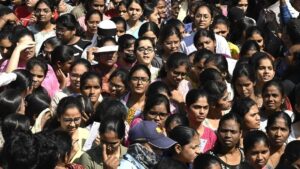
1. There have been many demonstrations worldwide in support of Palestine over the last two years, but this is the first major working class action of this nature. The call was given by working class organisations, and other sections of society joined the marches. The massive response from the workers surpassed all expectations. Dockworkers, transport workers, metalworkers, teachers, government employees and others struck work and came onto the streets en masse. Schools and universities too were shut. It was a general strike.
The international media underplay the level of participation in this strike by referring to tens of thousands attending the demonstrations nationwide, whereas videos show crowds of tens of thousands at individual locations, in a strike that took place in more than 75 cities throughout Italy. Public support in Italy for the liberation of Palestine appears to be overwhelming. Even the journalists of the state-owned television broadcaster voiced their support for the strike on the air. Significantly, this is happening in a country ruled by a neo-fascist party closely allied with Israel and the U.S., and in a Europe clouded over with extreme Reaction.
2. Videos of interviews with Italian workers reveal that they participated in a politically conscious manner. Indeed, the strike was not about any immediate economic demand of the Italian workers; rather, it concerned the attack by imperialism on the people of an oppressed nation. The Italian workers’ participation in this strike could nevertheless accelerate their own class struggles in their country. This dialectic points to the centrality of the question of imperialism and oppressed nations in world developments today.
3. Meanwhile, several countries such as the U.K., Canada, Australia and France have suddenly decided to recognise “Palestinian statehood” in the abstract. Some well-meaning people might be deceived into thinking that this recognition of Palestine represents a shift in the positions of countries conferring it. However, firstly, this recognition of “Palestinian statehood” is devoid of a single concrete step towards it, and it has precisely zero practical significance. Secondly, those conferring this recognition include several states which have been supplying weaponry for Israel to ensure there are no Palestinian people left for a Palestinian state. As such, this recognition signifies no change in the basic stand of the countries who are conferring it.
Then what is the purpose of this ostentatious exercise? It comes in the wake of the worldwide abhorrence of the genocide being carried out by Israel in Gaza, which is reflected in the events in Italy and elsewhere. Along with this, the Palestinian Authority headed by Mahmoud Abbas—a faithful retainer of the western imperialist alliance—has lost any surviving shreds of credibility in the course of the last two years in which it has closely partnered the Israeli military’s depredations in the West Bank. Who now persists with the notion of a ‘two-state solution’? Israel itself has ruled out the possibility of a Palestinian state.
Objectively, then, the situation poses two real possibilities: there can be either a single Zionist state, or a single secular State of Palestine. For the alternatives to be posed in this manner is politically perilous for Israel and its backers.
It is to head off such a posing of alternatives that one set of western powers have conferred recognition of Palestinian statehood. This will help prop up the extant Palestinian Authority, decorating it with some legitimacy. In an apparent division of labour, another bunch of western powers, including the U.S. and Italy, have refused to confer recognition. We can now expect a debate between the two sets of powers on the question of recognition, which will engage the international media and serve as a diversion from the real question.
The Italian demonstrators have disregarded this entire diversion and straightforwardly placed the western powers themselves in the dock.
4. For two unendurable years, the principal tangible support to the cause of the Palestinian people has come from the people of the region, in particular the people and governments of Yemen and Iran, and the people of Lebanon, most of all the forces around Hezbollah. These forces have supported the cause of the Palestinian people at great cost to themselves. The protests by students in U.S. universities have been another significant expression of solidarity, in the heart of the principal imperialist backer of Israel.
However, the Italian strike is a major new development; we must await the unfolding of its full significance.
[Courtesy: Research Unit for Political Economy (RUPE), a Mumbai based trust that analyses economic issues for the common people in simple language.]
❈ ❈ ❈
‘A March of Humanity’: Italy Rediscovers its Collective Voice for Palestine
Romana Rubeo
On September 22, Italy witnessed one of the largest mobilizations in its recent history. Hundreds of thousands of people took to the streets in nearly 80 cities to demand a ceasefire in Gaza and to denounce Italy’s political, military, and economic collaboration with Israel. The day coincided with a 24-hour general strike called by the base union USB together with Cub, Adl, and Sgb.
The strike extended across both the public and private sectors, with major disruptions in transport and port activity. Demonstrators demanded a ceasefire in Gaza, an end to Italy’s collaboration with Israel, and a halt to the rearmament that is reshaping Europe’s political agenda.
From Rome to Naples, Bologna to Palermo, highways were blocked, ports were occupied, and universities were stormed by students chanting ‘Palestina Libera’ (Free Palestine).
What set this day apart were not only the sheer numbers, but also the voices and gestures that marked it: drivers honking in solidarity with students blocking roads, a firefighter in Rome donning a kuffiyeh to remind the crowd that “our responsibility is to rescue—even the children of Gaza,” and entire neighborhoods joining the chants of demonstrators.
These moments were the culmination of a tradition that, though long muted, has deep roots in Italy’s political and civic life.
From Equidistance to Alignment
For decades, Italy was known for its strong tradition of solidarity with Palestine—student mobilizations, union campaigns, and mass rallies that made the Palestinian cause part of the country’s political conscience.
This culture of solidarity was not confined to activists alone. It was echoed in public discourse, universities, and sections of the labor movement, which regularly placed the question of Palestine at the center of their internationalist agenda.
During the years of the First Republic (1948—1992), Italian foreign policy was often described as one of “equidistance” in the Middle East. While officially maintaining balanced relations with both Israel and the Arab world, Italy frequently demonstrated sympathy for the Palestinians, whether by supporting UN resolutions on their rights or by opening political space for the Palestine Liberation Organization (PLO), which established a recognized presence in Rome.
Solidarity initiatives flourished in those decades, giving Italy a distinctive role within Western Europe.
That balance began to erode with the advent of the Second Republic in the early 1990s. The political class gradually abandoned its earlier posture and aligned more closely with Israel and the United States.
The Palestinian cause, once central in Italy’s political and civic imagination, was increasingly marginalized. Today, Italy has moved from the position of mediator to that of supplier: it is the third-largest exporter of weapons to Israel, making the country directly complicit in the machinery of war now devastating Gaza.
A Chorus of Solidarity
In Rome, more than 50,000 people filled the streets, their march spilling onto the capital’s main ring road. What could have been an ordinary clash between protesters and commuters became a moment of collective defiance.
Instead of frustration, drivers responded with support. Horns honked in rhythm, fists rose from car windows, and chants of “Palestina libera” echoed across the blocked lanes. Protesters and citizens, often separated by inconvenience or indifference, found themselves united in one demand: freedom for Gaza.
Similar scenes unfolded in Bologna and Pisa, where students and workers brought traffic to a standstill, and in Genoa, Livorno, and Marghera, where protesters blocked ports—symbols of Italy’s economic lifelines.
Another moment came later in Rome, when a firefighter climbed onto the stage, taising a kuffiyeh in his fist. His words struck at the heart of the protest:
“Our responsibility is to rescue—even the children of Gaza,” he said. “Firefighters are not heroes. We are ordinary workers, and we must protest against policies that strangle us, against rearmament.”
It was not the voice of a politician, but of a worker whose daily duty is to save lives—reminding the crowd that solidarity is built not only in slogans but in the shared struggles of labor and dignity.
From Naples to Milan: A Nationwide Mobilization
Across the country, tens of thousands filled the streets of Naples, Palermo, Padova, Trieste, and beyond. In Naples, demonstrators occupied the train tracks of the central station, later burning photographs of Italian Prime Minister Giorgia Meloni and her Israeli counterpart Benjamin Netanyahu before moving toward the port.
Former mayor Luigi de Magistris described it as “a march of Neapolitan humanity for Gaza.”
In Milan, several hundred broke into the central station, clashing with police in the day’s most violent episode.
The government seized on this to launch a political attack. Meloni condemned the clashes as “violence and destruction that have nothing to do with solidarity.” Yet those incidents did not obscure the broader picture: the overwhelming majority of protests were peaceful, mass gatherings of students, workers, and families.
A Collective Voice
For years, Italy’s political mainstream and largest trade unions avoided direct confrontation over Gaza. September 22 changed that. Despite the absence of official party endorsements, the mobilization brought together a scale of participation rarely seen in recent Italian history.
Highways and ports were blocked, universities occupied, and squares filled with tens of thousands. More than a show of solidarity, it marked the reemergence of a collective voice that had long been absent from Italy’s streets.
And while the government denounced the protests, the message was clear: ordinary Italians are increasingly unwilling to accept their country’s role as a supplier of weapons to Israel, or its complicity in the Israeli genocide in Gaza.
[Romana Rubeo is an Italian writer and the managing editor of The Palestine Chronicle. Her articles appeared in many online newspapers and academic journals. She holds a Master’s Degree in Foreign Languages and Literature and specializes in audio-visual and journalism translation. Courtesy: Palestine Chronicle, a website that strives to highlight issues of relevance to human rights, national struggles, freedom and democracy. It is edited by Dr Ramzy Baroud.]
❈ ❈ ❈
Petro Implodes U.S-Colombia Relations with His Final UN Speech
Richard Emblin
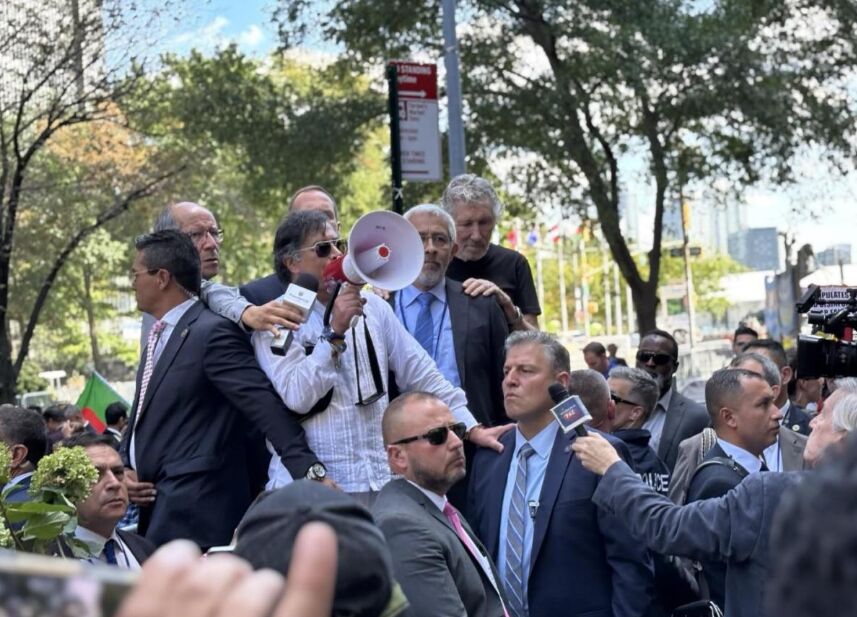
Colombian President Gustavo Petro used his final address to the United Nations General Assembly on September 23 to deliver a blistering denunciation of U.S. foreign policy and President Donald Trump, calling for criminal charges against the U.S. leader, and accusing Washington of complicity in genocide.
Speaking in New York at the 80th General Assembly, Petro – dressed in a white guayabera – launched into a fiery speech that quickly prompted the U.S. delegation to walk out of the chamber. His remarks went far beyond diplomatic criticism: they appeared aimed at imploding what remained of U.S.-Colombia relations, severing decades of strategic partnership on a global stage.
“This hall is a mute witness, and an accomplice, to genocide in today’s world. When we believed it was only the property of Hitler, Trump does not speak of democracy, he does not speak of the climate crisis, he does not speak of life – he only threatens, kills, and lets tens of thousands be killed,” Petro declared, accusing Trump of presiding over policies that cost countless lives.
The Colombian leader then called on the United Nations to initiate criminal proceedings against the current U.S. president. “There must be criminal charges opened against those officials of the United States, including the senior official who gave the order – President Trump, who allowed missiles to be fired against young people who simply wanted to escape poverty,” he said.
Petro alleged that Trump had personally authorized missile strikes against migrant boats in the Caribbean, killing vulnerable youths fleeing poverty. “Trump fires missiles at unarmed migrant boats and accuses them of being drug traffickers and terrorists, when they did not have a single weapon to defend themselves. The traffickers live in New York, just a few blocks away from here, and in Miami,” he told the assembly.
As he escalated his attack, Petro drew historical parallels between Trump’s America and Europe in the 1930s.
“And today, irrationalism is filling the United States, and it was the prelude to Hitler in 1933,” he warned. “As collapse approaches, while the old white societies of Europe and the United States continue applauding their new fashionable Hitlers, they do not listen to their young people, to their children, or to humanity.”
The accusations grew sharper when Petro addressed U.S. drug policy. He claimed that the true beneficiaries of the narcotics trade were not Latin American traffickers but elites in the United States.
“When most of the drug traffickers are blond and blue-eyed, keeping their vast fortunes in the world’s largest banks, and do not live in Bogotá, Caracas, the Caribbean, or Gaza, but in Miami – they are the neighbors of the President of the United States,” he said.
At that point, the U.S. delegation stood up and exited the chamber, leaving only a handful of allies to hear the remainder of Petro’s remarks.
Turning to Gaza, Petro urged the international community to act outside the U.N. Security Council, which he accused of paralysis due to U.S. veto power.
“The genocide must end with what follows diplomacy. It is with a vote of the United Nations General Assembly and not with a vote of the Security Council, where they veto. It is with a United for Peace for Palestine, forming an armed force to defend the life of the Palestinian people,” he said.
He insisted that blue-helmeted peacekeepers were insufficient and called instead for the formation of a powerful international army to intervene in Gaza.
“Not with blue helmets, untrained and sometimes unwilling to do what is necessary. It is with a powerful army from the countries that do not accept genocide. That is why I invite the nations of the world and their peoples, as part of humanity, to unite their armies and weapons. Palestine must be liberated,” Petro said, appealing to Asian, Slavic, and Latin American militaries to join forces.
In one of his most pointed accusations, Petro directly linked Trump to the ongoing war in Gaza:
“Trump not only lets missiles fall on young people in the Caribbean, not only imprisons and chains migrants, but he also allows missiles to be launched against children, women, and the elderly in Gaza. He makes himself an accomplice to genocide – because it is genocide, and we must shout it again and again.”
Petro further claimed that U.S. foreign policy in Latin America was being advised by Colombian political actors allied with drug cartels. “I do not know if Trump realizes that his foreign policy toward Colombia, Venezuela, and the Caribbean is advised by Colombians who are political allies of the cocaine mafia,” he charged.
As his speech drew to a close, Petro denounced the veto power wielded by Washington and its allies over U.N. resolutions. “Humanity cannot allow one more day of genocide, nor allow the genocidaires like Netanyahu and his allies in the United States and Europe to remain free,” he said, demanding that the Assembly act to stop what he repeatedly described as genocide in Gaza.
By the end of his 40-minute intervention, Petro had branded Trump a criminal, accused the United States of racism and imperialism, compared Western leaders to Hitler, and called for the creation of an international armed force to counter U.S. and Israeli power.
The fallout was immediate. Analysts warn that Petro’s words, delivered in front of world leaders, represent a deliberate rupture with Washington. Colombia, once described as the United States’ closest ally in Latin America, now appears to be positioning itself as a radical outlier. For Petro, the objective seemed clear: not to salvage a fragile relationship, but to bring it crashing down in real time.
[Courtesy: Richard Emblin is an award-winning photojournalist for Black Star and TIME; writer, editor, and visual storyteller; and founder of Colombia’s The City Paper. Courtesy: Resumen Latinoamericano, a newsletter whose focus is news and analysis coming primarily from Latin America by writers, researchers, and activists living there.]