❈ ❈ ❈
Perception vs Reality: What the Israel–Iran War Actually Reveals
Shivan Mahendrarajah
Myth-making as strategy
June 21, 2025: Since 13 June, “Operation Rising Lion” has dominated headlines, framed by a deluge of western media portraying Iran as days from building a nuclear bomb. In response, Israel unleashed waves of airstrikes on Iranian territory, targeting military, nuclear, and civilian infrastructure. Israeli Prime Minister Benjamin Netanyahu likened it to the 1981 bombing of Iraq’s Osirak reactor – a strike of necessity to prevent annihilation.
But beneath the familiar tropes of “pre-emptive defense” lies an unmistakable imperial calculus. Over 200 Israeli aircraft participated in the opening barrage, with deep-penetration strikes and cyber warfare. Iranian air defense and radar installations were among the first to be hit. Mossad and allied forces used proxy agents to ignite internal sabotage, including drone and car bomb attacks in major cities.
This was not a “surgical strike” to stop a bomb. It was a declaration of war – a bid to decapitate the Islamic Republic.
Iran: Weak ‘regime’ or resilient state?
Western assessments insist Iran is tottering: its economy hollowed out by sanctions, its population seething, its leadership fractured. But these are fantasies. What has emerged since Israel’s 13 June assault is not a ‘regime’ in collapse, but a state adapting under fire – around which the majority of Iranians, irrespective of political affiliations, have united.
Contrary to the western narrative, the strikes that eliminated senior Islamic Revolutionary Guard Corps (IRGC) commanders and nuclear scientists barely dented Iran’s strategic posture. Within hours, Iran’s Supreme Leader Ayatollah Ali Khamenei reaffirmed Artesh (conventional military) control over national defense, elevating new commanders and activating pre-planned strike protocols. This signaled a transfer of initiative from cautious IRGC veterans – many shaped by the traumas of the 1980–1988 war with Iraq – to a more hawkish generation, willing to directly strike Israel.
Iran’s retaliatory attacks on 13, 14, and 15 June – the third instalment of Operation True Promise – struck Tel Aviv, Haifa, and three Israeli military bases. Online observers admired how quickly the Iranian military pivoted to war footing despite the assassination of high-ranking officers. One noted:
“I don’t think the American or Israeli military could have taken the losses of so many senior commanders and still struck back.”
Did Israel achieve air superiority?
Initial reports claimed Israeli dominance of Iranian airspace, based largely on footage of Israeli jets evading response and striking decoy targets. Yet after a 12-hour “silence,” Iranian air defense (AD) systems re-engaged with full force. The delay has been interpreted as either the effect of cyber warfare or a deliberate “rope-a-dope” strategy: feign weakness, draw in the enemy, make him over-confident, counterstrike.
Iran lost facilities it expected to lose, such as the outdated IR-1 centrifuges at Natanz. Underground sites with IR-6 [SM1] centrifuges at Fordow were unaffected. Mobile and fixed AD units resumed operations by nightfall, and there are unconfirmed reports of Israeli aircraft downed in later attempts to breach Iranian skies.
Israeli media touted “air superiority,” but most confirmed strikes targeted decoys. As military analyst Mike Mihajlovic explained, “more than three-quarters of the videos circulating are actually hits on the decoys.”
The illusion of dominance, broadcast by Tel Aviv, is cracking.
War by terror
Unable to sustain large-scale aerial assaults, Israel shifted tactics. Standoff missile strikes from Iraqi airspace waned. Instead, Mossad and its internal assets launched FPV drone attacks, car bombings, and anti-tank guided missile strikes. Five car bombs exploded in Tehran on 15 June alone. Civilian sites – hospitals, dormitories, and residential buildings – were hit.
These are not military operations. They are acts of terror. Still, the west echoes Tel Aviv’s narrative. The BBC and others describe these incidents as “strikes,” implying aerial precision, rather than the car bombings they are. This deliberate linguistic obfuscation dehumanizes Iranians while sanitizing Israeli aggression. Yet, this has galvanized Iranians and united them.
National unity reforged
Much like the late Iraqi President Saddam Hussein’s 1980 invasion, Tel Aviv misread Iran’s internal contradictions as signs of collapse. Yet from 13 June onward, Iranians from across the political spectrum – including long-time dissidents – have rallied behind the state.
Political analyst Sadegh Zibakalam questioned:
“Which opposition figure has spoken and written as much as I have against this regime? But how can I join the enemy in this situation? Was it right for the MEK to join Saddam?”
Former political prisoner Ali Gholizadeh added, “Despite all my criticisms of the government, I stand fully behind the commander-in-chief of the Iranian Defense Forces and [Armed] Forces in defending the homeland.”
Even reformist voices, once critical of Iran’s nuclear policy, now demand a bomb. Journalist and editor Ali Nazary says, “Iran must acquire a nuclear bomb as soon as possible. Conducting a nuclear test is the biggest deterrent.”
On Iranian social media, images of civilians killed in Israeli attacks have gone viral. As of 15 June, 224 Iranians – 90 percent civilians – were reported killed, with over 1,200 injured.
Crumbling illusions
The occupation state claims it destroyed 120 missile launchers and 200 AD units. But Iranian units continue to fire in visible clusters – indicating low attrition and high confidence. Independent analysts mock Israeli claims as propaganda. Patarames, a known military observer, posted:
“IRGC missile crews still feel so confident and safe that their launchers are firing in clusters. So much for Israeli air superiority.”
In truth, Israeli AD systems are being degraded. Iranian missiles increasingly strike with little interception. The myth of omnipotent Israeli defense is unraveling.
Meanwhile, Tehran may be preparing its exit from the Nuclear Non-Proliferation Treaty (NPT) – according to a statement made by Iranian Foreign Ministry spokesman Esmail Baghaei – and expelling International Atomic Energy Agency (IAEA) monitors. Parliament is fast-tracking bills. Crowds chant for a nuclear test. The west’s double standards on Israel’s arsenal and Tehran’s right to self-defense are fueling a shift in national strategy.
Global reactions: Hypocrisy laid bare
Washington’s rhetoric mirrors past duplicity. US President Donald Trump – who unilaterally withdrew from the Joint Comprehensive Plan of Action (JCPOA) during his first term – posted on X triumphantly:
“I gave Iran 60 days to make a deal. Israel attacked on day 61.”
G7 governments mumble about de-escalation, but offer no condemnation of Israeli aggression. The so-called “rules-based order” is silent as civilians die.
Iranians are not surprised. In 2001, they condemned the 11 September attacks and supported the US so-called War on Terror. Today, they watch the same west excuse terrorism against them. Trust is gone. Nationalism is surging.
Israel’s strategic gamble is backfiring. Hamas remains entrenched in Gaza and is targeting occupation soldiers in greater numbers. Hezbollah watches closely. Yemen’s Ansarallah-aligned armed forces are coordinating with Tehran. If Iraq’s resistance factions activate, US forces could be drawn in.
Meanwhile, Tel Aviv’s own population is rattled. Social media posts from Israelis hiding in bunkers – “they’re turning us into Gaza” – reflect growing fear. The psychological war, waged by Iran, is winning.
Across the Global South, sympathy lies with Tehran. As Australian journalist Caitlin Johnstone put it: “Imagine being so evil and reviled that people love watching you get hit.”
A war of narratives and attrition
“Operation Rising Lion” was meant to decapitate Iran, destroy its nuclear program, and shatter its morale. Instead, it has united a fragmented polity, discredited western media, and exposed the hollowness of Israeli deterrence.
Iran’s leadership has hardened. Its people are defiant. Its enemies are scrambling to control the story.
This is not just a war of missiles. It is a war of narratives, sovereignty, and historical memory. The Axis of Resistance understands this. Tel Aviv, it seems, does not.
The Persian lion is not in a good mood.
[Dr. Shivan Mahendrarajah is a Fellow of the Royal Historical Society. He was educated at Columbia University, and earned his doctorate in Middle Eastern and Islamic History at the University of Cambridge. Shivan is the author of peer-reviewed history articles on Islam, Iran, and Afghanistan; on counter-insurgency; al-Qaʿida and the Taliban movements of Afghanistan and Pakistan. Courtesy: The Cradle magazine, an online news magazine covering the geopolitics of West Asia from within the region.]
❈ ❈ ❈
Tel Aviv Miscalculates: Why Israel’s Shock Strategy Failed Against Iran
Ali Salehian
June 16, 2025: The Israeli occupation state’s early morning blitz on 13 June – the most brazen assault on Iranian soil in decades – was designed to replicate its past successes in Lebanon. It didn’t work.
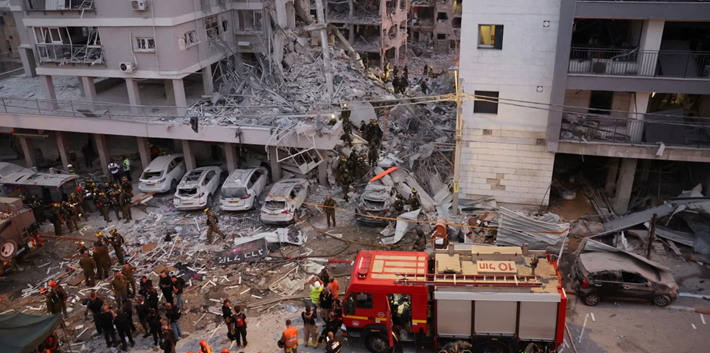
That Friday morning, Israeli fighter jets launched multiple attacks across Iran: 60 civilians were killed in a residential tower, several top nuclear scientists and senior military commanders were assassinated, and key air defense and nuclear infrastructure sites were hit.
The strikes marked a high-risk escalation, modeled in part on Israel’s September 2024 campaign in Lebanon, where a coordinated assassination spree eliminated Hezbollah’s elite Radwan unit leadership and, ultimately, secretary-general Hassan Nasrallah himself and his presumed successor, Hashem Safieddine.
A failed template
This “shock and awe” blueprint found some success in Lebanon, where Israeli intelligence had achieved deep penetration. In Tehran, however, it met a far more resilient nation.
While US President Donald Trump loudly demanded Iran abandon its nuclear enrichment rights, he pursued a carrot-and-stick approach of ‘maximum pressure’ sanctions, military threats, and negotiations to try and persuade Tehran to accept his unilateral demands during indirect talks.
This pattern had previously been repeated in the Ukraine–Russia conflict after negotiation deadlocks, involving operations deep inside Russia and attacks on Israeli strategic bombers.
For months, Tehran had calculated Israel’s Hezbollah strike model as one likely scenario for an attack on Iran. Accordingly, measures were taken to quickly replace commanders in such an event. At least tactically, however, Israel still managed to shock Iran with its attacks, mostly resulting from domestic infiltration and sabotage operations.
Tehran counters swiftly
But Iran’s response was swift. Within 72 hours, Tehran had launched three significant retaliatory operations. The country’s air defenses were restored, drone units re-engaged, and key command posts replenished. Footage and images of Israeli targets struck by Iranian munitions soon proliferated online, signaling both Tehran’s operational recovery and strategic messaging.
Iran’s offensive and defensive response was such, that Trump, initially jubilant about Israel’s actions and seeking to offer Iran a “second chance” for negotiation – even possibly entertaining the idea of joining a war with a certain victory against the Islamic Republic – returned to a declared neutral stance, seeking to rapidly end tensions.
But Tehran’s message has been clear and consistent: It views any Israeli aggression as inseparable from US support. The Islamic Republic has long warned that Washington’s logistical, intelligence, and operational backing enables all of Tel Aviv’s military campaigns. And while right-wing Israeli Prime Minister Benjamin Netanyahu continues to try to entangle the US in his Iranian regime-change agenda, Trump and others appear increasingly cautious.
Security for all or none
Iran has clearly stated its strategy in case of a US attack: security for all or none, meaning maritime security, energy security, and the security of US bases in West Asia.
Mohsen Rezaei, former overall Commander of Iran’s Islamic Revolutionary Guard Corps (IRGC), said in a recent interview that:
“America and Europe must withdraw their statesmen from behind Israel as soon as possible. If this does not happen, we cannot witness the United States and other countries continuing to supply ammunition to Israel. Their planes will enter the sky and will collide with our missiles; whether they are British, French, or American planes. Therefore, the dimensions of the war may become more serious and we have prepared ourselves for it.”
He added, “Of course, our effort has always been not to be the initiator, but we will be the finisher. If support for Israel continues, my prediction is that the supporters may also be drawn into the conflict.”
Iran possesses diverse defensive and offensive tools and conventional and unconventional options, which it will certainly reconsider seriously after the recent exchange of heavy fire.
As Mohammad-Javad Larijani, a top foreign policy advisor to Iran’s Supreme Leader Ali Khamenei, and secretary of the nation’s High Council for Human Rights, has said:
“There is an old rule in the Persian Gulf, if our (Iran’s) oil facilities are seriously damaged, we will not allow any country in the region to use its oil.”
There are many options Iran can employ to execute on that threat. Brigadier General Esmail Kowsari, a member of the Parliament’s National Security Commission, argued that “closing the Strait of Hormuz” could easily be one tactic on Iran’s agenda.
Misreading the Iranian battlefield
Tel Aviv has mistakenly assumed its Lebanon strategy was scalable. Several miscalculations undermined its copy-paste plan to decapitate Iran’s leadership.
First, Iran’s military command is vast, experienced, and rapidly replaceable. Unlike Hezbollah, a non-state actor with more limited resources, Iran maintains depth and redundancy across its armed forces. Brigadier General Abolfazl Shekarchi pointed to this capacity, dismissing Israeli assumptions that a few assassinations could cripple national defense.
Second, geography matters. Iran’s sheer size allows the strategic dispersal of critical assets. Israeli jets may have briefly penetrated key western nodes, but much of Iran’s infrastructure remains embedded in its eastern and central territories. The state’s military doctrine is built around such depth.
Third, while Israel’s intelligence apparatus did succeed in penetrating Iranian command circles, it did not achieve full-spectrum dominance. The Islamic Republic retains the capacity for counter-intelligence operations, and in the days since the attack, internal security has reportedly dismantled multiple espionage cells, which caused most of the recent explosions.
The Iranian version of solidarity as a strategic weapon
But perhaps Tel Aviv’s gravest misjudgment lay in its reading of Iran’s internal cohesion. Israeli PM Netanyahu appeared to believe that a sudden external strike would activate opposition forces within Iran – unleashing separatists, militants, and government critics to destabilize the state. This calculation has an equally ill-informed precedent: Former Iraqi president Saddam Hussein made a similar error in the 1980s.
But Iran’s political unity in the face of external threats has been repeatedly demonstrated. Even segments of society critical of the Islamic Republic have closed ranks when faced with foreign aggression. It is a nationalism forged not from state propaganda, but from the collective memory of wars, invasions, and isolation.
Tel Aviv has, in three short days, killed 224 Iranian nationals, the majority civilians, and reduced several residential buildings to rubble. That level of provocation has consequences. In this conflict, Iran’s deterrence is not only military – it is social.
A war not yet decided
As of now, the situation remains fluid. Tel Aviv’s campaign has triggered a rapid Iranian response, both in rhetoric and in kind. But more than that, it has exposed the limits of Israel’s military doctrine when applied to a state actor with deep – and even unknown – defenses and a mobilized population.
Tel Aviv’s western allies, once content to issue muted statements during months of Israeli attacks on Gaza, and its more recent strikes on Iran, have since shifted to active diplomacy. Washington is now scrambling to prevent a regional conflagration. What was once passive support is now active mediation, as Tel Aviv pushes to pull Washington deeper into its confrontation with Iran. Netanyahu, meanwhile, still eyes a broader war to settle Iran’s nuclear file by force and aims for a complete regime change. Israel’s aim is clearly to draw the US into a military campaign that could damage Iran’s nuclear infrastructure and weaken its military strength.
But Tehran has drawn its line. As Iranian Defense Minister Aziz Nasirzadeh warned in the immediate aftermath of the Israeli strikes:
“We are fully prepared and will support our operational forces in any way we can. We are ready for years of continued combat, and the armed forces are fully equipped.”
As with any conflict, outcomes remain uncertain. Yet, whether this spirals into a wider war or stalls into another frozen regional standoff depends less on Israel and more on whether the US is willing to follow Tel Aviv into the fire.
(Ali Salehian a senior researcher at the Governance and Policy Think Tank affiliated with Sharif University of Technology. He is also a PhD candidate at Tarbiat Modarres University. Courtesy: The Cradle magazine, an online news magazine covering the geopolitics of West Asia from within the region.)
❈ ❈ ❈
The Dangers Only Multiply: Could Israel’s War on Gaza Go Nuclear?
Joshua Frank
Israel’s robust military, the fourth-strongest in the world, is ravaging Gaza and, along with armed settlers, terrorizing Palestinians in the West Bank following the brutal Hamas massacres of October 7th. Like so many other colonial projects, Israel was born of terror and has necessitated the use of violence to occupy Arab territory and segregate Palestinians ever since. The realization that its existence was dependent on a superior military in an unfriendly region also encouraged Israel to pursue a nuclear weapons program shortly after the state’s founding in 1948.
Even though Israel was a young nation, by the mid-1950s, with the aid of France, it had secretly begun the construction of a large nuclear reactor. That two allies had teamed up to launch a nuclear weapons program without the knowledge of the administration of President Dwight D. Eisenhower turned out to be a colossal (and embarrassing) American intelligence failure.
Not until June 1960, the final year of Eisenhower’s presidency, did U.S. officials catch wind of what was already known as the Dimona project. Daniel Kimhi, an Israeli oil magnate, having undoubtedly had one too many cocktails at a late-night party at the U.S. embassy in Tel Aviv, confessed to American diplomats that Israel was indeed constructing a large “power reactor” in the Negev desert — a startling revelation.
“This project has been described to [Kimhi] as a gas-cooled power reactor capable of producing approximately 60 megawatts of electric power,” read an embassy dispatch addressed to the State Department in August 1960. “[Kimhi] said he thought work had been underway for about two years and that a completion date was still about two years off.”
The Dimona reactor wasn’t, however, being built to deal with the country’s growing energy needs. As the U.S. would later discover, it was designed (with input from the French) to produce plutonium for a budding Israeli nuclear weapons program. In December 1960, as American officials grew more worried about the very idea of Israel’s nuclear aspirations, French Foreign Minister Maurice Couve de Murville admitted to U.S. Secretary of State Christian Herter that France had, in fact, helped Israel get the project off the ground and would also provide the raw materials like uranium the reactor needed. As a result, it would get a share of any plutonium Dimona produced.
Israeli and French officials assured Eisenhower that Dimona was being built solely for peaceful purposes. Trying to further deflect attention, Israeli officials put forward several cover stories to back up that claim, asserting Dimona would become anything from a textile plant to a meteorological installation — anything but a nuclear reactor capable of producing weapons-grade plutonium.
Atomic Denials
In December 1960, after being tipped off by a British nuclear scientist concerned that Israel was constructing a dirty (that is, extremely radioactive) nuke, reporter Chapman Pincher wrote in London’s Daily Express: “British and American intelligence authorities believe that the Israelis are well on the way to building their first experimental nuclear bomb.”
Israeli officials issued a terse dispatch from their London embassy: “Israel is not building an atom bomb and has no intention of doing so.”
With Arab countries increasingly worried that Washington was aiding Israel’s nuclear endeavors, chairman of the Atomic Energy Commission John McCone leaked a classified CIA document to John Finney of the New York Times, claiming that the U.S. had evidence Israel, with the help of France, was building a nuclear reactor — proof that Washington was none too pleased with that country’s nuclear aspirations.
President Eisenhower was stunned. Not only had his administration been left in the dark, but his officials feared a future nuclear-armed Israel would only further destabilize an already topsy-turvy region. “Reports from Arab countries confirm [the] gravity with which many view this possibility [of nuclear weapons in Israel],” read a State Department telegram sent to its Paris embassy in January 1961.
As that nuclear project began to make waves in the press, Israeli Prime Minister David Ben-Gurion moved quickly to downplay the disclosure. He gave a speech to the Knesset, the Israeli parliament, admitting the country was developing a nuclear program. “The reports in the media are false,” he added. “The research reactor we are now building in the Negev is being constructed under the direction of Israeli experts and is designed for peaceful purposes. When it’s complete, it will be open to scientists from other countries.”
He was, of course, lying and the Americans knew it. There was nothing peaceful about it. Worse yet, there was a growing consensus among America’s allies that Eisenhower had been in on the ruse and that his administration had provided the know-how to get the program off the ground. It hadn’t, but American officials were now eager to prevent United Nations inspections of Dimona, fearful of what they might uncover.
By May 1961, with John F. Kennedy in the White House, things were changing. JFK even dispatched two Atomic Energy Commission scientists to inspect the Dimona site. Though he came to believe much of the Israeli hype, the experts pointed out that the plant’s reactor could potentially produce plutonium “suitable for weapons.” The Central Intelligence Agency, less assured by Israel’s claims, wrote in a now-declassified National Intelligence Estimate that the reactor’s construction indicated “Israel may have decided to undertake a nuclear weapons program. At a minimum, we believe it has decided to develop its nuclear facilities in such a way as to put it into a position to develop nuclear weapons promptly should it decide to do so.”
And, of course, that’s precisely what happened. In January 1967, NBC News confirmed that Israel was on the verge of a nuclear capability. By then, American officials knew it was close to developing a nuke and that Dimona was producing bomb-worthy plutonium. Decades later, in a 2013 report citing U.S. Defense Intelligence Agency figures, the Bulletin of the Atomic Scientists revealed that Israel possessed a minimum of 80 atomic weapons and was the only nuclear power in the Middle East. Pakistan wouldn’t acquire nukes until 1976 and is, in any case, normally considered part of South Asia.
To this day, Israel has never openly admitted possessing such weaponry and yet has consistently refused to allow inspectors from the International Atomic Energy Agency to visit the secretive site. Nonetheless, evidence suggests that a “major project” at Dimona was underway in 2021 and that Israel was by then actively expanding its nuclear production facilities. The lack of U.N. or other inspections at Dimona has, however, meant that there has been no public Israeli acknowledgment of its nuclear warheads and no threat of accountability.
A Rogue Nuclear Power?
Following the Six-Day War in June 1967, Israel seized large tracts of Arab land, including the West Bank from Jordan, the Gaza Strip and Sinai Peninsula from Egypt, and the Golan Heights from Syria. Not coincidently, that year was also the moment Israel crossed the nuclear threshold. (In 2017, it was revealed that, on the verge of the Six-Day War, the Israelis had even contemplated exploding a nuclear bomb in Egypt’s Sinai Desert as the ultimate threat to its neighbors.)
At that time, as human rights attorney Noura Erakat explained to Daniel Denvir on The Dig, President Lyndon Johnson’s administration came to see in Israel “a significant Cold War asset and [pivoted] very quickly and [established] this new policy of ensuring Israel’s qualitative military edge in the region whereby it can defeat singularly or collectively any Middle Eastern powers.” And that, she added, was done in those Cold War years “to ensure its sphere of influence across the Middle East in competition with the Soviet Union.”
As Israel and the U.S. remained the closest of allies, the thinking in Washington went, it could act as Washington’s military proxy in the Middle East. “From 1966 through 1970, average aid per year increased to about $102 million, and military loans increased to about 47% of the total,” the Congressional Research Service reported in 2014. “Israel became the largest recipient of U.S. foreign assistance in 1974… From 1971 to the present, U.S. aid to Israel has averaged over $2.6 billion per year, two-thirds of which has been military assistance.”
Despite Washington’s wish for a symbiotic, mutually beneficial relationship, Israel wasn’t afraid to go rogue when its leaders believed it would serve their interests. In June 1981, Israel bombed the Osirak nuclear reactor, then under construction in Iraq with the assistance of France and Italy..
Top officials in the administration of President Ronald Reagan weren’t pleased that the strike had been carried out with American F-16s, as Israel was legally required to utilize the fighter jets only in cases of “legitimate self-defense.” After some backroom wrangling, however, they decided to chalk the matter up as a diplomatic dispute, having come to believe that erasing Iraq’s nuclear program and maintaining Israel’s sole nuclear arsenal in the region justified the airstrike.
By the late 1980s, as the Soviets invaded Afghanistan, Israel joined the U.S., Pakistan, and Saudi Arabia in forming Operation Cyclone to supply arms to the anti-Soviet mujahideen resistance fighters. As the Cold War ended and the first Gulf War in Iraq began in 1990, Israel quietly assisted President George H.W. Bush’s administration from the sidelines, believing that directly entering the conflict would only embolden Arab countries to back Iraqi leader Saddam Hussein’s invasion of Kuwait. Despite the once-tenuous nature of the U.S.-Israeli bond, it’s long been understood that Israel can, at times, play an impactful role in the service of American operations in the region by providing intelligence and other covert support.
A Developing Dangerous Situation
Following the 9/11 attacks, Israel counseled the George W. Bush administration on how best to handle Osama bin Laden (and apparently later provided intelligence for the ambush that would kill him). As the planes struck the World Trade Center, Israel was experiencing a new Palestinian uprising known as the Second Intifada. Its leaders came to believe that they could benefit from the “Global War on Terror” President Bush had just announced. When Benjamin Netanyahu, then a former prime minister, was asked what it meant for the U.S.-Israel relationship, he replied, “It’s very good.” Then, lest he sound too optimistic about 9/11, he added, ”Well, not very good, but it will generate immediate sympathy… [it will] strengthen the bond between our two peoples because we’ve experienced terror over so many decades, but the United States has now experienced a massive hemorrhaging of terror.”
A year later, Israel became a booster of an American war on Iraq, helping spread the falsehood that Saddam Hussein possessed weapons of mass destruction and posed a threat not only to Israel and America but to the rest of the world as well.
“[Saddam] is a tyrant who is feverishly trying to acquire nuclear weapons,” Netanyahu declared to the U.S. House Committee on Government Reform in September 2002, six months before the invasion of Iraq. “And today, the United States must destroy [Saddam’s] regime because a nuclear-armed Saddam will place the security of our entire world at risk. And make no mistake about it: if and once Saddam has nuclear weapons, the terror network will have nuclear weapons. And once the terror network has nuclear weapons, it is only a matter of time before those weapons will be used.”
Israel would later use a similar line of reasoning to justify its 2007 strike on a suspected nuclear reactor under construction in Syria. Over the years, Israel has purportedly targeted Iran’s nuclear objectives in various ways as well, from cyberattacks to bombings. In 2010, Iran accused Israel of murdering physicist Masoud Ali Mohammadi and engineer Majid Shariariby in two separate incidents, as well as other scientists believed to be integral to Iran’s nuclear program. In 2021, Iran also claimed that Israel had struck a facility in the city of Karaj that its officials believed was being used to build nuclear centrifuges.
Many are concerned that Israel’s cruel war on Gaza, if it were to expand regionally to include Hezbollah in Lebanon, would drag Iran, a prominent Hezbollah supporter, into the fray. And that, in turn, might be all the justification Netanyahu would need to strike Iran’s supposed nuclear sites. In fact, in response to drone and rocket attacks on American personnel in Iraq and Syria by Iranian-backed militants, the U.S. recently destroyed a weapons facility in Syria.
As for the situation in Gaza, right-wing Heritage Minister Amihai Eliyahu, a member of Netanyahu’s coalition government, recently commented that “one way” to eliminate Hamas would be the nuclear option. “[T]here’s no such thing as innocents in Gaza,” he added. In response to those comments, Netanyahu suspended Eliyahu — a largely meaningless act — in an attempt to quiet criticisms at home and abroad that the war was harshly impacting innocent civilians. Or, perhaps, it had more to do with Eliyahu inadvertently admitting to Israel’s nuclear capabilities.
No doubt fearing a broader war in the Middle East, the Biden administration is committing itself heavily to Israel’s efforts to eliminate Hamas: not only by delivering interceptors for its Iron Dome missile defense system and upwards of 1,800 Boeing-made JDAMs (guidance kits for missiles) but also by replenishing stocks of weapons for Israel’s American-made F-35 fighter jets and CH-53 helicopters as well as KC046 aerial refueling tankers. In addition, two U.S. aircraft carrier task forces have been deployed to the Middle East, as has an Ohio-class nuclear submarine. To top it off, according to a New York Times investigation, the U.S. is providing commandos and drones to help locate Israeli (and American) hostages in Gaza.
While the Biden White House seems anything but eager for an expanded Middle Eastern war, it is nonetheless preparing for just such a scenario. Of course, any military escalation, especially one that leaves Israel fighting on multiple fronts, would only increase the chances that things could get much worse. A cornered, nuclear-armed Benjamin Netanyahu would be the definition of a perilous situation in a war where nothing, not journalists, schools, or even hospitals, has proven off-limits. Indeed, well over 25,000 tons of bombs had already been dropped on Gaza by early November, the equivalent of two Hiroshima-style nukes (without the radiation). Under such circumstances, a nuclear-capable Israel that blatantly flouts international law could prove a clear and present danger, not only to defenseless Palestinians but to a world already in ever more danger and disarray.
[Joshua Frank is an award-winning California-based journalist and co-editor of CounterPunch. He is the author of the new book Atomic Days: The Untold Story of the Most Toxic Place in America (Haymarket Books). Courtesy: TomDispatch, a web-based publication, founded and edited by Tom Engelhardt, aimed at providing “a regular antidote to the mainstream media”.]