❈ ❈ ❈
Inside America’s Academic Gulags: Interview with Rashid Khalidi
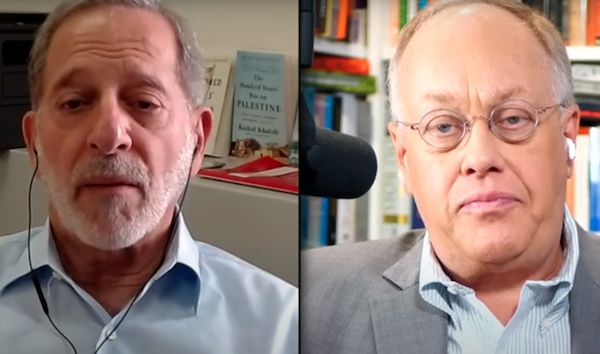
Chris Hedges
[Historian Rashid Khalidi, author of The Hundred Years’ War on Palestine, joins host Chris Hedges to detail the dwindling academic freedom in American universities and society at large as Donald Trump’s grip on free speech tightens.
Khalidi notes that while the conflation of anti-Zionism with antisemitism is an old tactic to stifle academic scrutiny of Israel, its current deployment is unprecedented. Today, professors are intimidated out of teaching about Israel and Palestine, entire Middle Eastern studies departments are threatened with receivership and federal funding is withheld from universities.
“I know many people who are not going to teach courses this semester of my colleagues out of fear that if I teach about settler colonialism, if I teach about genocide, if I teach this or that about the Middle East, I’m going to be hauled up before these kangaroo courts,” Khalidi tells Hedges.
“That means your life is going to be ruined. You’re going to have to get lawyers, have to deal with a process that is completely opaque and which is designed… to punish and discipline anybody who opens their mouth on Palestine.”]
● ● ●
Transcript:
Chris Hedges: One hundred and sixty students, professors and staff at the University of California, Berkeley, received a letter earlier this month from the university’s chief counsel, David Robinson. The letter informed them that files containing their names had been forwarded to the Department of Education’s Office for Civil Rights in response to its investigation of antisemitism on college and university campuses.
The decision, which violated protections offered by the 6th and 14th Amendments of the Constitution–the right to a lawyer, the right to an impartial jury, and the right to know who your accusers are and the nature of the charges and evidence against a person charged with wrongdoing–are part of a nationwide campaign to criminalize free speech by weaponizing antisemitism and, following the assassination of Charlie Kirk, any criticism of the far right and the Trump administration, including Trump himself.
The historian Rashid Khalidi, in a letter to the president of Columbia University, said that the restrictions on free speech at the university made it impossible for him to teach his fall course on modern Middle East history.
Columbia, along with many universities and state governments, has adopted the International Holocaust Remembrance Alliance (IHRA) definition of antisemitism. The IHRA definition, in the words of Khalidi, “deliberately, mendaciously and disingenuously conflates Jewishness with Israel, so that any criticism of Israel, or indeed description of Israeli policies, becomes a criticism of Jews.”
“It is impossible,” he goes on, “with any honesty to teach about topics such as the history of the creation of Israel, and the ongoing Palestinian Nakba, culminating in the genocide being perpetrated by Israel in Gaza with the connivance and support of the U.S. and much of western Europe.”
Columbia has stripped itself of academic integrity in a desperate effort to placate the Trump administration. It shut down the university’s encampments, permitted police on its campus to arrest over 100 students, acquiesced to appointing a Trump-approved monitor to review Columbia’s admissions records to enforce a supreme court ban on affirmative action, ensuring that the university does not admit too many non-white students.
The university also agreed to place its Middle Eastern, South Asian, and African Studies Department under “academic receivership,” stripping these departments of academic independence.
The criminalization of free speech, fatal to honest intellectual inquiry, is a plague that is destroying our universities and our wider society. Joining me to discuss this assault by the Trump administration and the acquiescence by leading institutions, including academic and the media, is Rashid Khalidi, the Edward Said Professor Emeritus of Modern Arab Studies at Columbia University and the author of numerous books including The Hundred Years’ War on Palestine, Palestinian Identity: The Construction of Modern National Consciousness and The Iron Cage: The Story of the Palestinian Struggle for Statehood.
Let’s talk about what they’ve done because I probably have not spent anywhere near the time in the confines of academia that you have but I did spend eight years–four as an undergrad and four in graduate school–and I’m just devastated. It’s easy to destroy, it’s very hard to rebuild.
Let’s talk about what these universities have done to themselves in terms of their own academic integrity and their fostering of intellectual life.
Rashid Khalidi: Well, I would argue that they’ve self-mutilated. In some cases, even before the Trump administration asked them to do that. Harvard, for example, fired the two people who ran their Middle East center, terminated a program with Birzeit University in the West Bank, and shut down a program at the Divinity School in the process of negotiating with the Trump administration over their demands on the university.
So we have had in many places what I would call anticipatory obedience, expecting something to come down and taking advantage of it, in some cases, to do things that powerful forces within the universities wanted to do anyway.
In the case of Harvard, you have people like Larry Summers, former secretary of the treasury, Bill Ackman, a big donor and alumnus, putting pressure on Columbia for months and months and months to crack down on student activism.
CH: Is this Columbia or Harvard?
RK: This is Harvard. We had the same kind of process going on here at Columbia. The president, the then president, we’ve cycled through three, four actually, in the last two and a half years. The then president appointed an antisemitism task force with three co-chairs expressly chosen for their absolute ignorance of the scholarship on antisemitism.
One was a tax lawyer, one was an urban studies specialist, one was a professor of journalism. Columbia has a very large number of experts on the Holocaust, genocide, antisemitism on its faculty, and those were expressly excluded from running this so-called task force, which produced a recommendation that Colombia adopt the International Holocaust Remembrance Alliance’s definition that you mentioned in the intro, which essentially was created to prevent criticism of Israel.
It wasn’t really intended to deal with the overwhelming majority of antisemitism today, which comes from the political right and has always come from the political right. The Nazis were not leftists. The Ku Klux Klan are not leftists. The people who marched through Charlottesville, Virginia, the University of Virginia campus town nearby, chanting “Jews will not replace us,” were not leftists.
So real antisemitism, most of it, is on the right. And such as there is on the left is largely distinct, or entirely in many cases distinct, from criticism of the policies of Israel, which is carrying out a genocidal series of massacres, ethnic cleansing and war crimes in the Gaza Strip, and against which majorities of Americans are now arrayed.
But in the eyes of the Trump administration, in the eyes of the people who produced this antisemitism task force report, part one, these protests are or were, “antisemitic.” So Colombia, again, even before the Trump administration insisted that it adopt this, had appointed a task force which recommended the same thing.
So we have been going down this path even before in March the Trump administration issued a set of demands which Colombia almost immediately accepted.
CH: I mean, many people say it had to do with the withdrawal of federal grants, Colombia was threatened with losing $400 million, if I have that figure right. Harvard, I think it’s $1.5 billion or something, and that this was the impetus to conform to the Trump demands. Or do you think it’s something else?
RK: Well, that certainly was an impetus, but as one of the co-chairs of this antisemitism task force said, they’re making us do what we wanted to do anyway.
The dominant faction of the Board of Trustees, a large number of the senior faculty from the professional schools have been pushing in this direction. A bunch of those faculty members from the medical school, the law school, and the business school, mainly, wrote an open letter to the president before the Trump administration started its extortion demanding the acceptance of IHRA, demanding the campus remain closed, demanding a whole series of things, purification of some departments.
That’s what I call the fifth column. So this is not just an assault from without. This was an assault from without, coordinated with folks on the inside, including I would say the dominant faction or a major faction of the Board of Trustees and a bunch of senior faculty in the professional schools, for whom, of course, the funding thing was an added impetus to what many of them wanted to do already.
CH: So at the same time you’ve had revoking of student visas for people outside the United States. That’s not something that’s, I think, disconnected from what’s happening. It seems to be all part of one package. Is that correct?
RK: Absolutely. I mean, the package is of course larger than universities and antisemitism. The package is an authoritarian package whereby the federal government does things that the federal government has not done ever before, interfering with the media in the way it’s doing, interfering with private universities in the way it’s doing.
And these are not just in pursuit of the chimera, the fantasy of antisemitism as the motivator of these demonstrations. This is a much broader agenda that this administration has held for a very long time. So cracking down on immigrants is something they’re doing anyway. And this is yet another attempt to argue, well look at these people, they’re saying things that are against our values.
Look at these people, these foreigners who come study in our universities, they’re stirring up violence. In fact, there was very little violence in most of the protests and much of it was violence against people in encampments as at UCLA [University of California, Los Angeles] by pro-Israel demonstrators.
The anti-immigrant thing is a key element of this administration’s whole approach. And what they’re doing with students is just one element of that larger being. And that’s what I think is really important. This is not just about universities. Many people don’t really care about elite universities.
It’s about our rights generally. It’s about rights of free speech. It’s about other rights and constitutional barriers to absolute power, which the founders and the framers were terrified of. I mean, they were thinking of King George. We now have to think of King Donald and the way in which he’s basically rewriting, trampling over whole chunks of the Constitution and the Bill of Rights.
CH: Universities are important. I mean I spent 20 years overseas and watched how authoritarian regimes, that once they close that space within universities, which is a kind of traditionally a sacred space for the free exchange of ideas, once they close that space, the kind of ability to resist, to dissent became almost impossible.
I just want to talk about, American universities, especially research universities, are world renowned. We’ve of course damaged that tremendously. But what do we lose by creating, in essence, these academic gulags where any criticism of genocide can see you suspended or expelled?
RK: Well, I think your comparison to authoritarian regimes abroad is very apt. I was in Chile visiting my son and my grandchildren when the Trump administration issued its demands in March. And my Chilena daughter-in-law said to me, this is exactly what they did here with the dictatorship.
The media, the judiciary, the lawyers, the universities, they had to shut down that space in civil society as a prelude or as part of the takeover by this authoritarian military regime. We’re not quite there yet, and I hope we never get there. But this is clearly part of a larger package, putting pressure on major television networks to censor speech of comedians. I’m sure they did that elsewhere, but I can’t imagine that before.
CH: Right and let’s be clear, but Kimmel didn’t say anything. I’ve listened to it three times. He said nothing. He said nothing.
RK: I know. It’s the demonstration effect. That’s what they’re doing with universities. That’s what they’re doing with the media. That’s what they’re doing with law firms. It’s just to show people we can do this. And that’s just the beginning, if you people don’t fall in line.
CH: You, although are emeritus, you still teach, I think, a very popular, probably what survey course? I think you have 400 students or something, which you’re not, which as I said in the introduction, you’re not teaching. I want to ask you specifically, what kinds of things you feel you could not say in that classroom that are historically, of course, accurate.
RK: Well, one of the things that the IHRA definition talks about is making certain kinds of comparisons. That these things are verboten, these things are in effect antisemitic. It says various other things about Israel.
I teach in the course you mentioned, which I will not be teaching this fall, unfortunately. I decided I couldn’t teach it. I teach, for example, about the Armenian genocide. And when you talk about that, you have to compare it to other genocides. The Herero and Nama genocide in what was then Southwest Africa, Namibia today. The Armenian genocide itself and it’s knock-on effects. Obviously the Holocaust.
And I would have had to bring in or people would have said, well, why are you not talking about what’s going on today, I would have had to bring in what is credibly been determined to be a genocide by all kinds of experts in this field. I would have had to bring that in and that would have brought me up potentially on disciplinary charges because Columbia has said that IHRA definition will be a basis for disciplinary proceedings.
And this has happened to colleagues of mine, one of whom was brought up after the fall 2023 semester. She teaches about genocide, Holocaust, and so on. She’s herself the daughter of two Holocaust survivors. And a student complained about some of the texts she was using and some of the things she was saying and some of the comparisons she was making. And she was dragged before a kangaroo court for the better part of an academic year.
And she finally decided she can’t teach anymore. She’s like me, retired, and was teaching the odd course. And I would have felt that teaching about, for example, the various constitutional laws in Israel, which are inherently racist, would lead me to fall afoul of one of the examples given in the IHRA definition, which is calling Israel a racist endeavor.
Well, I mean, you talk about this law passed in 2018, which says only the Jewish people have the right of self-determination and that Jewish settlement is a national value, those things are discriminatory and racist on the face of them. They are parts now of the Israeli constitution. They were adopted by the Knesset with a majority, which makes them constitutional provisions.
I couldn’t have said that in class without somebody saying, you’re violating IHRA and dragging me through the idiotic kangaroo courts that Colombia has arbitrarily set up or chosen to use federal law to set up. I had an argument with an administrator, I said well, this is federal law. I said, you have the capability in these tribunals of saying this has no merits in just throwing them out.
Instead, people are dragged through months and months and months of investigation. So those are examples, among others, of things that I might not have been able to say. I talk about Wahhabi Islam. Now, there are some people who could come up and say, well, the things you are saying are offensive to us as Saudis an ethnic group or offensive to us in terms of our religious beliefs.
And I would have had to put up with the same kind of idiotic proceedings that several of my colleagues have been dragged through, whereby they taught the subjects about which they know more than anybody on Earth in some cases, using texts that are the standard texts and students who are offended for whatever reason are able to use these procedures to, in one or two cases, either end their careers or force them to stop teaching what they were teaching.
CH: Let’s talk about the way academics such as yourself are monitored by groups like CAMERA [Committee for Accuracy in Middle East Reporting and Analysis], Campus Watch, I mean, of course, Charlie Kirk had, I think, a website called Professor Watch[list] or something. Talk about that. I mean, you’ve certainly, they’ve followed you pretty closely.
RK: Well, this is not new. I mean, this goes back to the 1980s and 90s when I think the ADL [Anti-Defamation League] was actually publishing books–this is before the internet, before online stuff–about people whom they argued were anti-Israel. And it’s been a constant feature we’ve been putting up with for decades now, actually.
When I arrived at Columbia in 2003, there was a large body of off-campus organizations that were pushing a narrative that there were a variety of faculty at Columbia who were antisemitic and anti-Israel. They found a group of collaborators within the student bodies. One of them, by the way, was Bari Weiss, who was an undergraduate at the time.
CH: Yeah, I was going to ask you and I just want you to stop and explain because she looks like she’s about to head the news division of CBS. Explain what she did at Columbia.
RK: Right. Well, she and a small group of other students complained about a number of my colleagues, most of them in the department that’s now targeted–the Middle East, South Asian, and African Studies Department. It then had a different name.
And they made a film called “Columbia Unbecoming,” Conduct Unbecoming, cute little name, always media savvy young lady, operating together with powerful off-campus groups which have propelled her to fame since.
They brought this before, the then president brought it before a committee which said there’s nothing to these accusations. That didn’t stop them. They had a chorus in what I call the gutter press. There was a newspaper published in New York then called the New York Sun. It’s still alive online. You have the Murdoch Washington, sorry, Wall Street Journal, the Murdoch New York Post. You had the Daily News. You had a couple of other papers.
And TV stations, especially Fox TV stations, which pursued this narrative for quite a long time, even after it had been debunked by this presidential committee that looked into these accusations. Ms. Weiss has gone on to fame and fortune since then, hired by the New York Times, fired by the New York Times, set up a paper of her own.
CH: I don’t think she was fired.
RK: Well, no, she probably wasn’t. That would have given too much credit to the New York Times, which deserves absolutely no credit. And their behavior in terms of Gaza and in terms of what’s been going on on campus has been despicable, in my view. And in the view of almost anybody else who knows what’s actually going on in Gaza and then reads the tripe that’s published daily on the news and opinion pages of the New York Times.
CH: I mean, it was quite vicious what she did, but you know, she was a stalking horse. These people are very well funded. In fact, AIPAC [American Israel Public Affairs Committee] and these Zionist groups will create talking points for these students. This is not an individual effort, let’s be clear. And the Hillel House on all of these campuses are just AIPAC houses.
RK: Well, every Hillel. I mean, Hillels used to be independent. Each Hillel at each university had its own local board of faculty and community members. When I was teaching at the University of Chicago, I went and spoke at the Hillel there, the then Rabbi, may God rest his soul, Danny Leifer, would invite me every couple of months and we’d have debates and arguments and discussions.
That’s impossible now. If you have, or publicly known to have supported boycott, divestment and sanctions, you cannot cross the portal of a Hillel anymore. There’s a national Hillel which has national rules. Many students are unhappy about that, many Jewish students, but it is what it is.
And there is an Israel Affairs Officer, as far as I know, appointed, I don’t know what the title is, but appointed by the Israeli government who’s there to make sure that the line is followed and that Israeli propaganda is generated as required.
So yes, you have, and that’s just the least of it. I mean, you have all kinds of groups, [Mothers Against College Antisemitism], faculty groups, powerful, well-funded off-campus groups, as well as Israel Studies programs that the universities themselves organize. There’s a major degree program with Tel Aviv University in the School of General Studies. There’s a new program to bring Israeli post-docs and faculty on sabbatical to Columbia.
The university has mandated that three faculty, new faculty, be appointed in Israel Studies. So you have all kinds of aspects to this which involve very powerful, very well financed, very well connected off-campus actors and in this the students are just a minor, really a minor factor.
If you look at the student body of Columbia, its views were very clear several years ago when majorities at Columbia and Barnard voted for divestment from companies that support the Israeli occupation. That’s the view of the majority of Columbia students a few years ago. My guess is it’s only grown stronger, that view.
But a small minority of students, probably a minority of Jewish students who oppose those views have garnered enormous attention and a lot of support from outside. They have, in particular, support within the Board of Trustees and among many alumni and donors, as well as these powerful off-campus organizations.
CH: I remember speaking to some of the Jewish students in the encampment at Columbia and they would go to Jewish Theological to prepare their meals for Shabbat and be insulted, harassed by Zionists. In fact, in many ways, anecdotally, the Jewish students who joined these protests were the ones who were most targeted on a campus.
RK: I mean, they had the hardest time because back home or in their community, there’s a deep, deep division. Especially older people are very committed to a certain vision of Israel. And for them, this is heresy, what many of these students were doing. That’s less the case with younger people across the spectrum.
Young people are much less likely to see the fantasies that are peddled by the mainstream media. They pay no attention to the New York Times or CNN or whatever. They get their news from alternative and independent and social media.
And they see a live stream genocide and they know that that’s true. That’s the truth. CNN is lies. The New York Times is lies. This is true. They know it. And so increasingly younger people who watch programs like the ones you do and many other people do nowadays, they get their news from podcasts.
They get the news, as I say, from live streamers in Gaza who are being systematically murdered one by one by the Israelis, by the way. Today, they issued a threat against one of these local journalists saying he’s Hamas. That’s a death sentence. There are over 200 journalists who have been murdered in Gaza. It’s the largest total of journalists in any war that I can remember. And the mainstream media doesn’t seem to pay any attention. These are their people. These are journalists. But they’re brown journalists. They’re Palestinians. They don’t count.
CH: Yeah. Well, I would also say they’re journalists that are actually doing the job rather than sitting in a hotel in Jerusalem being fed by background briefings by the IDF [Israel Defense Forces]. And in a way they shame the journalists because they’re actually reporting rather than acting as stenographers for power.
I want to ask about what it means to put these departments in receivership. What does that mean?
RK: Well, it hasn’t actually happened. We have yet to see what the monitor, appointed by the federal government, belonging to a company which celebrated Israel in a ceremony in June so we know where they stand in the politics of this issue. We have yet to see what that monitor is actually going to do.
We have yet to see what the newly appointed senior vice provost for area studies, whose remit starts with Middle East studies, which includes both that department of Middle East, South Asian and African studies and the Middle East Institute and the Center for Palestine Studies and the Institute for Israel and Jewish Studies. We know that the latter is going to be reinforced. They’ve already said they’re going to have three appointments in Israel Studies.
So he’s not going to do anything to the Institute for Israel and Jewish Studies except give them three lines. But we have yet to see what either the monitor or this senior provost are actually going to do vis-a-vis that department. I think the important thing is the chilling effect.
You don’t need to actually do a great deal. You just pick a few faculty members like my colleague in the law school, Katherine Franke, or my colleague whom I just mentioned, Marianne Hirsch, who decided not to teach her courses after being harassed in the way that I mentioned back in 2023.
You just have to pick a few targets and the demonstration effect of that is intended and is meant and sometimes succeeds in chilling speech, chilling teaching. I know many people who are not going to teach courses this semester of my colleagues out of fear that if I teach about settler colonialism, if I teach about genocide, if I teach this or that about the Middle East, I’m going to be hauled up before these kangaroo courts on the basis of some complaint by a student who may have interpreted or misinterpreted what I said in class or interpreted or misinterpreted one of the assigned readings.
And that means your life is going to be ruined. You’re going to have to get lawyers, have to deal with a process that is completely opaque and which is designed, by the way, in which the university’s chosen to administer it, to punish and discipline anybody who opens their mouth on Palestine. I mean, that’s the remit from the board of trustees. That’s the remit from the federal government. That’s the remit from these house committees that are launching investigation after investigation, harassing university presidents and are probably about to start harassing university faculty.
CH: And we should be clear on Katherine Franke, who I interviewed, I did a show with her, she was at the law school for 25 years, is a nationally renowned constitutional scholar and condemned the harassment of the students and was forcibly retired. I don’t know how you want to put it, but pushed out.
RK: Exactly. Exactly.
CH: Let’s talk about SIPA [School of International and Public Affairs]. I want to talk about it, I think it’s important because it’s headed by an Israeli. And this is Mahmoud Khalil’s school. So just talk about that little incestuous pit there.
RK: Well, the person who heads it is a woman named Keren Yarhi-Milo, who served as a captain in Israeli military intelligence and then worked in the Israeli mission to the United Nations, and who is a specialist in security studies and terrorism, what I call terrorology, a discipline which involves an absence of expertise about the society’s culture, history, languages of the people whom you were describing as terrorists, but which focuses on other things.
And I mean we have many Israeli faculty who are quite committed to Palestinian rights, who are harshly critical of Israel. I would argue that most of the ones in arts and sciences, in social sciences and humanities, fit into those categories. At the very least they’re not propagandists for Israel.
This is a woman who worked doing propaganda for Israel at the UN mission of Israel. And who worked, as I said, military intelligence. I don’t know in what branch. And she is the Dean of SIPA.
CH: This is, for people who don’t know, the School of International [and Public] Affairs.
RK: Correct, at Columbia. She has brought in or supervised a coven of warmongering former U.S. officials: Secretary of State Hillary Clinton, Secretary of State [Mike] Pompeo, the former ambassador to Israel, a man named Jack Lew, L-E-W.
What’s her name? Victoria Nuland, who was Assistant Secretary for East Europe, in fact helped to overthrow the previous Ukrainian regime operating in the Maidan at the time of the upheaval. Imagine, a senior American diplomat right there as the regime change took place. So this group organized in a center, a new center that I believe Secretary Clinton runs and Yarhi-Milo, are the new center of gravity.
A bunch of warmongers, a bunch of apologists for genocide, together with a former Israeli military intelligence officer, pretty much dominate much of the policy discourse that comes out of the School of International and Public Affairs today. I think Clinton and Yarhi-Milo had an op-ed this morning in the New York Times. They’re given a prominent platform for their views.
CH: Before we close, let’s talk about Gaza and let’s talk about, it just leaps from one horror to the next, mass starvation, the so-called Gaza Humanitarian Foundation. When I covered the war in El Salvador, I shared my apartment with a doctor, Alina Margolis, who had been in the Warsaw Ghetto. She was married to Marek Edelman, the deputy commander of the Warsaw Ghetto Uprising, the only one who survived.
Every story she told me about the ghetto, including the mass starvation and the use of food as bait to lure starving Jews onto the transports. It correlates completely with what’s happening in Gaza. Of course, the razing of the ghetto, the razing of Gaza. And then we have this performative recognition of a Palestinian state by countries like the UK or Canada, but the arms keep going to Israel.
RK: Right. Well, I mean, I’ve been asked about the recognition and coming at a time of the most severe war crimes of the 21st century, coming at the time of perhaps the first genocide of the 21st century, it’s quite remarkable that so many countries have put energy into what is in effect a fantasy, because if you talk about a Palestinian state and you don’t talk about ending occupation and ending colonization, you’re talking about nothing.
If you don’t say, where is this state going to be? Well, it’s going to be on the West Bank. Well, the West Bank is 80, 70 percent taken over by Israel already. What precisely are you talking about?
You’re not talking about ending occupation. You’re not talking about the 800,000 settlers illegally introduced into the West Bank by Israel since 1967. But you’re talking about a Palestinian state. Where?
At a time, as you say, when these horrors are not just continuing, they’re mounting. In a situation where the countries that are engaging in this recognition are, with the exception of the United States, the largest of them, the most important of them, the countries that arm Israel, the countries which, in the case of Europe, engage in a third of Israel’s external trade.
I mean, all they have to do is close that spigot. And Israel is in real trouble. The engines for Israeli Merkava tanks and Namer armored personnel carriers are manufactured in West Germany. Britain manufactures parts for the F-35 fighter. These are the weapons that are destroying Gaza. The planes, the tanks, the artillery, they all come from Europe and the United States. All of them.
Israel manufactures a lot of stuff, but most of the 155 millimeter artillery shells, most of the 120 millimeter tank shells, most of all of the engines for all of the armor, all of the warplanes, all of the attack helicopters come from outside. If you don’t do anything about that and you talk about a Palestinian state without talking about the necessary precondition for a Palestinian state, which is ending occupation and ending colonization, you are a participant in war crimes. You are more than complicit.
I would argue these countries, the United Kingdom stopped 10% of their arms shipments. 90% continue. Other countries, Germany, have curtailed some of their arms exports. The only country that stopped all of them on purchases and exports is Spain of the European countries. That’s just one step. The Spanish have also done something very important. They won’t allow ships coming to their ports with arms destined for Israel.
If every country did that, it would actually impose an impediment to the slaughter of Palestinians. Instead they’re making declarations down in the General Assembly even as we speak.
CH: I don’t have much hope that Israel will be stopped. I mean, the only two ways to stop this genocide and the mass expulsion of Palestinians is either to do what we did in Northern Iraq, which is push the Israelis out the way the Iraqis were pushed below the 38th parallel and create a no fly zone and use naval ships to essentially break the humanitarian blockade or to cut off the arms, I don’t see either of those happening.
What is this moment in history going to mean? Israel, the United States, certainly within the world community, especially in the Global South, are pariahs. It’s eviscerated any pretense of the rule of law, of international law. What are the consequences of this genocide?
RK: Well, I think you’ve actually put your finger on one of them. I think that the whole structure created after World War II, after the Holocaust, after Hiroshima and Nagasaki, after Dresden and London and Hamburg, the whole structure, the genocide convention, the restrictions on the use of certain weapons and so on and so forth, that is being trashed by Israel and the United States in Gaza.
Future aggressors are going to be able to do everything, anything unhindered without a fabric of law to restrain them. I mean, the law of war talks about proportionality and discrimination. Israeli statistics now talk about indiscriminate murder of civilians. 83% of those killed according to one database, Israeli database, Israeli military intelligence database, are civilians. That’s indiscriminate. That’s a violation of the rules of war.
If you can get away with that and claim human shields, which both the Biden and the Trump administration were happy to repeat after their Israeli choir masters. Everything that was created in the wake of World War II goes up in flames in Gaza. It just goes away. And so we’re going to have a much uglier, nastier world. It was ugly and nasty before.
These things were systematically violated by various countries, powerful and small. But what Israel and the United States are doing, the most powerful country in the world, supported by its most important ally, or supporting its most important ally, is a demonstration to the world that these things no longer have any force. Do whatever you want to civilians. Do whatever you want to doctors. Do whatever you want to journalists. Do whatever you want to anybody. And you can get away with it, just claim human shields or some other transparent pretext. And you’re good.
So I think that’s one of the consequences. Another consequence is it’s to be an entirely traumatized Palestinian population for I don’t know how long. What that will lead to in terms of vengeance, retaliation, resistance, I don’t know. Or alternatively, despair. A generation like the generation after 1948, which was mute. I mean my parents’ generation, they wouldn’t talk about it. The way survivors and relatives of survivors of the Holocaust for a generation wouldn’t talk about it. I remember I grew up in New York City. Some of my friends had family who had people lost in the Holocaust and they would ask their parents about it, they wouldn’t talk about it.
We may have that for a whole generation of Palestinians, but what I’m certain of is that this will shatter a whole series of the idea of an international legal order, the idea of a rules-based international order.
These things have just gone up in smoke in Gaza. And we’re all going to pay the price for that in the future, not just Palestinians. Palestinians are the sacrificial lamb today. But that will now apply to everybody else who is the victim of an aggressor the way the Palestinians are now.
CH: Great, thank you, Rashid.
[Chris Hedges worked for nearly two decades as a foreign correspondent for The New York Times, National Public Radio and other news organizations in Latin America, the Middle East and the Balkans. He was part of the team of reporters at The New York Times who won a Pulitzer Prize for their coverage of global terrorism. Hedges is a fellow at the Nation Institute and the author of numerous books, including War is a Force That Gives Us Meaning. Courtesy: The Chris Hedges Report.]
❈ ❈ ❈
Protesters at 100+ Campuses Tell Trump ‘Hands Off Higher Ed!’ – 2 Reports
Jessica Corbett
November 04, 2025
Aiming to “organize millions of students to disrupt business as usual and force our schools and our political system to finally work for us,” progressive groups and labor unions are planning a nationwide day of coordinated protests at over 100 US campuses on Friday, November 7.
Planned by Students Rise Up, in coordination with the American Association of University Professors (AAUP) and Higher Education Labor United (HELU), the upcoming demonstrations “will be the first in a series of nationwide days of protests leading up to student strikes and worker actions on May Day 2026,” according to organizers.
In addition to the unions, groups backing the effort include Campus Climate Network, College Democrats of America, Gen-Z for Change, Indivisible, Jewish Voice for Peace, March for Our Lives, and Sunrise Movement, whose executive director, Aru Shiney-Ajay, stressed in a Tuesday statement that “everyone deserves an accessible, affordable, and quality education.”
“Everyone deserves to be safe at school—no matter their race, gender, or immigration status,” Shiney-Ajay said. “Everyone deserves the freedom to peacefully protest. We’re joining with worker allies to demand our administrations and politicians start fighting for an education system that works for our generation.”
The plans for the protests come as campus administrations are considering President Donald Trump’s “Compact for Academic Excellence in Higher Education,” which schools can sign for priority access to federal funding and other “positive benefits.” Critics have condemned it as “authoritarian” and an “extortion agreement,” and some top universities have declined to sign on.
Alicia Colomer, managing director at Campus Climate Network, said Tuesday that “young people are making their message very clear: Universities should be a place of learning, not propaganda machines. That’s why students, workers, and alumni around the country are taking action.”
As part of Friday’s protests, organizers said, participants will urge campus leaders to reject Trump’s “loyalty oath” and, more broadly, “commit to freedom of expression, college for all, and security for all at school.”
Asked to comment on the day of action, Madi Biedermann, deputy assistant secretary for communications at the US Department of Education—which initially offered the compact to a short list of prestigious universities—repeated previous statements, telling Inside Higher Ed that “the Trump administration is achieving reforms on higher education campuses that conservatives have dreamed about for 50 years.”
“Institutions are once again committed to enforcing federal civil rights laws consistently, they are rooting out DEI and unconstitutional race preferences, and they are acknowledging sex as a biological reality in sports and intimate spaces,” Biedermann added, referring to diversity, equity, and inclusion.
Meanwhile, AAUP president Todd Wolfson put out a statement taking aim at the president’s assault on higher education.
“From attacks on academic freedom in the classroom to the defunding of lifesaving scientific research to surveilling and arresting peaceful student protesters, Trump’s higher education policies have been catastrophic for our communities and our democracy,” he said. “We’re excited to help build a coalition of students and workers united in fighting back for a higher education system that is accessible and affordable for all and serves the common good.”
November 7, 2025
Students and professors at over 100 universities across the United States on Friday joined protests against President Donald Trump’s sweeping assault on higher education, including a federal funding compact that critics call “extortion.”
Crafted in part by billionaire financier Marc Rowan, Trump’s Compact for Excellence in Higher Education was initially presented to a short list of prestigious schools but later offered to other institutions as a way to restore or gain priority access to federal funding.
The compact requires signatories to commit to “transforming or abolishing institutional units that purposefully punish, belittle, and even spark violence against conservative ideas,” while also targeting trans student-athletes and diversity, equity, and inclusion (DEI) policies.
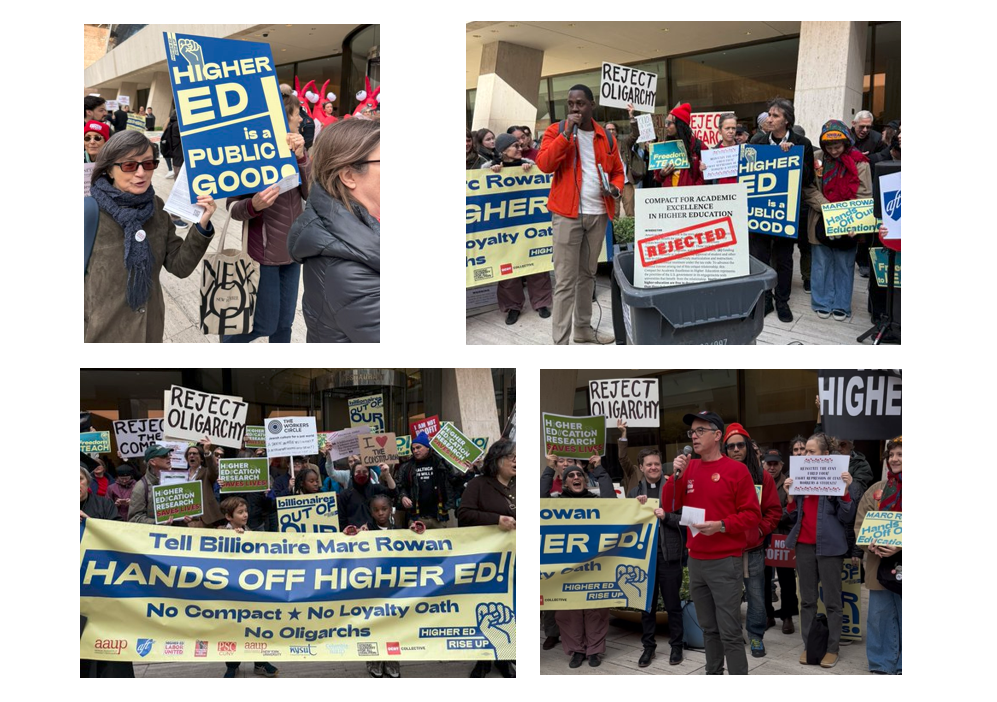
“The attacks on higher ed are attacks on truth, freedom, and our future. We’re organizing to protect campuses as spaces for learning, not control—for liberation, not censorship,” said Brianni Davillier, a student organizer with Public Citizen, which is among the advocacy groups and labor unions supporting the Students Rise Up movement behind Friday’s demonstrations.
At the Community College of Philadelphia, protesters stressed that “higher education research saves lives.” Duke University demonstrators carried signs that called for protecting academic freedom and transgender students. Roughly 10 miles away, at the University of North Carolina at Chapel Hill, they unfurled a banner that read, “Stand for Students | Reject Trump’s Compact.”
Professors from multiple schools came together for a rally at Central Connecticut State University, according to Connecticut Post.
“The compact would require universities submit to a system of government surveillance and policing meant to abolish departments that the government disapproves of, promote certain viewpoints over others, restrict the ability of university employees to express themselves on any major issue of the day,” said James Bhandary-Alexander, a Yale Law School professor and member of the university’s American Association of University Professors (AAUP) executive committee.
AAUP, also part of the coalition backing the protest movement, said on social media Friday: “Trump and Marc Rowan’s loyalty oath compact is [trash]!! Out with billionaires and authoritarians in higher ed! Our universities belong to the students and higher ed workers!”
Protesters urged their school leaders to not only reject Trump’s compact—which some universities have already publicly done—but also focus on other priorities of campus communities.
At the University of Kansas, provost Barbara Bichelmeyer confirmed last month to The University Daily Kansan that KU will not sign the compact. However, students still demonstrated on Friday.
“They did say ‘no’ but that’s like the bare minimum,” said Cameron Renne, a leader with the KU chapters of the Sunrise Movement and Young Democratic Socialists of America. “We’re hoping to get the administration to hear us and at least try to cooperate with us on some of our demands.”
According to The University Daily Kansan, “Renne said the groups are also pushing for divestment from fossil fuels, improvements in campus maintenance, and the removal of restrictions on gender ideology.”
Some schools have declined to sign on to the compact but reached separate agreements with the Trump administration. As the Guardian reported Friday:
At Brown University in Rhode Island—one of the first institutions to reach a settlement with the Trump administration earlier this year—passersby were invited to endorse a banner listing a series of demands by dipping their hands in paint and leaving their print, while a group of faculty members nearby lectured about the history of autocracy.
“Trump came to our community thinking we could be bullied out of our freedom,” said Simon Aron, a sophomore and co-president of Brown Rise Up. “He was wrong.”
Brown isn’t the only Ivy League school to strike a deal with Trump; so have Columbia University and the University of Pennsylvania, the alma mater of both Rowan and Trump. Cornell University followed suit on Friday amid nationwide demonstrations.
“November 7th is only the start,” said Kaden Ouimet, another student organizer with Public Citizen. “We’re building a movement of students, faculty, and campus workers to demand our colleges do not comply with the Trump regime, and its authoritarian campus compact.”
“We know that to fully take on autocracy, we have to take on the material conditions that gave rise to it,” the organizer added. “That is why we’re not only out to defeat Trump, but to also win a vision for affordability, security, and freedom for our generation—both in higher education, and in our democracy.”
[Jessica Corbett is a senior editor and staff writer for Common Dreams. Courtesy: Common Dreams, a US non-profit news portal.]