❈ ❈ ❈
School Closures, Student Deaths, Children Out of School: The State of Public Education
Aparna Kalra
Earlier this year, Member of Parliament John Brittas posted on X: “Govt admits in Rajya Sabha: India lost 18,727 government schools in 5 years, while private unaided schools rose by 8,475 in just one year. Public education is shrinking. Private schooling is expanding.”
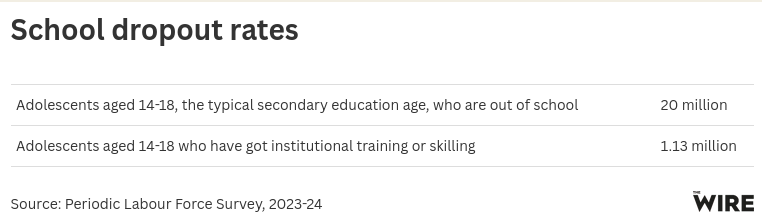
School closure, alarming in itself, gets doubly so when combined with another set of numbers, contained in the Economic Survey, 2025-26, tabled in Parliament three months ago: Most out-of-school children in India are between 14 to 18 in age. India has 20 million children who do not go to school in the 14-18 age group, described as secondary school age group by the survey. Of these, less than 1% have any formal skills training, the survey added.
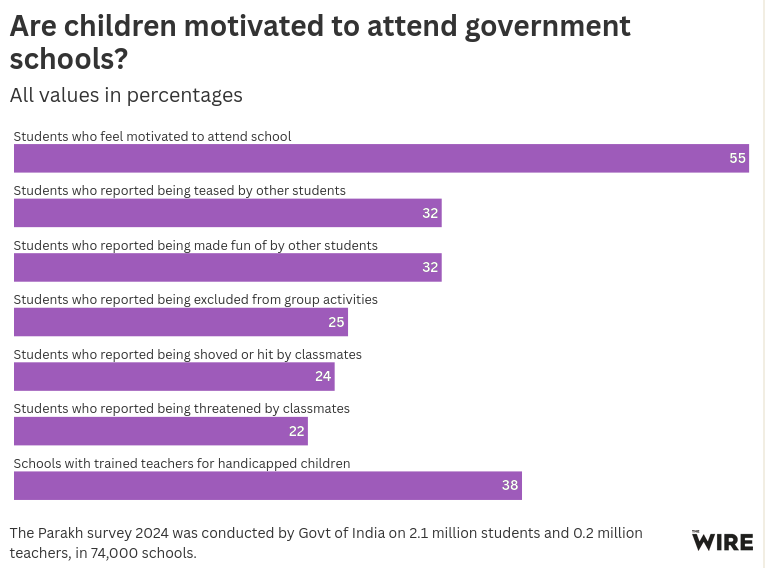
The Economic Survey did not stop there. It says not only are children not enrolled in school, the ones who are, don’t want to attend.
It described as “concerning” the findings of the Government of India’s Parakh survey of 2024: only 55% students feel motivated to attend school, and less than half feel safe there.
Governments, Union or state ones, are not responding to pressure from any quarter – legislature or judiciary – says lawyer Ashok Agarwal, who has fought and won several cases on the matter. Orders for school repair are essential, he argues – a dilapidated school is dangerous and one step away from closure.
Agarwal says he has toured the country and fought against the sorry state of government schools, tutoring parents and students to demand more, and calling upon the local panchayat to get vocal. But it is a lost battle.
“After I leave, they stop protesting. They are easily scared by the local politician or system,” he says.
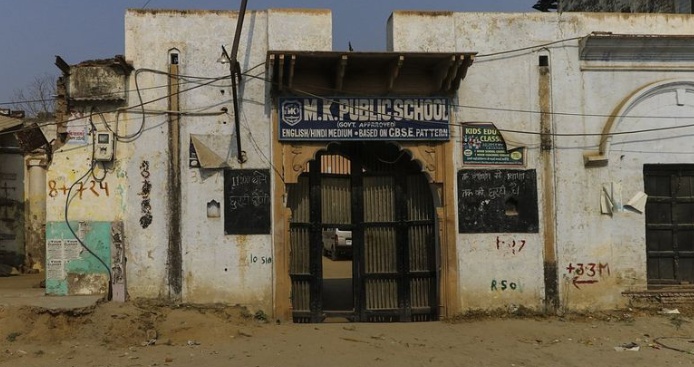
Here is what happened in Rajasthan, where seven young lives lost to a school building collapse resulted in court ire, but failed to yield reform.
Deaths, court orders, but no action
Seven children died last year in July in Piplod village of Jhalawar district when the roof and wall of their classroom collapsed on them.
The tragedy drew wide condemnation. The Wire reported that warnings from villagers about the school building’s condition were ignored. Members of higher castes had enrolled their children in a nearby private school. The school whose roof fell had students from tribal and lower caste families.
The Rajasthan High Court took suo moto action, even as the fallout, a survey by the state government, found 5,500 or around 9% of the total 63,000 schools in utter ruin. The survey was reported widely. So was the high court’s order barring entry of students in the 86,000 dilapidated classrooms found by the survey across schools.
Lawyer Agarwal, who had a writ pending in the high court for three years on the status of all government schools in Rajasthan, was relieved that the state government had been forced to give an account. Soon, his writ and the suo moto action of the court were joined, and placed in front of a special bench formed to probe the state of schools.
The court pressed the state government of Rajasthan for a complete blueprint of the repairs.
Another mishap
In January this year, the amicus curiae informed the court of another mishap: that the roof of the Government Upper Primary School in Bhains Khera village, district Bundi, had fallen. Thirty students, fortunately, escaped, having moved out of the school minutes before – they were sitting in the open field within the school compound.
The court moved from scolding to talking numbers and handwringing, as the Rajasthan government tarried. Through affidavits from various departments, it knew that Rs 20,000 crore was required for the construction and repair of the schools. Of this, only Rs 1,624 crore is sanctioned.
It called the budget allocated for school repair for the current financial year, Rs 1,000 crore, a “drop in the ocean”.
“How, with such a paltry and inadequate budget, the government will provide safe and secure infrastructure to school-going children,” asked the exasperated court last month.
[Aparna Kalra is a Delhi School of Economics alumnus whose forte is investigations, profiles and data journalism. She has reported for Reuters, Mint, and worked as a fact-checker on a Facebook project for AFP. Courtesy: The Wire, an Indian nonprofit news and opinion website. It was founded in 2015 by Siddharth Varadarajan, Sidharth Bhatia and M. K. Venu.]
❈ ❈ ❈
Niti Aayog Flags Poor Student Retention, Learning Outcomes in Report
Maitri Porecha
May 08, 2026: A decadal analysis of India’s school education system by Niti Aayog reveals that while India has achieved a near-universal access to school at the primary level, it faces challenges in retaining students at the secondary level. There is also a persistent crisis in achieving learning outcomes.
The report, titled ‘School Education System in India — Temporal Analysis and Policy Roadmap for Quality Enhancement’, highlights the ‘pyramid’ problem.
The education system currently resembles a sharp pyramid, housing 14.71 lakh schools and 24.69 crore students.
High dropouts
While the country boasts of 7.3 lakh primary schools, that number plummets to 1.64 lakh at the higher secondary level. Four out of every 10 children who enter the system drop out before completing higher secondary education.
“This structural fragmentation means only 5.4% of schools offer a continuous journey from Grade 1 to 12. For the vast majority of students, moving up through the grades requires changing institutions multiple times — a hurdle that contributes to a steep attrition rate,” the report said. “This fragmentation without any established linkage between schools for transitioning requires students to shift schools at key stages, depending on local availability, which further contributes to declining retention rates and limits the likelihood of progression to higher stages of education.”
To add to this, close to 7,993 schools across the country reported zero student enrolment, with the highest numbers seen in West Bengal (3,812) and Telangana (2,245). “While these schools appear operational in administrative records, they no longer serve any student population. These schools, despite zero enrolment, continue to receive financial and human resources due to the lack of updating of records, showing the difference between on-ground reality and planning,” the report said.
The report recommends ‘Cylindrical’ Schooling to fix the “leaky pipeline” of student dropouts, which involves creating composite schools that cover Grades 1-12 under one roof. The report points to the fact that the Right to Education Act ends at age 14, leaving families to bear the costs of tuition, books, and transport for older children.
No facilities
The report highlights that according to UDISE+ 2024-25, 1.19 lakh schools lack access to functional electricity. Access to water and hygiene facilities is also inconsistent. The share of schools with drinking water facilities has increased from 96.5% in 2014 to 99% in 2025, but 14,505 schools still lack functional water sources, and nearly 59,829 lack hand-washing facilities, compromising student health and hygiene.
“While internet access saw an eightfold increase (now at 63.5%), one-third of schools still lack connectivity, and 50% of government secondary schools operate without a science lab,” the report pointed out.
Improving learning outcomes in children and responsible use of Artificial Intelligence (AI) are challenges that need to be tackled in the school education system, the report said.
Despite high enrolment, reading proficiency in Grade 8 has dropped. In 2014, 74.7% of Grade 8 students could read a Grade 2 text; by 2024, that figure fell to 71.1%. In mathematics, only 45.8% of Grade 8 students can solve a basic division problem. “Recent PARAKH 2024 findings suggest that while students are good at rote patterns, they struggle with real-world application. For instance, fewer than 30% of Grade 6 students demonstrate competency in fractions,” the report stated.
The report pointed out that in October 2025, the Education Ministry announced that AI and Computational Thinking will be introduced from Grade 3. However, the report warns that without ethical frameworks and better teacher training, an over-reliance on AI could “diminish independent thinking” in younger learners.
‘School complexes’
The report recommended that to strengthen academic continuity, ensure equitable resource allocation, and enhance the efficiency of school governance, ‘school complexes’ should be operationalised as envisaged in NEP 2020. “The concept envisions grouping one secondary or senior-secondary school with all schools offering lower grades within a defined neighbourhood (typically within a 5 to 10 kilometre radius), including nearby Anganwadis,” it stated.
By aggregating academic and administrative functions across schools, school complexes enable optimal deployment of subject-specific teachers, science and ICT labs, libraries, sports infrastructure, and vocational education offerings such as skill labs.
“This model becomes particularly critical in rural, remote, and tribal regions where standalone schools may not have the resources to offer complete educational experiences,” the report recommended.
There is also a need to invest in the creation of open, interoperable, and evolvable Digital Public Infrastructure (DPI) in the education sector that can be used by multiple platforms and point solutions.
“National programmes such as PM e-Vidya, BharatNet, and Gati Shakti should be converged to accelerate infrastructure rollout and enable equitable digital access across school levels,” the report recommended.
Niti Aayog has said that a comprehensive vacancy mapping of all administrative positions from the block to the State level — including Cluster Resource Coordinators, Block Education Officers, and MIS personnel — should be conducted to fill critical vacancies at block and district levels through time-bound recruitment drives.
The report noted that India’s current 4.6% GDP allocation to education remains below the 6% target first recommended in 1964 and that higher allocation is key to achieving reforms.
[Maitri Porecha is a Senior Assistant Editor at The Hindu, reporting on public policy, with special interest in public health, pharmaceuticals, health technology, education and edtech. Courtesy: The Hindu, an Indian English-language newspaper, founded in 1878 and published from Chennai, with a long reputation for serious reporting and editorial analysis.]
❈ ❈ ❈
Government Report Reveals Stark Infrastructure Gap in Indian Schools
Maitri Porecha
January 03, 2025: Of the over 14.71 lakh schools in India, up to 1.52 lakh schools have no functional electricity, according to the latest data released by the Unified District Information System for Education (UDISE+) maintained by the Ministry of Education.
Of the 14.71 lakh schools, 10.17 lakh schools are government-run, of which 9.12 lakh schools have functional electricity, while 1.52 lakh schools do not.
Apart from the government-run schools, there are 4.54 lakh schools are government-aided, private and unaided, and others, of which 4.07 lakh schools have functional electricity.
Of the total schools, 14.47 lakh schools have drinking water facilities, but in only 14.11 lakh schools is the drinking water facility functional. Of the 10.17 lakh government schools, functional drinking water facility is available in 9.78 lakh schools. Of the 4.46 lakh government-aided, private and other schools, 4.33 lakh have functional drinking water.
With regard to toilets, of the 14.71 lakh schools, 14.50 lakh schools have toilet facilities, but only 14.04 lakh toilets are functional. The report says 67,000 schools operate without functional toilets, of which a majority (46,000) are government schools operating without functional toilets.
The condition is much worse when it comes to providing disabled-friendly facilities. Of 10.17 lakh government schools, only 3.37 lakh schools have disabled-friendly toilets, which accounts for 33.2% of schools. However, only 30.6% of them are functional.
The condition is slightly better in government-aided schools, with 35,640 (44.4%) of 80,313 schools having disabled-friendly toilets.
Of the 14.71 lakh schools, 11.34 lakh schools (77%) have ramps, and even an even lesser number of schools, 7.69 lakh (52.3%), have ramps with hand rails. When it comes to having functional computers for pedagogical purposes, one in two schools have no access to computers for teaching and learning. Of the 14.71 lakh schools, only 7.48 lakh schools (50%) have access to computers for teaching and learning. Also, 7.92 lakh schools have the Internet, while 8.41 lakh schools have computer facilities.
In the sub-category of government schools, of 10.17 lakh schools govt, only 4.42 lakh (43.5%) schools have computers functional for pedagogical purposes. Whereas in private unaided schools, of 3.31 lakh schools, up to 2.34 lakh (70.9%) schools have this facility.
Of the 14.71 lakh schools, up to 24,580 schools have no drinking water facility within the school premises.
Only 17.5% schools have co-curricular activity rooms/arts and crafts, that is, 2.57 lakh schools out of 14.71 lakh total schools. In government schools, this number is lower, with only 9.9% schools of the total 10.17 lakh schools having an arts and crafts room.
Among the total schools having secondary sections (2.86 lakh), only 1.6 lakh have an integrated science laboratory facility. Among the 1.19 lakh government secondary schools (59,972), 50.2% schools have a science lab facility.
Also, the uptake of solar panels in schools is less, with only 1.54 lakh schools (10.5%) of the total number of 14.71 lakh schools having solar panel facilities. In government schools, out of 10.17 lakh schools, only 89,746 (8.8%) have installed solar panels.
[Courtesy: The Hindu, an Indian English-language newspaper, founded in 1878 and published from Chennai, with a long reputation for serious reporting and editorial analysis.]
❈ ❈ ❈
57% Schools Have Functional Computers, 53% Have Internet Access: Education Ministry
The Hindu Bureau
January 02, 2025: According to the Union Education Ministry’s data, only 57.2% of schools in the country have functional computers while 53.9% have Internet access. The Unified District Information System for Education (UDISE) Plus is a data aggregation platform maintained by the Education Ministry to collate school education data from around the country.
While over 90% of schools have basic amenities such as electricity and gender-specific toilets, other facilities like functional desktop, Internet access, and handrail ramps remain limited. Only 52.35 are equipped with ramps, the report noted, underscoring significant gaps in accessibility.
The enrolment landscape has also seen changes, with the total number of students declining 37 lakh to 24.8 crore in 2023-24. The Gross Enrolment Ratio (GER) revealed disparities across educational levels. While the preparatory level boasts a GER of 96.5%, the foundational level is at a mere 41.5%.
Middle and secondary levels fare worse at 89.5% and 66.5%, respectively. Dropout rates also rose sharply at higher education levels, from 5.2% in middle school to 10.9% at the secondary stage.
“Despite efforts under National Education Policy (NEP), 2020, infrastructure gaps hinder our progress toward universal education. Optimising resources is key to meeting the ambitious targets for 2030,” an education ministry official said. NEP, 2020, prioritises inclusion and equity, and the UDISE Plus data offers a snapshot of representation.
[Courtesy: The Hindu, an Indian English-language newspaper, founded in 1878 and published from Chennai, with a long reputation for serious reporting and editorial analysis.]