❈ ❈ ❈
US Snubs India’s War on Terror
M.K. Bhadrakumar
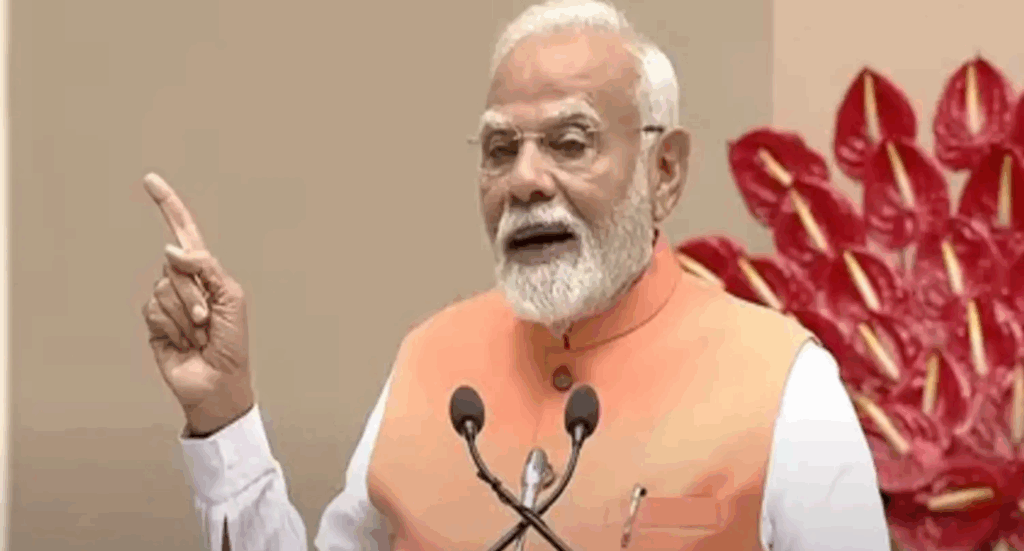
June 12, 2025: The Indian media reports make out that Prime Minister Narendra Modi’s reception for the seven parliamentary delegations waging the war on terror turned into a social occasion to celebrate the flashes of ‘national unity’ before the hurly-burly of politics returns as the election cycle picks up.
The PMO did not issue any press release on PM’s remarks. We wouldn’t know whether this event on Tuesday is a substitute for a special session of the parliament to discuss Pahalgam incident, which opposition parties demanded.
Regrettably, we won’t even know the international reaction to our war on terror against Pakistan. There have been no public statements. How can a war be waged when there is no clarity about the enemy?
Terrorism is a dicey subject with a complicated history. It is not only China which maintains “ambiguity or double standards”on terrorism — per EAM S. Jaishankar’s allegation — but even within India there are misconceptions. The contesting legacies of Bhagat Singh and Savarkar bear testimony to it.
We need to tread softly. Proposals are being mooted lately that India should rally the Global South in the war on terror. There is great risk that we may lethally erode our article of faith that Kashmir is an internal matter. The world-wide perception is already that the periodic eruption of India-Pakistan violence stems from the unresolved Kashmir problem. (See my article Operation Sindoor Outreach: What Did Panda & Co Achieve In West Asia? Rediff, June 5, 2025)
Our solution lies in diligently picking up the thread of negotiations during the time of Prime Minister Manmohan Singh and President Pervez Musharraf. But no serious attempt has been made in this direction in the past decade or more — nor is it ever likely by the ideology-driven present government.
If the bilateral track is unproductive or damaged, what is the alternative? Fixation about bilateralism shouldn’t be an alibi for inertia. The international environment today has dramatically changed and old dogmas have become obsolete. India is no longer vulnerable to external aggression / interference / interventions. Indians are a patriotic people and national unity doesn’t have to be promoted if the country faces an existential danger. We, our children and grandchildren are all stakeholders, because we live here and this is our only country.
We see a remarkable convergence between the three big powers — the US, Russia and China — on the efficacy of dialogue between India and Pakistan. What drives the big powers may not be altruistic motives, but, quintessentially, there is convergence that all three dread a weakened, failed Pakistani state and will prevent it no matter what it takes — IMF / ADB / World Bank, etc., have been lined up. Pakistan is a highly strategic entity in geopolitical terms.
Arguably, China’s helping hand to Pakistan too is not really any different — although a powerful lobby in our country is raising the spectre of a military ‘fusion’ between the two countries. Their diabolical agenda is to legitimise the hypothesis that our problematic relations with these two neighbours have no real solutions and all that is possible is a cauterisation of gaping wounds. This is a defeatist mentality unbecoming of a civilisation state.
After all, is China doing anything essentially different from what the US did during India’s cold-war era wars with Pakistan— or for that matter, what Russia is doing for India’s militarisation and national defence? Where was the ‘fusion’ then?
Russia has openly acknowledged the US’ good offices in checking the India-Pakistan tensions from spiralling out of control. All three big powers offered to promote dialogue. So, where lies the real problem?
Simply put, we remain stuck with the ‘management’ of Kashmir problem rather than seek a permanent solution. There are interest groups that adopt maximalist positions. And political leadership lacks the courage or the moral authority to approach the problem in a spirit of give and take. Remember, Germany and France also used to be eternal enemies; they even fought two world wars.
Ironically, even as PM hosted the seven multi-party delegations that returned home, in a hearing in the US Congress, at the House Armed Services Committee, the commander of the US Central Command, Gen. Michael Kurilla lavishly praised Pakistan as a key partner in counterterrorism.
The general unequivocally commended a “phenomenal partnership” on the part of the Taliban with Pakistan in the tribal areas on their border in the fight against ISIS with the support of US intelligence, which eliminated dozens of ISIS fighters and captured at least five high-value terrorists, who included Jafar, one of the key individuals behind the Abbey Gate bombing.
Gen. Kurilla disclosed that Pakistani army chief Gen. Asim Munir called him personally to inform, “I have caught him [Jafar], ready to extradite him back to the United States, please tell the Secretary of Defence and President.”
Gen. Kurilla added, “So we are seeing Pakistan, with the limited intelligence that we provide, go after them using their means to do that, and we are seeing an effect on ISIS Khorasan…
“And I would also tell you that since 2024 — the beginning — Pakistan has had over 1000 terrorist attacks in the western area [Baluchistan], killing about 700 security and [2500] civilians. They have an active counterterrorism fight right now, and they have been a phenomenal partner in the counterterrorism world.”
Interestingly, Gen. Kurilla alluded to a US-Russian convergence — and even possibly US-Iranian — in this regard, saying, “But remember, these [ISIS] are the same individuals that did the Crocus City Hall attack in Moscow [in March 2024 in which the death toll touched 143 and more than a hundred people were injured.] They did the attack in Kerman [in January 2024 at a commemorative ceremony marking the assassination of Gen. Qassem Soleimani at his grave in eastern Kerman, eastern Iran, where two bomb explosions killed at least 95 people and injured 284 others.]”
The US Army general summed up: “That’s why we need to— we have to have a relationship with Pakistan and with India. I do not believe it is a binary switch that we can’t have one with Pakistan if we have a relationship with India. We should look at the merits of the relationship for the positives it has.”
Isn’t it all too obvious that Shashi Tharoor who led the parliamentary delegation to Washington was beating a dead horse?
EAM condemned China publicly, but it is common sense that China also cannot afford the weakening of the Pakistani state. They’ve invested deeply in the CPEC. Or, consider Xinjiang’s stability and security and the nexus between ISIS and Uighur terrorists.
In reality, our irritation with China is that it is countering terrorist threats supported from abroad effectively, with a long-term perspective, in its own way, with all the wisdom that it can bring to bear on the challenge as a civilisation state — which has shown results, too — rather than follow our footfalls and muddling methods.
China cannot afford a hybrid war like Don Quixote’s against giant windmills because well-trained battle-hardened terrorists from Xinjiang actually constitute the cadres of the ISIS and terrorism is not an optical illusion.
(Ambassador M.K. Bhadrakumar served the Indian Foreign Service for more than 29 years. Courtesy: Indianpunchline, the author’s blog.)
❈ ❈ ❈
Who is India’s All-Weather Friend in This World?
Christophe Jaffrelot
In his latest book, S. Jaishankar writes: “After all, diplomacy is all about making friends and influencing people”. In the armed conflict between Pakistan and India this May, China reinforced its role as Islamabad’s “all-weather friend”. Beijing took Pakistan’s side far more clearly than in previous wars between the two neighbors. When the likelihood of Indian retaliation to the April 22 attack in Pahalgam increased, Chinese foreign minister Wang Yi declared: “As an ironclad friend and an all-weather strategic cooperative partner, China fully understands Pakistan’s legitimate security concerns and supports Pakistan in safeguarding its sovereignty and security interests“. During the conflict, according to Indian sources, China helped Pakistan with air defense and satellite imagery. And after the guns fell silent, when India – which had just denounced the Indus Treaty – indicated that it might deprive Pakistan of some of the water to which that treaty entitled it, China hinted that it too might deprive India of water from the Brahmaputra.
How do you explain this seemingly unconditional support?
First, Pakistan has become an important customer for Chinese arms dealers, as 80% of its arsenal is Chinese-made. Not only is Pakistan an attractive market for China, it also enables the latter to test on the battlefield weapons that the two countries have sometimes developed together.
Secondly, China has invested $68 billion in foreign direct investment in Pakistan in the framework of the China Pakistan Economic Corridor, the flagship of the Belt and Roads Initiative, despite the recurring tensions between Beijing and Islamabad stemming from Pakistan’s late payments or attacks on Chinese engineers by Baloch nationalists. What’s more, part of the $68 billion has been used to build roads, railroads and power plants in areas claimed by India, such as Gilgit Baltistan.
Thirdly, China probably wanted to seize the opportunity to make India’s life complicated, as two bones of contention have (re)emerged since Narendra Modi came to power. First, in keeping with Hindu nationalist ideology, the Indian government has expressed revisionist views, proclaiming its desire to restore Akhand Bharat, which would include the part of Ladakh conquered by China in the 1962 war. Secondly, India sought to resist China’s push into other South Asian countries, starting with Bangladesh, Sri Lanka and Nepal. For decades, China has kept India busy on its western flank by arming Pakistan, forcing New Delhi especially towards regional policies like Neighbourhood First or Look East.
Fourthly, India has alienated China by pursuing its rapprochement with the United States, as evidenced by good relations – till recently at least – between Modi and Trump, and India’s intention to attract American companies looking to relocate their Chinese factories to India.
Who is India’s all-weather friend?
While Islamabad can count on a particularly valuable all-weather friend, not only because it is the world’s second major power, but also because China clashes with India in the Himalayas, New Delhi, by contrast, was relatively isolated during the May crisis.
At the United Nations Security Council, India failed to get either Pakistan or the terrorist group to which it attributed the Pahalgam attack mentioned in the press release. Above all, the US intervention caught India off-guard. While the Trump administration, initially, refused to get involved, on the third day of the conflict, the hypothesis of a nuclear escalation led the White House to intervene – and it did without sparing India. On May 10, Donald Trump announced that he had silenced the guns thanks to an express mediation during which he promised good trade deals to the belligerents. He also invited them to negotiate a lasting peace and offered to act as his good offices to settle the Kashmir question. This sequence could only be seen as an affront by New Delhi for two reasons.
First, whenever American presidents have put an end to a conflict between Indians and Pakistanis, it has always been to the benefit of the former. On July 4, 1999, Bill Clinton summoned Nawaz Sharif to Washington to withdraw Pakistani forces from the Kargil heights. This time, Trump presented himself as the saviour who spared the world a nuclear war. While India claimed to have demonstrated its military superiority, the impression the world took away from this episode was that the conflict ended in a draw. The Indians who were the most determined to “do away with Pakistan”, whipped up into a frenzy by the nationalist hysteria of a media in thrall of the government, could only feel immense frustration.
Secondly, Trump was ruining India’s efforts not to internationalise the Kashmir issue, which, since the Treaty of Shimla negotiated by Indira Gandhi in 1972, was to be considered a bilateral affair. Here again, Trump was playing into Pakistan’s hands.
All in all, while India had been striving for years to avoid appearing indissolubly linked to Pakistan on the international stage, Trump marked a return to an “India-Pakistan hyphenation” that was dragging India down: entangled in an endless regional conflict, the country can hardly appear as a global power in the making.
In the aftermath, Trump showed even greater benevolence towards Pakistan when he declared: “Pakistan has very strong leadership. Some people don’t like when I say this, but it is what it is. And they stopped that war. I’m very proud of them”. In unison, General Michael Kurilla, the head of US Central Command (CENTCOM), recently hailed Pakistan as “a “phenomenal partner in the counter-terrorism world”.
The fight against terrorism, in fact, could be the explanation for the recent American-Pakistani rapprochement. At the end of February, the Trump administration decided “to exempt $397 million in security assistance to Pakistan from its massive foreign aid cuts. The funds will be allocated to a program that monitors Pakistan’s U.S.-made F-16 fighter jets-to make sure that they are used for counterterrorism, and not for action against India”. But then there is something paradoxical in Trump’s post-Pahalgam treatment of India and Pakistan as equals, as if one were not a victim of terrorism and the other the crucible of so many terrorist groups. Things may become clearer during the five-day official visit of Field Marshal Asim Munir who has been invited in Washington to discuss military and strategic ties between Pakistan and the United States.
Whatever the reason for Trump’s positive assessment of Pakistan, it contradicts India’s efforts to isolate the country. In fact, while New Delhi has been trying for years to marginalise Islamabad on the international stage, the past few weeks have shown that Pakistan retains many supporters – and not just in the United States.
At the very time when India and Pakistan were going through a serious crisis, the latter being accused by India of supporting jihadist groups operating on its soil, on May 9, the International Monetary Fund executive board approved a fresh $1.4 billion loan to Pakistan under its climate resilience fund and approved the first review of its $7 billion programme, freeing about $1 billion in cash. India protested at the board meeting that the Pakistan programme raised concerns about the “possibility of misuse of debt-financing funds for state-sponsored cross-border terrorism.” But no other country represented on the board supported it, even if only by abstaining from the vote. A month later, Pakistan obtained two positions in two UN bodies: on the one hand, Pakistan’s permanent representative to the United Nations, has been appointed chair of the U.N. Security Council’s 1988 Sanctions Committee, which monitors sanctions targeting the Taliban and, on the other, a Pakistani diplomat has also become vice-chair of the 1373 Counter-Terrorism Committee. These positions could hardly have escaped Pakistan by virtue of its status as a non-permanent member. But Pakistan’s election as a non-permanent member with 182 votes in 2024 alone testifies to the country’s non-marginalisation.
How is India’s longest-standing partner, Russia, behaving in this context? It has tended to show neutrality, even siding with Pakistan. Not only did Moscow keep silent after the Pahalgam attack, but it also pledged to resurrect a Soviet-era steel mill near Karachi. To give substance to the corridor that Pakistan and Russia are seeking to develop through Central Asia, a Lahore-Moscow train even inaugurated a new rail link this month.
In the aftermath of the Pahalgam attack, only two countries showed a vocam solidarity with India: Afghanistan and Israel. The former was responding to India’s overtures, with New Delhi and Kabul seeking to catch Pakistan on the back foot, but this strategy came to a halt when Beijing intervened, determined to pursue the Road and Belt Initiative in the area: Chinese mediation led to Afghan-Pakistani reconciliation, culminating in the opening of a Pakistani embassy in Kabul .
As a “friend of India”, in the words of Kobbi Shoshani, the Israeli Consul General in Mumbai, Israel supported the post-Pahalgam retaliation. Many Israeli observers have also drawn parallels between Netanyahu’s retaliation after the Hamas attack on October 7, 2024 and Modi’s last May. Whether the comparison is apt or not, India abstained – yes, abstained – at the United Nations when a motion calling for a ceasefire in Gaza was put to the vote in June 2025 when 149 countries supported it – and failed to condemn Israel’s attack on Iran in mid-June, dissociating itself from the stance taken by the Shanghai Cooperation Organization, whose main pillars are China and Russia.
Are we to conclude from recent developments that Israel is now India’s all-weather friend? It’s too early to say. But another question deserves to be asked: if China is more than ever Pakistan’s all-weather friend, can India afford not to deal China?
India’s dependence on China
The fact is that China has been providing unstinting support to a country that India’s political leadership portrays as ‘public enemy number one’ at a time when India is proving more dependent on China than ever in economic, industrial and commercial terms.
In 2024-25, China’s exports to India represented a record $113.5 billion, while India’s declining exports to China fell to $14.3 billion, resulting in a deficit of $99.2 billion. This figure reflects not only the weakness of Indian industry, which is unable to compete with Chinese manufactured goods, but also its dependence on Chinese suppliers.
Indeed, finished goods represent only a small proportion of India’s imports from China (6.8% in 2023-24), the bulk of which are intermediate goods (70.9%) and production goods (22.3%) that India’s industry and services need to produce and export. As a result, the more India exports, the more it imports from China. This logic is particularly at work in the electronics and pharmaceuticals sectors: while India exports a growing number of smartphones, starting with the iPhone, it imports components from China; while India has become “the world’s pharmacy” thanks to its exports of generic medicines, many of the active ingredients come from China.
It should be noted that India’s dependence on China is even greater than the statistics show, as India imports products manufactured by Chinese firms based in Malaysia or Vietnam – where they have relocated to circumvent the tariff barriers or import quotas set by many countries, including India. Solar panels are a case in point, making India extremely dependent on China for its energy transition.
In this context, the April-May crisis between India and Pakistan gave China the opportunity to put pressure on New Delhi. On April 28, the Indian press reported on additional delays in deliveries to India of iPhone spare parts imposed by the Chinese. Shortly afterwards, China decided to make access to rare earths more difficult, putting the Indian automotive sector in difficulty – hence New Delhi’s idea of sending a delegation to Beijing to negotiate an exceptional regime for India.
Indeed, India has begun talks with China on this and other issues and is seeking a compromise. Earlier this month, the Indian government announced that India would facilitate Chinese investment on its soil, reversing the decision that had been taken in 2020 in the wake of the confrontation between soldiers from the two countries. At the same time, on June 5, the Indian ambassador to China Pradeep Kumar Rawat was received by the Chinese vice-minister of foreign affairs, Sun Weidong, with both parties pledging to “jointly implement the leaders’ important consensus, fostering people-to-people exchanges [and] win-win cooperation, and driving China-India relations forward on a healthy and stable path”.
In conclusion, if, as Jaishankar says, “diplomacy is all about making friends and influencing people”, the question that Indian diplomats should closely examine today is none other than: where are the friends of India who are prepared to support her in adversity and isolate her public enemy number one, Pakistan? The question is all the more pertinent given that Pakistan itself has an all-weather friend on whom India is economically highly dependent – not to mention the Chinese threat in the Himalayas and India’s neighbourhood. If neither the USA nor Russia can play the role of India’s all-weather’ friend, India’s vulnerability to China will be even more difficult to counter.
Indian diplomacy, which had to be supplemented by other forces, as evident from the fact that that New Delhi had to send seven all-party delegations to explain India’s policy in 32 countries, is challenged to find a solution to the risk of New Delhi’s relative isolation vis-à-vis the growing threats coming from the China-Pakistan duo. All in all, isn’t it the transactional philosophy of multilateralism that deserves to be revisited? In his 2020 book The India Way: Strategies for an Uncertain World, S. Jaishankar wrote: “This is a time for us to engage America, manage China, cultivate Europe, reassure Russia, bring Japan into play, draw neighbours in …” But what about making friends, especially if this is what diplomacy is “all about”? Here, it’s India’s tradition of refusing alliances that is at stake. By multiplying its partners the plurilateral way, India has diversified its supports, but it has also diluted them: these transactional links are weak compared to those forged with an ally.
[Christophe Jaffrelot is Senior Research Fellow at CERI-Sciences Po/CNRS, Paris, Professor of Indian Politics and Sociology at King’s College London, Non-resident Scholar at the Carnegie Endowment for International Peace and Chair of the British Association for South Asian Studies. Courtesy: The Wire, an Indian nonprofit news and opinion website. It was founded in 2015 by Siddharth Varadarajan, Sidharth Bhatia, and M. K. Venu.]
❈ ❈ ❈
Nehru’s Vision of Foreign Policy Assumes Greater Relevance in Wake of the Modi Regime’s Abject Failures
S.N. Sahu
The abject failure of India’s foreign policy and its collapse under the Modi regime, especially after the launch of Operation Sindoor against Pakistan, has been a cause of national concern. Such disastrous performance was never witnessed during the tenure of any other Prime Minister of our country.
While Operation Sindoor’s military success in targeting Pak bases following the brutal killing of tourists by terrorists in Pahalgam in Kashmir has been acknowledged, its devastating fallout in the diplomatic and foreign policy front is very embarrassing.
Trump announcing ceasefire
Instead of India first announcing the ceasefire, it was US President Donald Trump who did so and repeated that claim several times on different occasions. He asserted that it was he who brokered it and claimed that both the countries ceased fire after he threatened to stop trade and commercial engagements with them.
Its denial by the spokesperson of External Affairs Ministry and Prime Minister Modi’s deafening silence on it unambiguously affirms that Trump’s claims are credible. A few days back Russian President Putin’s aide Ushakov corroborated Trumps claim saying that that the armed conflict between India and Pakistan was halted with the personal involvement of the American President.
Indira Gandhi’s Leadership
It is tragic that the country is witnessing such a sorry spectacle when India is reckoned with as a major player in international affairs and its military and economic might is globally acclaimed. Way back in 1971, neither the economic and military strength of India was anywhere near what we have in 2025.
And yet, under the leadership of Prime Minister Indira Gandhi, country’s foreign policy and diplomatic orientation formed a crucial part of formidable military strategy in the war of 1971 when Pakistan was dismembered, its soldiers surrendered before Indian Army and Bangladesh emerged as a new country.
She set an example of a remarkable leader providing leadership to India in shaping her own independent path by defying the intimidations and pressures from the then US President Richard Nixon who despatched seventh fleet to the Indian Ocean to threaten India.
In 2025, no country with the exception of Israel supported Operation Sindoor even as China, Turkey and Azerbaijan stood in solidarity with Pakistan.
Nehru’s vision
In 1927, when India’s independence was a distant goal and freedom struggle was gaining momentum under the leadership of Mahatma Gandhi, thirty-eight-year old Jawaharlal Nehru, while attending an anti-imperialism conference in Brussels wrote for the first time an article titled “A Foreign Policy for India.”
He outlined in it the crucial necessity of safeguarding our autonomy and independence to formulate and implement such a policy.
“We,” he thoughtfully wrote, “must understand world movements and politics and fashion our own movement accordingly”. “This cannot,” Nehru forcefully asserted, “mean that we have to subordinate our interests or our methods of work to those of any other country or organisation”.
“Nor does it,” he added, “mean that we should expect any help from outside or slacken our efforts at home”. “It simply means that we must educate ourselves in problems of world polity so that we may be able to serve our country better,” he stated.
Those words uttered ninety-eight years back deeply resonate when India’s foreign policy is in tatters and there is deafening silence of Modi regime on this grave issue.
It is educative that nineteen years after Nehru wrote that aforementioned article on India’s foreign policy, he very presciently talked about the capability of India to frame an independent foreign policy in his book, Discovery of India, published in 1946.
He wrote that in the future, India along with USA, erstwhile Soviet Union and China would matter in world affairs. With rare far sightedness, he could foresee the rise of India, in his words, “… as a strong united state, a federation of free units, intimately connected with her neighbours and playing an important part in world affairs”.
He then remarked with emphasis, “She is one of the very few countries which have the resources and capacity to stand on their own feet.”
After Nehru, successive Prime Ministers right up to Manmohan Singh – which of course include the tenure of BJP’s Atal Bihari Vajpayee – conducted India’s foreign policy in a manner affirming India’s capacity to stand on its own feet.
Nehru and Austria
In the middle of 1950s, eight years after India’s independence, with hardly any economic and military capability, India under the leadership of Prime Minister Nehru was requested by Austria to restore its freedom and sovereignty from the subjugation of the erstwhile occupation forces of the Soviet Union, Britain, France and the US, following the defeat of Germany in World War II.
Nehru took up the matter with the authorities of the erstwhile Soviet Union and requested them to sign the treaty so that all occupation forces would withdraw from Austria and it could get back its status as a free country. Indeed, Austria could recover its dignity as an independent nation wedded to the ideal of neutrality which remained central to Nehru’s non-aligned foreign policy eschewing alliances with military blocks and pursuing active engagement with all countries with a spirit of friendship, equality and reciprocity.
Vajpayee and Kargil Conflict
During the Kargil conflict, even Vajpayee did not visit the USA when President Clinton asked him to join the then Pak Prime Minister Nawaz Sharif in Washington to discuss the military disengagement and put an end to the ongoing conflict. Pakistan eventually withdrew from the Kargil heights occupied by its army personnel.
Failure of India’s Foreign Policy Under Modi
Tragically, now in 2025, after Operation Sindoor, the Modi regime’s approach to India’s foreign policy is demolishing its very foundation anchored in the ideals of independence.
As stated earlier, it was sadly reflected in the announcement of ceasefire by President Trump even before India did so.
Additionally, the dehyphenation of India with Pakistan so arduously achieved before 2014 has been reversed by the utter failure of our foreign policy under Modi regime and rest of the world has rehyphenated both the countries.
Failure of the all paty delegation to meet top functionaries of the 30 odd countries they visited to explain our position vis-a-vis Pakistan is yet again proves the sorry state of affairs of our foreign policy establishment.
Pakistan continues to get loans from the International Monetary Fund (IMF) and Asian Development Bank in spite of indulging in cross boarder terrorism against India, while the Modi administration is failing to get global public opinion mobilised against that country.
Besides, it is now set to chair the United Nations Security Council’s Taliban Sanctions Committee in 2025, and will also be a vice-chair of the Council’s Counter-Terrorism Committee. All such developments taking place in the backdrop of cease fire following Operation Sindoor is reflective of the failure of foreign policy architecture set by Modi Government to isolate Pakistan.
Nehru’s Legacy Endures
Modi, who boosted up his image domestically on the strength of his much hyped narrative that India’s stature has been considerably heightened globally under his leadership needs to introspect and assess the dismal failure of the foreign policy followed by his regime.
He should be mindful that during Nehru and Indira Gandhi’s period, the stature of India at the global level was very high because of the excellent personality traits and attributes of those leaders even as India was not militarily and economically all that strong. It is in this context that Nehru’s vision articulated in 1927 and in 1946 assumes greater significance to restore India’s credibility at the national and global level.
[S.N. Sahu served as Officer on Special Duty to President of India K R Narayanan. Courtesy: The Wire, an Indian nonprofit news and opinion website. It was founded in 2015 by Siddharth Varadarajan, Sidharth Bhatia, and M. K. Venu.]