❈ ❈ ❈
Indian Women’s World Cup Winning Team: A Mosaic of Unity in Diversity
T. Navin
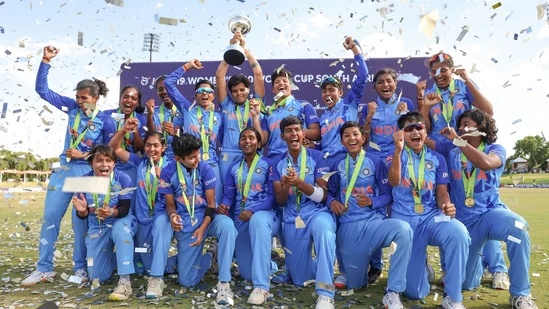
Indian women’s cricket team won the World Cup 2025. The Indian team’s triumph in the World Cup at a packed Wankhede Stadium in Mumbai was far more than a sporting victory — it was a celebration of India’s plural soul. From struggling to qualify for the semi-finals to scripting a remarkable run chase in the semi-final and lifting the trophy, the journey captured the imagination of the nation. In a country where men’s cricket has long dominated public attention and women athletes have often remained unnoticed; this victory is a turning point — an affirmation of women’s excellence and resilience on the global stage.
Yet beyond the glory of the win lies a deeper, more profound story. The world champions personified the spirit of unity in diversity, reflecting the very essence of India. Each player came from a distinct region, language, and cultural tradition, yet together they formed one inseparable tricolour — a portrait of India’s living pluralism.
Harmanpreet Kaur and Harleen Deol brought the vibrancy of Punjab, embodying the Sikh sporting tradition. Shafali Verma from Rohtak, Haryana, represented the fearlessness and raw determination of the state’s sporting culture. Smriti Mandhana, born in Mumbai and raised in Sangli, Maharashtra, hailed from a Marwari Hindu family that made the Marathi-speaking region its home — a blend of regional and cultural integration. Deepti Sharma from Agra and Sneh Rana from Dehradun reflected the perseverance of India’s Hindi heartland, while Jemimah Rodrigues, a Mangalorean Christian from Bandra, stood for the coastal diversity of the Konkani-speaking west coast. Renuka Singh from the hill village of Parsa in Himachal Pradesh brought the serenity and strength of the Himalayas, while Richa Ghosh of Siliguri and Uma Chetry from Assam carried the rhythm and aspirations of the East and Northeast. Arundhati Reddy from Hyderabad and N. Shree Charani Reddy from Kadapa represented the Telugu-speaking South, while Radha Yadav — born in Mumbai to a family from Jaunpur, Uttar Pradesh — bridged India’s North and West. Kranti Goud from Madhya Pradesh added the Central Indian heartbeat to this extraordinary mosaic.
Together, they stood not just as a team, but as a living symbol of India’s federal and cultural diversity.
Plurality as Strength, Not Threat
At a time when the spirit of plurality is increasingly seen as a threat to unity — when uniformity is projected as the only path to national cohesion — the Indian women’s team has offered a powerful counter-narrative. The push for “one nation, one language,” the portrayal of Hindi–Hindu–Hindustan as the sole definition of identity, and attempts to suppress linguistic, religious, and cultural differences reveal a deep-seated fear of diversity. The team’s victory, however, demonstrates that true strength lies in the coexistence of differences, not their erasure.
Diversity Brings Complementary Strengths
Each player’s background contributed unique strengths to the collective. The discipline and drive of the Punjabi players, the calm precision of those from the South and the hills, the creativity and flair of Bengal, and the resilience of the Hindi heartland together created a team balanced in skill, temperament, and mindset. What one lacked, another complemented — turning diversity into synergy. Rather than fragmenting the team, their varied upbringings made them more adaptive and resilient under pressure.
Plurality Enhances Empathy and Mutual Respect
When players from different religions, languages, and regions share the same dressing room, empathy and understanding naturally emerge. Their unity was not born of sameness, but of mutual respect. When Jemimah Rodrigues from Mumbai’s Christian community cheered on Shafali Verma from Haryana, or when Harmanpreet Kaur led a huddle uniting voices in Marathi, Telugu, Bengali, and Hindi, they demonstrated that diversity, when embraced, deepens solidarity.
Shared Goals Transcend Boundaries
Despite their varied roots, every player was bound by one dream — to bring the World Cup home. On the field, there was no north or south, no Hindu or Christian — only India. Their collective aspiration blurred all markers of identity. Plurality became a unifying force because it was anchored in a shared national purpose.
Representation Builds Belonging and Pride
The team’s composition — spanning Punjab, Bengal, Assam, Himachal, Maharashtra, Andhra Pradesh, Telangana, and Madhya Pradesh — gave millions of girls across India a mirror in which to see themselves. Each region could claim a part of the victory. Plural representation made the achievement not the triumph of one region or religion, but the shared joy of an entire nation. National pride became inclusive, not possessive.
Plurality Drives Innovation and Resilience
Exposure to multiple languages, styles of play, and regional cricketing cultures enriched the team’s strategic thinking. Their ability to discuss tactics across linguistic and cultural lines built flexibility and innovation. This cross-pollination of ideas — from batting approaches to field placements — fostered mental adaptability, a key trait that helped them bounce back from near elimination to become world champions.
A Living Portrait of India’s Pluralism
The Indian Women’s World Cup–winning team is a microcosm of India itself — a land where difference is not division, but dialogue; where unity arises not from uniformity, but from shared commitment amidst diversity. Their victory is a reminder that pluralism is not a weakness to be feared, but a source of creative strength to be celebrated.
In a time when the idea of India’s plurality is under strain, these women have reaffirmed a timeless truth — that the truest form of unity is one that embraces, not erases, diversity. Jemimah Rodrigues, who was once trolled on social media for openly expressing her Christian faith, through her fearless batting under pressure carried India into the semi-finals — a powerful reminder that strength of character and commitment to the nation transcend all boundaries of religion or identity. Her story, like that of her teammates, proves that diversity does not divide India; it defines and strengthens it.
[T. Navin is an independent writer. Courtesy: Countercurrents.org, an India-based news, views and analysis website, that describes itself as non-partisan and taking “the Side of the People!” It is edited by Binu Mathew.]
❈ ❈ ❈
A Cricket Victory with Grace and Without Macho Displays of Hyper-nationalism
Sayandeb Chowdhury
Patriarchy in India is paleolithic in its thickness, towering in its effrontery, and glacial in its tenacity. And in the last decade or so, we have only dug deeper and deeper. But there are days when something manages to crack open the ‘time-honoured’ armour patriarchy surrounds itself with. When Ibsen’s A Doll’s House premiered in Copenhagen in 1879, it was said that the sound of Nora Helmer closing the door behind her at the end of the play, in a gesture of defiant finality, was heard across the world.
Something similar may have happened on the second day of November. That Sunday midnight, a triumphant eleven, all women, in their shared camaraderie, their easy smiles, their candid demeanour, their carefree resolve and most importantly, their talent, won us all over. But more importantly, they also sent a message about sporting civility, about being oneself, and about not concocting their win with a shoddy show of macho hyper-nationalism. As is known, the masque of masculinity fears nothing more than women who are comfortable in their skins.
I come to cricket not as a writer, historian, or journalist but only as an eager, if critical, spectator. And like many, my cricket consciousness has an identifiable beginning – the evening of Wednesday, June 22, 1983. India was playing England in the Prudential Cup semi-final. The crowd at Old Trafford was mostly white, flying the Union Jack was still a thing, and players wore white shirts with folded sleeves, and Panama hats. As the evening segued into the night here in India, there Sandip Patil hit the decisive boundary that sucked the delirious small crowd of Indians into the ground. Me, just short of seven, and my father, glued to the monochrome television inside our apartment in Bombay, felt a wave of unprecedented ecstasy.
As a nation we had barely known the sight of trophies, one of the tallest of which glittered in the June English sun, in the hands of Kapil Dev just days later. India had defeated the mighty West Indies. That week has now attained the mysticism of a lore. But nothing could obscure what we understood later: that after English language, cricket had the promise to become the new site of postcolonial assertion in that decade, and our rag-tag ‘social-welfare’ nation, decisively, even if clumsily, took up the mantle exactly where the Caribbeans had left it. For a decade it seemed there was a fulfillment of sociologist Ashis Nandy’s famous quip, “cricket is an Indian game accidentally discovered by the British”.
Why do I remember those days? Because last week those days resurfaced unannounced. Surely I was not the not only who saw Kapil Dev’s iconic 175 in Jemima Rodrigues’ singlehanded brio against Australia, an innings what was low on optics and high on purpose; neither was I the only one who saw a whiff of Mohinder Amarnath in Deepti Sharma’s all-round play in the final, or saw Kapil’s run away from the wicket to dismiss Viv Richards in Harmanpreet’s unforgettable climactic catch in the final.
There are also other hints of that time today: no one gave a chance to Indian men in 1983, just like no one thought, till well into the middle of this tournament that the Indian women had a chance. So here was the story of the meek inheriting the earth, all over again, 42 years later. At least in cricket.
But there are differences in men’s and women’s cricket, in tone, if nothing else.
Consider what happened for much of those years in between? By mid-90s, the neoliberal market, smelling endless profit, galvanised cricket towards ends which barely sat well with the idea of the game. Cricket, to put it briefly, was first ‘carnivalised’, then caramalised, and then weaponised for the services of jingoism, especially in the last decade and a half or so. Every cricket match has become a ruse for overt brouhaha, braggadocio and sabre-rattling, stitched as it is now with pumped-up notions of national honour and global prominence. It seems that cricket is no more a subtle, clever game, but a gladiatorial arena where the hunger of million xenophobes have to be satiated. In other words, men’s cricket, willy-nilly, has become another province of bareknuckle masculine chest-thumping.
Last Sunday night, the women went against this grain and broke the mould, without even trying hard. Without painting their triumph with epic flourishes, one can safely say that they touched a chord in many of us who had long turned away from watching the game played by men.
After years it seemed that a bunch of eager sportspersons, with histories of gendered taunts and struggle written on them, have come to the pitch in the genuine spirit of the game, attended by a sense of resolve and comforted by a genuine display of what the French call jouissance; not as thick-jawed marauders a game away from their next ‘obvious’ victory. Also, gender may be the binding anchor of the woman’s team, but in its geographic, ethnic and caste diversity, it is also intersectional, a mirror of plurality that is India. To start with, they can well teach Indian men the ‘virtue’ and grace of going back to shaking hands with opponents after a match. Or shaking a leg without a care in the world. That would be a good beginning. The fences of patriarchy would come next.
But at the same time, to not express my deep concern would be to deify the women’s team. My caution comes from years of being fooled by the optics of cricket, and by the so-called vanguards of the game, all men, both inside and outside the playing field. Hence, I will hold my horses about the World Cup win being revolutionary, or ushering a new era of openness for women in sports. Patriarchy’s arms are, after all, long, and prejudice in this country is congenital. That’s always been the case.
In this case I am also weary of corporate funds flooding the game’s actors a capite ad calcem. This has happened to the most formidable of talents in men’s cricket. So, sooner than we know, the ‘celebrity cricket superwomen’ will be managed by talent brokers, and made to tweet in accordance with the will of the regime in Delhi, sugary with praise for the dear leader. The assertion of gender, class and caste would all be sucked out in favour of pageantry and spectacle. I am not naive to expect overt rebellion, but the option is not always bland, unquestioned conformity either. If that happens, it would be nothing short of an epic tragedy.
And yet, a grizzled middle-aged cricket cynic like me would still like to hope; and hope that unlike the Indian state which oversaw the transformation of Indian men’s cricket, women’s cricket, for a change, will assert its fundamental decency and transform the Indian nation into a better version of itself.
[Sayandeb Chowdhury teaches at Krea University, Sri City, Andhra Pradesh. Courtesy: The Wire, an Indian nonprofit news and opinion website. It was founded in 2015 by Siddharth Varadarajan, Sidharth Bhatia and M. K. Venu.]
❈ ❈ ❈
Jemimah, You Are the Republic’s Pride
Badri Raina
Dear Jemimah Rodrigues,
That you played the most decisive hand in getting the better of the mighty Australians is happily all over the media, both print and digital.
Your 127 was one of the finest knocks many of us have seen.
Nor can enough be said about the quality of your fielding; simply outstanding and inspiring.
Millions of good Indians across all denominations have noticed how you have received insult from those segments of our populace who have taken upon themselves to define our realities for us without being asked to do so, and without the least authority in the matter, social, religious, or constitutional.
Most hearteningly, you have also received the accolades you so richly deserve from other Indians who remain unaffected by the political poison that we have been subjected to in recent years.
We understand you are due to be invited to tea by the honourable prime minister who never fails to encourage those who succeed. It is our hope that in that meeting he will underscore to you the true face and depth of Sanatan by citing from the Rig Veda the hymn, “Ekam Sat, Viprah Bahudha Vadanti,” meaning, “The truth is one, the wise call it by many names.”
Your name for that Truth is Jesus, and we can be sure that Shri Narendra Modi will reassure you that you have every right as an Indian to call the one Truth by that name.
We also hope that measures required under the rule of law will be initiated to seek accountability from those who have sought to ridicule and abuse that right after your touching invocation of Jesus.
Dear Jemimah, the most wonderful thing always is to have your peers and compatriots lovingly on your side, both in the dressing room and outside.
We know that Captain Harmanpreet Kaur and her team wear you in the heart of their heart, so that the abuse and vulgarity so many now suffer at the hands of the misguided can be brushed off as dust that often gathers when we are engaged in some heavy lifting on behalf of any rightful cause.
The country loves you and is thrilled by your exploits.
We demand that you go on from strength to strength in full faith in the ideals of the Republic.
[Badri Raina taught English at Delhi University. Courtesy: The Wire, an Indian nonprofit news and opinion website. It was founded in 2015 by Siddharth Varadarajan, Sidharth Bhatia and M. K. Venu.]