❈ ❈ ❈
India’s American Dream in Tatters
Srujana Bodapati
The last couple of months have exposed the humiliating realities of the subordinate alliance that India has been gradually sliding into with the U.S. over the last three decades.
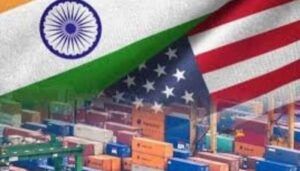
The imposition of 50 percent tariffs on Indian exports to the U.S., calls on the European Union to impose 100 percent tariffs on India, the revocation of the U.S. sanctions waiver for the operation of Iran’s Chabahar Port—of great interest to the Indian government—the sanctions on Indian firms and individuals trading in Russian oil, and, as a final nail in the coffin, the decision to set a $1,000 fee for applying for an H-1B visa: India has been dealt blow after blow by the U.S. and the Trump administration within the past couple of months.
Calling India, the “tariff king,” Trump imposed a 25 percent tariff on India goods, essentially because India refused to subject its peasantry —whose average farm size is 2.5 acres— to competition from highly subsidised large U.S. farmers, whose average farm size is 466 acres. He further imposed an additional 25 percent tariff while bizarrely accusing India of financing Russian persecution of Ukraine. One might be forgiven for mistakenly attributing the devastation in Ukraine to India and China rather than the U.S.-led NATO proxy war with Russia.
India’s textiles, leather goods, gems, and jewellery industries, which are largely small- and medium-scale and labour-intensive, have been hit hard by the tariffs. While electronics have so far been exempted, last week’s announcement of 100 percent tariffs on certain pharmaceutical products sent jitters through India’s pharmaceutical industry, which supplies 40 percent of the generic drugs imported by the U.S. The full impact of these tariffs is not yet known.
The tariff blow had barely subsided when India was challenged again by sanctions on Iran’s Chabahar Port, a facility that India developed and operates.
Chabahar Port perhaps, is the most important project that India has undertaken abroad, a critical part of India’s strategic connectivity. It provides India access to Afghanistan and Central Asia while bypassing Pakistan, with which India has long had hostile relations. The port is also central to India’s trade strategy of linking with Europe and Eurasia through the International North-South Transport Corridor in partnership with Iran and Russia, which will greatly reduce the cost of transporting goods from India to northern Europe through multimodal transport. When U.S. sanctions on Iran threatened this project, India, during Trump’s first term, obtained a waiver for Chabahar Port. Now that waiver has been nullified, as the Trump administration has reinstated sanctions on Chabahar Port, whose operator is an Indian state-owned corporation.
The Trump administration has turned the screws further, deliberately or not, on India with the steep hike of H-1B visa fees for migrant workers to $1,000. In recent years, an estimated 70 percent of H-1B visa recipients have been Indians. The U.S. has become an increasingly important source of foreign remittances to India, with nearly 28 percent of remittances from Indian migrant workers coming from the United States. These high visa fees, which most migrant workers cannot afford, also make hiring Indian workers expensive for U.S. firms, and are likely to sharply reduce Indian remittances. Foreign remittances are critical for India’s balance of payments, which runs a large trade deficit.
The shock of these series of actions to the Indian establishment has been huge. Trump single handedly upset India’s long-held assessment of its own relationship with Washington. Since Obama’s ‘pivot to Asia’ to contain China, successive Indian governments have embraced U.S. claims that ties with India would be among its most consequential relationships of the 21st century. On this basis, India increasingly staked its economic strategy and foreign policy on a trajectory of ever-closer geopolitical alignment with the U.S.
As a result, the Indian government and establishment seem at a loss on how to react to Trump’s various announcements, which are not only going to produce an immediate economic fallout for India, but also hurt its long-term economic and geostrategic plans.
The government’s reactions to the tariffs have been subdued so far. Unlike Brazil or China —where the presidents of both countries reacted strongly and openly to Trump’s threats, refusing to be threatened—the Indian prime minister chose to maintain silence while studiously refrain from talking about tariffs or the other issues.
Even though international media made much of Modi’s meeting with Putin and Xi Jinping at the Shanghai Cooperation Organization (SCO) summit in Tianjin, there is little evidence that this represents any geopolitical reorientation on the part of the Indian government. Immediately after the summit, during the visit of Germany’s foreign minister, he declared in a joint press conference India and Germany’s commitment to a ‘rules-based world order’ and the ‘freedom of maritime trade routes in the Indo-Pacific,’ and went so far as to claim that China’s increasingly aggressive behaviour in the region is a cause for concern for both countries, while India’s External Affairs Minister watched in silent agreement. Apparently, the Indian government is still betting India’s future on a closer alignment with the West.
Convinced of its vital role in helping the U.S. contain China, the Indian establishment believed it could maintain strategic autonomy. This autonomy —a necessity for India’s economic and strategic needs— meant keeping good relations with U.S. adversaries like Iran and Russia, a position it assumed the U.S. would tolerate.
With Trump’s second term, the Indian elite clearly realized the costs of linking itself with the U.S.: India can only be a subordinate ally. This means its national interests and sovereignty must be secondary to American priorities and the maintenance of U.S. hegemony. Though the Indian state resists this acknowledgment —hoping this difficult phase is merely temporary and attributable to Trump’s personality— it is facing a serious erosion of its capacity to direct its own economy and polity, safeguard its citizens’ welfare, and maintain sovereignty.
[Srujana Bodapati works in the area of agrarian relations in India, having participated in several studies around the country. She often writes on issues in the Indian Economy. Courtesy: Globetrotter, a project of Independent Media Institute, a nonprofit organization that educates the public through a diverse array of independent media projects and programs.]
❈ ❈ ❈
India’s Russian Oil Saga is Indeed Ending
M.K. Bhadrakumar
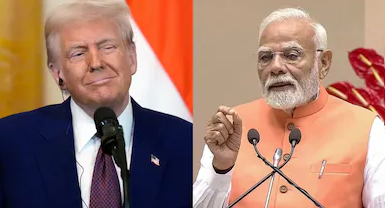
The latest US-Indian fracas over Russian oil has been rather odd with Trump attributing to PM Modi explicitly that India has terminated its imports of Russian oil. Why would Trump bluff?
One possibility that needs to be explored is what our trade negotiators camping in DC actually conveyed to their American counterparts, which the latter would have transmitted to the White House, whereupon, Trump added, typically, a touch of swagger to it.
Americans must be emboldened by the news that our public sector oil companies have already terminated the oil purchases from Russia presumably on instructions from the government. In fact, Reuters reported quoting a White House official on Thursday that Indian refiners are already cutting Russian oil imports by 50%.
The government must clarify the state of the play instead of parrying. If the game plan is to taper off the oil purchase and switch to American supplies, which is evidently Trump’s agenda to capture the expanding Indian market and dominate our energy policies, it will willy-nilly surface.
Our style of functioning vis-a-vis Trump presidency continues to be messy. Why is it that Trump calls Pakistan’s COAS a ‘great’ man and showers praise, while derisively disposes of the UK PM Keir Starmer or Italy’s Giorgia Meloni — or attributes false statements repeatedly to Modi?
We must introspect how we landed in a cul-de-sac. Trump likes to dominate others but is selective. Quite obviously, he no longer bullies North Korean leader Kim Jong-Un. It is about time to do some soul-searching.
This is important because the present standoff is not really about Russian oil, but is about India’s future role in the American foreign policy strategies. It is linked to India’s potential rise as a great power. I heard a riveting podcast recently on international security where the renowned American author and strategic thinker Jeffrey Sachs kept referring to India as one of the 4 great powers in world politics — aside the US, China and Russia.
In this quartet, the US faces growing isolation unless it lures India to its side as a subaltern, a role that ‘Global Britain’ gladly performed in a previous era. This predicament is at the core of the US’ blatant attempt to erode India’s time-tested relations with Russia. The US is zeroing in on the two core areas of India-Russia relationship, namely, energy and defence without which the relations get hollowed out.
Similarly, it is no secret that the serious efforts to improve our relations with China dating back to last October have not been to the liking of the US establishment. For one thing, the US fears that any strengthening of India-China ties would generate for New Delhi the strategic depth to double down on its independent foreign policy and create space for its diplomacy to push back the US pressures (eg., the diplomatic row with the Biden White House over GOI’s alleged trans-national crimes.)
On the other hand, the spectre that haunts the US is that once the Sino-Indian normalisation gets traction, the moribund RIC (Russia-India-China) platform may become reality, which would have profound impact on the international system and world politics, including the preservation of dollar as the world currency. Equally, RIC will not only discredit the US’ exceptionalism and challenge its hegemony but also sound the death knell for the US’ containment strategy against China.
Suffice to say, the present standoff is not confined to Russian oil. Make no mistake, the Americans will pull out all the stops if push comes to shove. Our main problem is the fragmentation within our divided house. I mean not only the political opposition but also the elements working as US lobbyists in our country.
The infiltration by the US intelligence has been pervasive in the post-cold war decades, and it includes even the Diaspora in America, especially those who have violated the relevant US laws by transferring funds to India. Certainly, the sensational case against Ashley Tellis in a US federal court conveys a message for Delhi, too, that the FBI, which we fancied to be a friendly entity, is flexing its muscle.
Curiously, the Indian media has abruptly moved away from the stunning news of Tellis’ arrest last month. After all, he enjoyed our patronage, holding the prestigious position of the Tata Chair at the Carnegie, which was virtually created to enhance his standing as a think tanker and influencer in DC.
The Indian media has given a slant that Tellis might have worked for China. But his recent writings speak otherwise; he continued to be critical of our friendly relations with Russia and Iran, and argued for a course correction with regard to India’s strategic autonomy and independent foreign policy.
In one of his recent essays published in the Foreign Affairs, the flag carrier of the US establishment, entitled India’s Great-Power Delusions (July/August 2025), Tellis’ thesis was that India’s present foreign-policy trajectory jeopardised its role and relevance in the emergent scenario of international politics characterised by the intensifying competition between the US and China, which is at the very core of geopolitics in the coming period — in sum, voicing frustration that India is not closely aligning with the geo-strategies of the Trump administration. Indeed, Tellis’ downfall remains a riddle wrapped in mystery inside an enigma.
The bottom line is that India’s diplomacy has no alternative but to develop the stamina of a long distance runner in order to retain its strategic autonomy. Don’t expect Trump’s reprieve even if India ends all oil imports from Russia. The pressure tactic will continue. Notably, Trump voiced optimism about ‘nice’ India-Pakistan relations soon, from the podium of the 2025 Gaza peace summit at Sharm-al-Shaikh, Egypt, in the presence of PM Shahbaz Sharif who was caught on the camera quietly chuckling.
We overlook the alchemy of the ‘Uniparty’ phenomenon in the US party system which ensures foreign policy consensus and is a legacy of the Cold War era, so that administrations may come and go but the compass set by the permanent establishment and deep state remains immune to major deviations. Simply put, our tendency to demonise Trump misses the woods for the trees.
There are times when India should stand up without hesitation and voice its indignation over the US’ pressure tactic. This is one such moment. Compare the forthright stance taken by the Chinese foreign ministry spokesman in Beijing while replying to a question regrading Trump’s remarks on Wednesday about India and China buying Russian oil:
“China has made clear its position on this issue more than once. China’s normal trade and energy cooperation with other countries, including Russia, is legitimate and lawful. What the U.S. has done is typical unilateral bullying and economic coercion, which will severely disrupt international economic and trade rules and threaten safety and stability of global industrial and supply chains.
“China’s position on the Ukraine crisis is objective, just and aboveboard. The world can clearly see that. We firmly oppose the U.S. directing the issue to China and imposing illicit unilateral sanctions and long-arm jurisdiction on China. If China’s legitimate rights and interests are harmed, China will take countermeasures to firmly defend its sovereignty, security and development interests.”
The Indian statement, in comparison, is evasive and digressive and is open to interpretation, leaving a sense of disquiet that there can’t be smoke without fire somewhere. The saddest part is that when Trump only demanded us to bend, we are now, after such bombastic rhetoric and bravado, are crawling in front of him. It demeans India and makes it a laughing stock of the entire Global South.
[Ambassador M.K. Bhadrakumar served the Indian Foreign Service for more than 29 years. Courtesy: Indian Punchline, the author’s blog.]