When Julian Jackson saw a Facebook livestream in mid-December showing a U.S. Border Patrol convoy snaking north up DuSable Lake Shore Drive toward his neighborhood in Chicago, Illinois, he headed toward the caravan to catch it from behind. Jackson and his fellow rapid responders in the city’s northern Rogers Park neighborhood, as well as the nearby Edgewater and West Ridge neighborhoods and the city of Evanston, Illinois, had learned a day earlier that Border Patrol’s “commander-at-large,” Gregory Bovino, was back in Chicago for what would end up being a forty-eight-hour grandstand of scattershot detentions and staged photo opportunities.
After warning others via text on an alert channel, Jackson used an alleyway to avoid a Chicago police roadblock and spotted a Black Hawk helicopter overhead, which helped him navigate to his destination. Rogers Park responder Jose Rizal soon saw the convoy exit the expressway. “We knew we could be in trouble,” Rizal told me days later. “We knew we had to get our people out into the street.” I spoke with local residents and used press reports and social media video postings to reconstruct how responders alerted the North Side community on that December 17 morning. Dozens of community members, many with phone cameras, sped outside to patrol, equipped with the orange whistles now carried by immigrants rights activists citywide, to blow either in quick bursts, indicating federal agents were nearby, or long bursts, if someone was being arrested.
But instead of invading Rogers Park, the Border Patrol agents traveled north toward suburban Evanston, where local responder Allie Harned alerted Evanston schools and directed patrol members to the Home Depot, Walmart, and Target stores nearby. At a Mobil gas station, Bovino touted the Border Patrol’s work on camera until Evanston’s mayor, Daniel Biss, confronted him. Residents blowing whistles surrounded Biss and Bovino, trilling like a flock of alarmed geese. These whistles have become more than an effective warning call in the growing numbers of cities the Trump Administration has recently been targeting for immigration enforcement, including Minneapolis, Minnesota; Charlotte, North Carolina; Memphis, Tennessee; New Orleans, Louisiana; and Columbus, Ohio. Whistles are sounding a collective outcry against violations of human bodies and human rights.
● ● ●
Historically, civil disobedience actions in which protesters place their bodies on the line to resist injustice are a key component of nonviolent direct action. Renowned examples include the 1960s civil rights era lunch counter sit-ins to end racial segregation, ACT UP’s 1990 storming of the National Institutes of Health to demand HIV treatments, and the 2020 racial justice protests following the murder of George Floyd, where activists around the country removed Confederate monuments and, in Portland, Oregon, blocked traffic with an eight-minute-and-forty-six-second die-in.
Civil disobedience in the name of liberation can be politically transformative and indelibly stamp collective memory. But the most impactful forms right now may be the everyday functional confrontations like Chicago’s rapid response efforts that are disrupting the federal machinery at the places where harm is being inflicted—supermarkets, schoolyards, courthouses, and deportation centers.
Traditional civil disobedience remains instrumental after this first, ruinous year of the second Trump Administration, as it was during Joe Biden’s and Barack Obama’s presidencies. It has been especially impactful on issues of immigration rights, climate justice, and solidarity with Palestine—all causes that, under today’s sweeping authoritarian assault, have become profoundly intertwined. For instance, the climate justice-focused Sunrise Movement has staged protests at U.S. Immigration and Customs Enforcement (ICE) facilities. In March 2025, Jewish Voice for Peace held a mass sit-in at Trump Tower in New York City to demand the release of Palestinian peace activist Mahmoud Khalil, who had been abducted by ICE agents. Eleven New York City officials and other activists were arrested in September when they demanded that they be allowed to inspect conditions inside a lower Manhattan ICE detention center. Forty-two Bay Area religious leaders chained themselves to a federal immigration court building in San Francisco, California, last December.
But under an authoritarian government that wages violence and feeds on chaos to sustain power, confrontational protest has become far more risky. Ill-trained Homeland Security agents often brutalize protesters, journalists, and bystanders. President Donald Trump has deployed National Guard troops to several cities led by Democrats on the pretext that protesters are “terrorists,” explicitly threatening to unleash the U.S. military against them and potentially invoking the 1807 Insurrection Act. In these conditions, the real-world consequences of committing legal civil disobedience versus engaging in street-level direct action are similar: Trump, Homeland Security Secretary Kristi Noem, and Attorney General Pam Bondi deem any interference with their operations as an attack on federal law enforcement and by extension, the regime itself. Following an ICE agent’s murder of Minneapolis resident Renée Nicole Macklin Good in early January, Homeland Security made this extreme position clear by classifying protesters who block ICE vehicles as domestic terrorists.
Entering the current administration’s second year, activists considering aggressive direct action face an acute tension between increasing political urgency as suffering deepens and the constant threat of retaliation.
● ● ●
It was a rare success when 200 protesters foiled a September ICE raid in downtown New York City, perhaps largely because Manhattan’s unique geographic and demographic density helped activists rapidly assemble against federal agents who rely on striking quickly. Activists in other U.S. cities are more vulnerable.
Compared to a demonstration in a fixed location such as the Broadview ICE facility outside of Chicago or an encampment, rapid response as a form of protest is not as easily targeted because it is embedded in the community infrastructure. Chicago, a city historically built of neighborhoods, has a highly developed citywide anti-ICE rapid response network. North Side community groups like Protect Rogers Park (PRP) communicate regularly with others like the group in Brighton Park on the Southwest Side, the area with the city’s highest concentration of Spanish speakers.
PRP has refined its ground game since it was founded in 2017, says lead organizer Jill Garvey. Consequently, the group was able to quickly scale up its response activity last September when Trump ordered “Operation Midway Blitz.” She describes a layered response of more than 4,000 volunteers in Rogers Park who keep in contact with activists in nearby communities. “In any given neighborhood there may be school safety groups, bike patrols, or smaller groups organizing to protect churches, daycares, food pantries, or other sensitive places,” she explains. Immigrant sub-communities have also formed networks. On the North Side, a group of more than 200 Latine gardeners, many vulnerable to ICE arrest, connects through its own alert channel.
School rapid response teams run by parents and neighbors report ICE sightings to staff and often include them in a Signal alert channel. All nine schools in the West Ridge neighborhood that borders Rogers Park have their own teams, according to West Ridge coordinator Hector Ruiz. In November, Garvey says ICE appeared across the street from a Rogers Park high school where elementary students were visiting, prompting the school to lock down. “When the word went out about those five-year-olds being stuck there, at least 100 parents and community members mobilized to patrol the neighborhood, monitor intersections, and escort the kids back to their school,” she says.
Chicago organizers have also shared their experiences with responders in other cities now facing ICE and Border Patrol operations. Garvey said that on the first day of the Trump Administration’s operation targeting the Somali community in Minneapolis last December, PRP did an online training for more than 1,000 Twin Cities residents. Garvey, who also works through an activist nonprofit that she co-founded called States at the Core, has helped develop rapid response networks in New Orleans, Columbus, and Charlotte.
● ● ●
While rapid responders directly address ICE assaults as they occur, other creative activists, in a kind of unspoken partnership, demonstrate at ICE facilities, often through offbeat, subversive performance art. Some also engage in civil disobedience, but these theatrical activists undercut the mechanisms of repression more by breaking norms than laws. In Portland, Oregon, a city known for freestyle, leaderless insurgency, protesters outside the city’s ICE processing center have dressed in blow-up animal costumes, including frogs, that lampoon Trump’s fearmongering assertion of antifa agitators run amok. They have captured the media with iconic absurdity, offering the image of an undulating chicken facing off against a masked ICE operative who patrols the sidewalk with a Glock 19 semi-automatic pistol. “Being silly in the face of tyranny is very much a Portland thing,” says protester Nadya Malinowska, a community health advocate who has been arrested three times outside the ICE processing center.
During the “No Sleep for ICE” protests, community members locate hotels where ICE agents are staying and serenade them all night by banging pots and pans. In Los Angeles, California, which responded powerfully to repel Trump’s deployment of the National Guard in June, one woman played the lighthearted role of filming ICE vehicles from behind, then posting “Spending quality time with ICE” videos on TikTok. “Creative resistance is especially important when confronting an increasingly authoritarian administration that is always out to paint its opponents as radical, violent agitators,” says Jamie Henn, co-founder of 350.org, a climate justice organization with chapters across the United States. The group led the 2013 White House Keystone XL action, during which more than 1,200 people were arrested, helping push the Obama Administration to ultimately drop support for the pipeline. He explains that sometimes the most innovative, outside-the-box spectacle might later appear to be straightforward: “What seems obvious now, like lunch counters in the Civil Rights Movement, wasn’t then.”
The Handmaid Army is a group of women who parade silently in macabre unison dressed in the red hooded cloaks and face-obscuring white bonnets from the chilling dystopian novel and television series The Handmaid’s Tale. They have marched in front of the Lincoln Memorial, the U.S. Supreme Court building, Trump Tower, and the offices of Fox News to dramatize that fascism subjugating women’s bodies is no longer speculative fiction. “Shame, shame,” they chant, publicly turning the televised drama’s weaponized misogynist chorus against the male supremacist Trump Administration.
Dramatic actions like the wild Portland animal displays, “No Sleep For ICE,” and the Handmaid Army marches often unsettle everyday routines, highlight abuse, energize morale, and build community. While they do not generate immediate concrete policy change or provide direct aid, their effect is better understood as a strategic alliance with the organizations that do substantive work. Alyssa Walker Keller, a coordinator for the Portland Immigrant Rights Coalition (PIRC), refers to the protesters outside the city’s ICE processing center as “our neighbors.” PIRC, located strategically across the street, oversees several thousand volunteer rapid responders statewide, posts regular alerts on its website, and provides legal support and direct aid.
● ● ●
Current direct action protests face the dual challenge of a dictatorially oriented government that does not negotiate and a conflict-avoidant Democratic Party that often cedes its limited Congressional leverage—though bolder activist mayors like New York City’s Zohran Mamdani and Chicago’s Brandon Johnson are pushing from below.
Organizations in recent decades that have successfully carried out direct action, such as ACT UP in the 1990s or 350.org and its climate justice allies in the 2010s, influenced democratic institutions insisting on specific demands.
Sarah Schulman, an ACT UP historian and professor at Northwestern University, cautions that “doing actions when they’re not tied to a demand ultimately dissipates energy.” But she notes that current actions weave into a larger fabric of resistance. “There are people on the street blowing whistles at ICE, people in New York who elected a mayor we hope will arrest ICE, people disrupting ICE vehicles and demonstrating and getting arrested at detention centers. The movement is a conscious or unconscious coalition of communities responding to what’s happening.”
So how will direct action strategies interplay with other forms of protest as national power dynamics inevitably evolve throughout 2026?
Progressives are continuing to overcome their initial disorientation of a mind-bending, multifront, Supreme Court-enabled, Project 2025-driven onslaught against immigrant communities, the federal workforce, veterans, LGBTQ+ people, public health, K-12 education, colleges and universities, free speech, reproductive freedom, DEI, and environmental and foreign aid programs—all while the Trump Administration has militarily occupied the nation’s capital and other cities; threatened or carried out attacks on European, North American, and Latin American countries; and fueled the Israeli genocide in Gaza. The list is staggering, and activists have not yet created a road map to navigate such an unprecedented, overarching authoritarian assault.
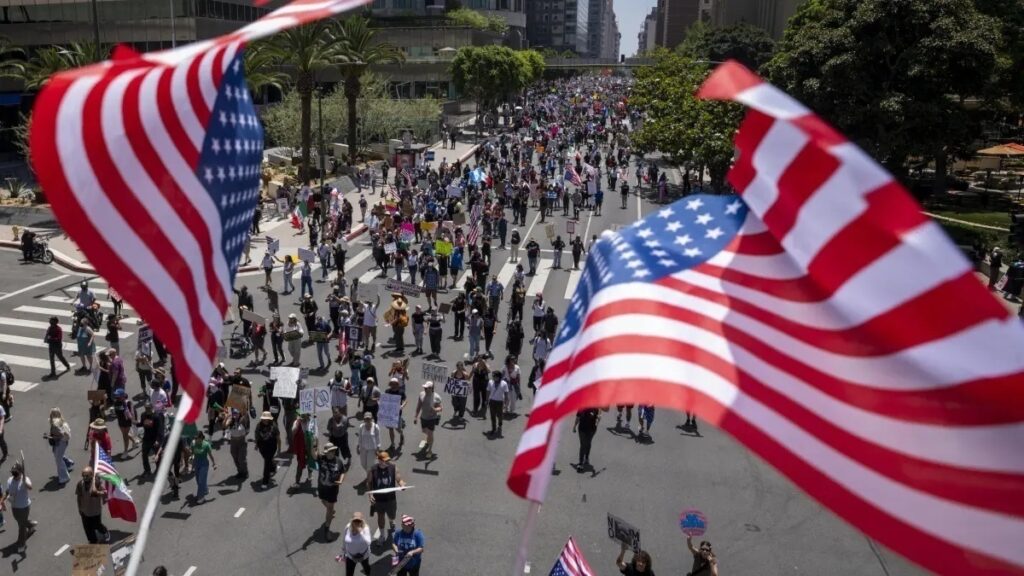
As the shock recedes and activists test effective strategies, build alliances, and mentally fortify themselves through crises, they’re likely to further develop both modest and aggressive direct action methods that complement more traditional protest like the massive No Kings marches and legislative and electoral work at the national, state, and local levels.
The Politics of Nonviolent Action by political scientist Gene Sharp is an intriguing playbook that categorizes a taxonomy of 198 direct action methods to challenge power by impeding its operation or withdrawing compliance. The list includes strikes, boycotts, walkouts, work slowdowns, occupations, invasions, unauthorized assemblies, financial default, and conscientious objection. Additional tactics include violating dress codes, leaking documents, and damaging tools or equipment. Last fall Brandon Johnson became the first mayor to sign an executive order declaring his city an enforceable “ICE-Free Zone,” prohibiting use of parking lots, garages, and other city-owned property for federal immigration operations. Since then, Evanston and several Bay Area municipalities have passed similar resolutions and ordinances.
Throughout this past year, a resistance movement representing varied constituencies that have often worked separately and protested differently has emerged—and has an opportunity to integrate the work of its different parts. The attacks on immigrants wielded by an unaccountable domestic military force is a compelling movement unifier because this repression cuts across so many other social justice concerns.
The Sunrise Movement and Jewish Voice for Peace continue to use direct action in campaigns that link immigration justice to the climate crisis and Palestinian rights. Sunrise is part of a coalition of groups planning large-scale student strikes for May 2026 that will build on a one-day action last November at more than 100 colleges. A key question for the coming spring is whether college students, traditionally pivotal leaders of direct action, will reinvigorate their activism after the dismantling of Palestine solidarity encampments and amid free speech repression on campuses.
Every day, the nation collectively witnesses horrific violence against the most vulnerable among us. Street-level support people around the country, like Chicago’s rapid response volunteers, not only provide direct aid and protection, but double as crucial documentarians. Anyone with an orange whistle, cellphone, or an Instagram account can contribute.
So, while Border Patrol’s Bovino, faceless ICE agents, and U.S. military forces continue raiding the streets, the communities that own them are already repelling the machine.
[Erik Gleibermann is a San Francisco-based social justice journalist. He has written for The Atlantic, The New York Times, The Washington Post, The Guardian, Slate, Black Scholar, and World Literature. Today, where he is a contributing editor. His memoir-in-progress is titled Jewfro American. Courtesy: The Progressive Magazine, an American magazine and website of politics, culture and progressivism with a left-leaning perspective.]