❈ ❈ ❈
Bogota Summit Launches Global South’s Legal Intifada Against Israel and US Impunity
José Niño
From 15–16 July, Bogota became the unlikely capital of a global insurrection against western legal impunity. Over 30 countries – including key powers from the Global South and even some European states – gathered in the Colombian capital for the Hague Group Emergency Summit.
This was the most ambitious multilateral initiative yet to directly confront what participants unflinchingly termed Israel’s genocide in Gaza, and the broader culture of impunity that has shielded the occupation state since 1948.
From steadfast client to anti-imperial spearhead
That the summit was held in Colombia – a long-standing US vassal in Latin America – was not incidental. Once regarded as Washington’s most loyal client in the hemisphere, Colombia’s dramatic pivot under President Gustavo Petro represents the boldest regional defiance of US authority in decades.
Petro, who severed diplomatic ties with Tel Aviv in 2024, has placed Bogota on a collision course with the US over his unwavering opposition to the occupation state’s onslaught in Gaza.
Washington reacted predictably by issuing warnings to allies against the “weaponization of international law,” and sanctioning UN Special Rapporteur Francesca Albanese for her “illegitimate and shameful efforts” to advance the International Criminal Court’s (ICC) prosecutions of Israeli and US officials. Bogota responded with direct defiance. In the run-up to the summit, Petro publicly backed Albanese, declaring that “the multilateral system of states cannot be destroyed,” in a thinly veiled rejection of US diktats.
Over 30 nations participated, including the eight founding members of the Hague Group – Bolivia, Colombia, Cuba, Honduras, Malaysia, Namibia, Senegal, and South Africa, co-chaired by Colombia and South Africa. They were joined by more than 20 additional states spanning Latin America, Africa, Asia, and even Europe.
The participation of European countries such as Portugal and Spain was noteworthy. Both states only established full diplomatic relations with Israel in the latter half of the 20th century: Portugal in 1977 and Spain in 1986, emblematic of their historic caution over Israel’s contested legitimacy.
But since Tel Aviv’s genocidal war on Gaza began in late 2023, Madrid has adopted a string of punitive diplomatic moves.
Spain canceled a €6.6 million (around $7.2 million) ammunition purchase from an Israeli firm, scrapped a €285 million (around $310.7 million) anti-tank missile deal with the Spanish subsidiary of Rafael Advanced Defense Systems, banned Israeli weapons from port entry, formally recognized Palestinian statehood, and pushed to suspend the EU–Israel Association Agreement.
Though neither European state fully endorsed all of Bogota’s proposals, their participation and scathing denunciations of Israeli policy reflect a deeper fracture within Europe over Tel Aviv’s legitimacy and the cost of complicity.
Laying the legal gauntlet
Central to the summit was a blistering legal and moral condemnation of Israel’s conduct in Gaza and the occupied West Bank. The Hague Group issued a detailed catalog of war crimes: the mass killing of over 57,000 civilians, the targeting of hospitals and schools, the weaponization of starvation and siege, and the deliberate use of forced displacement.
The apartheid state in the occupied West Bank, enforced through racial segregation, parallel legal systems, and land confiscations for settlements, was cited as a textbook violation of the Fourth Geneva Convention and, per the International Court of Justice’s (ICJ) 2024 advisory opinion, a breach of international prohibitions against forced territorial acquisition and apartheid.
Francesca Albanese delivered the summit’s keynote, setting the tone with an uncompromising indictment:
“For too long, international law has been treated as optional – applied selectively to those perceived as weak, ignored by those acting as the powerful … That era must end.”
The ICC arrest warrants against Israeli Prime Minister Benjamin Netanyahu and former Defense Minister Yoav Gallant – citing crimes such as starvation as a weapon, indiscriminate civilian targeting, and the murder of Palestinian non-combatants – were repeatedly invoked as a historic turning point.
The Resistance Axis of lawfare
The summit’s ethos was clearly to rupture the impunity enabled by the UN Security Council’s paralysis. The Hague Group, founded in January 2025, framed itself as the Global South’s corrective to a postwar order that protects violators so long as they are shielded by US power.
That paralysis, most attendees argued, was not accidental but structural: The P5 veto system ensures impunity for those, such as Israel and its allies.
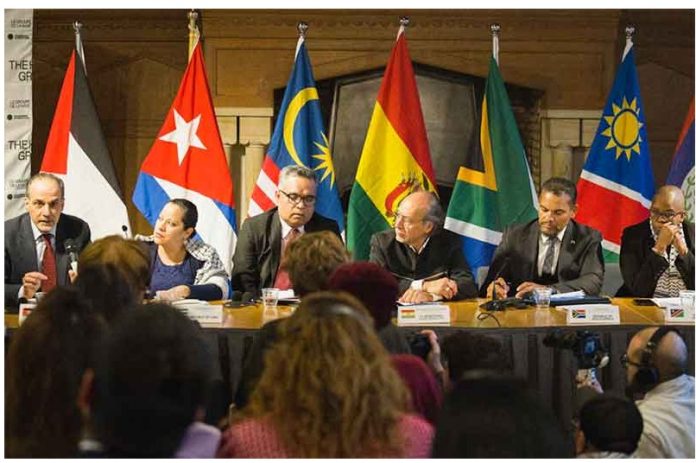
Meeting in the San Carlos Palace, delegates from 12 states – Bolivia, Colombia, Cuba, Indonesia, Iraq, Libya, Malaysia, Namibia, Nicaragua, Oman, Saint Vincent and the Grenadines, and South Africa – announced six binding measures. These included a full arms embargo on the occupation state, port bans for Israeli military vessels, contract reviews to terminate commercial complicity with the occupation, and firm support for domestic and international prosecution of Israeli officials.
These policies were anchored in the ICJ’s 2024 opinion declaring Israel’s occupation illegal and the UN General Assembly’s September 2024 resolution urging decisive global action within 12 months.
A global rift – but still an uphill battle
Despite the breakthrough, significant limitations remain. Only 12 states adopted the measures outright. Others were given until the UN General Assembly in September to sign on. Key powers, including China, withheld endorsement – despite supporting the initiative’s aims – likely due to economic entanglements with Israel, including port infrastructure investments.
Organizers acknowledged the uphill road ahead: absent broader UN uptake and stronger alignment from economic powers, Washington’s veto and European hesitation could neuter the Hague Group’s legal insurgency. But the coalition remains adamant that justice is no longer negotiable.
Colombian Vice Minister Mauricio Jaramillo Jassir captured the summit’s urgency:
“The Palestinian genocide threatens the entire international system … The participating states will not only reaffirm their commitment to opposing genocide, but also formulate concrete steps to move from words to collective action.”
A warning – and a promise
The Bogota summit was not just another international conference. It openly challenged the post-1945 legal fiction of a “rules-based order” – a system long exposed as a euphemism for western prerogative.
As South Africa’s International Relations Minister, Roland Lamola, asserted, “No country is above the law, and no crime will go unanswered.”
Yet the struggle remains unfinished. The Hague Group’s bold confrontation with Israeli impunity marks a decisive break, but the future of this legal uprising hinges on whether its momentum can breach the fortified walls of New York and The Hague, and whether powers like China, India, and Brazil shift from quiet endorsement to active alignment.
On 16 July, as thousands gathered in Plaza Bolivar in support, the message was unambiguous: either the era of impunity ends, or the legitimacy of the global order collapses with it.
(Jose Nino is a freelance Colombian writer specializing in Latin American affairs and the foreign influences impacting Europe’s right-wing parties. Courtesy: The Cradle, an online news magazine covering the geopolitics of West Asia from within the region.)
❈ ❈ ❈
In Colombia, The Hague Group Charges Israel With Genocide
Jose Olivares
On Tuesday, ministers and officials from over 30 countries gathered in Bogotá, Colombia to convene The Hague Group, an international organization co-chaired by the governments of Colombia and South Africa. The two-day conference will discuss steps forward for the international community to stop Israel’s ongoing genocide of Palestinians.
The gathering comes amid heightened aggression from the U.S. government against the “emergency conference” and one of its lead speakers—Special UN Rapporteur for the West Bank and Gaza Francesca Albanese—as Israel continues to sabotage negotiations between Israel and Hamas.
Dozens of government officials from around the globe took to San Carlos Palace, the site of the Colombian Ministry of Foreign Affairs, in downtown Bogotá on Tuesday morning. Cameras, mostly from Colombian news organizations, pointed to the front of a large salon, with over two-dozen flags making up the backdrop for a panel of speakers from across the world. The countries represented at the emergency conference this week include Algeria, Bolivia, China, Brazil, Iraq, Lebanon, Nicaragua, Oman, Pakistan, Spain, Turkey, and Venezuela.
The Hague Group was created last year through the help of Progressive International, an organization founded in May 2020 to unite, organize, and mobilize progressive forces around the world. The Hague Group is pushing for an end to Israel’s offensive, and has organized this week’s emergency conference. Other organizations, including international human rights groups and organizations advocating for Palestinian rights, are present such as the Hind Rajab Foundation. Notably, Qatar and Egypt, which are overseeing negotiations between Hamas and the Israeli government, are in attendance.
“There is nothing to negotiate about. Israel needs to withdraw from Gaza totally and unconditionally,” Albanese told Drop Site News during a press conference on Tuesday afternoon when asked about the negotiations between Hamas and Israel. “This is the first thing. And then Israel owes huge reparations to Palestinians for what it has done,” she added.
The conference marks an inflection point for how some states will address the ongoing slaughter of Palestinians by Israeli military forces. Some governments and officials are divided in their approach to pressure Israel, with some officials more hesitant than others on whether to call for the severance of diplomatic relations and whether to place sanctions on Israel.
Some government officials will be meeting in private during the week for high-level negotiations. Government officials from several countries will all be meeting in closed-door sessions on Tuesday to discuss the Hague Group’s proposed measures. It is unclear what those proposed measures are, but they are likely to be announced on Wednesday morning during the closing ceremony. In Tuesday’s closed-door meetings, Albanese presented her expertise to international officials.
“The Bogotá conference will go down as the moment in history that states finally stood up to do the right thing,” Albanese had said in the lead-up to the conference. She called the formation of The Hague Group the “most significant political development of the last 20 months.”
During Tuesday morning’s opening event, various officials spoke, calling for an end to Israel’s attacks on Gaza. Colombia’s foreign minister, Rosa Yolanda Villavicencio, said during her morning address that Israel’s attacks constitute an unequivocal “genocide.”
The meeting comes amid heightened aggression by the U.S. government toward the Hague Group, and the escalation of diplomatic tension between the U.S. and Colombia.
In an official statement to Drop Site, the U.S. State Department said it strongly opposed the Hague Group’s meeting in Colombia.
“The United States strongly opposes efforts by so-called ‘multilateral blocs’ to weaponize international law as a tool to advance radical anti-Western agendas,” a State Department official said. “The so-called Hague Group—whose leading voices are South Africa and Cuba, authoritarian and communist regimes, respectively, with deeply troubling human rights records—seeks to undermine the sovereignty of democratic nations by isolating and attempting to delegitimate Israel, transparently laying the groundwork for targeting the United States, our military, and our allies.”
The U.S. will “aggressively defend our interests, our military, and our allies, including Israel, from such coordinated legal and diplomatic warfare. We urge our friends to stand with us in this critical endeavor.” The Trump administration withdrew the U.S. from the UN Human Rights Council earlier this year.
Annelle Sheline, a former foreign affairs officer at the State Department who resigned in March 2024 over the slaughter in Gaza, is attending the week’s proceedings. In response to the attempt by the US State Department to bully participating countries at the emergency meeting of the Hague Group, she told Drop Site, “These are sovereign states who have every right to uphold their obligations as UN members, including under the UN Convention on the Prevention and Punishment of the Crime of Genocide.” She added, “This is not the weaponization of international law. This is the application of international law.”
Last week, Secretary of State Marco Rubio announced sanctions on Francesca Albanese, who has strongly condemned Israel’s U.S.-backed military assault. Rubio said that the sanctions on Albanese are due to her “illegitimate and shameful efforts” to prompt International Criminal Court action against U.S. and Israeli officials, companies, and executives. “Albanese’s campaign of political and economic warfare against the United States and Israel will no longer be tolerated,” he added.
During the press conference, Albanese stressed that nations should sever ties with Israel and place sanctions on Israel. Regarding the sanctions placed on her by Marco Rubio: “it’s not about me. It’s about the Palestinian people,” saying that it is symbolic. Although she is shaken by them, she said, the sanctions are representative of the ongoing war and the US’s complicity
“There is hope that these two days will move all present to work together to take concrete measures to end the genocide in Gaza and, hopefully, end the erasure of the Palestinians,” Albanese said during her morning address at the opening of the emergency conference, calling for states to take significant steps forward to address the genocide.
Albanese called for each state to “immediately review and suspend all ties with Israel,” and called on governments to review the “military, strategic, political, diplomatic, economic relations—both imports and exports” with Israel and to “make sure that their private sector, insurers, banks, pension funds, universities, and other goods and services providers in the supply chains do the same.” Albanese has recently issued a report naming U.S. companies as complicit in Israel’s war.
“These ties must be terminated as a matter of urgency,” Albanese added. “Let’s be clear: I mean cutting ties with Israel, as a whole.”
Colombia: Host Against Genocide
That the emergency conference is taking place in Colombia is significant and symbolic. Last year, Colombian president Gustavo Petro cut diplomatic ties with Israel, due to the genocide in Gaza. Petro, an outspoken critic of Israel and the U.S., had faced mounting pressure by the U.S. government as well.
During Trump’s first weeks in office, tensions escalated between both governments when Colombia refused to accept a group of deportees from the U.S., who were shackled and being transported in a military plane. Trump and Petro engaged in a loud, public spat on social media, leading to threats of tariffs leveled by both countries.
The brief flare-up was not a blip in U.S.-Colombian relations. In recent weeks, tensions have radically escalated. In early July, the U.S. and Colombian governments both recalled their respective ambassadors, due to escalating tensions in both countries.
According to reporting from El Pais, former Colombian Foreign Minister Álvaro Leyva, who had a public falling out with president Petro after he was investigated for allegations of corruption, allegedly sought help from U.S. Republicans to oust Petro. Levya was unsuccessful. In April, Leyva publicly accused Petro of being addicted to drugs.
After the allegations of the attempted ouster surfaced, Petro publicly criticized Leyva and the U.S. government. In turn, the U.S. recalled its top diplomat for “urgent consultations,” accusing Petro of promoting “baseless and reprehensible” statements. Petro then followed suit and recalled the U.S. ambassador.
The Colombian foreign minister opened Tuesday’s event. “Colombia has positioned itself without ambiguity: what is happening in Gaza is a genocide,” Villavicencio said on Tuesday morning. “That is why this meeting seeks to go beyond declarations. We seek to support investigations by the International Criminal Court, demand commitment by the International Court of Justice, propose specific sanctions, and mobilize every instrument that International Law allows.”
International Representation
Other speakers on Tuesday morning included Riyad Mansour, the Palestinian ambassador and permanent observer of Palestine to the UN; Varsha Gandikota-Nellutla, the Executive Director of The Hague Group; Zane Dangor, the Director-General of the Department of International Relations and Cooperation of South Africa; and Dr Thaer Ahmad, a Palestinian-American doctor, who has visited Gaza to treat victims.
Dr. Ahmad spoke openly about the devastation he observed, while working at Nasser Hospital in Khan Younis and Al Aqsa hospital in Deir El Balah last year. “First responders and paramedics are prevented from doing their job or sometimes killed in the line of duty,” Dr. Ahmad said. “Starvation and water is being used as a weapon of war.”
Mansour also addressed the conference’s opening. “The core values we believed humanity agreed were universal are shattered—blown to pieces, like the tens of thousands of starved, murdered, and injured civilians in Palestine,” Mansour said. “Accountability alone is not enough for justice to prevail in Palestine. We must deconstruct the regime of illegal colonial occupation and apartheid to ensure that the current horrifying crimes do not repeat. The best and most assured way to protect the Palestinian people from more crimes is their freedom.”
(José Olivares is an award-winning bilingual investigative journalist, reporting on immigration, Latin America, criminal justice, and human rights. He is originally from Mexico City and is based in New York City. Courtesy: Drop Site News, an independent news portal on politics and war. It is founded by Ryan Grim, Jeremy Scahill, and veterans of The Intercept.)
❈ ❈ ❈
“A Revolutionary Shift is Underway”
Francesca Albanese
Remarks of Francesca Albanese, the UN Special Rapporteur on the situation of human rights in the Palestinian territory occupied since 1967, at the Hague Group Emergency Conference of States in Bogotá, Colombia.
Excellencies, Friends,
I express my appreciation to the government of Colombia and South Africa for convening this group, and to all members of the Hague Group, its founding members for their principled stance, and the others who are joining. May you keep growing and so the strength and effectiveness of your concrete actions.
Thank you also to the Secretariat for its tireless work, and last but not least, the Palestinian experts—individuals and organisations who travelled to Bogota from occupied Palestine, historical Palestine/Israel and other places of the diaspora/exile, to accompany this process, after providing HG with outstanding, evidence-based briefings.
And of course all of you who are here today.
It is important to be here today, in a moment that may prove historical indeed. There is hope that these two days will move all present to work together to take concrete measures to end the genocide in Gaza and, hopefully, end the erasure of the Palestinians from what remains of Palestine—because this is the testing ground for a system where freedom, rights, and justice are made real for all. This hope, that people like me hold tight, is a discipline. A discipline we all should have.
The occupied Palestinian territory today is a hellscape. In Gaza, Israel has dismantled even the last UN function—humanitarian aid—in order to deliberately starve, displace time and again, or kill a population they have marked for elimination. In the West Bank, including East Jerusalem, ethnic cleansing advances through unlawful siege, mass displacement, extrajudicial killings, arbitrary detention, widespread torture. Across all areas under Israeli rule, Palestinians live under the terror of annihilation, broadcast in real time to a watching world. The very few Israeli people who stand against genocide, occupation, and apartheid—while the majority openly cheers and calls for more—remind us that Israeli liberation, too, is inseparable from Palestinian freedom.
The atrocities of the past 21 months are not a sudden aberration; they are the culmination of decades of policies to displace and replace the Palestinian people.
Against this backdrop, it is inconceivable that political forums, from Brussels to NY, are still debating recognition of the State of Palestine—not because it’s unimportant, but because for 35 years states have stalled, refused recognition, pretending to “invest in the PA” while abandoning the Palestinian people to Israel’s relentless, rapacious territorial ambitions and unspeakable crimes. Meanwhile political discourse has reduced Palestine to a humanitarian crisis to manage in perpetuity rather than a political issue demanding principled and firm resolution: end permanent occupation, apartheid and today genocide. And it is not the law that has failed or faltered—it is political will that has abdicated.
But today, we are also witnessing a rupture. Palestine’s immense suffering has cracked open the possibility of transformation. Even if this is not fully reflected into political agendas (yet), a revolutionary shift is underway—one that, if sustained, will be remembered as a moment when history changed course.
And this is why I came to this meeting with a sense of being at a historical turning point —discursively and politically.
First, the narrative is shifting: away from Israel’s endlessly invoked “right to self-defence” and toward the long-denied Palestinian right to self-determination—systematically invisibilised, suppressed and delegitimised for decades. The weaponisation of antisemitism applied to Palestinian words, and narratives, and the dehumanising use of the terrorism framework for Palestinian action (from armed resistance to the work of NGOs pursuing justice in international arena), has led to a global political paralysis that has been intentional. It must be redressed. The time is now.
Second, and consequentially, we are seeing the rise of a new multilateralism: principled, courageous, increasingly led by the Global Majority it pains me that I have yet to see this include European countries. As a European, I fear what the region and its institutions have come to symbolize to many: a sodality of states preaching international law yet guided more by colonial mindset than principle, acting as vassals to the US empire, even as it drags us from war to war, misery to misery and when it comes to Palestine: from silence to complicity.
But the presence of European countries at this meeting shows that a different path is possible. To them I say: the Hague Group has the potential to signal not just a coalition, but a new moral center in world politics. Please, stand with them.
Millions are watching—hoping—for leadership that can birth a new global order rooted in justice, humanity, and collective liberation. This is not just about Palestine. This is about all of us.
Principled states must rise to this moment. It does not need to have a political allegiance, color, political party flags or ideologies: it needs to be upheld by basic human values. Those which Israel has been mercilessly crushing for 21 months now.
Meanwhile I applaud the calling of this emergency conference in Bogota to address the unrelenting devastation in Gaza. So it is on this, that focus must be directed. The measures adopted in January by the Hague Group were symbolically powerful. It was the signal of the discursive and political shift needed. But they are the absolute bear minimum. I implore you to expand your commitment. And to turn that commitment into concrete actions, legislatively, judicially in each of your jurisdictions. And to consider first and foremost, what must we do to stop the genocidal onslaught. For Palestinians, especially those in Gaza, this question is existential. But it really is applicable to the humanity of all of us.
In this context my responsibility here is to recommend to you, uncompromisingly and dispassionately, the cure for the root cause. We are long past dealing with symptoms, the comfort zone of too many these days. And my words will show that what the Hague Group has committed to do and is considering expanding upon, is a small commitment towards what’s just and due based on your obligations under international law.
Obligations, not sympathy, not charity.
Each state immediately review and suspend all ties with Israel. Their military, strategic, political, diplomatic, economic, relations – both imports and exports – and to make sure that their private sector, insurers, banks, pension funds, universities and other goods, and services providers in the supply chains do the same. Treating the occupation as business as usual translates into supporting or providing aid or assistance to the unlawful presence of Israel in the OPT. These ties must be terminated as a matter of urgency. I will have the opportunity to elaborate on the technicalities and implications in our further sessions but lets be clear, I mean cutting ties with Israel as a whole. Cutting ties only with the “components” of it in the oPt is not an option.
This is in line with the duty on all states stemming from the July 2024 Advisory Opinion which confirmed the illegality of Israel’s prolonged occupation, which it declared tantamount to racial segregation and apartheid . The General Assembly adopted that opinion. These findings are more than sufficient for action. Further, it is the state of Israel who is accused of war crimes, crimes against humanity and genocide, so it is the state that must be responsible for its wrongdoings.
As I argue in my last report to the HRC, the Israeli economy is structured to sustain the occupation, and has now turned genocidal. It is impossible to disentangle Israel’s state policies and economy from its longstanding policies and economy of occupation. It has been inseparable for decades. The longer states and others stay engaged, the more this illegality at its heart is legitimised. This is the complicity. Now that economy has turned genocidal. There is no good Israel, bad Israel.
I ask you to consider this moment as if we were sitting here in the 1990s, discussing the case of apartheid South Africa. Would you have proposed selective sanctions on SA for its conduct in individual Bantustans? Or would you have recognised the state’s criminal system as a whole? And here, what Israel is doing is worse. This comparison— is a legal and factual assessment supported by international legal proceedings many in this room are part of.
This is what concrete measures mean. Negotiating with Israel on how to manage what remains of Gaza and West Bank, in Brussels or elsewhere, is an utter dishonor international law.
And to the Palestinians and those from all corners of the world standing by them, often at great cost and sacrifice, I say whatever happens, Palestine will have written this tumultuous chapter—not as a footnote in the chronicles of would-be conquerors, but as the newest verse in a centuries-long saga of peoples who have risen against injustice, colonialism, and today more than ever neoliberal tyranny.
[Courtesy: Progressive International, an international organization uniting and mobilizing progressive left-wing activists and organizations.]