Historian Richard Eaton: Mughals Were Not a Foreign Empire; NCERT Seeking to Erase Their History – 2 Articles
❈ ❈ ❈
‘Absolutely Wrong to See Mughals as a Foreign Empire’: Historian Richard Eaton
Sidharth Bhatia
[Preeminent historian of pre-modern India Richard M. Eaton is “very concerned” at the erasure of the Mughals – “one of the most spectacular empires not just in Indian history but world history” – from school books.
He pointedly says that though the Mughals were Muslims, “they saw religion as a very personal affair and rarely tried to convert non-Muslims.” According to Eaton, “they saw fooling around with religion as something that would only endanger the stability of the state.”
Eaton also makes it clear that the villainising of the Mughals today will not change the basic fact that their influence on art, culture, food, language and everything else in India is all-pervasive and part of India. “You will never get rid of the Mughals, you will have to live with them.”
At the same time, even as they “contributed enormously to shaping India as we understand it today”, the Mughals “themselves were transformed in the process and ultimately succumbed to the much larger population that was already there, which was Indian,” says Eaton.
Full text of his interview.]
● ● ●
Sidharth Bhatia: Hello and welcome to The Wire Talks. I am Sidharth Bhatia. The new social science textbooks for high school classes will hardly have much on the Mughals. A chapter on Mughal rule has been removed. Where they are mentioned, they are portrayed as intolerant.
Akbar’s rule was a “blend of brutality and [tolerance]”. And Aurangzeb had banned “un-Islamic practices” and collected taxes from non-Islamic subjects. That is what is mentioned in the books.
In recent years, the Mughals have emerged as villainous outsiders who unleash terror on their Indian subjects. And the BJP government and its ideological parent and supporters have done everything in their power to erase their memory. Roads, towns, cities have all been renamed and left to them. The Sanghis would take credit for many landmarks, including the Taj Mahal, which is considered to be a Hindu temple by many people.
What is behind this antipathy towards Mughal emperors who left behind a lasting imprint in India in terms of architecture, culture and public governance, among other things?
Most importantly, they came here, lived and died here, becoming part of the land rather than pack up their bags and leave like the British did.
I put this question to my guest today, Professor Richard M. Eaton, who is widely known and respected as the preeminent historian of pre-modern India. He is the author of highly regarded books such as Essays on Islam and Indian History, and most recently, India and the Persianate Age: 1000 to 1765. He teaches at the University of Arizona and is currently co-editing with Ramya Srinivasan, The Oxford History of the Mughal World.
Professor Eaton, welcome to The Wire Talks.
Richard M. Eaton: Thank you so much. It’s a pleasure.
SB: How do you see what is happening in India? How do you read it socially and politically?
RE: Well, it’s very disturbing from the perspective of a historian who is committed to trying to reconstruct or narrate the past according to confirmed evidence and rational argument.
The job of the historian, among other things, is to try to connect the past with the further past and also connect the past with the present. And we all know that the present day–we can never escape the past. We formulate policies, we perceive the world through the lens of the past. And for all these reasons, it’s important for historians, I think, responsible historians, to be faithful to narrating and relating the past as truthfully as possible.
And that is one of the reasons that I am certainly very concerned about the apparent drive to erase or at least minimise the profile of what is certainly one of the most spectacular empires in not just Indian history but world history. And not to sufficiently appreciate the tremendous role that the Mughal Empire has played in shaping India as we know it today. So that’s my opening kind of remark on this question.
SB: Is the BJP government, the current establishment’s, view of the Mughals informed solely by the fact that they were Muslims, or is there something more?
RE: Well, I think it’s certainly part of that. I mean, there’s no question that the religious status of the Mughal Empire, of the Mughal rulers, at least the ruling dynasty, is a very important fact. They identified themselves obviously as Muslims. That’s true.
But they really saw religion as a personal affair and very seldom made any attempt to do anything like convert non-Muslims to Islam. I know that’s a very controversial issue, but it is important to say that the Mughals, for their part, were primarily concerned with loyalty, with revenue and with stability.
And they saw fooling around with religion as something that would only endanger the stability of the state. Akbar and Aurangzeb were both very explicit about not allowing religion to interfere with state policy. And so that’s a very important point, I think, that people have to bear in mind.
Although it’s true that the dynasty was a Muslim one, they were very clear, beginning really from the very start with Babar, that religion should not be involved in affairs of the state.
SB: So what else can it be?
RE: What else can be–? Oh, you mean the problem with why the Mughals are so controversial?
SB: Yes.
RE: Well, it’s hard to know what else, because the Mughals were pre-eminently successful in creating a state, a polity, that from the standpoint of governance was very workable. There’s no question that many of the institutions that both India and Pakistan and Bangladesh have inherited today are derived from Mughal practices.
So to answer your question, I think it really does come down primarily to religion as being the sticking point here, not governance.
SB: You did write in a recent article that they set up systems–that much of modern India’s administrative and legal infrastructure was inherited from Mughal practices and procedures, you did write that recently.
But I’m just raising a possibility. Could it be that the very fact of success could be a sticking point in that it shows up and it punctures the myth of a golden age which they came and spoiled? Because if they were so good, then of course the whole argument of them being disruptive forces falls apart.
RE: Right. That’s true. I think that you make a very good point. And this goes to the issue of the colonial period where the British had a very clear interest in demonising the Mughal Empire for the simple reason that they were the immediate predecessors to the Raj.
And the British had an obvious interest in painting the Mughals in as dark as light as possible in order to project themselves as bringing peace, stability, efficiency to a land that had immediately before them experienced war, instability and incompetent rule.
So the Mughals were necessarily seen – and not just the Mughals but the Delhi Sultans as well – as states that were basically failed states in contrast to what the British projected themselves as being, of course, efficient and just and all the rest of it.
So I think the Raj has a very important role in casting the Mughals in this negative light, which, of course, modern India has inherited.
SB: And as you can see at this moment, at least, modern India seems to [be] quite happy to take the colonial version.
Now, my next question is, there’s no escaping Mughal influence; as you have pointed out, Indian culture, architecture, art and speech, are all permeated by Mughal practices and sensibilities–the food.
Without Mughal influence, these things just wouldn’t have existed. It’s a fact of life. So isn’t it a bit, shall I say, foolish and foolhardy to try and eliminate that? You can change a few street names and you can change the textbooks, but how do you eliminate that from everyday life?
RE: You cannot. You could also try to even expunge Arabic and Persian words from Hindi or Bengali or Marathi, but it’s impossible. People just keep on speaking what it is. You’ll never get rid of the Mughals. You’re going to have to live with them forever. I’m very sorry. But it’s just that simple.
It’s in the music, it’s in the food, it’s in the clothing, it’s in culture, after all. And culture is something that’s inherited – from whatever the origins may have been, it’s woven into the fabric of everyday life.
SB: Yeah. I mean, what are you going to do? Change all of Hindi cinema? All of Indian cinema is based on Hindustani and there are so many films made on Mughal kings.
By the way, I think it may have reached you that in this textbook changes, Akbar is no longer ‘Great’. That is the one thing that grated, in a manner of speaking. They have removed the ‘Great’ part.
RE: Of course, the irony there is that the word Akbar in Arabic means not just great, but the greatest. But no, I don’t have any objection to that. We used to say Alexander the Great. And then he’s been recently demoted to simply Alexander of Macedonia. And I think that’s a more accurate description anyway. He was the king of Macedonia.
The word great is a value judgement. And I think it’s dangerous to go around calling certain people ‘Great’ and other people ‘not so great’ and others simply ‘bad’. Historians should not be fooling around with that sort of thing. I have no objection to getting rid of the word ‘Great’.
SB: But this is more popular culture than anything else, I suppose, because certain rulers and certain people; for example, Genghis Khan is known to be a–sometimes he’s a cruel despot who killed people on his way to building an empire. Sometimes he’s a masterful general. So you’re right. Let’s not set too much store by this.
RE: It’s really a very important point because it speaks to the issue of making value judgments. And one of the great problems of history writing is that historians are tempted to turn history into a morality play where you have right and wrong, you have good people and bad people. And in popular history, this happens all the time. We are constantly looking back and designating this character as good or great and that character is evil and despotic.
And value judgments are simply don’t have any proper place, in my view, anyway, in the writing of history. Historians are simply trying to explain the past and not make any judgement of whether it’s good or bad.
SB: Now, coming back to religion, because I think that’s the sticking point, we all agree, is that looking back and studying that part of history, every king, every emperor, every ruler had more or less similar objectives: expand territory, increase revenue and eliminate rivals. For that, they were ready to do whatever helped them.
For example–I come to religion. For example, Akbar’s greatest general was General Man Singh, who was a Rajput. And Shivaji on his part had Muslim generals and so on and so forth. I think you have written even in your article that there were strategic tie-ups with the Rajputs that started Akbar onwards. And you find that subsequent rulers, Jahangir and then Shah Jahan, had Rajput blood in them. These were strategic tie ups. These helped everybody. Akbar’s harem had Rajput princesses and so on and so forth.
So basically what I’m trying to say is religion is not such a black and white thing. It’s a bit more complex.
And secondly, what this does is tell us that these people came and they became part of the land – call it Hindustan or call it whatever. So surely religion should not matter in this case. It can be disproved.
RE: That’s true. As I was saying a moment ago, the states wanted efficiency and they would employ those officers who they knew they could rely upon for conducting governance in a practical and effective way: bring in the revenue, suppress rebels.
And whether you’re Rajput or whether you’re Maratha, they don’t care, whatever your religion is … You’re quite right. Politics is a practical business of securing stability, revenue and loyalty. And religion can only get in the way.
The British, for their part, were always suspicious of Christian missionaries operating – and as you probably know, there was a long debate. In fact, the East India Company did not even allow them until the early 19th century to operate in India.
So I think that it’s really characteristic of any ruling structure to try to keep religion away to the extent possible.
Akbar, for his part, actually punished officials in Bengal who were found to have tried to convert someone. And in this particular case, the person was simply removed from his jagir because they wanted to make it very clear that ‘this is not something we’re going to do. Conversion is not part of our agenda in Bengal or anywhere else.’
SB: Now, coming to the biggest villain of them all: one of the biggest targets of Hindutva groups is Alamgir or Aurangzeb, who’s seen as a bigot and particularly cruel towards Hindus. Yet for a long time after his death, he was seen as a devout person, under whose rule there was peace, security and justice. What changed? When did it change?
RE: Yes, that’s a very important question. You’re quite right. Aurangzeb actually stands out among all the Mughal emperors as being the most revered, the most venerated among all Indian subjects, not just Muslims.
The phrase that was constantly heard was ‘Alamgir zendapir’, which means ‘Alamgir the living saint’. And no other emperor among the Mughals, or for that matter, ruler among the sultans that I’m aware of, was ever accorded that kind of status. And his grave site in Maharashtra was a pilgrimage site at the same time. People would throng the grave, bringing their prayers, their supplications to the site because he was seen as a saint. Indeed, he was buried near a saint.
And unlike all the other Mughal emperors who glorified themselves with a spectacular tomb, of which Taj Mahal is the largest and most spectacular, only Aurangzeb and Babar, the first and the last of the great Mughals, refused to have any great tomb built over their grave site. It was open to the sky.
So it is ironic that Aurangzeb, who was indeed in many respects the most saintly of the emperors, has been vilified as the most villainous, and indeed even evil.
So what changed? In my estimation, what changed was the scholarship of Jadunath Sarkar, the great historian, who wrote, without a doubt, the most important, the most meticulously researched and the longest biography of Aurangzeb – five volumes, published in the 1920s, actually, it was exactly 100 years ago. I think 1924 was the last volume that was published.
And he was writing that – the argument I was making in the article to which you referred – he was writing that biography at a time of intense agitation in Bengal, throughout India. The national movement was in full swing. Muslim and Hindu identities were becoming more sharply divided, as both Muslims and Hindus appealed to the past to look for models in a post-British world.
It’s interesting, the earliest volumes of Sarkar’s work portrayed Aurangzeb in a very favourable light. But by the time you get to volume five, the last volume – which was written, by the way, in 1922-1923, after the partition of Bengal had been revoked and the whole drive to politicise religion in order to get the national movement moving, and the people supporting it – Aurangzeb was seen in an increasingly negative light by Sarkar.
And it’s interesting that no major biography of Aurangzeb was written after 1924. We’ve gone exactly 100 years now, and it’s Sarkar’s vision of Aurangzeb that has kind of dominated the popular perception of the man.
And that’s very unfortunate, because Aurangzeb actually was a very complicated figure. I think Sarkar understood that. But I think Sarkar, by the end of his writing of that biography, became influenced by the politics of his own day. He was in Calcutta, after all, which was a hotbed of the national movement, of course. And I don’t think he was able to fully extract himself of that particular environment.
SB: Despite having written favourably about Aurangzeb in his earlier life?
RE: That’s correct. I think so.
SB: You mentioned the colonial rulers who tried to portray the Mughals as poor administrators. But what else did the colonial movement do which aided and abetted this atmosphere of creating this division, so to speak, between communities, between the past of the communities?
RE: Well, I think the British were very cynical. Some of them actually quite openly advocated the old Roman idea of divide and rule. The British understood they were a tiny minority in this vast subcontinent of India.
And beginning already in the late 18th century, in the time of Warren Hastings, you already are having separate law codes for Muslims and Hindus. And that was a very important point, this divide and rule tactic begins very early in the British Raj, already with the East India Company, so that the Muslims would be ruled according to the Sharia and Hindus according to the Dharma Shastras. And Brahmin pandits [were] put in a very special position in that regard.
So that the idea of dividing Hindus and Muslims as a political strategy was kind of baked into the East India Company’s understanding of governance from the very beginning.
And it only increased, I mean–probably the most spectacular example of that is the division of Bengal in 1906, when it was divided in half in order to give an award to the Muslims in Eastern Bengal. But that policy had very deep roots is what I’m saying. And that undoubtedly played a very outsized role in structuring the national movement.
I mean, the whole idea of having two separate parties, the Congress and the Muslim League, was a direct outgrowth of what had been happening beginning from the 1880s, but really took off in the early 20th century, exactly the time that Sarkar was writing his biography of Aurangzeb.
SB: And that’s stayed with us to this day.
RE: Precisely.
SB: But why are the colonial rulers not seen–why is the same scrutiny not applied to the colonial rulers, who were no less cruel towards their Indian subjects? And they, of course, were true outsiders who came, who kind of looted, if that’s the word, and then they walked away after having devastated the Indian economy. Why is the same scrutiny not applied there?
RE: Well, there are a couple of answers. One is that the British went back home. They didn’t stick around. So once they left India physically – when you’re out of sight, you’re out of mind. And so that would be part of it.
But the other part of it is that the British did obviously contribute enormously to the infrastructure of modern India. And they were not bashful about boasting that the creation of the railroads, the telegraph, the educational system – so it was not all Mughal.
Modern India was, in certain respects, a product of British engineering, I think of the canals, and this has to be said. So like many states, it’s always a mixed kind of thing that we have to think about.
I think that it has to do with the passage of time, that the more that the British have receded into the past, it’s easy now for Indians to become almost nostalgic, looking back at the period when things, so we imagine, were more efficient than the present day.
So that might have also played a role in this more positive evaluation of the British today.
SB: Also, there is no – again we come back to the basic problem – there is no one religion to associate with the British, while there is, and it’s the vast numbers of Muslims in this country, who now perhaps are sort of bearing the brunt of whatever the Mughals are portrayed as.
RE: That’s correct.
SB: You have something to link them with, despite the fact – and interestingly, the textbook actually says, I believe now, again, I have not seen the textbooks, but according to newspaper reports, the textbooks say, ‘it must be noted that no, the effects of that rule do not apply in modern times’, as though that’s going to convince anybody.
But could it be that, I mean, that’s become a handy weapon, the kind of attacks on the Mughals have become a weapon to beat a vast community with? I put it a little bluntly.
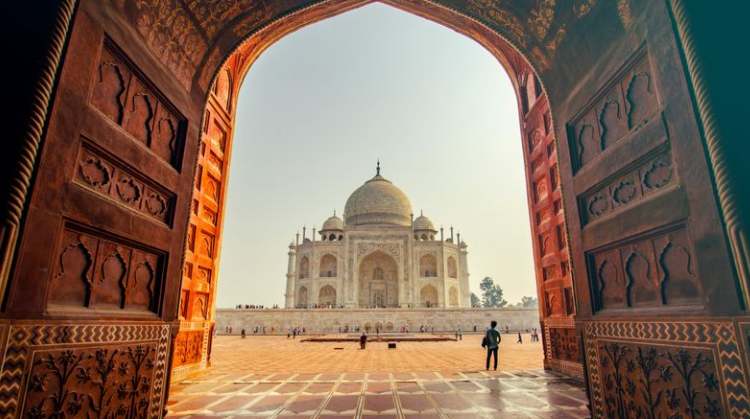
RE: I think that’s true. I agree with you. You look at the Taj Mahal: world-renowned, probably the most spectacular example of architecture we have anywhere on the planet, and it’s almost a sense in which modern Indian regimes have a difficult time knowing what to do with it.
SB: Yes.
RE: My understanding is it’s been removed from the tourist brochure in Uttar Pradesh, which is just simply absurd. I was at the Taj Mahal just last December and was astounded to see the enormous figure of tourists every day, thousands and thousands. I mean, it is a cash cow, as you know. The government is reaping enormous revenue from the people who go there. So there’s a certain kind of cynicism, I would say, about how people look at these monuments today.
But I also noticed that–I went to other Mughal monuments while I was in India last December and January. And it’s interesting that you can go to these monuments and there’s a little kind of information bureau before you actually see the monument. As you go into it, there are brochures and documents related to it.
But in many cases, what you see is not a description of the monument itself, so much as a description of other monuments and other parts of India, mainly temples, rather than what you’re actually going to be looking at.
And so this is a kind of, almost a sense of embarrassment about having all this–everywhere in Delhi as you know, not just Old Delhi, but all over New Delhi, you are constantly confronting the presence of Mughal architecture. It’s another one of those things you cannot get away from.
So there is this kind of an ironic relationship with the past, which Indians seem to be having today, especially with regard to the Mughals. So I fully agree with your comment.
SB: Well, I would qualify that and say some Indians, there are a lot of Indians who are quite comfortable with it, with both the monuments and Mughal rule.
RE: Absolutely.
SB: This is my final point and I would like you to elaborate upon it, that generations might grow up, if these textbooks are allowed to remain, thinking that they didn’t exist, and if they did, it was for a blip, and if it was a blip, during that small period they were really, really evil towards Indians and especially Hindus.
So this is my worry about this brainwashing that will go on.
RE: I think that’s a valid point. To me, the most important takeaway to me as I study Indian history, and as I look at the Mughals and I look at other communities that have come into India across the long sweep of Indian history, which is indeed very, very long–what’s extraordinary is how successfully these groups have been integrated into becoming Indian.
The Mughal empire ultimately was an Indian empire. And that is another thing that cannot be escaped. It’s not just the fact that the dynasty itself became biologically Rajput after just three or four generations. It’s the fact that beginning with Akbar, the rulers knew that they had to patronise the elements of Indian society that most prior dynasties had always patronised, which is to say Brahmins and Jains who served in the court, whose Sanskrit works were translated into Persian. And this is what you do if you’re a legitimate ruler of India, you patronise Brahmins.
And of course, the native language of the Mughals was not Persian. It was Hindustani or Urdu or Hindi. And what’s extraordinary, to me, is that over the long course of Indian history, the Mughals succeeded not only in terms of governance and polity, but also in terms of becoming Indian. It’s absolutely wrong to see the Mughals as a foreign empire. You could easily say that America is a foreign empire because there were settlers who came here from England and transformed the places in certain ways.
So that to me is the most important takeaway of the Mughals. On the one hand, they contributed enormously to shaping India as we understand it today. But on the other hand, they themselves were transformed in the process and ultimately succumbed to the much larger population that was already there, which was Indian.
SB: For me, I think the biggest proof of that, evidence of that, is that in the last 100 years, there have been so many films that have been made on Akbar and on Shah Jahan. And on Jahangir. Not so much on Aurangzeb.
But these films were made and in all of them, they were romanticised. I think that’s very significant to me that they were romanticised rather than villainised, if I may coin a word. And they were shown to be romantics, interested in poetry, interested in their courtly manners, very very elegant, their clothes. And every now and then you see some element of that showing up in fashion.
So as you said, they cannot be wished away because they are part of us.
RE: Absolutely. It was a very highly sophisticated, very civilised culture that they brought with them, a sensibility. That begins right with Babar, who came in, he was a great admirer of poetry and was a very harsh critic of people who did not know how to make a proper poem at a proper time.
And the same is true, of course, with art. You think of Jahangir, who was constantly hiring a team of artists who were painting things for his various manuscripts.
And that sensibility is what carried over as well throughout the whole dynasty. And of course, again, even with art and architecture, one sees how that gradually blended with Indian sensibilities. Look at Rajput miniatures and how Mughal sensibility has merged with that.
So it’s all part of a fascinating story of how culture works ultimately to influence each other in creative ways. And it’s that creative element that I think is most exciting, most important and most hopeful about understanding the Mughal past.
SB: Thank you very much professor. I’m very, very pleased that we had this conversation. Thank you very much for joining.
RE: Thank you so much. It’s been a great pleasure.
[Sidharth Bhatia is a journalist and writer based in Mumbai and is a Founding Editor of The Wire. Courtesy: The Wire, an Indian nonprofit news and opinion website. It was founded in 2015 by Siddharth Varadarajan, Sidharth Bhatia and M. K. Venu.]
❈ ❈ ❈
Erasing the Mughals: NCERT’s Assault on Truth and Memory
Ranjan Solomon
The latest revision of India’s NCERT syllabus seeks to erase the Mughals from our collective memory. What is being presented as “curricular rationalisation” is, in fact, a brazen attempt to rewrite history in the image of a narrow, sectarian ideology. The Mughals were not an accidental dynasty. For over three centuries, they shaped India’s politics, economy, art, architecture, administration, and plural traditions. To delete their contributions is to deny students the right to know their own layered history.
The Mughal Century must be acknowledged as “A Golden Era of Learning and Exchange”. The Mughal dynasty (1526–1857) was not merely a reign of monarchs. It represented one of the most remarkable periods of South Asian history, where local traditions fused with Persian, Central Asian, and Islamic influences to produce a unique, syncretic culture.
Akbar’s Sulh-i Kul (Peace with All): Historian Irfan Habib reminds us that Akbar “pioneered the idea of a secular state” by abolishing the jizya tax on non-Muslims and welcoming scholars of all faiths to his court. The Ibadat Khana debates in Fatehpur Sikri, where Hindus, Muslims, Jains, Parsis, and Jesuit priests exchanged ideas, reflected an intellectual cosmopolitanism far ahead of its time (Habib, Akbar and His India, 1997).
Shah Jahan and the Flourishing of Arts: From the Taj Mahal to the Red Fort, Mughal architecture remains India’s most enduring aesthetic legacy. Ebba Koch, in her classic study Mughal Art and Imperial Ideology (2001), notes that Mughal architecture was a deliberate political project—monuments built not just for beauty but to embody pluralism and sovereignty.
Aurangzeb, the Misunderstood Sovereign: Demonised by colonial historians and Hindutva polemicists alike, Aurangzeb was a complex figure. Audrey Truschke’s Aurangzeb: The Man and the Myth (2017) challenges simplistic portrayals, noting that he expanded the empire to its greatest extent, patronised Hindu temples, and employed more Hindus in his administration than any other Mughal ruler. His Fatawa-i-Alamgiri, a massive compendium of Islamic law, stands as a testament to his intellectual rigor and administrative drive.
As historian Shireen Moosvi shows in The Economy of the Mughal Empire (1987), India under the Mughals accounted for nearly a quarter of the world’s GDP. Their revenue system was sophisticated, their roads and caravanserais facilitated commerce, and Indian textiles dominated global trade markets. Economy and Global Trade prospered as almost never before.
The fact of coexistence and its dear links to the social fabric have important lessons to absorb. The Mughals governed not by suppression alone but by accommodation. Satish Chandra notes in Medieval India (1999) that “no other empire of its time achieved such levels of integration between diverse communities.” Rajput nobles rose to high ranks in the Mughal court; Maratha chieftains negotiated and fought with them in equal measure; Sikh Gurus had evolving relations with Mughal rulers, sometimes cooperative and sometimes conflictual. The empire was not flawless, but it was plural—a reflection of India’s composite society.
In Kashmir, Mughal rule brought major transformations. Akbar annexed the Valley in 1586, integrating it into the larger polity. Jahangir, enchanted by Kashmir, famously said: “If there is a paradise on earth, it is this, it is this, it is this.” He adorned the Valley with Mughal gardens, caravan routes, and cultural exchanges that endure today. Their patronage of Kashmiri crafts and Sufi shrines left an indelible mark on the region’s history.
The denigration of the Mughals began with British colonialism. One could baptise it ‘Colonial Hatred, Post-Colonial Amnesia’. To justify conquest, colonial historians painted them as despots and contrasted “Oriental decadence” with British modernity. As historian Shahid Amin has argued, the colonial archive deliberately exaggerated Mughal “decline” to make the British appear as India’s saviours.
Hindutva ideologues today have inherited this prejudice, but twisted it further by weaponizing history to demonise Muslims and fracture the shared heritage of Indians. By erasing the Mughals from textbooks, they aim to present India as an exclusively Hindu civilisational state. This is not history. It is propaganda.
To tamper with history is to tamper with truth. It brings with it the peril of historical amnesia
Young Indians will grow up deprived of knowledge about one of the most formative epochs of the subcontinent. They will know little of the architectural genius that produced the Taj Mahal, the debates that shaped Akbar’s court, the textile wealth that drove global trade, or the syncretic traditions of music and poetry nurtured under Mughal patronage.
The erasure of the Mughals is not about the past. The present is not excluded. It legitimises majoritarian politics, fuels communal hatred, and denies India its plural soul. By extinguishing memory, the ruling establishment seeks to extinguish dialogue, dissent, and diversity. There are lessons, of course, and when people speak of learning from them, they have in mind, I think, two ways of applying past experience: One is to enable us to avoid past mistakes and to manage better in similar circumstances next time; the other is to enable us to anticipate a future course of events. To manage better next time is within our means; to anticipate does not seem to be.”
History is not a weapon to be wielded by insecure governments. It is a shared inheritance, a mirror that reveals both glory and folly. To delete the Mughals is to amputate centuries from India’s living body. No politician, however powerful, has the right to wipe away truth. It is an irrational way of resisting the assault on knowledge
India’s young deserve better. They deserve to know that their nation was shaped by many rulers, many faiths, many voices. They deserve to learn that the Mughals were part of India—not intruders, but shapers of its destiny. To forget them is to forget ourselves.
[Ranjan Solomon is a political commentator, and human rights activist. Courtesy: Countercurrents.org, an India-based news, views and analysis website, that describes itself as non-partisan and taking “the Side of the People!” It is edited by Binu Mathew.]