When the Babri Masjid was barbarically brought down on December 6, 1992, the Pakistan President magisterially pronounced that the Hindus were avenging themselves on Babar for their defeat at his Muslim hands. Our then Foreign Secretary, J.N. ‘Mani’ Dixit, gently reminded him that Babar had not defeated a Hindu but a Muslim—Ibrahim Lodi! Touche!
Another introductory story. I was sitting next to the distinguished 1965 war veteran Capt. Ayub Khan, a Lok Sabha MP from Rajasthan, when he suddenly rose to mock L.K. Advani (a Sindhi) saying that while the Sindhis had succumbed to Muslim invaders, the brave Rajputs of Rajputana had resisted the Mughals to the end! No wonder in the 1965 war that he had been hailed as “our Ayub” as against “their Ayub”.
Jinnah’s speech
It is such irony that counts in the long run. Not imitating the worst in the enemy. On April 15, 2025, the Pakistan Army chief riled many Indians when he paraphrased Jinnah’s March 22, 1940, speech where he set out his rationale for Pakistan: “The Hindus and the Muslims belong to two different religious philosophies, social customs, and literature. They neither intermarry, not inter-dine together, and indeed they belong to two different civilisations which are based mainly on conflicting ideas and conceptions… It is quite clear that Hindus and Musalmans derive their inspiration from different sources of history. They have different epics, their heroes are different, and they have different episodes. Very often the hero of one is a foe of the other, and likewise their victories and defeats overlap.” (S.S. Pirzada, Foundations of Pakistan, page 338.)
It was widely believed in India that it was this belligerence that provoked the terrorist attack a week later at the meadow near Pahalgam. Our spokesman could have riposted by quoting other sentences from the same Jinnah speech, pointing to how Jinnah envisaged India-Pakistan relations after the creation of that country: “There is no reason why these States should be antagonistic to each other. It will lead more towards natural goodwill by international pacts between them and they can live in complete harmony with their neighbours. This will lead further to a friendly settlement all the more easily with regard to minorities by reciprocal arrangements between the Muslim India and the Hindu India.” (Pirzada, ibid, page 337, italics mine.)
That is exactly what the Simla Agreement of 1972 and the earlier Nehru-Liaquat Pact of 1950 sought to achieve. If, instead of a violent response to terrorist violence, we had adopted what our last High Commissioner to Pakistan, Ajay Bisaria, has called “anger management” in our relations with our difficult western neighbour, or the Gandhian way of non-violent striving for an elusive agreement with Pakistan, Trump would still have been on our side, our economy would not have been beset with impossible conundrums, our foreign policy would not be in humiliating disarray, and Modi would not be sneaking into photo-ops with Putin and Xi!
Moreover, Pakistan would still stand isolated internationally as an economically bankrupt, politically unstable military dictatorship, not a “phenomenal partner” of US hegemonism rewarded with invitations to lunch at the White House for their self-promoted Field Marshal.
Operation Sindoor
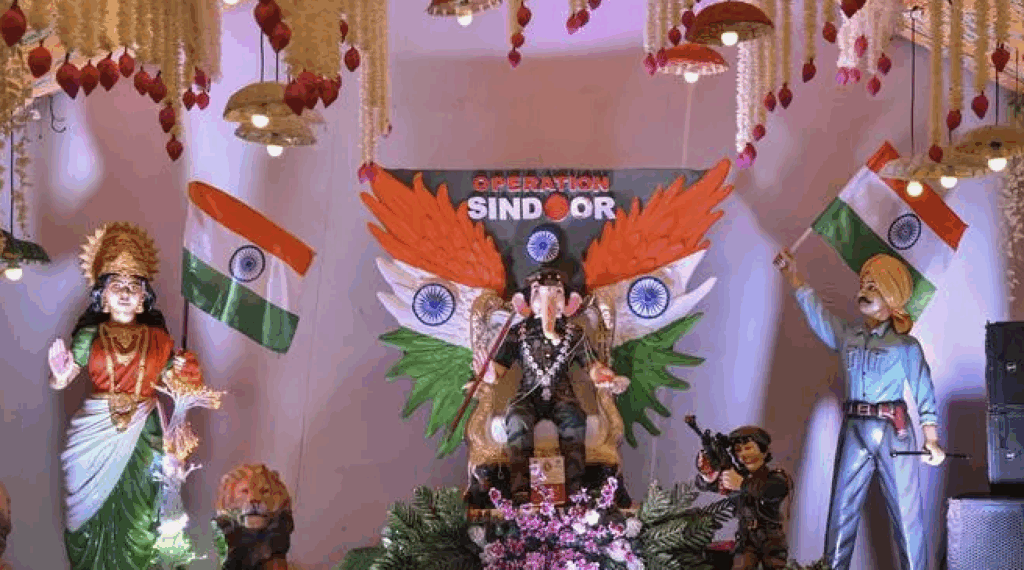
Instead, we prepared and then launched Operation Sindoor. Without, for the moment, going into the merits of Operation Sindoor (dealt with in previous columns), I confine myself to the point that women wearing sindoor and wiping it off at the death of the husband is an exclusively Hindu practice; it is not the practice in other communities that comprise the best part of a fifth of our population.
To invoke sindoor, and then call the next two operations against terrorists Operation Mahadev and Operation Shivshakti, and then label our proposed shield in the skies as “Sudarshan Chakra”, is not only a major departure from past practice, it also takes us down to Pakistan’s level by converting an inter-state issue into an inter-religious matter. We seem to have regressed to mediaeval times when Allah-o-Akbar was responded to with Har Har Mahadev.
No sectarian names
The British imperial regime might have been based on “divide and rule”, but the Indian Army, from the days of the East India Company to the British Raj to post-Independence, has always been intensely secular, realising that since all religions are represented in all ranks, the Army cannot afford to divide to rule but has to “unite to command”.
Therefore, the Indian Army, whether of the East India Company, British Indian or truly Indian, never gave sectarian names to its military operations. It was the Modi establishment that suddenly ended this delicate sensitivity this year. Where the pride of the Indian armed forces has been to never succumb to religious passion and always ensure religious harmony in all ranks, whatever hideous massacres were occurring in the civil realm, the thin edge of the wedge to transform our religiously diverse, plural, and strictly secular armed forces into a weapon of Hindutva, has been the very recent labelling of military operations with blatantly Hindu names.
Please bear with me as I illustrate my point with the names of pre-Independence military operations to post-Independence operations—all the way till this year’s India-Pakistan four-day war in May 2025.
Names from history
In the Second World War, the 4th Indian Division was the first to be thrown into the attack against the Italians camped in fortified positions at Sidi Barrani on the Mediterranean coast in a military action neutrally labelled “Compass”. Subsequently, the Division was deployed in Eritrea as part of the equally neutrally named “Gazelle Force”.
Then came Iraq, where three divisions of the British Indian army arrived in Basra, named quite non-communally as “Force Sabine”, and then moved on to capture Baghdad, Palestine, and Syria. They also captured the oil fields and refineries in southern Iran to prevent these vital military assets from falling into German hands.
At about the same time, the 3rd Indian Motorized Brigade moved to the attack on Rommel who was attempting to force an entry into Egypt from the North African coast. The operation’s nomenclature was the religion-neutral “Battleaxe”. Rommel was then winkled out of Tobruk in an operation named, non-denominationally, as “Operation Crusader” (non-denominationally as it was not Christians taking on Muslims, as in the mediaeval Crusades, but Allied Christians taking on Axis Christians).
The mixed British Indian army, incorporating Hindus, Muslims, Sikhs, Zoroastrians (Parsis), and Christians, then fought its way from Cyrenaica (Libya) to Sicily and on to mainland Italy in a series of operations whose names strictly eschewed any religious or scriptural connotation: “Operation Torch”, “Operation Overlord”, “Operation Olive”, and so on.
While these operations were on, the Indian army was substantially withdrawn to fight on other fronts, notably Malaya and Singapore and, above all, in Burma. But before we move to these neigbouring theatres, let us note that a part of the British Indian army’s mule trains supplying Allied fighting forces, and dubbed “Force K”, also known as the ‘Indian Contingent’, was trapped in Dunkirk and partly evacuated in “Operation Dynamo” and its follow-up, “Operation Aerial”. Note these neutral names.
The liberation of Burma from the Japanese was largely a British Indian army affair. The military operations were once again non-denominationally titled “Anakim” (shelved); “Tarzan” (north Burma); “Bullfrog” (Akyab in Burma’s Maya peninsula); “Extended Capital” (Irrawaddy valley), “Dracula” (to capture Rangoon), and so on.
While all these tell a fascinating story, I cannot afford to wander too far from my basic point that the military operations bravely fought by the pre-Independence British Indian army were never named for any religion-related purpose.
After Independence
After the blood-soaked Partition, India’s independent army foreswore any religious nomenclature for any of its many Operations from 1947 to 2024, naming them “Gulmarg”, “Duck”, “Vijay”, “Easy”, “Gulab” and “Eraze” in Jammu and Kashmir in 1947-1948; “Vijay” against Portugal in Goa, 1961; the tragic “Leghorn” against China in 1962; “Air Observation Post”, “Bakshi”, and “Faulad” in 1965, besides “Ablaze” in the Western sector, “Riddle” in the Punjab sector, and “Nepal” in the Sialkot sector.
We then had Operations “Cactus Lily”, and naval operations “Trident”, “Python”, and “Talwar” in 1971; “Meghdoot” in Siachen, 1984; “Vijay” and “Safed Sagar” in Kargil, 1999; “Parakram” in 2001-02; and the disastrous “Pawan” in Sri Lanka, 1987.
Even after the BJP came to power again in 2014, we gave a religion-neutral name, “Swift Retort”, to the air attack on Balakot in 2019. Why then have we suddenly, inexplicably, started naming our military operations and plans with strong religious connotations in 2025?
War heroes of all hues
Before we answer that question, let us remember our war heroes, most of whom have been Hindus and Sikhs but have also included such members of the religious minorities as Brig. Mohammed Usman (Kashmir, 1947); Havildar Abdul Hamid who won his Mahavir Chakra at the Battle of Asal Uttar, Khemkaran, September 10, 1965; Lt. Col. Ardeshir Tarapore, Battle of Chawinda, September 11, 1965; and Lance Naik Albert Ekka, Battle of Hilli, December 3, 1971. The colourful Anglo-Indian Christian brothers, Trevor Keelor and his sibling, who rocked as stars of the skies in 1965, deserve special mention (whatever might have been the later disreputable events).
And let us also remember such distinguished army chiefs as the Zoroastrian Field Marshal Sam Manekshaw (1969-73) and the Christian S.F. Rodrigues (1990-93), besides the Sikh generals J.J. Singh (2005-07) and D.S. Suhag (2014-16); naval chiefs like the Parsi Jal Cursetji (1976-79), Christians like R.L. Pereira (1979-82), O.S. Dawson (1982-84), Robin Dhowan (2014-16), and Vishnu Bhagwat (1996-98), himself a highly secular Hindu and married to a very distinguished Muslim lady.
Top of the list are the air chiefs: Zoroastrians A.M. Engineer (1960-64) and Fali Major (2007-09); the Muslim Idris Hasan Latif (1978-80); and Christians D.A. La Fontaine (1985-88) and Norman Browne (2011-13), besides a sheaf of Sikhs beginning with Air Chief Marshal Arjan Singh (1964-69) and continuing to Dilbagh Singh (1981-84), B.S. Dhanoa (2016-19), and the current chief, Amar Preet Singh.
Why should such secular armed forces be suddenly burdened by Hindu appellations? The rot seems to have set in with a non-military operation of rescuing non-Muslims from Taliban Afghanistan, named Operation Devi Shakti. Coincidentally or otherwise, this saffronisation of the names of military operations seems to have started with the institution of the office of Chief of Defence Staff (CDS) over the heads of the chiefs, with a view, it is said, to coordinating the three wings of our armed forces, but rendered somewhat dodgy by naming in succession two retired generals who never made it on merits to army chief, but, allegedly, for ideological reasons.
Before I get thrown in jail, now that Ali Mahmudabad has vacated his cell on getting bail, let me clarify that I am only pointing to the coincidence of past practice in regard to the nomenclature of military operations being abandoned in favour of Hinduism-related names only when the chain of command was changed.
How India differs from Pakistan
However that might be, it is Pakistan that names its military operations and plans after religious leaders, historical or mythical religious milestones, and co-religious conquerors from a distant past. Unsurprising, as Pakistan was conceived in religious bigotry and consecrated in its Constitution as an Islamic republic.
But should we, who have prided ourselves as the direct opposite—a plural, cosmopolitan, humane, compassionate state of equal citizenship for all whatever our caste or creed or class may be—should we be lowering ourselves to becoming a Hindu mirror in which Pakistan can recognise itself? Is that what Sindoor, Mahadev, Shivshakti, and Sudarshan Chakra are all about: the Pakistanisation of Bharat Mata?
[Mani Shankar AiyarMani Shankar Aiyar is a four-time MP, former diplomat, and author of several books. Courtesy: Frontline magazine, a fortnightly English language magazine published by The Hindu Group of publications headquartered in Chennai, India.]