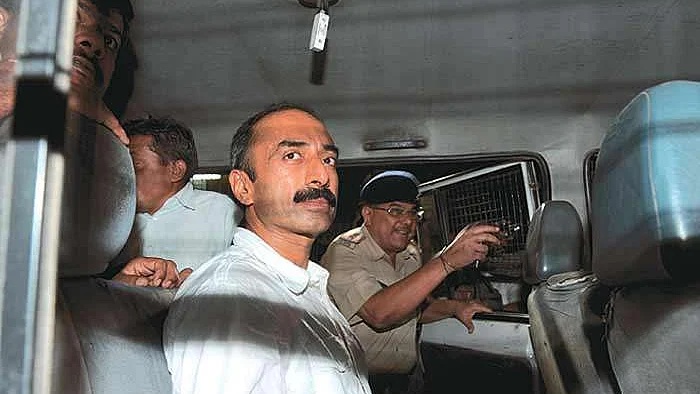
We speak of democracy, freedom, and justice — but sometimes nations betray their bravest voices. Sanjiv Bhatt, once a senior police officer who dared to speak uncomfortable truth about the 2002 Gujarat carnage, sits in prison. His crime? Not murder. Not corruption. But refusal to bow before power. India today celebrates loudspeaker leaders, celebrity politicians, and “strongmen” scripted by propaganda. Yet it forgets quiet courage. Bhatt stands where conscience led him, while those accused of enabling mass violence march to applause, garlanded as national guardians.
Many of big names in the arena of activists around the country tend are into the next agitation which they will also delete from their memories when yet another issue arrives. At the risk of sounding cynical, the self-baptized as the ‘radical’ are into the buzz of protest and rallies as coffee times in cafes, only as long as it is safe. Convictions be damned.
Bhatt did not just serve the uniform; he honoured the Constitution. When he testified that state machinery had been complicit in the Gujarat pogrom, he broke the code of silence that protects political power. For that moral breach, the system turned on him. He is not the first truth-teller India has punished — but perhaps one of the starkest examples of how a state, when captured by ideology and arrogance, treats dissent as treason.
The vengeance dressed as justice
The legal battle around Bhatt reflects not justice, but vengeance disguised as law. His imprisonment stems from a 1990 custodial-death case in Jamnagar — revived decades later and pursued with a relentlessness conspicuously absent in cases involving those politically empowered. In June 2019, a sessions court sentenced him to life; the Gujarat High Court upheld it in January 2024. The Supreme Court refused bail and suspension of sentence in 2025, though it ordered the appeal to be heard expeditiously.
What stands out is not just the outcome but the pattern: multiplicity of cases, procedural aggression, and the systematic isolation of a whistle-blower.
In the Gujarat riots-related litigation, the court-appointed SIT dismissed his sworn testimony against the state’s highest leadership — a decision the Supreme Court endorsed in Zakia Jafri v. State of Gujarat (2022). Yet even in that case, Justice D.Y. Chandrachud — then in dissent on one critical procedural facet — emphasised the fundamental duty of the justice system to allow truth and evidence to breathe, not be throttled by state assertions.
Bhatt’s legal odyssey exposes a judiciary caught between constitutional promise and political pressure — and his continued incarceration symbolises how legal process, when bent, becomes an instrument of power, not principle.
A man punished for refusing silence
Bhatt’s fall from office is not accidental — it is a message. A state that demands surrender treats dignity as rebellion. He could have chosen silence, earned promotions, faded into comfort and irrelevance. Instead, he chose truth. That choice cost him his freedom, career, reputation, and safety.
And it cost his family a life of peace.
His wife, Shweta Bhatt, stands alone against a machinery designed to break resolve. Their children grew up watching a parent treated not as a whistle-blower but as an enemy of the state. Their home came under surveillance; their lives shrank to courtrooms, police notices, and hostile media.
Democracies do not collapse in one dramatic moment. They corrode slowly when the State convinces citizens that the whistle-blower is the threat, not the misconduct he exposed.
Today, Bhatt is not merely imprisoned — he is being erased.
Selective justice — a modern epidemic
It is worth asking: if custodial deaths are the reason for life imprisonment today, where are the life sentences for:
- Encounter specialists celebrated as heroes?
- Policemen decorated despite extrajudicial killings?
- Rioters and hate criminals filmed committing violence but roaming free?
- Those whose hate speech triggers death and displacement?
Selective prosecution is a political act. It tells citizens: Speak against power, and the law will find you – even decades later. India’s legal history is littered with cases where powerful actors walked free despite bloodshed and human rights abuses. Yet Bhatt sits in a high-security cell, not for a riot, not for conspiracy, but for speaking before the Supreme Court about state complicity. Justice becomes dangerous when it becomes personal.
The moral duty of remembrance
Have we all forgotten Sanjiv Bhatt? Is the struggle for justice going to change things? Is this right-wing democracy, or has democracy been hollowed out to merely retain its name? He is accused falsely; killers roam free. Satish Bhatt asked questions and told the truth. We are bound to remember our real heroes — not those who pay crowds to manufacture greatness.
A nation that imprisons truth-tellers and worships theatrical power is not secure; it is frightened. The day we forget voices like Bhatt’s is the day we accept fear as governance, silence as patriotism, and obedience as citizenship.
Silence is complicity. Forgetting is surrender. A family pays the price, a nation loses a conscience
Behind every political prisoner is a family forced into economic ruin, emotional fatigue, and social isolation. The Bhatt family is no exception. They live with stigma, surveillance, and the slow violence of uncertainty. Their suffering does not trend on social media. They do not receive solidarity marches or celebrity petitions — only scattered voices of conscience in a climate of intimidation.
This is what makes Bhatt’s case chilling: it teaches the next generation that truth is punishable.
Democracies are not destroyed in a moment; they erode through forgetfulness. Bhatt’s imprisonment is not just a case file — it is a mirror. It asks whether we will defend truth only when convenient or stand by it when it demands courage.
History will not remember those who roared hatred from podiums; it will remember those who endured punishment for speaking principle. If we cannot defend men like Sanjiv Bhatt, then we do not defend democracy — we merely perform it.
Remembering him is not nostalgia; it is duty. Justice begins with memory — and resistance begins by refusing to look away.
If his voice is buried, ours will be next.
[Ranjan Solomon is a political commentator and human rights defender. Courtesy: Countercurrents.org, an India-based news, views and analysis website, that describes itself as non-partisan and taking “the Side of the People!” It is edited by Binu Mathew.]