David Walsh
On Monday, Harvard University president Alan Garber announced the university would not comply with the Trump administration’s demands to crush political opposition, hand over control of critical departments to government oversight and generally establish a reign of ideological terror and right-wing thought control on the Cambridge, Massachusetts campus.
The White House immediately responded by pausing $2.2 billion in multi-year grants and $60 million in multi-year contracts to Harvard. Trump further threatened, in his thuggish-ignorant manner, that the institution might lose its tax exempt status “and be Taxed as a Political Entity” if it continued its allegedly “political, ideological, and terrorist inspired/supporting” ways.
The conflict between Harvard and the Trump regime poses fundamental issues of democratic rights, including academic freedom. Simultaneously, it raises the questions of how the ongoing, unrelenting assault on basic rights can be repulsed and the need for the working class to intervene in a mass way, with its own program and in defense of its own social interests.
In an authoritarian document sent to Harvard April 11, the government demanded, among other things, that the university act to “prevent admitting students hostile to the American values and institutions inscribed in the U.S. Constitution and Declaration of Independence, including students supportive of terrorism or anti-Semitism.”
This from a fascistic government that is engaged in a full-scale assault on the Constitution and an ever-growing list of illegal activities. As for the claim that Harvard students are supporting either “terrorism or anti-Semitism,” this is a monstrous lie aimed at suppressing opposition to the Israeli regime’s genocidal extermination, with U.S. government support, of tens of thousands of Gazans.
Furthermore, Harvard would have been obligated to carry out an audit “for viewpoint diversity, such that each department, field, or teaching unit must be individually viewpoint diverse,” i.e., that right-wing and crackpot viewpoints should be represented. The administration wants to have Nazi-style Gauleiters running these institutions with the aim of turning them into propaganda centers, in which the biology or astronomy departments would be compelled to teach “intelligent design” and creationism, funding would be provided for biblical studies, the development and use of vaccines would be questioned at the institutional level, etc.
In addition, the government ordered various schools and departments to be directly spied on and monitored to ensure opposition to Zionism and U.S. imperialism was eliminated, including the Divinity School, Graduate School of Education, School of Public Health, Medical School, Center for Middle Eastern Studies, Department of Near Eastern Languages and Cultures and more.
In response, Garber and Harvard correctly state that the Trump government “presents demands that, in contravention of the First Amendment, invade university freedoms recognized by the Supreme Court.”
The university will not surrender its independence or relinquish its constitutional rights. Neither Harvard nor any other private university can allow itself to be taken over by the federal government. Accordingly, Harvard will not accept the government’s terms as an agreement in principle.
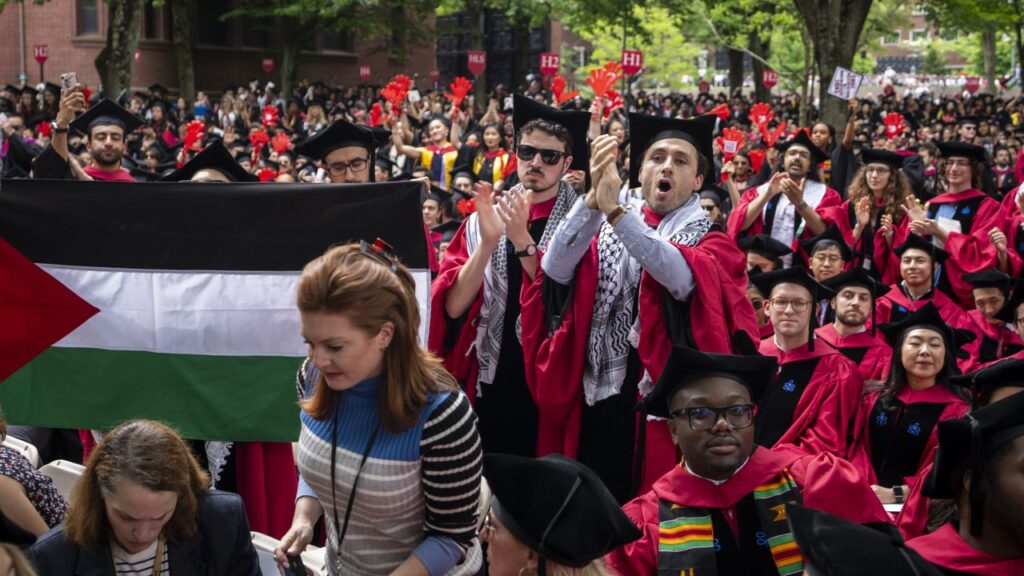
Broad sections of Harvard’s faculty and an overwhelming majority of students have enthusiastically welcomed the University president’s declaration, however belated. It followed weeks of adaptation and equivocation. The disgraceful capitulation of Columbia University provoked a sense of revulsion. It is evident that Garber’s decision to issue this statement was all but forced upon him by the demands of students and faculty that Harvard take a stand against the fascist thug in the White House. The statement has been made little more than a week after mass protests against Trump in Boston and cities throughout the United States.
To the extent that it rejects the Trump administration’s attempt to eradicate freedom of speech and place universities and schools under the iron heel of the government, the statement issued by Harvard is a significant development. It would be a serious mistake, however, to rejoice prematurely.
Read with a critical eye, Garber’s letter is far less than a ringing affirmation of democratic rights, let alone an unequivocal denunciation of the Trump administration. It accepts the primal lie that it was necessary to combat a “antisemitism” at Harvard, thereby lending a degree of totally unwarranted legitimacy to the repression of students.
Moreover, the university’s message to Trump and company concludes by promising that “Harvard remains open to dialogue about what the university has done, and is planning to do.” This clearly indicates that the University is willing to make an unprincipled compromise.
Harvard, founded in 1636, is the oldest university in the U.S. and the most prestigious. Its estimated endowment of $50.7 billion makes it the wealthiest such institution in the world.
It is a major capitalist-imperialist institution, training ground for hundreds of heads of state and government around the world, U.S. presidents and vice presidents, cabinet secretaries, state governors, senators and representatives and other political figures, along with innumerable academic defenders of the status quo. It has deep, lucrative connections to the military-intelligence apparatus and other state bodies.
It can be safely assumed that Garber, before issuing his statement, held intense discussions with influential members of the military-intelligence community and, especially, with mega-millionaire and billionaire financiers, among whom dissatisfaction with elements of Trump’s economic policies is growing.
However, without harboring illusions in the university’s commitment to an uncompromising defense of democracy, Harvard is also an important academic and scholarly resource, as are other significant American universities, which carries out much valuable research and hosts vital intellectual labor. The government has already launched a wrecking operation against all that. The Boston Globe reports that
A top scientist at Harvard who has spent years unraveling the mysteries of tuberculosis woke up Tuesday morning and discovered an order from the federal government telling her to halt her research.
At their best, Harvard and universities and colleges are important educational institutions. The government is attempting to destroy the university as an institution where educators are able, in the words of philosopher John Dewey:
To investigate truth; critically to verify fact; to reach conclusions by means of the best methods at command, untrammeled by external fear or favor, to communicate this truth to the student; to interpret to him its bearing on the questions he will have to face in life.
To aim a blow at any of these operations, Dewey continued, “is to deal a vital wound to the university itself.”
One is not obliged to accept this all too rosy description of the bourgeois academy, which is ultimately dominated by class interests, to recognize that fundamental issues of democratic rights are at stake. Once again, in their crude and violent assault on Harvard, with the hope of intimidating less powerful colleges and universities, Trump and company show no originality.
They are taking yet another page from Hitler’s playbook. The Nazi regime, as the Wiener Holocaust Library points out, “placed great emphasis on who the teachers were.” Under a law enacted only three months after Hitler took power, “all Jewish teachers, and teachers with undesirable political beliefs (such as communists), were dismissed.”
This act also made membership of the Nazi Party compulsory for all teachers. [The first book burnings took place one month later across from Humboldt University in Berlin.] The National Socialist Teachers League, created in 1929, became responsible for the control and education of teachers following the Nazi rise to power. All teachers were required to attend a one-month compulsory Nazi training course, which emphasised Nazi ideology and the importance of advocating the regime’s ideas.
The Harvard chapter of the American Association of University Professors has filed suit, accusing the administration of engaging in an “unlawful and unprecedented misuse of federal funding and civil rights enforcement authority” with the intent of undermining academic freedom and free speech within the university. The allegation is no doubt true, but the defense of academic freedom and other democratic rights cannot be entrusted to the courts, whose decisions, in any case, the government merely flouts.
Garber and the administrators who preside over these institutions are operating under immense pressure, as the government’s billion-dollar extortion attempt reveals, and—as noted above—would like, if they can, to reach a deal.
However, these are issues over which no compromise or conciliation is possible. The fate of intellectual life and the democratic rights of the population hangs in the balance. The attacks on students and faculty, including the abduction of foreign students for opposing the Gaza genocide, coincide with the hammering of living standards by inflation, the destruction of hundreds of thousands of federal workers’ jobs and the assault on Social Security, Medicaid and Medicare, all of which threaten to further impoverish wide layers of the population.
The fight against Trump and the rest of the fascist forces cannot be waged successfully apart from the broadest popular mobilization.
The working class must come forward in defense of the students and the rights to freedom of thought, speech and assembly. The universities and the knowledge they contain are the heritage of—and a resource that belongs to or should belong to—the entire working population. It has a critical stake in this. Workers cannot allow the cultural vandals infesting the White House, relentless promoters of everything backward and ignorant, to destroy such institutions.
There is no way to defeat the menace of dictatorship without getting to the core of the problem, the capitalist system, with its vast social inequality and oligarchic rule. The fight to defend democratic rights is a struggle that vastly transcends the boundaries of Harvard Yard and other universities and colleges.
In the final analysis, the defense of all democratic rights is inseparably bound up with the struggle against the capitalist system. The oligarchy that rules society cannot tolerate freedom of speech and the exercise of critical thought. It understands all too well that the power of reason, when exercised without restraint, will lead to the conclusion that capitalism is incompatible with the needs of modern society and must be ended and replaced with socialism.
The defense of Harvard and other universities against the fascists requires the building of the International Youth and Students for Social Equality (IYSSE), a revolutionary movement among young people based on a socialist program and perspective, to spearhead this movement and provide it conscious direction.
(Courtesy: World Socialist Web Site (WSWS), the online publication of the International Committee of the Fourth International.)
❈ ❈ ❈
More Than 150 Campuses Held Day of Action Against Trump’s Attacks on Higher Ed
Julia Conley
Weeks after the Rutgers University Senate passed a resolution to form a “mutual defense compact” — aiming to band together with other universities to protect from the Trump administration’s attacks on academic freedom and free speech — university communities’ push for their schools to stand up to the White House is gaining momentum.
Labor unions, Palestinian rights groups, and other advocacy groups on Thursday held rallies and events to mark the Day of Action for Higher Education, with students and faculty at more than 150 schools demonstrating against President Donald Trump’s funding cuts; attacks on diversity, equity, and inclusion (DEI) initiatives; targeting of academic freedom; and deportation operations in which a number of student organizers have been rounded up in recent weeks.
“[Immigration and Customs Enforcement] is abducting students,” said the Debt Collective, a sponsor of the day of action. “The Trump administration is suppressing free speech. Tuition is rising and workers and staff aren’t paid living wages. We need higher education to be a liberation machine, not a deportation and debt-making machine.”
The signs displayed at one rally in Pittsburgh reflected the wide array of attacks Trump has launched against higher education — from billions dollars of funding cuts to the National Institutes of Health, impacting biomedical and scientific research at universities across the U.S. to the ICE arrests of international students who have spoken out against Israel’s U.S.-funded assault on Gaza.
Like the mutual defense compact proposal that’s now gained traction at several schools, the day of action is partially a response to Trump’s demand that universities collaborate with the administration to punish students who took part in nationwide Palestinian solidarity protests last year.
Columbia University has drawn ire for reportedly giving the names of students, including organizer Mahmoud Khalil, to the Trump administration before he was detained by ICE; refusing to provide protection to Khalil and his fellow organizer, Mohsen Mahdawi, who was also arrested this week; and revoking degrees from some pro-Palestinian protesters.
In contrast, faculty senates at Big Ten schools including the University of Nebraska at Lincoln, Indiana University at Bloomington, Michigan State University, and the University of Massachusetts at Amherst have joined Rutgers in passing resolutions calling for the creation of mutual defense compacts to protect against the “legal, financial, and political incursion” of the Trump administration.
On Thursday, members of the faculty senate at the University of Michigan, also part of the Big Ten Academic Alliance, advocated for passage of a resolution to defend “academic freedom, institutional integrity, and the research enterprise” — and push back against administrators’ closing of the school’s DEI office at the behest of Trump’s White House.
“The University of Michigan abandoned DEI in-part to avoid the wrath of Trump and most schools, not just ours, have been cowed into this kind of preemptive capitulation. Most schools, not just ours, have gone silent, just when we need them to speak up,” sociology and law professor Sandra Levitsky told Michigan Advance on Thursday.
At Indiana University, Jim Sherman, a professor emeritus in psychological and brain sciences, said that while faculty members and students are calling on their institutions to form a coalition against Trump, many administrators at public universities seem to want to draw as little national attention to their schools as possible.
“I think a lot of universities are thinking, basically, ‘Boy, I hope they don’t come after us.’ You know, ‘Let them come after Columbia or Harvard or Stanford… Let them go after the big dogs,’” Sherman told Common Dreams. “Maybe if we stay quiet and don’t do very much, they’ll just ignore us.”
But that approach will only worsen the sense of “anxiety, angst, uncertainty, [and] instability” that’s spreading across college campuses today, said Sherman.
“When I was an active faculty member, the years and the job were just full of joy,” he said. “My collaboration with colleagues across the U.S. and across the world were just incredible. I couldn’t have wanted a happier and more fulfilling life.”
“Rather than doing your teaching and research,” he added, “I think the major goal right now for many of us is protection.”
Sherman expressed hope that the growing support for mutual defense compacts will soon leave a critical mass of schools with no choice but to join — and ultimately place pressure on university presidents, who thus far have declined to back the movement.
“If you’re in the Big Ten and suddenly five or six universities join, you don’t want to be the one who’s left out or not [doing] anything,” said Sherman.
Outside the Big Ten, Harvard University garnered applause this week when it announced — unlike its Ivy League peer Columbia — that it will not comply with Trump’s demands to expel students who took part in pro-Palestinian protest, end its recognition of Palestinian solidarity groups, or audit its programs for “viewpoint diversity.” The elite university now faces a threat from Trump to have its tax-exempt status revoked.
The mutual defense compacts that have passed so far call for participating universities to “commit meaningful funding to a shared or distributed defense fund,” which could potentially be used in cases like that of Indiana cybersecurity professor Xiaofeng Wang, a Chinese national whose home was raided last month by the Department of Homeland Security and FBI and who was fired by the university, or international students targeted by ICE.
“As long as different universities put their resources together, whether it’s sharing information about legal issues, whether it’s talking about cases that have been resolved one way or another, whether it’s making funds available for the protection of faculty,” Sherman said. “I think the biggest goal should simply be unification and coordination and cooperation among as many universities who want to join in as possible.”
University presidents are also facing pressure from labor unions to support a mutual defense compact, with a dozen graduate students’ unions affiliated with the United Electrical, Radio, and Machine Workers of America releasing a statement Wednesday.
The unions — representing tens of thousands of students at University of Minnesota, Northwestern University, North Carolina State University, and others — urged schools to establish an International Worker Support Fund and to ensure they won’t “comply with ICE or other federal agencies initiating unconstitutional requests, such as sharing names and documentation statuses of students and workers or allowing ICE or other federal agents to enter campuses and university buildings.”
Paul Boxer, a psychology professor at Rutgers who co-authored the original resolution at the school, emphasized that while university presidents have not yet expressed support for the mutual defense compact, support for defending First Amendment rights, academic freedom, and the diversity that thrives on many college campuses is strong among those who make up university communities.
“We do believe it’s extremely important,” Boxer told Common Dreams, “that faculty, staff, students, alumni, anyone connected to higher education at all, whether it’s public or private, understands that universities — certainly at the level of the individuals who are providing higher education services, who are doing that kind of work, who are invested in the present and future of higher education — we are all committed to this cause.”
(Courtesy: Common Dreams, a non-profit US news portal.)