❈ ❈ ❈
Gulfisha’s Voice Breaches Prison Walls Despite Media Apathy
Pamela Philipose
The nation in its majesty can afford to overlook one prisoner helplessly struggling with the enormity of the injustice being done to her. After all, this country counts 4,34,302 unfortunates as undertrial prisoners (2022 data), so what is one more?
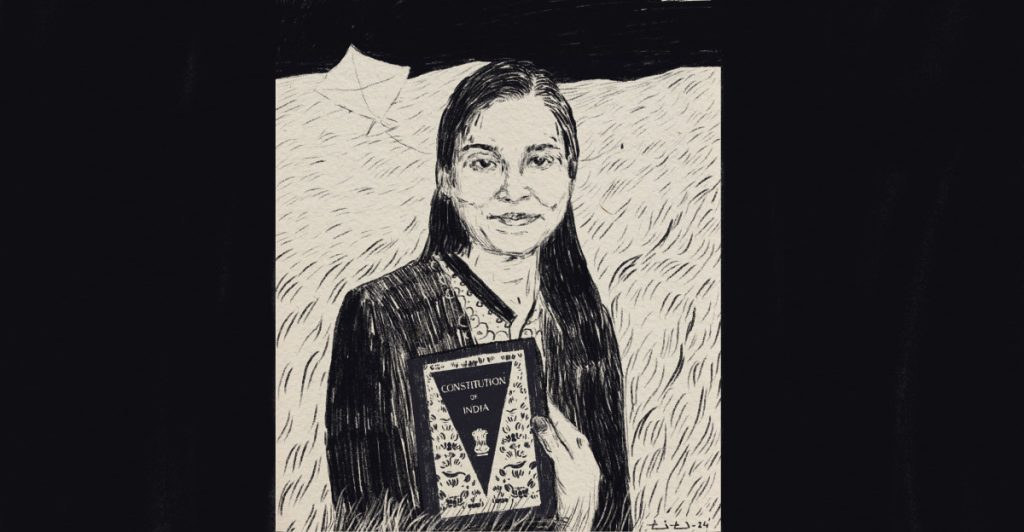
But let us look a little closer at this figure: Gulfisha Fatima, dwarfed by towering prison walls. Half a decade has gone by and she has not been granted bail during this entire span, not even an interim one. Five years spent in the Kafkaesque labyrinth of the Indian criminal justice system, where FIRs like 59/2020 – drawing on the draconian provisions of UAPA and the IPC – are like fine steel mesh designed to trap and bleed lives. Three benches of the Delhi High Court have cogitated over it but have not been able to move the young Muslims named in this FIR and who continue to be incarcerated an inch closer to bail. As for Gulfisha Fatima, she happens to be the only woman charged in that FIR who is still in jail.
Has this horrendous scenario provoked even a ripple on the calm surface of the national media?
Do they spare a fleeting thought on the way the years have been stolen from a woman who was 27 in 2020, when she was jailed, with her whole promising future ahead of her? Have newspapers ever asked themselves if their niggardly, cursory coverage of this case suffices to bring the story home to their readers? Do their occasional paragraphs measure the length and breadth of the overweening cruelty of a carceral state? By failing to pay the necessary attention to her case, have they not strengthened the will of the State to continue its repression? As information gatherers and interpreters are they not bound by their professionalism to deliver what scholars term as epistemic justice? Have they ever asked themselves whether they are ending up playing the role not of journalists but of masons, cementing up the walls around Gulfisha?
It is to break the intolerable silence of the media, the impossible sluggishness of courts, and the incalculable viciousness of the police, that a remarkable week-long campaign – the Free Gulfisha Campaign – was launched by gender activists and civil society actors on April 9. It saw individuals from across the country speak out against this obvious injustice because the media did not, thus breaching prison walls despite media apathy.
But there’s a twist here. The videos they made of themselves reciting poetry or reading passages, were from Gulfisha’s own prison notebooks. In the silence and isolation of her five years of prison time, she turned herself into her own witness. Words shot through with pain and passion were laboriously set down on prison stationery. As a Wire article noted: “Over the five years, despite the five years, Gulfisha has kept writing. She documents her every thought, her every emotion, her every dream… She writes to keep sane. She writes to retain her humanity…” (‘Living in the Time of Gulfisha Fatima’, April 9; see article below)
There are many striking aspects of this body of work but let me highlight three of them. First, it emerges from a woman, locked away by an inhumane system, whose every word testifies to her own living humanity. The pleasure she takes when a fellow prisoner is released is palpable as a diary entry of January 24, 2022 reveals: “In the evening, (censored) had told me that her lawyer informed her that she would leave jail tonight. After bandh ginti, my ears were waiting to hear the announcement on the speaker. .. The moment her name was announced, I hurled a short scream into the air.”
Despite her own dire situation, it is Gulfisha’s concern for her aging parents that emerges strongest of all (‘I Long for Freedom’: Gulfisha Fatima on Five Years of Incarceration, April 13, 2025):
“Last time in the courtroom, noticing my father stuttering, I asked him since when you have started getting such difficulty? He whispered, “Hamesha darr ka ehsaas hota rehta hai jaise abhi kuch bura honewala hai isliye atak jata hu bolte bolte [I am constantly afraid that something bad is going to happen, and so I get stuck while speaking]”.
“After my bail rejection, at least 4-5 days were very depressing for Ammi Abbu. Even I was unable to speak to them with my usual cool temperament…I could say nothing. Ammi also was trying to hide her despair by pretending to have sore throat…”
Second, there is the sharp and candid awareness of passing time and the impact it is having on her mind and body (‘’I Long for Freedom’: Gulfisha Fatima on Five Years of Incarceration’, April 13, 2025):
“Though incarceration has done no harm to my body, “, she writes, “yet it has successfully managed to inflict on my mental health. The retention power of memory has deteriorated so badly that I forget even to call my mom very often…”
On May 23, 2022, a diary entry went:
“These days I have not been so well due to which I remain in bed 2-3 days, BP goes down sharply randomly. This restlessness caused some poetry, I hope you would like it. Ever since the third year of imprisonment started, my hopes of release have been declining despite useless efforts to stay hopeful.”
But she tries to draw strength from every resource that comes her way, and that is the third notable aspect. Eid is a chance to dress up.
“The coming Eid-ul-fitr will be my 6th Eid to be celebrated over here. For that day I have bought some jewellery designed [at the] stitching center and Kaajal. I don’t spare any chance of celebrating, be it Raksha bandhan, women’s day, Holi, easter etc. When I tie Rakhi, I ask my fellow inmates to protect me from ……in lieu of Rakhi. Hehehe… in fact I grab every opportunity to fill myself with auspicious vibes of festivity (‘I Long for Freedom…’).”
Then there is Faiz, who himself faced prison and who wrote poetry about that experience:
“He shall always remain in our hearts and spirits. You know in my most melancholic moments, particularly in the mournful nights, he accompanies me, sharing strength and solidarity with the balm of his beautiful poetry. I feel he wrote these 2 ashaars for us…” (Diary entry, May 25, 2022).
There are other small pleasures too, a bright moon, a semal tree, a little girl (“most cutest baby of the world”), for whom Gulfisha procures rubber bands from the canteen to tie a pony tail. It makes her “look like an angel”!
Then there is the possibility of love. An extremely touching poem goes like this:
“My love,/for you beat two hearts/in my bosom/forever in strife…A heart restless/to be touched by you,/the other self-appointed sentinel/forbidding the briefest rendezvous./ A heart unfettered/in the confines of its fantasy,/the other turns the key/of a heavy lock/on your very memory.”
This is Gulfisha Fatima, in her own words. This is the woman the State has chosen to lock up indefinitely. There will be a time of reckoning for this blatant and perverse incarceration, of that we can be sure. And with it too will come a moment of truth for the Indian media.
(Courtesy: The Wire.)
❈ ❈ ❈
Living in the Time of Gulfisha Fatima
Jhelum Roy
Gulfisha Fatima was arrested on this day (9 April) in 2020. She has been jailed since.
Deliberating on movements and barricades, writer and cultural theorist, Brahm Prakash had written in his book, Body on the Barricades, that it is the worker’s strike that changed our sense of time in modern history. Not technology, astrology, horology or movement of sun and stars, but rather it was the slave’s strike that sent the sun to set. It was the workers who put their bodies on the barricades to bring down working hours. Eight hours for work, eight hours for rest, and eight hours for ‘what we will’ – these were all brutally fought for with blood and sweat.
For women though, having to work double shifts between the home and the workplace, the day worked differently. Living curfewed lives, any time for rest, leave alone for ‘what we will’ is encroached upon by the needs and wants of work and familial burden. Feminist struggle has therefore been about breaking free of curfews; of razing the prisons to the ground, and claiming time: time for rest, and more importantly, time for ‘what we will’.
And then, there are Gulfisha Fatima’s poems, written from a cell in Tihar jail, which etch a completely different temporality.
The criminal justice system itself works to banish people, to strip them of their personhood, and reduce them to just a case number. Banished for five years, Gulfisha writes of time in prison, of endlessly waiting, of desperately yearning to break free. Jailed for registering dissent against this carceral state that intends to criminalise the very existence of people it deems the ‘other’, Gulfisha writes of freedom and unfreedoms, of dark nights and bleak days, of love and longing. She writes to her parents, her friends, her comrades, her beloved. She writes to the court, to this inhumane system that makes farce of judgments, to its utterly indifferent machinations that makes prisoners of persons. Above all, she writes to us, who perhaps remain eons away in sheltered bubbles – all those of us who have been able to move on, all those of us who can afford to leave the battlefield, all those of us for whom living in a small barred cell is unfathomable.
Growing up in Seelampur, Delhi as a first generation woman learner, for Gulfisha, unfreedom is perhaps not an alien concept. As women, we have all been fighting against shackles in our homes, in our mohallas, in schools, in colleges, in offices, in fields, and factories. All our lives have been about bargaining with cages: cages of norms, cages of ‘morales’, cages of love, cages of protection, cages of paternalism, cages of patronisations.
It has been about walking a tightrope, of reigning in our desires, our voices, our anger, our dreams. Our lives have been about stealing time – time for ourselves, time for our pleasure, time for dreaming, time for exploring ‘what we will’. It is bearing these experiences, these journeys that Gulfisha thinks of time in prison.
When she goes through trial everyday waiting for her trial to begin, when her days are about gintis and barack numbers and FIR numbers, when she counts the days for mulaqat and court, she converses with Faiz.
She confesses how she cannot bring herself to have his conviction that it is only a matter of time before she will be free, only a matter of time when these days of despair and gloom, exploitation and oppression will be over. She cannot bring herself to believe, ‘fakat chand roz aur…just a few more days’. Stuck in a limbo of endless time and yet not enough to live, to breathe, she says in this translation by the Free Gulfisha Fatima Campaign,
Listen, Faiz
Do you know,
The difference between
Your wait and mine
Is just
The appointed time
“Just a few more days”
Did you know
Like the gentle breeze
The silent clouds too have nothing to say
When I Ask them
“how many seasons like this?”
“how many seasons more?”
She writes of stealing time to remember loved ones, to gather strength, to lean on memories to fight another day. She writes how her memories of her loved ones smiling make her feel the skies, how she ‘makes time’ (‘banaye fursat’) to remember their portraits to bring to life her dreams and desires, how they light up the sky like the moon, how the picture comes to life filling the void with sound, helping pass time and armouring her to fight another day.
In another poem, she poignantly writes of long lonely nights now spent in memories, in feeling left behind, and yet still gathering the strength to believe that perhaps one day she will reach home by dusk. She writes of her school days – the day her father took her to school but brought her back on seeing her tears. She hopes against hope that her tears will now make her father come and take her home again. She writes of history exams when she would keep forgetting the dates, and of now when she forgets everything but dates. She writes of the silence of the four walls, of them finding voice one day only to collapse again to make way for silence. For five years, Gulfisha has been writing.
These five years have also taught Gulfisha how the criminal justice system stops time. She writes of the way the court works to exhaust one. She writes of the elusiveness of justice, meant to eat one up. In a system that thrives on killing hope, in a country where over 70% prisoners are undertrial, even waiting becomes resistance. It becomes a battle of outliving one’s oppressors, it becomes a battle of winning against one’s patience, it becomes a battle of exhausting the regime with your resilience.
So despite the odds, Gulfisha nurtures hope. Despite the statistics, Gulfisha keeps vigil. Despite the system failing her again and again, Gulfisha patiently waits. Court date after court date. Mulaqat after mulaqat. Judgment after judgment. In a ‘secular state’ where people are discriminated against on the basis of their clothes, in a ‘republic’ where mass murderers get enthroned while students are sent behind bars, in a ‘democracy’ where dissent is criminalised, a ‘sovereignty’ that disenfranchises, kills, disappears its own citizens, a ‘socialist state’ where justice always eludes the oppressed, Gulfisha still refuses to give up. So she writes.
Over the five years, despite the five years, Gulfisha has kept writing. She documents her every thought, her every emotion, her every dream. In a place where time seems to hold no meaning, Gulfisha seems to be racing against time. She writes to keep sane. She writes to retain her humanity that this system is trying to kill with all its brute force. She writes to retain her right to dissent in a system that is trying hard to make her submit. She writes to retain everything that makes ‘her’ her, that this system is trying to strip away, tareekh pe tareekh. Her handwritten letters to her parents and friends are also often accompanied by dried leaves and flowers – little scraps of beauty she finds in the wasteland of Tihar, barrack number 6. One hears she also teaches in jail – the same way she used to at the Seelampur protest site. It is also in these little acts that she sends a bit of herself to the world. Stripped of everything else, this is her resistance. Barred from everything else, this is the way she keeps reminding us to never forget, to never forgive. This is her refusal of this system that cares little for the toiling masses. To the sahib, she therefore, writes (once again, translated by the Free Gulfisha Fatima Campaign):
Its true, that I am but a girl
But I too am rooted in this land
I reject you because maybe
You, I understand.
Or, let me believe you to be the best
Let me believe you lead the rest
Let me believe you brought us boons
Let me believe you gave us no wounds
Let me believe you a magician
Let me believe you innocent of those demolitions
Let me believe that you did everything
Let me believe that you did nothing
Let me believe that we are flourishing
Let me believe that we are truly free
Let me believe you the powers that be
Let me believe you make our times proud
Let me believe you stand above the crowd
Let me believe you to be God to all
Just show me that you believe me
to be one of your own
That’s all.
On the fifth year of her wrongful incarceration, a social media campaign is asking us to read her poems in our homes, in our classrooms, in our mohallas and on the streets, to circulate recordings of those readings and demand her release from April 9 to 16.
Gulfisha had set out to the Seelampur protest site as a first time protestor. Growing up in an area where ‘development’ hardly comes, an area that hardly existed in our political registers before the anti-NRC-CAA protests, an area where law and order only exists to penalise the residents, Gulfisha’s poems grow out of these experiences and become lessons on temporality and resilience, about women’s struggle to steal time, about the prisoners negotiations with time, about the women political prisoners’ struggle to both make time as well as to break free of the time loop.
Above all, the poems pointedly ask, are we doing enough to keep Gul’s faith, are we going to be able to look her in the eye and say it truly is but ‘chand roz aur, meri jaan, fakat chand hi roz (a few days more, my love, just a few days more)…’?
(Jhelum Roy is a PhD student at Jadavpur University in Kolkata. Courtesy: The Wire, an Indian nonprofit news and opinion website. It was founded in 2015 by Siddharth Varadarajan, Sidharth Bhatia, and M. K. Venu.)