❈ ❈ ❈
A Global Awakening: How People Power is Reshaping Western Policy on Palestine
Ramzy Baroud
Is it finally happening? Is the West turning against Israel? Or are we, whether motivated by hope or driven by despair, simply engaging in wishful thinking? The matter is not so simple.
Last July, a significant number of countries and organizations signed the ‘New York Declaration,’ a strong statement that followed a high-level meeting titled, “Conference on the Peaceful Settlement of the Question of Palestine.”
The conference itself and its bold conclusion warrant a deeper conversation. What matters for now, however, is the identity of the countries involved. Aside from states that have traditionally advocated for international justice and law in Palestine, many of the signatories were countries that had previously supported Israel regardless of context or circumstance.
These mostly Western countries included Australia, Canada, and the United Kingdom, among others. Some of these nations are also expected to formally recognize the state of Palestine in September.
Of course, one has no illusions about the hypocrisy of supporting peace in Palestine while still arming the Israeli war machine that is carrying out a genocide in Gaza. That notwithstanding, the political change is too significant to ignore.
In the case of Ireland, Norway, Spain, Luxembourg, Malta, and Portugal, among others, one can explain the growing rift with Israel and the championing of Palestinian rights based on historical evidence. Indeed, most of these countries have historically teetered on the edge between the Western common denominator and a more humanistic approach to the Palestinian struggle. This shift had already begun years prior to the ongoing Israeli genocide.
But what is one to make of the positions of Australia and the Netherlands, two of the most adamantly pro-Israel governments anywhere?
In Australia’s case, media accounts argue that the friction began when the federal government denied an Israeli extremist lawmaker, Simcha Rothman, a visa for a speaking tour.
Israel quickly retaliated by ending visas for three Australian diplomats in occupied Palestine. This Israeli step was not just a mere tit-for-tat response but the start of a virulent campaign by Israeli Prime Minister Benjamin Netanyahu to wage a diplomatic war against Australia.
“History will remember Albanese for what he is: a weak politician who betrayed Israel and abandoned Australia’s Jews,” Netanyahu said, again infusing the same logic of lies and manipulation tactics.
Israel’s anger was not directly related to Rothman’s visa. The latter was a mere opportunity for Netanyahu to respond to Australia’s signature on the New York Declaration, its decision to recognize Palestine, and its growing criticism of Israel’s genocide in Gaza.
Though Albanese did not engage Netanyahu directly, his Home Affairs Minister, Tony Burke, did. He answered the accusations of weakness by boldly arguing that “strength is not measured by how many people you can blow up.”
This statement is both true and self-indicting, not only for Australia but for other Western governments. For years, and numerous times during the genocide, Australian leaders have argued that “Israel has the right to defend itself.” Since blowing people up hardly qualifies as self-defense, it follows that Canberra had known all along that Israel’s war is but an ongoing episode of war crimes. So, why the sudden, though still unconvincing, shift in position?
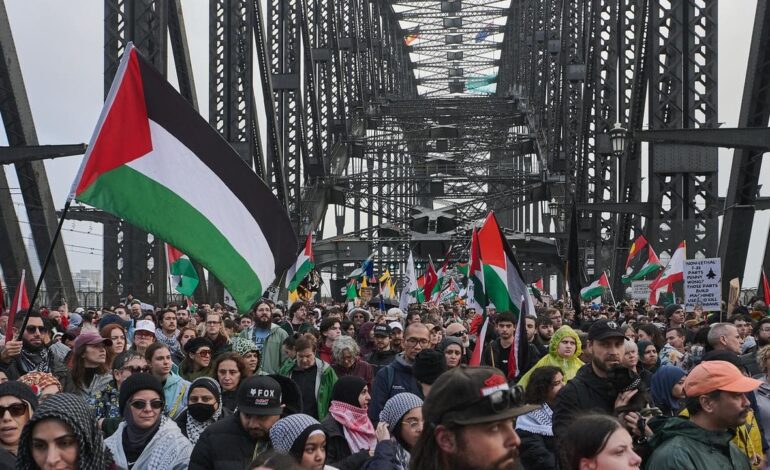
The answer to this question is directly related to the mass mobilization in Australia. On a single Sunday in August, hundreds of thousands of Australians took to the streets in what organizers described as the largest pro-Palestinian demonstrations in the country’s history. Marches were held in more than 40 cities and towns, including a massive rally in Sydney that drew a crowd of up to 300,000 people and brought the city’s Harbour Bridge to a standstill. These protests, which called for sanctions and an end to Australia’s arms trade with Israel, demonstrated the immense public pressure on the government.
In other words, it is the Australian people who have truly spoken, courageously standing up to Netanyahu and to their own government’s refusal to take any meaningful step to hold Israel accountable. If anyone should be congratulated on their strength and resolve, it would be the millions of Australians who relentlessly continue to rally for peace, justice, and an end to the genocide in Gaza.
Similarly, the political crisis in the Netherlands, starting with the resignation of Foreign Minister Caspar Veldkamp on August 22, 2025, is indicative of the unusually significant change in European politics toward Israel and Palestine.
“The Israeli government’s actions violate international treaties. A line must be drawn,” said Eddy van Hijum, the leader of the country’s New Social Contract Party and deputy prime minister.
The “line” was indeed drawn, and quickly so when Veldkamp resigned, ushering in mass resignations by other key ministers in the government. The idea of a major political crisis in the Netherlands sparked by Israeli war crimes in Palestine would have been unthinkable in the past.
The political shift in the Netherlands, much like in Australia, would not have happened without the massive public mobilization around the Gaza genocide that continues to grow worldwide. While pro-Palestine protests have occurred in the past, they have never before achieved the critical mass needed to compel governments to act.
Though these governmental actions remain timid and reluctant, the momentum is undeniable. People’s power is proving more than capable of swaying some governments to impose sanctions and sever diplomatic ties with Israel, not only through pressure in the streets but also through pressure at the ballot box.
While the West has not yet fully turned against Israel, it may only be a matter of time. The precious blood of hundreds of thousands of innocent Palestinians in Gaza deserves for history to be finally altered. The children of Palestine deserve this global awakening of conscience.
[Dr. Ramzy Baroud is a journalist, author and the Editor of The Palestine Chronicle. He is the author of six books. His forthcoming book, ‘Before the Flood,’ will be published by Seven Stories Press. His other books include ‘Our Vision for Liberation’, ‘My Father was a Freedom Fighter’ and ‘The Last Earth’. Baroud is a Non-resident Senior Research Fellow at the Center for Islam and Global Affairs (CIGA).]
❈ ❈ ❈
In another article, The Gaza War Isn’t Over, But Israel has Already Lost, published in CounterPunch, Thomas Knapp adds (extract)
In late August, a Quinnipiac poll found that 50% of Americans now classify Israel’s operations in Gaza as genocidal, and that 60% — 37% of Republicans, 75% of Democrats, and 66% of independents — oppose continued military aid to Israel, at least while the genocide continues.
The effects of changing American attitudes toward Israel may not make themselves felt immediately, but the outcome is more “inevitable” than the fantasies of expansionist Israeli politicians.
[Courtesy: CounterPunch, an online magazine based in the United States that covers politics in a manner its editors describe as “muckraking with a radical attitude”. It is edited by Jeffrey St. Clair and Joshua Frank.]
❈ ❈ ❈
More Than a Boat: The Gaza Flotilla as a Symbol of a Growing Global Movement
Ramzy Baroud
One needs only to examine the actions and rhetoric of the Israeli government to fully appreciate the profound significance of the solidarity flotillas bound for Gaza. As the latest and most significant of these efforts, the Global Solidarity Flotilla sets sail, Israel’s hostile discourse has intensified, articulated most forcefully by National Security Minister Itamar Ben-Gvir.
The extremist minister has ominously declared that all the volunteers on board the Flotilla are “terrorists,” vowing that they will be treated as such. To grasp the chilling meaning of treating non-violent activists as terrorists, one must consider a recent investigation by The Guardian newspaper. The report exposed that of the 6,000 Palestinians detained in Gaza during the first 19 months of the genocide, all were held under a law that classifies them as “unlawful combatants,” thus terrorists, allowing for indefinite imprisonment.
This investigation revealed that the vast majority of those incarcerated by Israel are in fact civilians, including medical workers, teachers, journalists, civil servants, and children. The fact that Israel would extend this same draconian definition to international activists, whose declared mission is to break the siege on Gaza, powerfully underscores the political and strategic value of these missions in Israel’s eyes.
Israel’s deep-seated fear of civil society involvement in its military occupation and war on the Palestinian people is not a recent development. The ongoing genocide has merely highlighted the utter failure of the international legal and political system and, in turn, the rising importance of civil society.
When the first solidarity boat, sent by the Free Gaza Movement, reached Gaza in 2008, Israel was incensed. The activists served as crucial ambassadors, educating their communities about the Israeli siege on the Strip. Tel Aviv’s response to the 2010 Gaza Freedom Flotilla, which included the MV Mavi Marmara, was lethal. Israeli commandos killed 10 activists, sending a stern message that Israel would not tolerate any interference, even from well-known and respected Western-based charities, in its war against the Palestinians.
Since then, treating activists as criminals has become standard operating procedure, bolstered by the fact that not a single Israeli has ever been held accountable for the outrageous violence against civilians. This, however, has not deterred solidarity activists, who have attempted to sail again and again – in 2011, 2015, and 2018. The eventual infrequency of these missions was not due to a lack of interest, but rather the fact that some European countries, in coordination with Israel, did everything in their power to prevent the activists from setting sail.
This dynamic has shifted dramatically with the current genocide. Solidarity with Palestinians in Gaza has surged and now dominates many European societies, eventually winning the support of various governments, including Spain, from which the latest Global Solidarity Flotilla has embarked. Starting from Barcelona, the boats are to be joined by others along the way. They will collectively carry vital supplies to Gaza, knowing full well that their chances of being intercepted and seized, along with their life-saving cargo, are far higher than their chances of reaching the besieged coastal Strip.
This stark reality has been reinforced by recent events. The Conscience flotilla, for instance, was targeted by drones off the coast of Malta last May. Meanwhile, the Madleen and Handala were seized and confiscated in June and July. Prior to the targeting of the Madleen, Defense Minister Israel Katz described Greta Thunberg, the renowned international activist who joined the flotilla, as “antisemitic.” He issued a warning: “You’d better turn back .. because you will not reach Gaza. Israel will act against any attempt to break the blockade or to assist terrorist organizations.”
This fury echoes the angry language and violent actions consistently used by Israeli governments against anyone or any entity that dares to challenge the Israeli siege on Gaza. But why such fury? These seemingly small, underfunded initiatives are, on their own, hardly enough to break the Gaza siege or to feed the two million people who are experiencing both a genocide and famine.
Israel is fully aware of the potent effectiveness of civil society action in the case of Palestine. In fact, most of the advocacy for Palestinian rights globally does not originate from those who purport to represent the Palestinian people, but from civil society at large. This includes a wide range of actions: political advocacy that lobbies governments, legal advocacy that holds states accountable to international law, economic pressure through divestment and boycott initiatives, cultural and academic boycotts, and massive grassroots mobilization.
The solidarity flotillas are therefore a powerful expression of how far civil society is willing to go to do the work that should have been the responsibility of governments and international institutions. Ben-Gvir’s explicit threat to treat activists as “terrorists” is a direct reflection of Israeli fears and, paradoxically, a powerful acknowledgment of the international solidarity movement’s growing influence.
While it is ultimately the Palestinian people, their sumud (steadfastness), and resilience that will defeat the Israeli stratagem, one must not underestimate the critical role of international solidarity. The freedom flotillas are not isolated acts to be judged based on their ability to reach Gaza. Instead, they are a vital piece of an intricate global process that will ultimately lead to Israel’s profound isolation on the international stage — a process that has already begun with considerable success.
[Dr. Ramzy Baroud is a journalist, author and the Editor of The Palestine Chronicle. He is the author of six books. His forthcoming book, ‘Before the Flood,’ will be published by Seven Stories Press. His other books include ‘Our Vision for Liberation’, ‘My Father was a Freedom Fighter’ and ‘The Last Earth’. Baroud is a Non-resident Senior Research Fellow at the Center for Islam and Global Affairs (CIGA).]