❈ ❈ ❈
Zubeen Garg and His All Embracing and Inclusive Interpretation of Assam
Ayaan Halder
Sitting before the television screen, my mother weeps, as Zubeen Garg’s pyre is set ablaze to echoes of the line ‘Dhumuhar xote mur bohut jugore nasun (I have danced with the storm through ages).’ It has been five days since the minstrel’s demise, far from home, in Singapore. Five days of an Assam frozen in time with disbelief. Of a loud, omnipresent silence, as the only sound one hears is a Zubeen Garg song – a Mayabini, a Meghor boron, a Maya, or a Pakhi meli diye – wafting into their ears from innumerable little shrines that have cropped up in crevices and storefronts across the state.
The days have been a unanimous, deeply secular affair – with people with different religious beliefs praying for the departed Zubeen in myriad ways. I, who do not believe as strongly in an afterlife, have also surprised myself by lighting a clump of incense at one such shrine. And talking to the people who had gathered there, I wasn’t surprised to know that some are actually observing religious rituals one usually only reserves for the deaths of their kin.
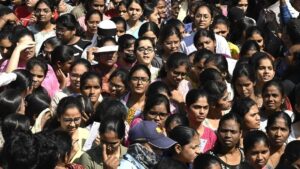
Since Zubeen’s body was brought from the airport to his home in Guwahati, before being taken to the city’s Indira Gandhi Athletic Stadium, (where it remained on display till midnight, September 22), the endless sea of people, in what would go on to be the fourth largest funeral procession/gathering recorded in history, has only echoed with chants of “Joi Zubeen da”, simply refusing to disperse. The sight has been a curious one, with men holding hands to keep people at bay, and cars distributing water bottles intermittently. Many languages were heard amidst the chaos, and people prayed to many Gods. My aging parents, whom I have always known to fear large gatherings, had also joined me on the streets. And looking around, I had barely seen a face without the ungovernable grief of having lost someone very, very dear.
And so I cannot help but think of what Zubeen means to this crowd, not in fragments, but as a united whole. A crowd so endless, so diverse, grieving, mourning and celebrating a man so unanimously in a state that has known so much skirmish.
Fending for himself through his music
Born into an Assamese family to poet and civil servant Mohini Mohon “Kapil” Borthakur and singer and actress Ily Borthakur, Zubeen moved about wherever his father’s transferrable job took them. He was singing and composing from his schoolboy days, and by the time he found himself pursuing a BSc degree in Guwahati’s B. Borooah College in the early 1990s, Zubeen had found his true calling. And, in a way that he would later recollect with much fondness, he left the degree unfinished after promising his principal that he will fend for himself through his music.
This was a time when Assam was struggling with large scale violence and militarisation in the backdrop of counter-insurgency operations like Operation Bajrang and Operation Rhino. And as kids who grew up in the state in the 1990s and early 2000s would confirm, when Zubeen’s debut album Anamika (1992) hit the scene, the cassettes were like a salve to the wounds of a war-torn people. Since then, there was no turning back for him, as he invaded people’s musical consciousness with album after album like fresh showers pouring down on a parched field. And while at 52, his death comes painfully too early, the sheer volume of his work is staggering. A fan has set up a museum chronicling a stupendous 38000 songs he has sung.
A balm through the decades
To me, Zubeen first arrived in the back of my father’s car, where I would take solace in the extraordinary melody of his voice, while we trudged through Shillong’s slow traffic. As a Bengali boy in Northeast India, who traces his ancestry back to East-Bengali partition-era migrants, one of my earliest and greatest of links to Assam was Zubeen and his songs. It was always obvious that Zubeen – both literally and figuratively – was omnipresent in Assam. From house-parties to Bihu functions, his songs – of joy, sorrow, love, grief or politically charged anger – were everywhere. During Bihu season, entire towns waited with bated breath for his arrival, as he often performed at multiple concerts in a single night while touring across the state.
In Assam’s memory, he remains a “naughty boy”– a lively son, a “rockstar” brother, a dear impish friend who didn’t mind cussing. But at the same time, he also remained a calm and sensible guiding light for the state in times of crisis – be that during Anti CAA protests that shook the state in 2019, or the more recent protests against the government’s large scale concretization and deforestation projects in Guwahati.
I must note here that by becoming something whose musical rasa we have equally enjoyed and shared with Assam’s indigenous people, for those with diasporic identities like me too, Zubeen’s music has served as a balm through the decades. Numbing our sense of homelessness and helplessness caused by the many governmental and non-governmental mishandlings of migrants and refugees in the region, and erasing, at least a little bit, the ever-looming stamp of us being “outsiders”, as we sang his songs out loud with our friends. This is primarily because Zubeen’s linguistic and cultural assertion – his Jatiyotabad – was something beautifully sensitised and humanistic. Something that drew us in, and made us a part of the broader Assamese identity as well.
‘Assamese’ music
He understood that to “protect” the jati, mati and bheti (the community, the land and the hearth), one need not take digs at other marginalised people. That the roots of a language threatened by erasure must be nourished through fresh and voluminous “creation” in the present, and not by languishing in the past. That for a language to stay alive, one must put it thoroughly to use. And that is what he went on doing through the decades, quietly, humbly, and cheerfully.
This focus on the power of voluminous and quality creation of art over parochial identity politics became most clear a few years ago, when an organiser objected to him singing his Hindi songs at a Bihu event, and Zubeen cinematically left the venue mid-show after telling the organiser, “You cannot dictate me. Because it is I, not you, who has sung 16,000 songs in 25 years.”
While absorbing rock and pop influences, he extensively wrote, revived and recalibrated music that was primarily “Assamese” – giving new life to the language through sounds that were both contemporary and profound. Sounds that spoke to Assam’s masses, and for them. He also played a pivotal role in giving new life to how Assam celebrated and understood its indigenous culture – engaging deeply and extensively with forms like Bihu, Borgeet, and Tokari, among countless others. With myriad influences and a mad, mad spirit, Zubeen sang of many things – right from deep love in the folds of a handkerchief (Rumaal), to flirtatious rendezvous with strangers through open windows (Khirike Melutei), to a father’s wrath at having caught his child asleep on the study table (Pakhi Pakhi Ei Mur), and to the redundancy of routine life within capitalism (Jontro). He simultaneously did not shy away from taking his music beyond linguistic lines; leaving distinct marks upon a staggering list of music industries in India. This morning, while exploring his discography, I was quite pleasantly surprised at finding out that he has even sang Chatt Puja songs in Bhojpuri.
Zubeen seemed to understand his predecessor Bhupen Hazarika’s interpretation of the Assamese identity, and the fact that its survival and flourishment required an effort towards welcoming the myriad people of the state into its fold. He was uncomfortable being boxed into narrow identity politics, preferring to call himself a socialist. Speaking of his broad worldview, that the one of Zubeen’s greatest impacts, aside from his Assamese compositions and recordings, has been on the Bengali film industry – a fact that he would discuss with much joy, often calling himself “adha-Bangali” (half-Bengali), and recollecting his boyhood years spent in the Bengali-majority Karimganj (now Sribhumi) district in Assam.
‘Comrade’
Although he always has remained a staunch ideologue of the idea of self-determination of Assam and its people, songs like Xunere xojua poja and Politics nokoriba bondhu that starkly criticise the political exploitation of the Assamese people have also always borne within them a strong Marxian undercurrent. The same can in fact be said about his roles in films like Mon Jai (2008). And while he never pledged allegiance to a political party, I suppose in the end, his own clarifications cement his place as a man who carried in him the strong spirit of socialism. Calling himself “Che Guevara’r xissyo (Che Guevara’s disciple),” he unapologetically, enthusiastically used to declare “Moi bamun nohoi. Moi loghun singi hetu di athuwa tori disu. Mur kunu jati nai. Mur kunu dhormo nai. I am a socialist (I am not a Brahmin. I have snapped the Brahmanical thread, and have strung up mosquito nets with it. I have no caste. I have no creed. I am a socialist).” In fact, when faced with moral diktats from any quarters – be that from politicians, godmen, secessionists, or concert organisers – he simply shrugged his shoulders, and said “Moi khatir nokoru (I don’t give a damn).” Because of this inclusiveness, Zubeen never once lost mass support when he sang his Hindi numbers at Bihu functions, criticised casteist and religiously backward practices, or called out armed organisations for violent tactics targeting innocents.
As Dolly Kikon has recently pointed out, Zubeen was never a bourgeoisie icon. He was a “people’s artist”, and remained amongst them till his last breath. It wasn’t an unusual sight in Guwahati, where he lived through most of his professional life, for one to find him chatting, or sharing a pinch of tobacco, with someone vending vegetables on the footpath, or bantering with a homeless person on the streets at night. And of course, there is the great and pervasive philanthropic role that he has played for the poor in Assam –contributing extensively in material, financial terms. In fact, there is a running joke here that Zubeen’s management had not allowed him to install Google Pay on his phone out of fear that he’d go broke in a matter of days because of his benevolence.
It is only hours after Zubeen’s cremation that I write this article. And on my heavy heart, an image now remains embedded. The image of how the ceremony began with puritanically Brahmanical rituals in a way that would have irked the loghun snapping “Comrade” that Zubeen was, and yet how the moment his pyre was set ablaze, the crowd drowned everything out with loud echoes of his Mayabini – a beautiful song about love and romance, which Zubeen had once urged us all to sing aloud, if we were to lose him some day – making it all about his rebellious worldview.
[Ayaan Halder is a poet, author, and doctoral research scholar at the Department of Law, Gauhati University, Guwahati, Assam. Courtesy: The Wire, an Indian nonprofit news and opinion website. It was founded in 2015 by Siddharth Varadarajan, Sidharth Bhatia and M. K. Venu.]
❈ ❈ ❈
Grieving the Loss of Zubeen Garg, Assam’s North Star
Megha Kashyap
I have been grieving since September 19, 2025.
The whole of Assam has been grieving with me to the untimely passing away of our last rebel child Zubeen Garg. It is hard to put into words how much this name and this person means to every Assamese living in the world. Zubeen da (as we all call him) was more than a singer, he was the pulse of Assam, he was the soundtrack of our childhoods in a state that was torn by armed rebellion against the Indian state.
He was rain in tin roofs in Assamese monsoon, someone who’s voice resonates the flow of the river Brahmaputra,
A state ravaged by violence in the 80’s and 90’s following the Assam Agitation, demand for Assamese sovereignty from post-colonial India and state sponsored violence that killed hundreds, if not thousands of people all over the state. It was Zubeen’s album called Anamika, that accompanied the sorrow, grief, love and loss of Assam.
His songs echoed across Assam’s valleys, rice fields and tea plantations, giving us all many reasons to fall in love with our land, our paddy fields, our community and our culture, despite the despair. If Cuba had Fidel Castro, we had Zubeen Garg. His larger than life personality encapsulated rebellion against oppression and exploitation of common people.
There are countless videos of him helping vegetable sellers or rickshaw pullers, sitting down on the road with labourers and sharing meals with them, or helping them financially. He was a people’s hero. He strung the hearts of all Assamese, bringing all of us together as a community without any class, caste, religion or other social divisions.
He spoke his mind, never mincing words to call a spade a spade. In his own words:
Mur Kunu Jati Nai (I have no caste)
Mur Kunu Dhormo Nai (I have no religion)
Mur Kunu Bhogwan Nai ( I have no God)
Moi Mukt (I am free)
When the news of his passing away landed on my WhatsApp group on September 19, I was strolling in Regent’s Park, London. My initial reaction was shock and denial. I remember sitting down on one of the benches to read what happened. I immediately had to speak to my mother who loves Zubeen da. She broke down on the call and I was trying to calm her down by saying maybe it was his destiny that called him to Singapore to embrace his death. I carried on the day without thinking much.
Later in the evening when I returned to my flat, I asked Alexa to play my Assamese playlist. When it played one of my favourite songs of Zubeen da, i.e Samoyu Jen Atori Roi, something inside me triggered and then came the incessant tears and pain. Since then, I have been crying inconsolably. This slow simmering grief comes to me in waves, in waves of nostalgia of living my childhood and adulthood in his lyrical company.
I realised and felt deeply how intimately I am connected to him. He didn’t even know I existed. My closest encounter with him was in 2003. It was my first Bihu concert held in Judge’s field Guwahati. Dad took my elder sister and myself to watch the show. I was mesmerised as a child to watch this long haired, hipster donned in a black leather jacket walk out with a microphone in his hand singing Mayabini. I was enchanted by him. And ever since then I have been in love with Zubeen da.
I carried his songs, his lyrical compositions wherever I went. When I was working across Assam on flood relief, his songs gave us company in the evenings, when we would sit down with the community to share a meal, we sang and danced to his Bihus to give us hope and joy when everything around us was submerged in water. Years later, when I moved to Sikkim and then to Delhi, I found my home in his songs.
I used to say that I want someone to love me like Zubeen da’s songs; gentle, tender and who would become my quiet shelter in the storms I cannot control. English language and words cannot do justice to how Zubeen da described love and how to love someone. His songs engrained in my psyche that to love someone is to let your roots entwine without losing your soil, to be gentle in their breaking and joyful in their rising.
When I moved to London for my PhD, besides finding my home in Zubeen da’s songs, I found my Assameseness is defined and laid out bare in his lyrics. Encountering existential questions on who is an Assamese and what makes me an Assamese in my doctoral project on borders in Assam, my quest took me back to his songs. His songs stayed with me on nights when I lost my patience in writing through trauma and pain of seeing Citizenship Amendment Act (CAA) protests in Assam in 2019.
Years later, I realised I am so intimately connected to Zubeen da through his songs. For me Assam is Zubeen da. I fantasise the smell of rain through his songs, the echoes of Bihu through his songs, the burning desires of love through his songs, the radical activism to hold onto Assameseness through his songs. I am also reminded that I am more Assamese than I think I am.
Crying alone in a train station in Lancaster, UK, on 22nd Sept, sat on a bench, when two staff approached me, I was finding it difficult to tell them why I am crying inconsolably at the death of a singer. I could not tell them in my own native tongue Assamese, that there are thousands of us living in all parts of the world, crying inconsolably right now.
Zubeen da’s passing away is a personal loss for so many of us. It is as if he is a family member. Continents apart, being far away from my people and community, I carry this immense pain and grief. I don’t’ know how to navigate a world without Zubeen da. And I know many of us echo the same feeling.
[The author is a feminist academic and activist from South Asia with over a decade of experience working across the development sector and academia in South Asia, parts of Africa, and the UK. She has a PhD in Gender Studies from SOAS, University of London and works as the Decolonising Research Fellow at London South Bank University (LSBU), where she leads the university’s institutional commitment to decolonising curriculum, research, and practice. Courtesy: The Wire, an Indian nonprofit news and opinion website. It was founded in 2015 by Siddharth Varadarajan, Sidharth Bhatia and M. K. Venu.]