❈ ❈ ❈
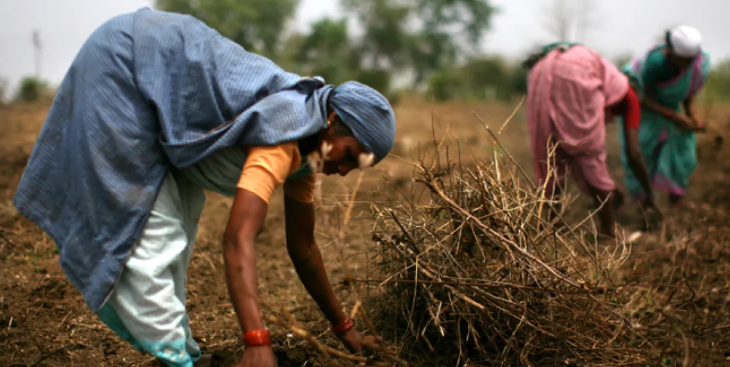
Adani’s Great Land Grab in Maharashtra Leaves Farmers Fuming
Amey Tirodkar and Anand Mangnale
Land has always been at a premium in Maharashtra’s Chandrapur district because of its wealth in natural resources and minerals, be it coal, iron ore, or limestone, which explains the presence of many big corporations in this region. Now, a new game of land grab is at play in the district, especially in Korpana tehsil, known for its limestone deposits and the cement industries that have mushroomed here over the past 30 years.
Korpana tehsil lies at the border of Maharashtra and Telangana. Since 2001, Ambuja Cements (formerly Gujarat Ambuja Cement Ltd) has had an integrated cement plant in Korpana’s Gadchandur city. Gadchandur, also known as “cement city”, is home to several large cement factories belonging to companies such as Ambuja Cements, Maratha Cement Works, Ultratech Cement, and Dalmia Cement, and they source limestone from the nearby villages. For one such project, namely the Nandgaon-Ekodi limestone mine, Ambuja Cements applied for environmental clearance (EC) for limestone mining on a land parcel of 369.52 hectares spread across four villages: Nandgaon, Ekodi, Kawthala, and Bhoyegaon. A public hearing was held as part of the EC process on January 29, 2021, details of which are available on the government’s Parivesh portal.
In the public hearing, several farmers, including Kawthala’s then sarpanch Naresh Satpute, also affected by the project, put forth some demands.
They wanted the land deals to be completed by May 31, 2021; one member of each 7/12 extract (a revenue document that gives details of land ownership) to be given a job in the company; and farmers to get Rs.50 lakh per acre and compensation of Rs.30 lakh each if they were not given jobs. (These are recorded in the minutes of the public hearing.)
As per the minutes, Ambuja Cements replied: “After receipt of EC, land acquisition process will be carried out,” that indicating that the farmers’ demands would be considered after acquisition. The company also said that there would not be “any mediator involved during the process of land acquisition” and that the agreements would be “between the project proponent & landowner only”.
Ambuja Cements was granted the EC in August 2022. In September 2022, the Adani Group acquired Ambuja Cements and its subsidiary ACC Ltd for $10.5 billion (roughly Rs.81,000 crore) in what the pink press called the group’s largest ever acquisition and India’s largest ever M&A (merger and acquisition) deal in the infrastructure and materials space.
However, the company did not initiate work on the limestone project. Then, in the monsoon months of 2024, a group of people descended on the four villages. Naresh Satpute said: “Nitin Zade from Ambuja Cements said the process of buying land would start soon. We knew Nitin because he is from a nearby village and had been working at Ambuja Cements’ Gadchandur plant for many years.”
The farmers were initially hesitant to sell because the company’s offer price was too low. “They were offering us Rs.25 lakh per acre. We were not ready to sell,” said Satpute.
Land sales begin
Then, he added, in late 2024 Sudhir Mungantiwar, the BJP MLA from Ballarpur in Chandrapur district and a former Cabinet Minister, met them in Chandrapur. “There, the company people offered Rs.35 lakh per acre. Mungantiwar told us farmers that we should now sell the land to the company or MIDC [Maharashtra Industrial Development Corporation] would come in and we won’t get even this amount.”
At this point, the farmers began to sell their land at Rs.35 lakh per acre to the “company people”. However, when they went to the registrar’s office in Korpana Block Office, they found that the buyer was not Ambuja Cements but a different company. Satpute said: “However, we still signed the papers because Rs.35 lakh per acre was a large amount. Also, once all the farmers began to accept the cheques, who will oppose?” (The EC mentions Rs.72 lakh per hectare as the compensation amount.)
Satpute’s family sold 12 acres. The registration process for 10 acres has been completed and the remaining two acres are in the process of being sold at the time of filing this report.
New buyers
Soon, the farmers realised that each of them was selling to a different buyer. Bebitai Madan Satpute, Naresh Satpute’s mother, sold her land to Victorlane Projects Pvt. Ltd, while a farmer named Nandkishor Thakre, also of Kawthala village, sold his land to Vihay Realtors Pvt. Ltd. In total, 13 such companies bought the land where Ambuja Cements was supposed to start a limestone mine.
Enquiries by Frontline revealed that all 13 companies are registered at the same address: 103 and 104 Ramsukh House, Thube Park, Shivajinagar, Pune. This address also appears on the sale deeds registered in the Korpana registrar office. One of the names figuring in the sale deeds is that of Tushar Satywan Gajbhiye. When contacted on June 17, Gajbhiye claimed that all the paperwork was legal and promised to call back with more responses but did not.
Nitin Shamsundar Zade, who interacted with the farmers on the land sale, was the land acquisition officer in Ambuja Cements’ Gadchandur division for many years and is a familiar figure in the area. Zade was made an additional director in all 13 companies on a single day: February 27, 2025. When contacted by Frontline, Zade said he could not talk without permission from his bosses. Asked if he was still working at Ambuja Cements, he did not give a straight answer. Further enquiries revealed that 7 of the directors in these 13 companies are current or former employees of Ambuja Cements, ACC, or linked companies.
All 13 companies are part of the Rucha Group of companies, according to Shailendra Rathi, the group’s land acquisition officer. The group’s beneficial owner (with 95 per cent shares) is Raj Rajeshwar Projects LLP, a company incorporated in May 2022 and owned by Prashant Nilawar, who was implicated in the Rs.1,000 crore Buldana cooperative society scam of 2021. The Buldana scam involved a money laundering operation to conceal alleged proceeds from corruption within Maharashtra’s Public Works Department.
Rucha group
Speaking to Frontline, Rathi said: “We are in the land banking business. We buy land at various locations. Sometimes we develop them. So, in these four villages too, we have bought land.” Asked why the group was buying the land, he said: “There is no concrete proposal right now. We are just buying it.”
On whether the group companies were buying the land for Ambuja Cements, Rathi said: “We have nothing to do with Ambuja Cements. We are buying the land for ourselves.” Regarding the environmental clearance for limestone mining, he said: “We don’t know the history. There could be some clearance given, but that was long ago, in 2021 [the EC was actually given in August 2022]. We have been buying land over the last few months.” Asked if the group would sell the land to Ambuja Cements, Rathi said: “The company has not thought about it.”
On whether the Rucha Group had asked Sudhir Mungantiwar to contact the farmers, Rathi said: “We have no idea whether Mungantiwarji met the farmers or not. We have nothing to do with him, and we are not in touch with him.” Asked if it could be a breach of law were Rucha Group to sell the land to Ambuja Cements in future, Rathi said: “No such question arises; we have not thought about selling as of now.”
Rathi admitted that Gajbhiye was an employee of his company. On Nitin Zade, he said: “He is our local man. We made him director for extending help locally.” When asked if Zade was also an employee of Ambuja Cements, Rathi said: “I am not aware of that. It is possible he could be working for them. We don’t have an issue with where Zade works locally.”
Too many red flags
It is quite a coincidence that Zade was the land acquisition officer for Ambuja Cements and that Rathi’s companies made him a director for acquiring the same land for which Ambuja Cements had acquired an EC. Rathi said: “We were not aware of Zade’s association with Ambuja.”
Since the land parcels fall in Korpana tehsil and are part of the proposed mining site, Frontline reached out to Pallavi Akhare, the tehsildar of Korpana. She said: “I have no idea about the land being sold. I have asked my colleagues to find out what is happening.” Both the tehsildar and other local administration officials claimed to be ignorant of the enormous land deals taking place in their jurisdiction.
Why did ACC pay Rs.100 cr more to acquire Rucha Group?
Strangely, ACC paid Rs.298.61 crore to acquire the Rucha Group companies that had already bought the land parcels. paying almost Rs.100 crore more than it would have had it acquired the land directly from the farmers.
When contacted, Sudhir Mungantiwar said: “I have neither asked nor forced anyone to sell the land. A few local BJP workers came to me and told me that the company is buying only 300 acres. The other [tracts of] land close to the proposed project land would also be affected. These farmers won’t be able to do agricultural work there. So, these workers were demanding that the company buy all the land there. I told the District Collector that it is a genuine issue, and to ensure that all farmers concerned get proper compensation, and the company buys all the land concerned. My relation to this case ends here.”
As for companies other than Ambuja Cements buying the land, Mungantiwar said: “I am not aware who bought the land. I only know the farmers are happy that they got good compensation.”
Legal angle
Speaking to Frontline, Lara Jesani, a well-known advocate of the Bombay High Court, said: “The EC specifies the compensation payable by Ambuja Cements to the farmers for their land being taken over for the project. Ambuja Cements alone is the project proponent in the EC and the terms and conditions of the EC bind the company.”
Regarding the 13 other companies buying the land, she said: “Ambuja Cements ought to be paying compensation to the farmers for the project land as per the EC. If it is found that companies purportedly related to Ambuja Cements in some ways have bought the land, it must be investigated. The authorities have to investigate if the terms of transfer and the compensation payable to the farmers were followed in these sales.” Jesani added that the authorities need to check whether the EC’s terms have been complied with.
The EIA Notification, 2006, states that an environmental impact assessment (EIA) study must necessarily include social impact assessment and rehabilitation and resettlement (R&R) issues. They include a plan for resettlement, compensation to affected people, alternative livelihood concerns/employment for affected people, and so on.
Ambuja Cements’ promises
In the EC, Ambuja Cements agreed to pay compensation in three parts: 40 per cent lump sum, 40 per cent in the form of fixed deposits, and 20 per cent in the form of annuities (such as LIC policies). It also agreed, inter alia, to identify alternative land for farming, organise vocational and skills training, and make a one-time (livelihood) payment of Rs.5 lakh per project-affected family.
The entitlement matrix was derived on the basis of the Right to Fair Compensation and Transparency in Land Acquisition, Rehabilitation and Resettlement Act, 2013, known as the LARR Act. It includes extra compensation for vulnerable families and consideration for project employment. Also, if additional impacts are identified during implementation, the entitlement matrix is updated.
Since the Rucha Group companies purchased the project land instead of the project proponent, none of these R&R conditions have been met.
Official response
In response to Frontline’s questions, Ambuja Cements replied with a statement that said: “The [land] acquisition was facilitated through multiple special purpose vehicles, which are wholly owned subsidiaries of Ambuja Cements.” The Rucha Group companies bought the land in 2024. But, as per Ambuja Cements’ annual reports and stock market filings, the companies became subsidiaries via a share purchase agreement only in February 2025.
Ambuja Cements also said in its statement that the “method of acquisition, whether direct or through subsidiaries, does not alter the legal ownership or the intended use of the land”. But earlier, at the public hearing, the company had promised that there would be no mediator and that the purchase agreements would be between project proponent and landowner only.
In its statement, Ambuja Cements further said: “Any questions raised around alleged job assurances stem from unilateral and informal references noted by a few landowners in their voluntary no objection certificates during the initial phase of the project. These references were not part of any contractual agreement with Ambuja Cements, nor were they recognised by regulatory authorities as a valid basis for granting Environmental Clearance (EC).”
EC and R&R
The EC was issued after the Ministry of Environment, Forest and Climate Change accepted the conditions of the R&R plan, which includes a one-time payment per project-affected family, skills training, and other specifics.
The R&R plan and the commitments made by Ambuja Cements are mentioned in the EIA report, based on which the public hearing took place. The report is in the public domain.
One specific condition was: “Action taken report of R&R plan shall be submitted annually. As discussed during the meeting, the benefit to project-affected persons as a percentage of the sale price shall be submitted to the Ministry.”
In its statement, Ambuja Cements also said: “The entire land acquisition was completed within six months—a clear indication of mutual interest, trust, and the fulfilment of expectations on both sides. Farmers received compensation rates significantly above prevailing government guideline values.”
Strangely, as per its annual report, ACC paid Rs.298.61 crore to acquire the Rucha Group companies that had already bought the land parcels. In other words, it paid almost Rs.100 crore more than it would have had it acquired the land directly from the farmers. (The budget as per the EC was Rs.201 crore.)
The Ambuja Cements statement also noted: “We continue to receive fresh requests from neighbouring landowners who wish to sell their land to Ambuja Cements—a strong testament to our fairness, transparent dealings, and the trust we have built on the ground.”
Chandrapur’s farmers are unhappy. Ambuja Cements did not buy the land directly from them despite its assurances in the public hearing, and their demand for one job per 7/12 extract, and the R&R guarantees specified in the EC, have not been met so far. Naresh Satpute said: “We are being cheated. But what can we do?”
[Amey Tirodkar works with Frontline’s Mumbai Bureau. Anand Mangnale is an independent journalist. Courtesy: Frontline magazine, a fortnightly English language magazine published by The Hindu Group of publications headquartered in Chennai, India.]
❈ ❈ ❈
The Real Story Behind Assam’s 3,000-Bigha Land Row
Pratyush Deep
A video clip from a Gauhati High Court hearing has been raging across social media. It shows Justice Sanjay Kumar Medhi, visibly astonished, reacting to the allotment of 3,000 bighas of land in Assam’s Dima Hasao district to a private cement company.
“3,000 bighas! The entire district? What is going on? A private company being given 3,000 bighas? … Public interest, not private interest, is what matters,” Justice Medhi said during the August 12 hearing.
Online, though, the story took on another life. As the clip spread, many users, including the social media handles of the Congress and CPI(M), claimed that the land was being handed over to the Adani Group. The conglomerate had to issue a formal denial on August 18, clarifying that such reports are “baseless” and that it has no connection to the cement company.
After the misinformation and the subsequent clarification, the actual issue – the long-running conflict between tribal villagers and land allotments in Sixth Schedule areas – was once again sidelined.
Newslaundry had earlier reported on similar tribal resistance to other mining projects in the same district. One of them is linked to Adani Group’s Ambuja Cement, whose limestone mining project has been allotted over 1,200 bighas and has been facing stiff local opposition over fears of displacement.
A fight older than the viral clip
The company at the heart of the viral video is Mahabal Cement, which received the disputed allotment in Umrangso, an environmental hotspot in Dima Hasao district. Since December 2024, 22 residents of Nobdi Longku Kro and Chotolarpheng villages have been challenging the allotment in court. They have alleged that the Dima Hasao Autonomous Council (DAHC) had granted the land without following due process.
Dima Hasao, a Sixth Schedule district established in 1951, is governed by the North Cachar Hills Autonomous Council, which oversees land management and governance in the region, particularly for its tribal communities. The district has both surveyed and unsurveyed lands – land rights in the surveyed land are governed by the council and in line with traditional arrangements recognised by the revenue department in unsurveyed areas.
The petitioners claim their families have lawfully lived on and cultivated these lands since 1975, and have consistently paid taxes to the DAHC through village headmen, or gaon buras. The land, they argue, is communally owned under tribal customs and distributed among villagers by the gaon buras.
But in 2024, a revenue official informed them that their land had been acquired for a private company’s project. The patwari allegedly coerced some villagers into signing No Objection Certificates (NOCs) and accepting cheques of Rs 2 lakh as compensation, the petitioners claimed.
On May 16, a group from Nobdi Longku Kro submitted a formal objection letter to the DAHC, accusing officials of using “coercion” and “disinformation” to push through an “involuntary” acquisition.
While a section of villagers allege coercion, the case has seen at least nine hearings since February this year.
Three months before the villagers approached the court last year, the land dispute had reached the Gauhati High Court through a PIL filed by an activist on behalf of villagers. While the court disposed of the matter in November, allowing residents to return if new circumstances arose, tensions on the ground continued to escalate. A petition was filed in December.
The hearings
During the first hearing on February 2, the Gauhati High Court directed the authorities to clarify how 3,000 bighas of land, located near parcels owned by the petitioners, had been allotted to Mahabal Cement. The court also sought an update from the DAHC on the progress of land demarcation related to the allotment.
By April, the council submitted an affidavit acknowledging that a resolution passed in January had approved the provision of alternate land to affected residents. This was followed by a notification on March 6, confirming the re-allotment of land roughly 500 meters from the village, in equal proportion to what was acquired, along with monetary compensation for agricultural use.
Meanwhile, Mahabal Cement also filed a separate petition, alleging inaction on its complaint about individuals allegedly disrupting its cement project. The court later merged the petitions, hearing them jointly on August 12 when its remarks went viral.
The court noted: “A cursory glance into the facts of the case would reveal that the land which has been sought to be allotted is about 3,000 bighas, which itself appears to be extraordinary.”
While Mahabal Cement claimed that the land had been allotted following a mining lease granted through a tender process, the court raised serious concerns, pointing out that the district is a Sixth Schedule area “where the priority has to be given to the rights and interest of the tribal people residing there”. “The area involved is Umrangso in the district of Dima Hasao which is known as an environmental hotspot containing hot spring, stopover for migratory birds, wildlife, etc.”
The court will next hear the matter on September 1.
[Pratyush Deep is a journalist with Newslaundry. Courtesy: Newslaundry, an Indian media watchdog founded in 2012 by Abhinandan Sekhri, Madhu Trehan and Prashant Sareen, that provides media critique, reportage and satirical commentary.]
❈ ❈ ❈
A Land Grab in Disguise
Harinder Happy and Shivam Mogha
The Punjab government has withdrawn the Land Pooling Policy, 2025, which had faced strong backlash from farmers, unions, and civil society for being exclusive, anti-farmer, and lacking legal and ethical transparency. While the state had promoted it as a move toward inclusive development and organized urban growth, the reality on the ground told a different story. Before this withdrawal by the state, the Punjab and Haryana High Court had put a stay on the policy, citing various legal and procedural issues. What began as local protests by affected farmers escalated into statewide opposition. Many people compared the policy to the controversial 2020 farm laws, claiming it was even more harmful due to the direct taking of land.
In May and June of that year, the Punjab government had issued notifications proposing the Land Pooling Policy 2025. The goal was to create well-planned urban estates and infrastructure to meet the needs of the growing population by consolidating fragmented land parcels. Under this policy, the government would have pooled agricultural land through special development authorities. They planned to develop this land for residential, commercial, industrial, institutional, or mixed-use purposes and then return a portion to the original landowners after construction. On average, around 27 to 28 percent of the original land area would have been returned as developed plots, based on the type of development. The Chief Minister and other officials had stated that this policy would regulate thousands of illegally built colonies across the state and improve farmers’ lives by making them part of urban development.
While land pooling is not new in India and has been used to consolidate fragmented lands into planned infrastructure, and many cities have grown through it, policies like Punjab’s often justified themselves by claiming they would develop the area or improve farmers’ lives. This reflected a mindset that overlooked the needs of villagers and their socio-cultural and farming life. Villages faced many structural issues, and it was crucial to move beyond the notion that development only meant urban growth and expansion of secondary industries.
The policy had several shortcomings that led to widespread protests from farmers. It provided vague reasons for not following the Right to Fair Compensation and Transparency in Land Acquisition Act, 2013 (LARR, 2013), arguing that the whole acquisition process took more than a year and led to litigation over land acquisition challenges. This reasoning was unfounded. By ignoring LARR, 2013, the state also avoided key provisions like obtaining consent from 70 percent of affected people for public projects and 80 percent for private projects. Hastily drafted, the policy further ignored critical steps such as Social Impact Assessments (SIAs), public hearings, and evaluations of social costs, which are essential under LARR, 2013. SIAs assess how land loss impacts livelihoods, ecology, and village life, as well as landless people and artisans. Still, the Punjab government had skipped these steps in places like Chamkaur Sahib and Mattewara.
The initial draft of the policy had allowed 30 days for objections after the land title was published in newspapers, but a later notice cut this period to just 15 days. Not only this, the policy did not clarify the responsibilities between the Land Acquisition Collector and the Property Officer. This left farmers confused about who would manage property matters after construction and who could buy the land. The original draft excluded commercial plots and special residential assistance for those pooling up to 3 Kanals (0.375 acres), and though later notices revised this, benefits were offset by reducing their residential plot share. Likewise, the policy mandated a 60:40 cost-sharing for zonal road construction between landowners and the authority and prohibited landowners from developing residential plots smaller than 150 square yards on their own land. This created an unfair financial burden and excessive control over landowners.
During the 2020–21 farmers’ protest against the three farm laws, a significant complaint was the lack of consultation, a concern echoed by AAP. Despite several meetings between the government and farmer representatives since 2022, farmers had never requested this policy. Conspicuously, the drafts were not proposed in the state assembly either, raising an important question: who actually wanted it?
The necessity of this policy was further called into question as thousands of urban colonies across Punjab remained empty. About 76 villages would have been directly affected for housing, and 40 for industrial zones, needing over 65,000 acres. Yet, the government had not clarified who would receive these homes. Past failures also contributed to this distrust: more than 30,000 existing colonies were unregulated, many with vacant homes. The Greater Mohali Area Development Authority (GMADA) had faced delays of over a decade with land pooling, retaining prime plots while giving farmers less valuable land.
It was clear that farmers in Punjab were skeptical about the scheme. Protests by them showed nearly total rejection, as seen in the PR-7 Aerotropolis project in Mohali, where only 51 out of 8,000 landowners (just 0.6 percent) had opted in. Despite this, the government continued to ‘claim’ success and participation. This policy came at a time when Punjab’s net agricultural sown area had already declined, from 4.25 million hectares in 2001–02 to 4.11 million hectares in 2022. The amount of land used for non-agricultural purposes had steadily increased, rising from 6.8 percent of the total geographical area in 1990–91 to 10.2 percent in 2021–22. With no long-term support system in place, this risked economic displacement and loss of identity, security, and ecology, leading farmers to label it a “land grab in disguise.”
The land pooling policy had mandated ₹30,000 per acre per year for three years as compensation, later “announced” to be ₹1 lakh per acre annually until construction was complete, potentially costing around ₹6.5 billion. A critical question remained: where was the state’s budget for such a massive expense? Given Punjab’s unstable financial situation, this promise seemed dubious. When the Aam Aadmi Party took office in March 2022, the state’s public debt stood at ₹2.92 lakh crore. By 2025–26, it was projected to exceed ₹4.17 lakh crore. With such considerable debt, could the state realistically fund this large-scale compensation plan without further borrowing? If it could, it would only worsen Punjab’s existing debt problems.
Many villages in Punjab had formally passed resolutions opposing the policy. Keeping true to the farmers’ protest culture in the region, farmers had taken to the streets, organizing local protests and statewide tractor marches on July 30, while warning of a Delhi-style protest. One major outcome of the 2020–21 farmers’ protests had been the marginalization of traditional political parties in Punjab. AAP had taken advantage of this situation in the 2022 assembly elections, winning more than one-third of the assembly seats. However, the same farming community that had supported AAP was now leading the opposition against it.
Given the worsening agrarian crisis, farmers had expected AAP to promote agricultural diversification. Nevertheless, the Economic Survey 2024–25 showed otherwise: monocropping had intensified. The share of paddy among all crops increased from 40.01 percent in 2021–22 to 40.8 percent in 2023–24, and wheat rose from 45.0 percent to 45.2 percent during the same period. It was visibly believed that AAP was shifting its attention toward urban Punjab to compensate for rural losses. Disillusioned farmers are no longer engaging with the party, and the policy’s politics will severely impact AAP’s future in Punjab, since there is enough damage to the party among rural and agrarian Punjab.
[Harinder Happy was media coordinator of Samyukta Kisan Morcha. Shivam Mogha was was co-editor of Trolley Times. Both are PhD scholars at Jawaharlal Nehru University. Courtesy: Countercurrents.org, an India-based news, views and analysis website, that describes itself as non-partisan and taking “the Side of the People!” It is edited by Binu Mathew.]
❈ ❈ ❈
Adani Power Receives 1,020 Acres for Lease in Bihar’s Bhagalpur – at Rs 1 Per Acre Per Year
Aathira Perinchery
It’s a windfall for the Adani Group. Its subsidiary company, Adani Power, has just received 1,020 acres in Pirpainti in Bihar’s Bhagalpur district on a 25-year-lease to build, own and operate a power plant – at just Rs 1 per acre per year.
This comes at a time when villagers have alleged that many have not received full or fair compensation from the state government for their agricultural lands, primarily fruit tree orchards such as mango and litchi. The infamous Srijan scam too looms large over this lack of fund disbursement. Farmers are also aware that though they may receive some compensation for their lands, they will no longer have a means of livelihood.
The move to commission yet another coal-based power plant in a state that is witnessing high levels of air pollution also raises questions surrounding health impacts on local communities, as well as India’s climate goals and transition to renewable energy sources.
Windfall for the Adani Group
On September 15, Prime Minister Narendra Modi inaugurated multiple development projects worth around Rs 40,000 crore in Purnea, Bihar. Among these is a Rs 25,000-crore, 2,400-megawatt, coal-based thermal power plant in Pirpainti in the adjoining district of Bhagalpur. This was to make Bihar self-reliant in the power sector, Modi remarked. Per the press release, this will be Bihar’s largest private sector investment and is designed on “ultra-super critical, low-emission technology”.
“The project will provide dedicated power and strengthen Bihar’s energy security,” the statement said.
What Prime Minister Modi did not mention is the private company that will build, own and operate this power plant for 25 years: Adani Power Ltd, a subsidiary of the Adani Group.
Two days before Modi’s address, on September 13, Adani Power signed a 25-year Power Supply Agreement (PSA) with the Bihar State Power Generation Company Ltd (BSPGCL). Per this Agreement, Adani Power will set up a greenfield ultra-supercritical power plant consisting of three units each of a 800 MW capacity, under the “Design, Build, Finance, Own, and Operate” model.
In June, JSW Energy, Torrent Power and Bajaj Group’s Lalit Power were in the running for the bid in addition to the Adani Group. Last month, Adani Power received the Letter of Intent for the project from the Bihar state utility. Per a press statement by the Adani Group, the first unit will be commissioned within 48 months of the appointed date, and the last one within 60 months of the appointed date.
It plans to invest USD 3 billion – nearly Rs 25,000 crores – in the project. The electricity generated in the plant will be sold to state power utilities for Rs 6.075 per KWh.
Compensation concerns
What has raised eyebrows about this deal is that Adani Power will need to pay just Rs 1 per acre per year for the 1,020-odd acres of land it will take up for the project over 25 years.
Villagers told Bharati News/Molitics that many land owners had received different rates of compensation for their lands, and that they did not know why a uniform rate was not applied for the process.
They also alleged that some have not received full compensation for their lands that were taken up by the state government for the power plant 12 years ago. Villagers said that the pending payments they receive in future for these lands will be at the same rate as the land deal from 12 years ago and not at the higher rates that currently exist.
Villagers also alleged that some who tried to go to Bhagalpur to meet Prime Minister Modi during his visit to the city on September 15 to talk about these concerns were arrested and prevented from meeting him.
With their lands gone, many are worried: while they may receive a one-time compensation for their lands, they will no longer have any means of livelihood.
Land is a precious commodity in Bihar, with 28 of its 38 districts being prone to flooding. For the people of Pirpainti – a majority of whom are either cultivators (land owners or co-owners) or agricultural labourers, as per the latest Census (2011) – cultivable land is very important too.
Some villagers told Bharati News/Molitics that the state government had listed their lands as “barren” when they took over the plots for the power plant – when these are in fact prime agricultural lands currently housing lakhs of fruit trees such as mango and litchi.
Studies such as this one have found that these fruit crops are a sustainable and steady source of income for farmers in Bihar. They are also flood-tolerant – and therefore a climate resilient crop. Scientists have been advocating that farmers cultivate climate-resilient crops, as a mitigation strategy in today’s times of increased climate change impacts such as floods and droughts. Both mango and litchi are also important cash crops for the state – Bihar is the top producer of litchis in the country, and the third largest producer of mangoes.
A history of opposition
Villagers have been opposing the project since it was mooted in 2014 (then envisaged as a supercritical 1,320-megawatt thermal power plant). Land acquisition was to have been completed by 2016 – but it did not happen.
According to Land Conflict Watch, farmers in the area rallied under the banner of Kisan Chetna and Utthan Samiti alleging irregularities in receiving compensation for the land that they had given up for the project in 2014. Though revenue officials tried to engage in talks, villagers prevented the construction of the boundary wall at the site of the proposed power plant because they had not received compensation.
According to The Telegraph, funds to the tune of Rs 200 crore were required to settle compensation to be given to land owners as part of the land acquisition for the power plant. The Union government purportedly released these funds to the proforma disbursement account of the Bhagalpur district administration. From there it was then transferred to the account of the district land acquisition office in Bhagalpur, which was responsible for distributing the amount to land owners.
However, this didn’t happen – because of the infamous Srijan scam that surfaced in 2017. As part of this scam, government funds amounting around Rs 880 crores were fraudulently transferred between 2004 and 2014 into the account of an NGO called the Srijan Mahila Sahyog Samiti in Bhagalpur, in collusion with officials at the district land acquisition office. Srijan illegally withdrew money – about Rs 270 crores – meant for the land owners who had given up their land for the Pirpainti thermal power plant.
From public sector undertaking to private hands
The proposal for the Pirpainti thermal power plant originally meant the NHPC, a public sector undertaking under the central government, to set up the plant.
Per the Central Electricity Authority, as of 2021, Bihar had 22 thermal power plant units, most of which are part of four major thermal power plants: the Barauni, Kahalgaon, Muzaffarpur and Nabinagar plants. All these power plants, which generate a total of 7,050 megawatts of electricity, are owned and operated by central public sector undertakings.
In 2014, when it was first mooted as a supercritical 1,320-megawatt thermal power plant, a memorandum of understanding was signed between the Pirpainti Bijlee Company, Bihar State Power Generation Company Limited and NHPC Limited.
Today, the Pirpainti thermal power plant has been handed to Adani Power to build, own and operate for 25 years – and will be the first and largest private sector thermal power plant in the state.
What changed, more than a decade later, for the state government to have handed it over to private players?
Moreover, the nature of the power plant has also changed over the years – from being mooted as a thermal power plant in 2014, to a solar power plant (also to be developed by NHPC) in 2021, and back to a thermal power plant in 2025.
In fact, per Land Conflict Watch, media reports had noted that the state government had, in 2021, already acquired 1,350 acres of the required land with only 25 acres left to be acquired. Again, opposition from farmers led to the project being shelved.
Coal, environment and health
Pirpainti, where the 2,400 MW coal-based power plant will be constructed, is located in the Kahalgaon sub-division in Bhagalpur district. The district is already home to a large thermal power plant – the 2,340 MW Kahalgaon Super Thermal Power Station.
For Subhasis Dey, a researcher who hails from Bhagalpur and has been following ecology and the environment in the state and district for decades, locating another power plant in the same district and just a few kms away doesn’t make sense.
One issue is the Indian government commissioning a new coal-based power plant despite its commitment to invest in renewable energy to enable a transition from polluting fossil fuels to cleaner energy sources, Dey agreed. Another is how yet another power plant in the region could be problematic for the climate, environment and health, he said.
With coal-powered power plants come numerous health concerns. Arsenic is one of the many pollutants that coal-fired power plants produce. Coal emissions release this pollutant into the air, while fine, powdery fly ash – a by-product of coal combustion – can leach into the ground, contaminating soil and water.
Arsenic poisoning is already a huge concern in Bihar. In 2021, scientists at the Mahavir Cancer Sansthan and Research Centre in Patna screened the blood profiles of 2,000 cancer patients. They found that most of the cancer patients with high arsenic levels in their blood were from the districts near the river Ganga. Among these districts is Bhagalpur.
In the same district and just around 7 kms away from Pirpainti, where the new coal-fired thermal power plant will arrive, lies the village of Kaliprasad. In 2023, scientists from the same cancer research centre in Patna studied 102 households and found that people here were suffering from many serious health-related problems such as skin issues (hyperkeratosis and melanosis on palms and soles), breathlessness, general body weakness, mental health disorders, diabetes, hypertension (raised blood pressure), hormonal imbalance, neurological disorders and cancers.
They found that 77% of household hand pump water had arsenic levels far higher than the WHO recommended level of 10 µg/L (micrograms per litre): the highest level they recorded was a staggering 523 µg/L. The concentration of arsenic in the urine of 60% of the people in these 102 households was very high. The highest concentration they recorded was 374 µg/L – nearly 7.5 times more than the permissible limits. With people in the vicinity already suffering from arsenic poisoning, a new coal-based power plant in the region would only add to the disease burden.
Particulate pollution and its impacts on health are yet another concern that people living in areas near coal-powered thermal power plants have to endure. And Bihar has one of the highest levels of particulate pollution in the country: between 2018 and 2022, Bihar – along with Delhi, Rajasthan, Uttar Pradesh – exceeded the national permissible limit of 60 μg/m3 (microgram per cubic metre) for fine particulate matter or PM2.5 for at least 250 days.
PM2.5 is a major air pollutant emitted by the burning of fossil fuels including coal combustion in thermal power plants. Researchers at the Jawaharlal Nehru University, New Delhi, who studied ambient air pollution, meteorological influences and health risk implications in Bihar from 2021 to 2024 found that fine particulate matter “consistently emerged as the most hazardous pollutant” across all years. The study identified Bhagalpur as one of the four major “hotspots” for PM2.5 pollution in the state.
But while particulate pollution is a huge health concern in Bihar, its surging power demands mean that power plants cannot be wished away, Shashidhar Jha, environment researcher and safeguard specialist, told The Wire.
But there may be a safer way out: agri-PV or agrivoltaics – a system where solar panels are located together with crops in agricultural fields – would be ideal for an agrarian economy like Bihar that is also witnessing a huge surge in power demands, Jha said.
“There is a high scope for agri-PV in Bihar and this should be explored with shade-growing crops,” Jha said.
(Aathira Perinchery is an independent journalist based in Kerala in southern India. She is a trained wildlife biologist who later took up science journalism. Courtesy: The Wire, an Indian nonprofit news and opinion website. It was founded in 2015 by Siddharth Varadarajan, Sidharth Bhatia, and M. K. Venu.)