❈ ❈ ❈
$70 Trillion in Inherited Wealth Shows Global ‘Inequality Emergency’ Spiraling Out of Control
Jake Johnson
November 04, 2025: A panel of experts convened by South Africa’s president warned Tuesday that the world is facing an “inequality emergency” as the richest people on the planet capture a disproportionate share of new wealth and prepare to pass it down to their heirs—perpetuating the chasm between economic elites and everyone else.
The panel, led by Nobel Prize-winning economist Joseph Stiglitz, notes in a new report that over $70 trillion in wealth will be passed down to heirs over the next decade. In the next 30 years, the panel estimates, 1,000 billionaires will transfer more than $5.2 trillion to their heirs mostly untaxed.
“Inequality is one of the most urgent concerns in the world today, generating many other problems in economies, societies, polities and the environment,” states the report, published ahead of the G20 meetings in Johannesburg at the end of the month.
Joining Stiglitz on the panel, formally called the Extraordinary Committee of Independent Experts on Global Inequality, were Adriana Abdenur of Brazil, Winnie Byanyima of Uganda, Jayati Ghosh of India, and Imraan Valodia and Wanga Zembe-Mkabile of South Africa.
“Inequality is not a given; combating it is necessary and possible,” the experts wrote. “Inequality results from policy choices that reflect ethical attitudes and morals, as well as economic trade-offs. It is not just a matter of concern for individual countries, but a global concern that should be on the international agenda—and therefore the G20’s.”
Since 2000, the global 1% has captured more than 40% of all new wealth while the bottom half of humanity saw its wealth grow by just 1%, according to the new report. More than 80% of countries—accounting for roughly 90% of the global population—have high levels of income inequality, which undermines social cohesion, economic functioning, and democratic institutions nationally and worldwide.
The panel recommends a broad scope of policy changes to tackle runaway income and wealth inequality, from ensuring the fair taxation of multinational corporations and ultra-rich individuals, to antitrust policies that reduce corporate concentration, to major investments in public services.
The experts also called for the creation of an International Panel on Inequality—inspired by the Intergovernmental Panel on Climate Change (IPCC)—“to support governments and multilateral agencies with authoritative assessments and analyses of inequality” that would “empower policymaking.”
“The committee’s work showed us that inequality is a crisis in need of concerted action,” Stiglitz said Tuesday. “The necessary step to taking this action is for policymakers, political leaders, the private sector, journalists and academia to have accurate and timely information and analysis of the inequality crisis. This is why our recommendation above all is for a new International Panel on Inequality.”
“It would learn from the remarkable job the IPCC has done for climate change, bringing together technical expertise worldwide to track inequality and assess what is driving it,” he added.
[Jake Johnson is a senior editor and staff writer for Common Dreams. Courtesy: Common Dreams, a US non-profit news portal.]
❈ ❈ ❈
New Wealth of Top 1% Surges by $33.9 Trillion since 2015 – Enough to End Poverty 22 Times Over
Human Wrongs Watch
[Based on Oxfam’s new briefing paper, “From Private Profit to Public Power: Financing Development, Not Oligarchy”.]
The world’s richest 1% increased their wealth by more than $33.9 trillion in real terms since 2015, reveals new Oxfam analysis ahead of the world’s largest development financing talks in a decade, in Seville, Spain.
This is more than enough to eliminate annual poverty 22 times over at the World Bank’s highest poverty line of $8.30 a day.
The wealth of just 3,000 billionaires has surged $6.5 trillion in real terms since 2015, and now comprises the equivalent of 14.6% of global GDP.
Wealthy governments are making the largest cuts to life-saving development aid since aid records began in 1960.
Oxfam analysis finds that G7 countries alone, who account for around three-quarters of all official aid, are cutting aid by 28% for 2026 compared to 2024.
Whilst critical aid is cut, the debt crisis is bankrupting governments – 60% of low-income countries are at the edge of a debt crisis – with the poorest countries paying out far more to repay their rich creditors than they are able to spend on classrooms or clinics.
Only 16% of the targets for the Global Goals are on track for 2030.
Oxfam’s new analysis examines the failures of a private investor-focused approach to funding development. A decade-long effort by major development actors to recast their mission as one of supporting powerful Global North financial actors has led in fact to a host of harms and at the same time only mobilized paltry sums.
The analysis also looks at the role of private creditors, who now outpace bilateral lenders by five times and account for more than half the debt owed by low- and middle-income countries, in exacerbating the debt crisis with their refusal to negotiate and their punitive terms.
What the World Bank described as a “billions to trillions” paradigm shift has been a boon for wealthy investors – the richest 1% own 43% of global assets – but now faces overwhelming evidence of failure, even according to former champions.
Alarmingly, there is new momentum behind the idea of diverting the little aid that remains to private financial actors.
New Oxfam analysis shows that between 1995 and 2023, global private wealth grew by $342 trillion – 8 times more than global public wealth, which grew by just $44 trillion.
Global public wealth – as a share of total wealth – actually fell between 1995 and 2023.
Oxfam is urging governments to rally behind policy and political proposals that offer a change in course by tackling extreme inequality and transforming the development financing system:
[Courtesy: Human Wrongs Watch. Human Wrongs Watch seeks to inform about some of the so many human ‘wrongs’, at a time when ‘humans are under the mercy of two dominant powers: the market lords and the war lords’. It is published and edited by Baher Kamal.]
❈ ❈ ❈
Meanwhile, another report put out by Human Wrongs Watch cites a UN News Report that says:
Ending hunger by 2030 would cost just $93 billion a year — well under one per cent of the $21.9 trillion spent on military budgets over the past decade, according to UN estimates.
[“Ending World Hunger Costs Less than 1% of Military Spending”, Human Wrongs Watch, 18 November 2025]
❈ ❈ ❈
More than 400 Million Children Globally Live in Poverty, Missing Out on at Least Two Daily Needs Such as Nutrition and Sanitation
UNICEF
20 November 2025: More than 1 in 5 children in low- and middle-income countries – or 417 million – are severely deprived in at least two vital areas critical for their health, development, and wellbeing, according to UNICEF’s flagship report issued on World Children’s Day today.
The State of the World’s Children 2025: Ending Child Poverty – Our Shared Imperative draws on data from over 130 low- and middle-income countries to assess the breadth of multidimensional poverty by measuring deprivations across six categories: Education, health, housing, nutrition, sanitation, and water. The analysis shows that 118 million children experience three or more deprivations, and 17 million face four or more deprivations.
“Children growing up in poverty and deprived of essentials like good nutrition, proper sanitation and shelter, face devastating consequences for their health and development,” said UNICEF Executive Director, Catherine Russell. “It doesn’t have to be this way. When governments commit to ending child poverty by implementing effective policies, they can unlock a world of possibilities for children.”
The highest rates of multidimensional poverty among children are concentrated in Sub-Saharan Africa and South Asia. In Chad, for example, 64 per cent of children face two or more severe deprivations, and just under 25 per cent face three or more.
Sanitation is the most widespread severe deprivation, with 65 per cent of children lacking access to a toilet in low-income countries, 26 per cent in lower-middle income countries, and 11 per cent in upper-middle income countries. A lack of adequate sanitation can increase children’s exposure to diseases.
The share of children facing one or more severe deprivations in low-and-middle-income countries dropped from 51 per cent in 2013 to 41 per cent in 2023, largely due to prioritising child rights in national policies and economic planning. However, progress is stalling. Conflict, climate and environmental crises, demographic shifts, mounting national debt and widening technological divides are compounding poverty. At the same time, unprecedented cuts to Official Development Assistance (ODA) risk deepening child deprivation across low- and middle-income countries.
Yet progress towards ending child poverty is possible. For example, Tanzania achieved a 46-percentage point reduction in multidimensional child poverty between 2000 and 2023, partially driven by government cash support grants, and empowering poor households to make their own financial decisions. While in Bangladesh, child poverty dropped by 32-percentage points over the same period, thanks to government-led initiatives that increased education and electricity access, improved housing quality, and investment in water and sanitation services that reduced open defecation from 17 per cent in 2000 to zero in 2022.
Poverty undermines children’s health, development, and learning – leading to weaker job prospects, shorter lifespans, and increased rates of depression and anxiety. The report highlights that the youngest children, those with disabilities, and those living in crises are particularly vulnerable.
The report also examines monetary poverty, which further limits children’s access to food, education, and health services. According to the latest data, more than 19 per cent of children globally live in extreme monetary poverty, surviving on less than US$3 per day. Nearly 90 per cent of these children are in Sub-Saharan Africa and South Asia.
The report includes an analysis on 37 high-income countries, showing that about 50 million children – or 23 per cent of the child population in these countries – live in relative monetary poverty, meaning their household has significantly less income than most others in their country, potentially limiting their ability to participate fully in everyday life.
While poverty declined, on average, by 2.5 per cent across the 37 countries between 2013 and 2023 – progress has stagnated or reversed in many cases. In France, Switzerland, and the United Kingdom, for example, child poverty increased by over 20 per cent. During the same period, Slovenia reduced its poverty rate by more than a quarter, largely thanks to a strong family benefits system and minimum wage legislation.
The report comes at a time when many governments around the world are scaling back foreign assistance. Cuts in development aid could result in the deaths of 4.5 million children under the age of 5 by 2030, according to The Lancet. At the same time, recent UNICEF estimates show the cuts could leave six million more children out of school by next year.
❈ ❈ ❈
500+ Experts Worldwide Call for Global Panel to Address ‘Inequality Emergency’
Julia Conley
November 14, 2025: Emphasizing that economic inequality is “a policy choice,” more than 500 economists and other experts on the global wealth gap are endorsing a call made earlier this month in the first-ever G20 report on inequality: The “inequality emergency” must be confronted by new international body inspired by the United Nations’ panel on climate change.
The creation of an International Panel on Inequality (IPI) was a central recommendation of the landmark report set to be presented next week at the G20 Leaders Summit in Johannesburg, and renowned economists including 2024 Nobel economics laureate Daron Acemoglum, Thomas Piketty, Isabella Weber, Ha-Joon Chang, and Jason Hickel were among those who signed a letter Thursday urging the creation of the committee.
The inclusion of economists, climate scientists, epidemiologists, historians, and experts from a range of other disciplines “reflects a key fact,” said the signatories. “High levels of economic inequality have a negative impact on every aspect of human life and progress, including our economies, our democracies, and the very survival of the planet.”
“Just as the Intergovernmental Panel on Climate Change (IPCC) has played a vital role in providing neutral, science-based, and objective assessments of climate change, a new International Panel on Inequality would do the same for the inequality emergency,” reads the letter, which was also signed by global economic leaders including former US Treasury Secretary and Federal Reserve Chair Janet Yellen and former World Bank top economists and leaders.
Since its inception nearly four decades ago, the IPCC has provided governments with the most up-to-date scientific information about planetary heating and its impacts. Its assessments have informed the creation of the United Nations Framework Convention on Climate Change; the 1997 Kyoto Protocol, which subjected wealthy countries to emissions targets for the first time; and the 2015 Paris Agreement, which has required countries to develop and implement plans to draw down planet-heating emissions.
An IPI, said the experts on Thursday, “would provide policymakers the best, most objective assessments on the scale of inequality, its causes and consequences, and consider potential solutions.”
“We believe this is in the interests of policymakers from across the political spectrum, who see the importance of this issue and the need to base responses to it on data and evidence and sound analysis,” reads the letter. “We know that scholars and experts across the world would readily contribute their time voluntarily—as thousands do for the IPCC—in support of such a necessary and vital international initiative. We are ready to assist in this process.”
The letter followed the release of the G20 Extraordinary Committee of Independent Experts on Inequality’s landmark report, which was presented to South African President Cyril Ramaphosa earlier this month ahead of the G20 Leaders Summit.
The Extraordinary Committee, which is led by Nobel Prize-winning economist Joseph Stiglitz and also includes inequality experts such as Winnie Byanyima of Uganda and Jayati Ghosh of India, warned that in the last quarter-century, the wealthiest 1% of people around the globe have captured more than 40% of all new wealth—$1.3 million on average—while the bottom 50% has seen its wealth grow by just 1%, or about $585, in constant US dollars.
One in four people around the globe—roughly 2.3 billion people—face moderate or severe food insecurity, meaning they regularly skip meals. The report found that the problem is getting significantly worse, with the number of food-insecure people rising by 335 million since 2019.
The report found that 80% of all countries—accounting for roughly 90% of the global population—have high levels of income inequality, making them seven times more likely than more equal countries to experience democratic decline.
“We are at a dangerous moment in human history,” said Piketty, co-director of the World Inequality Lab and World Inequality Database. “Rampant inequality is dividing nations and communities, threatening our social fabric, human rights, and the very essence of democracy. A global effort to tackle inequality is needed—and rigorous analysis of its causes, drivers, and solutions is the first step.”
“Governments need to live up to the G20 Summit’s promise of ‘solidarity, equality, sustainability’ and urgently establish an International Panel on Inequality,” he added.
Countries with low levels of inequality included Norway, Sweden, Denmark, and Finland—places that also consistently rank high on global reports on happiness and that were found to have low levels of “health, social, and environmental problems,” according to the report.
The countries with low levels of inequality have “generous universal transfers and social insurance, supplemented by targeted assistance,” the report says.
“High inequality is the result of decades of a failed economics that has primarily benefited the richest in our societies,” said Chang, research professor at the School of Oriental and African Studies at University of London. “Not only is there a lot of evidence showing that higher inequality produces more negative economic and social outcomes, there are quite a few examples of more egalitarian societies growing much faster than comparable but more unequal societies.”
The signatories of the letter emphasized that inequality “is not inevitable.”
“Clear and proven steps can be taken to reduce it and build more equal societies and economies,” they wrote, “which are the fundamental foundation stone of a successful future for us all.”
[Julia Conley is a staff writer for Common Dreams. Courtesy: Common Dreams, a US non-profit news portal.]
❈ ❈ ❈
Analysis Details Billionaire Takeover of US Politics
Jake Johnson
November 21, 2025: A yearlong investigation published Friday by the Washington Post examines how a small number of billionaires, now richer than ever, have exploited openings provided by the US Supreme Court, lawmakers, and sleepwalking regulatory agencies to flood the American political system with cash and advance their ideological—and financial—interests.
The Post analysis reveals that the nation’s top 20 billionaire donors pumped close to $5 billion combined into the US political system between 2015 and 2024, attempting to exert influence over both state-level and national elections.
In 2024, the newspaper found, over 80% of federal campaign spending by the 100 richest Americans flowed to Republicans, who delivered once again for rich benefactors by enacting yet another round of highly regressive tax cuts this past summer.
Topping the list of billionaire donors is Miriam Adelson and her late husband Sheldon, who have spent $621 million on federal races and $37 million on state races over the past decade, mostly backing Republican campaigns—including that of President Donald Trump.
Others on the list include former New York City Mayor Michael Bloomberg, shipping magnates Richard and Elizabeth Uihlein, hedge fund manager Ken Griffin, Tesla CEO Elon Musk, and investor George Soros.
“In three landmark decisions, starting with 2010’s Citizens United vs. FEC, federal courts gutted post-Watergate campaign finance restrictions, clearing the way for donors to contribute unlimited money to elections,” the Post observed. “As a result, US politicians are more dependent on the largesse of the billionaire class than ever before, giving one-four-hundredth of 1% of Americans extraordinary influence over which politicians and policies succeed.”
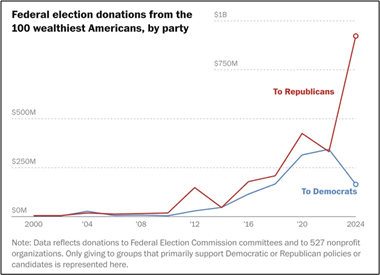
Sen. Sheldon Whitehouse (D-RI) called Citizens United, which spawned the super PACs that many billionaires now use as vehicles for unrestrained election spending, “the original sin.”
“Five Supreme Court Republican appointees, many helped onto the Court by right-wing billionaires, open the floodgates for unlimited political spending,” Whitehouse wrote in a social media post on Friday. “Then they refuse to police anonymous political spending they know is corrupting. This is the result.”
Sen. Bernie Sanders (I-Vt.), who has long decried the corrupting influence of billionaire and corporate money on American politics, said the Post investigation underscores why “we must overturn Citizens United and move to the public funding of elections.”
[Extract. Jake Johnson is a senior editor and staff writer for Common Dreams. Courtesy: Common Dreams, a US non-profit news portal.]