❈ ❈ ❈
After the Headlines Fade: Gaza Abandoned While the Genocide Persists
Ramzy Baroud
A colleague, an editor at a widely read outlet that centered Gaza throughout the two-year genocide, recently voiced his frustration that Gaza is no longer a main focus in the news.
He hardly needed to say it. It is evident that Gaza has already been pushed to the margins of coverage — not only by mainstream Western media, long known for its structural bias in Israel’s favor, but also by outlets often described, accurately or not, as ‘pro-Palestine.’
At first glance, this retreat may appear routine. Gaza during the height of the genocide demanded constant attention; Gaza after the genocide, less so.
But this assumption collapses under scrutiny, because the genocide in Gaza has not ended.
According to Gaza’s Health Ministry, nearly 500 Palestinians have been killed and hundreds more wounded since the so-called ceasefire was declared in October 2025, despite repeated claims that large-scale massacres had ceased. These are not isolated incidents or “violations”; they are the continuation of the same lethal policies of the last two years.
Beyond the daily death toll lies devastation on an almost incomprehensible scale. More than 71,000 Palestinians have been killed since October 2023, with entire neighborhoods erased, infrastructure pulverized, and civilian life rendered nearly impossible.
To grasp the depth of Gaza’s crisis, one must confront a brutal reality: well over one million people remain displaced, living in tents and makeshift shelters that collapse under winter storms, floodwaters, or strong winds. Infants have frozen to death. Families are swept from one temporary refuge to another, trapped in a cycle of exposure and fear.
Beneath Gaza’s ruins lie thousands of bodies still buried under rubble, unreachable due to Israel’s destruction of heavy machinery, roads, and emergency services. Thousands more are believed to be buried in mass graves awaiting excavation and dignified burial.
Meanwhile, hundreds of bodies remain scattered in areas east of the so-called Yellow Line, a boundary claimed to separate military zones from Palestinian “safe areas.” Israel never respected this line. It was a fiction from the start, used to manufacture the appearance of restraint while violence continued everywhere.
From Israel’s perspective, the war has never truly stopped. Only Palestinians are expected to honor the ceasefire — compelled by fear that any response, however minimal, will be seized upon as justification for renewed mass killing, fully endorsed by the US administration and its Western allies.
The killing has merely slowed down. On January 15 alone, Israeli attacks killed 16 Palestinians, including women and children, across Gaza, despite the absence of any military confrontation. Yet as long as daily death tolls remain below the psychological threshold of mass slaughter — below 100 bodies a day — Gaza quietly slips from the headlines.
Today, more than two million Palestinians are confined to roughly 45 percent of Gaza’s already tiny 365 square kilometers, with only trickles of aid entering, no reliable access to clean water, and a health system barely functioning. Gaza’s economy is effectively annihilated. Even fishermen are either blocked entirely from the sea or restricted to less than one kilometer offshore, turning a centuries-old livelihood into a daily risk of death.
Education has been reduced to survival. Children study in tents or in partially destroyed buildings, as nearly every school and university in Gaza has been damaged or destroyed by Israeli bombardment.
Nor has Israel abandoned the rhetoric that laid the ideological groundwork for genocide. Senior Israeli officials continue to articulate visions of permanent devastation and ethnic cleansing — language that strips Palestinians of humanity while framing destruction as policy, a strategic necessity.
But why is Israel determined to keep Gaza suspended at the edge of collapse? Why does it obstruct stabilization and delay movement to the second phase of the ceasefire agreement?
The answer is blunt: Israel seeks to preserve the option of ethnic cleansing. Senior officials have openly advocated permanent occupation, demographic engineering, and the denial of Palestinian return to their destroyed areas east of the Yellow Line.
And the media?
For its part, Western media have begun rehabilitating Israel’s image, reinserting it into global narratives as if collective extermination never occurred. More troubling still, even parts of the so-called ‘pro-Palestine’ media appear to be moving on — as though genocide were a temporary assignment, rather than an ongoing moral emergency.
One might attempt to justify this neglect by pointing to crises elsewhere — Venezuela, Iran, Yemen, Syria, Greenland. But that argument collapses unless Gaza has truly emerged from catastrophe, though it has not.
Israel has succeeded, to a dangerous degree, in systematically dehumanizing Palestinians through mass killing. Once violence reaches genocidal proportions, lesser — yet still deadly — violence becomes normalized. The slow death of survivors becomes background noise.
This is how Palestinians are killed twice: first through genocide, and then through erasure — through silence, distraction, and the gradual withdrawal of attention from their ongoing collective suffering.
Palestine and its people must remain at the center of moral and political solidarity. This is not an act of charity, nor an expression of ideological alignment. It is the bare minimum owed to a population the world has already failed — and continues to fail — every single day.
Silence now is not neutrality; it is complicity.
[Dr. Ramzy Baroud is a journalist, author, and the Editor of The Palestine Chronicle. He is the author of six books. His forthcoming book, ‘Before the Flood,’ will be published by Seven Stories Press. His other books include ‘Our Vision for Liberation’, ‘My Father was a Freedom Fighter’, and ‘The Last Earth’. Baroud is a Non-resident Senior Research Fellow at the Center for Islam and Global Affairs (CIGA).]
❈ ❈ ❈
What Does Israel Want from Renewed Attacks on Gaza? Analysts Explain the Political Calculus
Quds News Network
Israeli airstrikes killed 31 Palestinians across Gaza on Saturday, hitting a police headquarters, residential neighborhoods, and tents sheltering displaced families, as attacks intensified just as the ceasefire entered a critical new phase, raising urgent questions about the timing and purpose of the escalation.
The Israeli assault came as Israel was expected to implement key commitments under the ceasefire agreement, including opening crossings, allowing the entry of humanitarian aid, and facilitating the return of governance mechanisms to the Strip, while mediators continued efforts to move the deal toward its next phase amid mounting humanitarian pressure in Gaza.
Evading Obligations and Sabotaging the Deal
International relations expert Ali Abo Rezeq said the escalation reflects Israel’s attempt to escape its own obligations under the ceasefire agreement, after months of placing the burden entirely on the Palestinian side.
“Politically, Israel is trying to flee the phase of obligations,” Abo Rezeq said. “All previous stages imposed requirements on Palestinians, such as handing over prisoners and bodies, which Israel used to claim the Palestinian side was obstructing the deal.”
He explained that the situation changed once the agreement required Israel to open crossings, allow aid, withdraw forces, and begin reconstruction.
“When Israel’s turn came, it began sabotaging the agreement with all its force,” he said.
Genocide as a Goal
Abo Rezeq said Israel is also targeting early signs of recovery in Gaza, even when they take place under extreme humanitarian conditions.
“You build a camp, a school made of tents, or a clinic made of tents, like what happened in ‘Ghaith’ camp in Al-Mawasi,” he said. “This represents the possibility of recovery, even in a very harsh environment, and that directly contradicts the primary goal of genocide, which is to kill all hope for survival and life in Gaza.”
Rami Abdu, head of the Euro-Med Human Rights Monitor, said the Israeli army has committed “compound crimes” against Gaza’s population under fabricated justifications.
“The army of genocide has committed layered crimes since yesterday, claiming that fighters emerged from a tunnel in Rafah, even though the city is under full Israeli control,” Abdu said.
“This puts Israel, the world, and the mediators before one clear truth,” he added. “Israel gives no consideration to any agreement.”
Destroying Internal Order and Engineering Chaos
According to Abo Rezeq, Israel is deeply disturbed by the return of even limited internal order in Gaza, which explains the direct strike on the police headquarters in Sheikh Radwan.
“Israel is not upset about full security returning, but about any level of discipline,” he said. “That is why it bombed the police station, killing police officers, complainants, and prisoners at the same time.”
He added that Israel seeks to turn Gaza into a scene of internal chaos rather than a society with functioning institutions.
“The model Israel carefully planned is Gaza as internal guerrilla warfare, not a space with even minimal security control,” Abo Rezeq said.
Israeli journalist Elior Levy, speaking to Israel’s public broadcaster KAN, confirmed this assessment, saying Israel deliberately chose the police headquarters as a target.
“Israel selected the police headquarters in Gaza City as a target in response to Hamas deploying its forces across the Strip and seeking to escort the convoy of the new technocratic government,” Levy said.
Abo Rezeq also said Israel opposes coordination between Gaza’s national administration committee and the former government in the Strip.
“Some figures arriving through this government called for a consensual handover while benefiting from existing expertise,” he said. “This directly contradicts Israel’s plan to bring Gaza’s leadership on the back of an Israeli tank.”
Political analyst Ahmad Al-Heila said the sudden escalation serves multiple strategic goals tied to the next phase of the ceasefire.
“The surprise bombing and the killing of dozens aim to entrench the equation of Israel’s absolute military dominance,” Al-Heila said. “The army wants to kill and bomb freely while moving toward the second phase of the ceasefire.”
He said the strikes also seek to obstruct the work of the Palestinian national technocratic committee expected to enter Gaza via Rafah from Cairo.
“Targeting the police station is an act of engineering chaos and preventing internal security,” he said.
Forced Displacement
Beyond Gaza, Abo Rezeq said Israel is using the massacres to pressure Egypt into accepting large-scale displacement.
“Israel is not only pressuring Palestinians, but also Egypt,” he said. “It insists that if thousands leave Gaza, only hundreds should be allowed to return.”
He warned that this approach amounts to a slow forced displacement into Egypt and a long-term attempt to dismantle Palestinian political existence in Gaza.
Al-Heila added that the timing of the strikes sends a clear message to Palestinians.
“Bombing coincided with talk of opening Rafah,” he said. “The message is: leave Gaza with no return, because it is a land of death and unfit for life.”
[Courtesy: Quds News Network, the largest independent Palestinian youth news network, advocating for freedom, dignity, and Palestinian self-determination.]
❈ ❈ ❈
Who are the Criminals? Listen to Hind Rajab
Kathy Kelly
January 29th, 2026, marks the second year since the Israeli military, using U.S. provisioned weapons, murdered Hind Rajab. Had she lived, this little Palestinian girl who liked to dress up as a princess would now be 7 ½ years old. An Israeli Defense Force unit fired a barrage of missiles at the car in which she and her relatives were fleeing from an Israeli military invasion of their neighborhood.
The family’s fatal ordeal began on January 29th, 2024, in Tel al-Hawa, an area south of Gaza City, when Israeli forces ordered Hind’s family to evacuate from their home. Hind’s mother, Wissam Hamada, and an older sibling set forth on foot. It was raining heavily, and Hind’s mother didn’t want her walking through the storm. Hind joined her aunt, uncle, and four cousins as they fled by car from invading Israeli forces. Hoping to reach a shelter at the Al Ahli hospital, Hind’s uncle sought advice from the Palestine Red Crescent office about what route would be safe to take. But before they could find refuge, the Israeli military fired on their car, immediately killing Hind’s aunt, uncle and three of her cousins.
Her surviving cousin, fifteen-year-old Layan, was able to re-connect, by phone, with relief workers at the Palestinian Red Crescent office. That conversation ended when Layan screamed that the tank was very near and the relief workers then heard an explosion. Hind watched in horror as Layan was killed. The relief workers called Hind. The utterly frightened girl answered, and they urged her to remain hidden in the car and try to be calm. Rescuers would come, they said. But it would be suicidal for relief workers to set forth without first coordinating with the Israeli military. It took several hours for the Israeli military to give clearance for two ambulance workers to travel the approved route, an eight-minute drive, in hopes of rescuing Hind.
Surrounded by the corpses of her family members, Hind pleaded with the Red Crescent workers to come soon. “I’m so scared,” she told them. “Please come.”
But when the rescuers were within 162 feet of the vehicle where Hind was trapped, Israeli tank fired missiles assassinated them.
Hind’s voice continues reaching people. Three award winning films have told her story, awakening consciences, worldwide, to Israel’s ongoing genocide.
Hind’s voice echoes, tragically, in the pleas of Palestinian children today who face torture and death at the hands of Israel’s genocidal policy makers and militarists. Palestinian children living in makeshift tents, soaked and chilled by winter storms, long for relief. Hind’s pure innocence speaks for them, also, these little ones who could never be mistaken for criminals or security threats, little ones who beg for warmth and protection. The vocabulary changes slightly: Please come. I’m so cold. Please come. I’m so sick.
Yet trucks laden with relief supplies remain blocked, at the border crossings, while children who are near death suffer under tortuous conditions.
More than 100 children are reported to have died in Gaza since the October 2025 ceasefire.
A January 26, 2026 UNICEF report notes that Israel’s relentless attacks have decimated water and sewage systems in Gaza. Since the onset of winter, heavy rainfall has caused unsafe water to flood densely populated areas where people are crowded into makeshift tents. The grounds become muddy, making hygiene nearly impossible as people sleep in saturated clothes and bedding. Storms have collapsed tents. Fuel for generators is scarce, and there has been no central electricity for over two years.
Lacking warm blankets and sleeping on cold, wet ground, children whose immunities are already weakened risk dying of hypothermia and waterborne illnesses.
So far, this winter. as of January 27, 11 infants under the age of one have died from hypothermia and extreme cold.
A 34-year-old mother in the al-Mawasi tent camp near Khan Younis remains devastated after she lost her two-week-old infant who died because of the extreme cold.
“I woke my husband immediately so we could take him to the hospital,” she told Al Jazeera, “but he couldn’t find any means of transportation to get us there.”
Heavy rains made it impossible to reach the hospital. The next morning, using a donkey cart, they raced to the hospital, but it was too late. Mohammad Abu al-Khair died on December 15, 2025.
In Khan Younis, 27-day old Ayesha Ayesh al-Agha died of hypothermia on January 17, 2026.
On January 20th, in Gaza City, Shaza Abu Jarad, three months old, died of hypothermia
Each infant lived in a tent, unprotected from the cold and rain.
Please listen to Hind’s voice, her whispers, her pleas. Allow her voice to resonate. Demand an immediate end to Israel’s grave violations of international human rights and humanitarian law. Urge the international community to ensure that Israel and all countries participating in its genocide are held accountable under international law. Boycott. Divest. And don’t buy into genocide.
[Kathy Kelly, Board President of World BEYOND War, co-coordinates the November 2023 Merchants of Death War Crimes Tribunal. She is the author of Other Lands Have Dreams, published by CounterPunch/AK Press. Courtesy: LA Progressive, a California (USA) based online news and commentary portal, founded by Dick Price and Sharon Kyle, whose mission is to provide a platform for progressive thought, opinion and perspectives on current events.]
❈ ❈ ❈
Freedom for Some, Silence for Others: What You Need to Know About Palestinian Hostages Held by Israel and Ignored by the World
Quds News Network
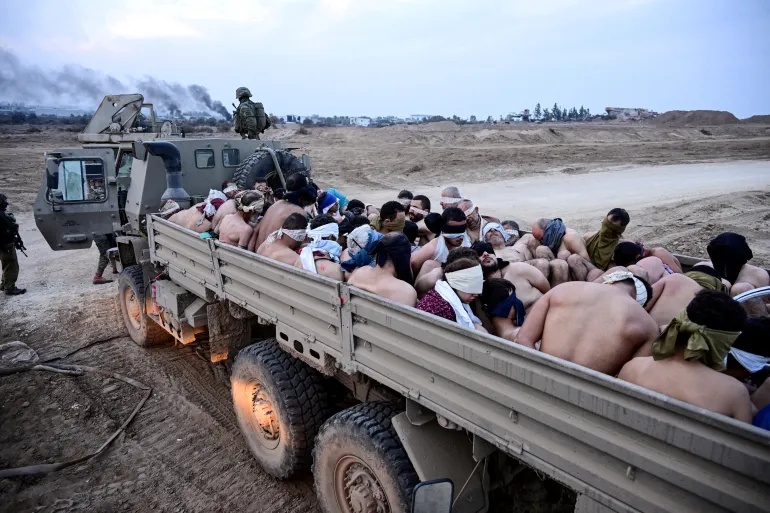
While the world was calling for the release of Israeli captives held in Gaza for over two years, more than 9,350 Palestinian hostages, including children, women, and journalists, are being held in Israeli jails, amid reports of torture and medical negligence.
According to the latest update issued on January 19 by Palestinian prisoners’ advocacy groups, from October 2023, when Israel launched its assault on Gaza, to this date, the number of Palestinian hostages doubled, rising from 5,000 to more than 9,350.
Of those in detention:
- 53 female detainees, including two children
- 350 children
- 3385 under administrative detention
- 1237 under “unlawful combatant” law
According to the Palestinian Commission of Detainees and Ex-Detainees Affairs and the Palestinian Prisoner’s Society (PPS), since 1967, Israeli forces have detained an estimated one million Palestinians, or approximately 20 percent of the Palestinian population. Statistically, this means one out of every five Palestinians has been imprisoned at some point in their life.
Administrative Detention
The groups said they have documented a “dangerous increase” in the number of Palestinians held under administrative detention in Israeli prisons.
The latest figure of administrative detainees as of the beginning of January stands at 3,385 people, which the monitor said is the highest number recorded since this type of detention began being used on a wide scale.
Israel routinely uses administrative detention and has, over the years, placed thousands of Palestinians behind bars for periods ranging from several months to several years, without charging them, without telling them what they are accused of, and without disclosing the alleged evidence to them or their lawyers.
According to Israeli newspaper Haaretz, Western states rarely employ administrative detention and in some countries, the practice does not exist at all.
Israeli occupation authorities use it mainly in the West Bank against Palestinians “while its use against Israeli citizens, particularly Jewish ones, is rarely employed.”
Silent Death
According to the Palestinian Prisoner advocacy groups, 87 known detainees have died in Israeli prisons since the start of the Israeli genocide in Gaza. Among them are at least 51 detainees from Gaza and a child, the highest number in history.
Since 1967, a total of 324 Palestinian prisoners have died in Israeli occupation prisons. The group said the identities of many martyrs among Gaza’s detainees remain undisclosed, as the Israeli occupation continues to conceal them, making this the “bloodiest stage in the history of the prisoner movement.”
Of those, Israel continues to withhold the bodies of 95 detainees, including those who died since the start of the Israeli assault, 84.
According to a recent released report by Physicians for Human Rights–Israel (PHRI), based on data obtained from the Israeli army and Israel Prison Service (IPS), 98 Palestinians have died in Israeli prisons and military detention centers since October 2023, in many cases seemingly as a direct result of torture, medical neglect, and food deprivation by soldiers and prison officers. Of those detained from Gaza, who make up the majority, less than one-third were classified by the Israeli army itself as militants, meaning Israel was responsible for the deaths of dozens of Palestinian civilians in custody.
Additionally, dozens of detainees from Gaza remain forcibly disappeared, with no confirmed information on their fate. Israeli occupation authorities have been accused of torturing Palestinian detainees.
This includes being handcuffed and shackled 24 hours a day, seven days a week, even while sleeping, eating, and using the restroom.
Testimonies also describe regular beatings by guards, extreme overcrowding, humiliation, and inadequate hygiene. An Israeli reserve soldier exposed lately shocking abuses at Israel’s infamous Sde Teiman military base, describing it as a “sadistic torture site” where dozens of Palestinian detainees from Gaza died under brutal conditions.
The soldier described Sde Teiman as a place where “people enter alive and leave in body bags.”
He said the death of detainees was no longer surprising. “The real surprise,” he added, “is if someone survives.” He stated that Israeli occupation authorities oversee systematic abuse.
According to his account, Palestinian detainees suffered starvation, untreated war wounds, and denial of basic hygiene needs. “Some urinated and defecated on themselves because they weren’t allowed to use the bathroom,” he said.
In August 2024, the Israeli rights group B’Tselem said Israeli occupation authorities systematically abusing Palestinians in “torture camps”, subjecting them to severe violence and sexual assault.
Its report, titled “Welcome to Hell”, is based on 55 testimonies from former Palestinian detainees. The overwhelming majority of these detainees were held without trial.
Many prisoners from Gaza have been subjected to forced disappearance and held incommunicado under inhumane conditions, creating an environment where extrajudicial killings can occur without oversight or accountability.
In addition to torture, the Palestine Center for Prisoners Studies documented over 30 deaths resulting from medical negligence. Israel is reported to routinely deny prisoners access to basic medical care, holding them in unsanitary, disease-ridden conditions and delaying or outright refusing necessary treatment for extended periods. In many cases, prisoners are only transferred to hospitals when they are on the brink of death.
“Unlawful Combatants”
The Israeli occupation forces have abducted more than 2000 known Gazans during the genocide, a number that is likely even higher, and are holding them in indefinite incommunicado detention, without charge or trial, under the Unlawful Combatants Law, in clear violation of international law.
There are currently 1,237 detainees classified as “unlawful combatants”, the highest recorded since the start of the genocide, the advocacy groups said. This figure does not include all Gazan hostages abducted during the genocide and currently held in detention camps run by the Israeli army.
The groups noted that this classification also applies to Arab detainees from Lebanon and Syria.
According to Amnesty International, citing former detainees, during their incommunicado detention, which in some cases amounted to enforced disappearance, Israeli military, intelligence and police forces subjected them to torture and other cruel, inhuman or degrading treatment.
The Unlawful Combatants Law grants the Israeli military sweeping powers to detain anyone from Gaza that they suspect of engaging in operations against Israel or allegedly posing a threat to state security for indefinitely renewable periods without having to produce evidence to substantiate the claims.
“Our documentation illustrates how the Israeli authorities are using the Unlawful Combatants Law to arbitrarily round up Palestinian civilians from Gaza and toss them into a virtual black hole for prolonged periods without producing any evidence that they pose a security threat and without minimum due process. Israeli authorities must immediately repeal this law and release those arbitrarily detained under it,” Amnesty International said.
Israeli forces abducted the detainees from locations across Gaza including Gaza City, Jabalia, Beit Lahiya and Khan Younis. The detainees were rounded up at schools housing internally displaced families, during raids on homes, hospitals, and newly installed checkpoints. They were then moved to Israel.
Those detained included doctors taken into custody at hospitals for refusing to abandon their patients; mothers separated from their infants while trying to cross the so-called “safe corridor” from northern Gaza to the south; human rights defenders, UN workers, journalists and other civilians.
One of the most well-known cases is that of Dr. Hussam Abu Safiya, the Director of Kamal Adwan Hospital in northern Gaza, who has been imprisoned by Israeli forces since December 2024, sparking growing fears that he may not “make it out alive.”
His family is also concerned for his physical and mental health. Israeli forces kidnapped Dr. Abu Safiya after storming Kamal Adwan Hospital. Soldiers forced him out at gunpoint, destroying the hospital and putting it out of service. Surrounded by bomb-struck buildings, Abu Safiya walked down the middle of a road strewn with debris, his white medical coat standing out against the rubble as he made his way toward Israeli tanks.
The Israeli military claimed in January 2025 that Abu Safiya had been involved “in terrorist activities” and held “a rank” in Hamas that it said had made the Kamal Adwan Hospital a stronghold during the war.
In March, an Israeli court extended the detention of Abu Safiya for six months. The ruling classified him as an “unlawful combatant”. But according to the Al Mezan Center for Human Rights, no formal charges had been made against the hospital director.
A spokesperson for the Al Mezan Center said recently that Abu Safiya is still being detained in Ofer Prison in the occupied West Bank, where he faced dire conditions, inadequate food and overcrowded cells.
Underground Cells?
Video clips released by Israeli media in January 2025 showed Palestinian detainees chained inside underground cells without mattresses or blankets, enclosed by iron gates, and not exposed to sunlight.
The Israeli Broadcasting Authority reported that detainees are shackled and kept in a tiny cell for twenty-three hours every day, with only one chance to leave the cell during the day to enter a tiny, dark courtyard. The underground prison is called Rakevet, located beneath Israel’s Nitzan Prison in Ramleh. Israel claims that the prison is reserved for the most dangerous detainees, whom Israel says are members of the Hamas elite and the Hezbollah-affiliated Radwan Forces.
Euro-Med Monitor said this claim “does not excuse the violation of international law’s regulations regarding the treatment of detainees and prisoners.”
“This claim is untrue and frequently used as a pretext for torture and retaliation, as evidenced by the fact that thousands of detainees from the Gaza Strip were released after being subjected to cruel torture and unlawful detention conditions under the pretext of elite membership.”
In March, the Commission for Detainees and Ex-Detainees Affairs and the Palestinian Prisoner’s Society revealed disturbing testimonies from detainees from Gaza. Testimonies were collected during the first legal visits conducted by Palestinian lawyers to detainees held in the secret underground prison, Rakevet.
The visits took place under extreme surveillance, with guards accompanying the lawyers at all times and prohibiting any mention of family or events outside the prison.
According to lawyers, detainees showed visible signs of fear and trauma. At first, many were unable to speak freely due to the heavy surveillance, however, after reassurances from the legal teams, some agreed to share their experiences.
One detainee, identified as S.J., said he was arrested in December 2023 and immediately subjected to six days of continuous interrogation under what he called the “disco” and “pampers” methods, references used by detainees for particularly humiliating techniques. He described being forced to wear adult diapers after being denied access to a bathroom, while enduring continuous loud music, severe food and water deprivation, and being kept blindfolded and handcuffed throughout. S.J. was then transferred multiple times, from the Sde Teiman to Ashkelon Prison, then to the Moscobiya detention centre for 85 days, followed by Ofer Prison, and finally to the Rakevet section. He said the conditions in Rakevet were the worst he experienced with three detainees per cell, no sunlight, and humiliating exercise time where prisoners were not allowed to lift their heads.
Another detainee, W.N., said he was arrested in December 2024 and endured violent interrogations by Israeli forces and intelligence operatives. He reported being sexually assaulted with a search device, denied medical treatment, and forced to sit on his knees for long periods. Prisoners were made to curse their own mothers, he added, and he sustained a broken finger during transport, a tactic he said guards deliberately use against detainees.
A third detainee, K.D., said he was subjected to repeated interrogations using the “disco” method and stress positions, often tied to a chair for long hours or thrown to the floor, while loud music played continuously, making it impossible to rest or sleep. He developed scabies in Ofer Prison and received no treatment after being transferred to the Rakevet. He suffer from chest pain made worse by the use of tight restraints and said the prison administration punishes inmates by deliberately breaking their thumbs.
Another detainee, A.G., held for 35 days at Sde Teiman, said he entered prison with an injury and received no medical care. He developed a high fever and lost consciousness several times. For 15 days, he was shackled and blindfolded around the clock. Later transferred to Rakevet, he described permanent surveillance in cells, bans on prayer, threats of death, and violent assaults during yard time. The prisoners were allowed to shower only when guards decided, and were given one roll of toilet paper every three days. Food is minimal, and detainees track time by when guards confiscate blankets at dawn.
The two advocacy groups said that Rakevet was one of several facilities repurposed or reopened by Israel to hold Gaza detainees since the start of the Gaza war. Other facilities include Sde Teiman, Anatot, Ofer camp, and the Menashe camp for West Bank detainees.
These sites, they said, have become synonymous with “instantaneous, systematic physical and psychological torture”.
Freedom for Some, Silence for Others
While the world was calling for the release of Israeli captives held in Gaza over the past two years months, it remains largely silent about the more than 9,300 Palestinians imprisoned in Israeli jails.
After Hamas and Israel reached an agreement in January 2025, 1,777 Palestinian prisoners, who spent a total time amounting to about 10,000 years in Israeli prisons, were released.
Moreover, Israeli forces have re-arrested several of them, breaching the terms of the deal.
Now, all the living and deceased Israeli captives held in Gaza have been released by the Palestinian resistance under the ceasefire deal.
But what about the Palestinian hostages held in Israeli jails?
The International Center of Justice for Palestinians (ICJP) said on Tuesday, “Palestinian hostages remain detained in Israeli prisons. They are systematically tortured and sexually abused by Israeli prison staff” while all Israeli captives have returned, adding since October 2023, the cumulative number of Palestinians detained by Israel has reached around 30,000, while just over 2,000 detainees have been released through ceasefire agreements, meaning that for every Palestinian freed, fifteen more were arrested.
[Courtesy: Quds News Network, the largest independent Palestinian youth news network, advocating for freedom, dignity, and Palestinian self-determination.]