❈ ❈ ❈
“Enough is Enough”: Goans Fight to Reclaim Selfhood Against Inept Governance
Ranjan Solomon
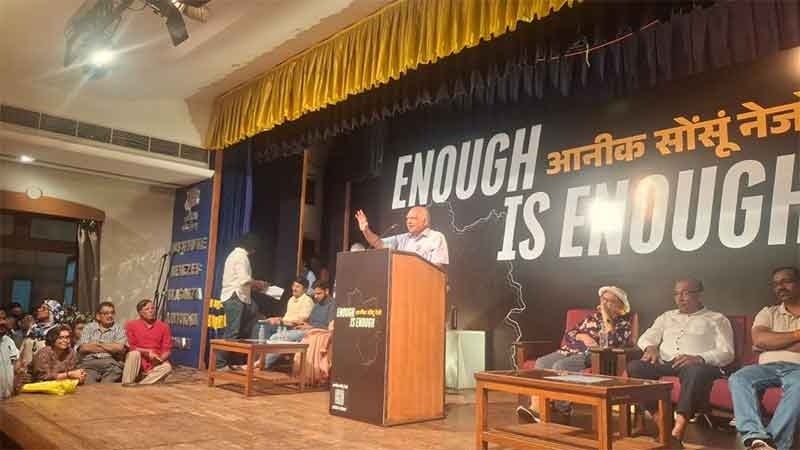
“Enough is Enough” (or Aanik Sonsum Nezo) movement in Goa is a citizen-led initiative, spearheaded by retired Justice Ferdino Rebello, aimed at combating rapid ecological degradation, chaotic urban development, and the loss of local identity. Initiated in early 2026 following a surge in environmental destruction and illegal land conversions, the movement brings together activists, NGOs, and concerned residents to protect Goa’s land, rivers, and forests. It has now acquired the character of a mass movement.
As of February 2026, Goa is experiencing a significant surge in protests against the state government, driven by growing anger over anti-people and unplanned development. Thousands of residents have taken to the streets, particularly in Panaji’s Azad Maidan, to oppose the “sale of Goa” and demand the preservation of the state’s ecological and cultural identity.
The primary provocation for recent protests is the hostility to Section 39A of the Town and Country Planning (TCP) Act, introduced in 2024, which allows the government to convert “green zones” (hills, orchards, agricultural land) into “settlement” zones for construction. Residents feel that these conversions are occurring without proper consultation, threatening the state’s water security, biodiversity, and the livelihood of local communities.
Protests highlight the impact of rapid, unsustainable development, particularly in the tourism sector, which is straining local infrastructure. They also oppose:
- Hill-cutting for projects, such as a proposed university project in Tivim.
- Environmental impact of large-scale projects, which have caused water shortages and broken-down waste management systems.
- Addition of another casino ship in the Mandovi River, citing ecological strain and congestion.
Protests are also intensifying against large-scale infrastructure projects seen as damaging or unnecessary. The protests reflect a broader, deep-seated anxiety about the loss of Goa’s identity, often termed the erosion of Goemkarponn. Many residents feel their land and heritage are being sold to outsiders, driving the push to “Save Goa”. Protesters are demanding greater transparency in government decision-making, arguing that local panchayats are often bypassed in land-use decisions.
Inept or poor governance at governmental level is characterized by a lack of transparency, accountability, and ethical behaviour, which often leads to systemic corruption, weak rule of law, and a failure to meet the basic needs of the population. When governance is inefficient, it can result in retarded development, economic stagnation, infrastructure failures, and dysfunctional social services like education and healthcare.
Beginning early 2026, the Goa government is being confronted by sustained, and widespread protests, with the populace accusing the administration of being “autocratic,” “insensitive,” and ignoring the “voice” of the people. Expectedly, they have no answers that people pose. Widespread corruption, misuse of public funds, and a lack of accountability are the trademarks of government failures. Added to this are administrative faintness, red tape, nepotism, and lack of strategic planning. Slow economic growth, low investment, rising unemployment, and increased poverty are its outward consequences. The ongoing protests, which have often seen collaboration between local villagers, environmentalists, and opposition political parties indicate that the battle for Goa’s future is growing into a critical issue in 2026 and beyond.
The “People’s Charter” of demands launched by “Enough is Enough” focuses on a root-cause and policy reform rather than partisan politics. It uses a “Gardeners-not-florists” approach to encourage hands-on citizenship to nurture the roots and protect the soil of Goa. A charter has evolved and has several multi-disciplinary components:
- Immediate protection of hills, forests, rivers, lakes, and coastal areas from construction and destruction.
- Repealing specific sections of the Town and Country Planning (TCP) Act (Section 17(2) and 39A) that allow for rampant conversion of agricultural land.
- Stopping illegal mega-projects, sealing illegal structures in Coastal Regulation Zones (CRZ), and removing casinos from the Mandovi River.
- Enforcing strict, sustainable development principles (polluter pays, precautionary principles) for projects costing over ₹5 crore.
- Safeguarding the demographic and cultural, social identity of Goa from excessive, unsustainable influxes and development that alters the state’s character.
- Taking action against complicit government officials and professionals (architects/engineers) involved in falsifying documents for land deals.
- The focus on quantity over quality, has turned Goa into “cheap gambling, narcotics, and over-crowded destination” rather than preserving its unique “Susegad” culture, is seen as a key failure of policy.
Using non-violent, Gandhian-style protests and civil disobedience to highlight people’s suffering, “Enough is Enough” reaches all sections of the people – every village and town to build localized resistance and awareness. It holds meetings across various talukas to mobilize public support and raise awareness regarding land rights and environmental risks.
Governance in decline – Democratic deficit
With a sharp decline in the quality of life for residents, thousands of Goans have taken to the streets, including at Azad Maidan, to protest the conversion of green zones, orchards, and hill slopes into “settlement” zones. The protests, which included a hunger strike by MLA Viresh Borkar, have demanded the scrapping of Section 39A.
The government is ham-fisted and arrogant despite the hard facts. The perception that the government is unwilling to acknowledge its faults is a recurring theme in political discourse. The government is also accused of being obdurate in pushing through destructive infrastructure projects, such as massive road expansions, deforestation, and changing land-use zoning for private, commercial, or “corporate” benefit, often despite vocal local opposition.
Meanwhile there is widespread administrative and civic neglect. There are innumerable complaints regarding poor maintenance of roads, erratic power and water supply, and a crisis in garbage management. There is a marked lack of transparency, with bills passed without discussion, and corruption that has “rotted” the system signalling corrupt and non-transparent governance. These attempts to derail democracy show tendencies to fascist and autocracy.
The government is accused of pushing through land-use changes behind the back of local village panchayats and gram Sabha’s. Protesters argue that the government ignores environmental concerns and favours developers and corporate interests over the rights of local communities.
Public transport in distress
There is also the state’s failure to implement an equitable and just policy on taxi services or regulate the existing, taxi system is frequently cited as a major, stubborn issue that ruins the tourist experience. Public transport is hopelessly inadequate, thus multiplying the crisis.
Critics have described the government as “power-intoxicated” and “ruthless” in its decision-making, particularly regarding infrastructure projects and land-use policies. The administration is criticized for breaking promises, such as the failed assurance to remove casinos from the River Mandovi, which has led to increased pollution.
Amidst claims of a “shambles” economy, the government launched a shallow austerity drive, banning the purchase of items like new ACs and vehicles.
Reclaiming Goa
Goans feel their state is being “destroyed” and call for development that respects local, environmental, and cultural identities. The Chief Minister who controls the narrative, casually shifts blame on previous administrations or political opponents rather than correcting its course.
In the end, the message rising from Goa’s villages, hills, and riverbanks is unmistakable: development without consent is not progress. The growing citizens’ movement reflects a deeper yearning to reclaim governance from arrogance and restore it to accountability. If the government continues to ignore this moral and democratic call, the protests will only deepen. Goa’s people are no longer willing to watch silently as their land, culture, and future are bargained away. The struggle today is not merely against policies – it is for the soul of Goa itself.
[Ranjan Solomon has worked in social justice movements since he was 19 years of age. After an accumulated period of 58 years working with oppressed and marginalized groups locally, nationally, and internationally, he has now turned a researcher-freelance writer focussed on questions of global and local/national justice. Since the First Intifada in 1987, Ranjan Solomon has stayed in close solidarity with the Palestinian struggle for freedom from Israeli occupation, and the cruel apartheid system. Courtesy: Countercurrents.org, an India-based news, views and analysis website, that describes itself as non-partisan and taking “the Side of the People!” It is edited by Binu Mathew.]
❈ ❈ ❈
A Green Revolution in Goa
Janhavi Acharekar
“I think of Goa as a beautiful woman draped in a green sari,” said Debbie, my guide to Goa’s hinterland, when I was writing a travel book on Mumbai and Goa, and gathering information for my novel. But that was 17 years ago and much has changed in Goa since. As a frequent visitor (and sometime resident) since childhood, I have seen the Goan landscape changing. According to a recent report, the State has lost 90 square kilometres of tree cover in the past decade. Plastic pollution, irresponsible tourism, development at the cost of the environment, mining, rampant construction fuelled by a rising population of urban refugees, have all contributed to the ecological crisis that the beautiful State faces today.
Goa attracts people for various reasons. For creative folk, its natural beauty serves as an inspiration and refuge, with its liberal, progressive-minded milieu fostering artistic growth. This has led to the State hosting a thriving community of artists from inside and outside Goa. Meanwhile, with the climate crisis becoming a reality, the dominant colour in art around the world is green. In Goa, too, the voices of protest are steadily rising.
On Panjim’s shoreline along the river Mandovi, lights from casinos shine brighter than the stars in the night sky. On beaches like Morjim, volunteers and forest guards struggle to keep tourists at bay as they lead Olive Ridley hatchlings into the sea with artificial light which mimics the horizon’s natural glow now lost to the glare of beach shacks. Meanwhile, the ocean, rivers and lakes heave with trash, reflecting a nation afflicted by a deeper social malaise. In the midst of all this gloom, the forests of Mollem still stand triumphant, thanks to a people’s movement that has been protesting against their proposed destruction in the name of development.
Aamche Mollem
The ongoing campaign Aamche Mollem (My Mollem), bringing together environmentalists, students, teachers, farmers, fisherfolk, scientists, hoteliers, artists, and people from all walks of life, is famous for resisting a proposal for constructing a railway line, a transmission line, and a highway inside the forest that was announced conveniently at the peak of the COVID-19 pandemic. Their efforts resulted in the Supreme Court appointing a Centrally Empowered Committee to scrutinise the projects, annulling one and modifying the other two.
The travelling exhibition Kaghazi Pairahan (Clothes made of Paper, from March 22 to June 1) at the newly opened Arthshila Goa is a tribute to such protest movements. Exhibits include photobooks, zines, unpublished dummies and pamphlets, audio recordings and film footage that have played a role in shaping social and political dissent across South Asia. The materials used by Aamche Mollem, wherein artists from various disciplines got together to engage with the people and mobilise support through art, film, music, poetry, puppetry and campaign literature, form a part of the show.
“Art can ignite local citizenship. In this case, it became the entry point for dialogue,” said artist Svabhu Kohli, who played a prominent role in the campaign and whose practice is inspired by the natural world. Along with Trisha Dias Sabir, Nishant Saldanha and Deepti Sharma—key figures of the campaign—Kohli was awarded the Serendipity Arts Festival Public Art Grant 2022 for the installation, The Island that Never Gets Flooded.
Some of the protest literature is enshrined in an interactive installation at Arthshila that includes a zine library and community table: the centrepiece is a map of the forest that traces the projects, inviting people to participate with their memories of the affected regions. It also showcases samples of communication, like postcards with illustrations of various forest species, that were distributed among people to write on and send to political leaders. The installation was launched with readings and activities themed on citizenship.
Meanwhile, towards the end of the pandemic, the mangroves along the Panjim-Bambolim highway mysteriously took ill. The phenomenon, caused by the dumping of debris, led to the birth of the Earthivist Collective. Comprising artists, musicians, filmmakers, photographers, performers, scientists, journalists, academicians, and environmentalists, the collective proclaims that it “use[s] art to draw attention, provoke emotion, drive action, and galvanise social change”.
Mhadei Aamchi Mai
The seeds of this were sown by Mangrave, an interactive public art project created alongside the dying mangroves by artist, curator, gallerist and the collective’s founding member, Miriam Koshy. Entry was through a chakravyuh or spiral made of bamboo, leading to a machan (platform) from where visitors could view the destruction around them. This was accompanied by swamp poetry, Baul music, and other performances.
Its success paved the way for the festival Mhadei Aamchi Mai (The Mhadei is Our Mother/MAM), held in collaboration with the Goa Heritage Action Group led by author and heritage activist Heta Pandit, and with Save Mhadei Save Goa Front. It was a response to the ongoing dispute between Goa and Karnataka over the diversion of the waters of the Mhadei to Karnataka. If actualised, the diversion would unleash vast ecological destruction in Goa.
The ecological carnage in a State in whose culture nature is revered and conservation is deeply entrenched is ironic. Goa’s devrais or sacred groves, belief in rakhondars or guardian spirits, and practices like the khazan system have existed for millennia. The latter, simply put, is a sustainable farming system balancing fresh and saline water that dates back over 3,000 years; considered to be one of the solutions to climate change, khazans—known for their biodiversity—would be severely impacted by the diversion of the Mhadei waters, creating a domino effect.
Held at the riverfront in Miramar in May 2023, the festival was a smorgasbord of performances, art installations, plant walks, sketchwalks, poetry, etc. It kicked off with Hema Sardesai’s song “Mhadei Aamchi Mai”, featured jazz by Italian musician Matteo Fraboni, and poetry readings. An art exhibit with clay from the riverbank, and a Bharatnatyam performance by dancers wearing plastic ghungroos highlighted the problem of plastic pollution and the need for conservation. It ended with a prayer exhorting Goans to be the river’s rakhondars.
“MAM was a gathering to celebrate and honour the river. We realised that it needed to evoke community and be on a bigger scale to have more impact,” said Koshy. Thousands turned up in response to the call for a 7 kilometre-long human chain; it included luminaries like environmentalist and Mhadei activist Dr Rajendra Kerkar, and Goa’s most prominent writer, Damodar Mauzo. Coinciding with the Assembly election in Karnataka, the celebration garnered tremendous attention.
“Nhoi: The Goa River Draw”
Bookworm Trust and Library’s ongoing community project, “Nhoi: The Goa River Draw”, has been documenting the Mhadei from 2018 through drawings and personal histories of riverside communities. The Nhoi river drawings were the result of workshops held over a period of nine months, across 13 libraries along the river.
The project retrieved forgotten river words in Konkani and documented story artefacts, among other things, and its community art panels resulted in an exhibition. A part of MAM and featured in the digital archive, Goa Water Stories, the project is moving forward through collaboration with other libraries, by documenting the riparian flora of their villages, and generational and scientific knowledge through artworks, handmade art herbariums, and zines. The aim is to compile a publication that can go back to these libraries.
Goa Water Stories
In the newly launched digital archive, Goa Water Stories, 18 young Goans use art as a medium to map and document the State’s waterbodies. Curated by filmmaker Wency Mendes and supported by the Living Waters Museum, Sunaparanta Goa Centre for the Arts, and institutions attached to Goa University and the Goa Institute of Management, this community art project has watercolours with pigments sourced from rocks and soil of the khazans, oral histories, family recipes, village folklore, sustainability practices, and more.
The latest in Goa’s artistic engagement with community, with ecology at its heart, the ambitious multimedia project comprising interactive “story-projects” covers the gamut of Goa’s waterbodies, from its famous beaches to its lakes, rivers, khazans, wells, salt pans and groundwater sources. These are documented in the form of illustrations, photographs, cyanotypes, field recordings, interactive maps, film and text, all meta data-tagged and geo-tagged, with options for translation. The project is vast in scope, presenting, among other things, the challenges for Goa’s mangroves, wells, traditional oystershell windowpanes, and exploring its tricky relationship with tourism, starting with the hippie legacy.
“The beautiful aspect of Goa Water Stories is its transdisciplinary nature and the collaborative work by these young people of Goa who came together in various ways to engage and interact with each other and narrate these stories. This meant regular field visits, leaving at 4 in the morning, returning late in the evening, coming back covered in leeches. More importantly, it was about sharing positive energy with one another,” said Mendes.
Sensible Earth
When entrepreneur Sanjiv Khandelwal set out on a bike trip across Africa hoping for self-discovery, the last thing he expected to find was a plastic gutkha packet. It was a moment of realisation. “I decided to stop complaining and do something,” said the founder of Sensible Earth, a collectively driven organisation that promotes a range of sustainable practices in Goa. It is best known, perhaps, for its upcycling initiative, the Maka Naka Plastic campaign, seeking a plastic-free Goa, with a focus on single-use plastic bags. For this, old clothes are repurposed into cloth bags by 66 local women who have made over 150,000 bags so far, preventing the use of approximately 35,00,000 plastic bags, and 140,000 garments from going to landfills. The organisation also works extensively with schools across Goa, educating them about plastic through various activities.
“The most joyous part has been working with 5,500 children. Adults are often unmoved but kids are enthusiastic. They really get it,” said Khandelwal.
Community gatherings at the Sensible Earth Centre, housed in a traditional Indo-Portuguese Goan home, see a range of activities promoting sustainability, like workshops on Shibori dyeing, origami and creative upcycled craft, as well as film screenings and pay-it-forward “gratitude” lunches made with local produce. The space hosts informal discussions as well as theatre. Who Stole the Water? a play about Goa’s water issues, produced by Mustard Seed Art Company and directed by theatre stalwart Isabel de Santa Rita Vás and Kiran Bhandari, was staged in November 2023.
Ironically, a stone’s throw from the Sensible Earth Centre, the once-pristine fields along Torda creek—a protected migratory bird site in the village of Salvador do Mundo—are lined with garbage, much of it plastic.
An idea for installations along the creek that was in the works between incubatees (Sensible Earth also organises sustainability-focused initiatives) and artist Hanif Kureishi, who was a local resident, was cut short by the latter’s sudden demise in 2024. Kureishi, co-founder of St+art, had previously created the installation Why—a giant question mark made of 3,00,000 recycled plastic bottles, on the Hussain Sagar Lake in Hyderabad, in response to the problem of single-use plastic.
Goa Green Brigade
A motley group of audience members and activists sang a familiar song, “We shall overcome”, in three languages—Hindi, English and Konkani—at the private museum founded by artist Subodh Kerkar, Museum of Goa. It followed a presentation by the environmental activist group, Goa Green Brigade, as a part of an event called MOG Sundays, which includes discussions on books, art, social issues and, increasingly, environmental concerns.
“As someone who has worked with Greenpeace and been actively involved in the environmental sector, I strongly believe that dialogue and action must go hand in hand,” said Nilankur Das, curator of MOG Sundays. “Art,” he added, “has the power to provoke thought, evoke emotions, and inspire action. By bringing social issues into cultural spaces, we ensure that these conversations remain active and urgent.”
Meanwhile, at Sunaparanta, artists-in-residence Annabel Schenck and Sourav Chatterjee drew comparisons between Panjim’s coastline and that of Marseille in France. Chatterjee’s soft, expressionist-style paintings portraying community life in Goa are made using pigments from the earth of Luberon. Printmaker Schenck’s work, in contrast, comprises stark metal engravings. Among her works, inspired by Goa’s ghost nets (“Do you know that a 3×3 ft net can kill 300 sea creatures?” she asked), is an engraving featuring the Porvorim flyover—a project embroiled in controversy over the translocation of a sacred banyan tree —trapped in a ghost net. “What’s happening in Goa today is what happened in Marseille in the name of development after the Second World War,” she said. “Today, only 5 per cent of our original forest cover is left. Is development always progress?” she asked.
Folk theatre
But art galleries and museums are not the only spaces engaging with environmental themes; Goa’s traditional practices are rooted in the region’s ecology. According to Tanvi Bambolkar, a specialist in Goan folk culture, most Goan folk art invokes the local flora and fauna.
The folk theatre form of Ranmale, exclusive to the Sattari and Sanguem talukas, has begun to address contemporary environmental concerns consciously. “Sattari is a densely forested area and there have been issues with the presence of tigers there. This has reflected in performances lately,” Bambolkar said, adding that a recent performance was a fun satire on irresponsible tourism at the waterfalls in the region.
The much-awaited annual competition of tiatr—Goa’s famous Konkani musical theatre—at Panjim’s Kala Academy saw environmental themes creep in with plays like Oh Goa! and Odruxtta Fattlean Odruxtt (A Disaster of a Disaster) this year.
Reaching the right audience
The arts have often been catalysts for socio-political change but how does one reach the right audience to make an impact?
“Debating on (digital) platforms is not enough. People power is the most potent. We need people to come on the street,” said ex-journalist and co-founder of Goa Green Brigade, Avertino Miranda. He lauded the success of Aamche Mollem but said that fighting for the environment should be a continuous process.
The success of Aamche Mollem and MAM was largely due to the emotional connection forged through art and local culture. But they are not without their challenges. “There is burnout,” said Koshy. “It takes a lot of work and energy to mobilise support and get funds.”
“Success stories don’t happen in a generation,” said Kohli, emphasising that Aamche Mollem will be an intergenerational campaign. “Art allows for a sense of pause, to reflect upon who we are or were, and where we are going.”
As I wrote this piece, villagers in Loutolim protested the impending destruction of khazan lands for the Borim bridge project while those in Socorro, Guirim and Sangolda celebrated a court order demanding the restoration of illegally filled paddy fields, brought about by the efforts of Goa Green Brigade.
There is hope but more participation is required and much more work needs to be done. For now, despite the rapid destruction, Goa’s woods are still lovely, dark and deep. At the same time, its contemporary art is a sobering reminder that there are miles to go before Goans can sleep peacefully.
[Janhavi Acharekar is an author, a curator, and creative consultant. Courtesy: Frontline magazine, a fortnightly English language magazine published by The Hindu Group of publications headquartered in Chennai, India.]
❈ ❈ ❈
‘Our Fight Is Everyone’s Fight’: A Diary of Goa’s Six-Day Protest Against Land-Regulation Changes
Saachi D’Souza
At roughly 1 pm on February 25, in Panjim’s central Azad Maidan, it is 32 degrees. Under the dome of the main pavilion, MLA Viresh Borkar and activist Tushar Gawas are on Day 5 of a hunger strike. They are members of the Revolutionary Goans Party.
Right by the giant brass urn containing the ashes of the Goan freedom fighter, Tristão de Bragança Cunha, they have set up a neat circle of mattresses, bottles of rehydrating fluid and fans. An image of Ambedkar and a copy of the Constitution of India are displayed prominently.
Members of their families and neighbours from their village of Palem-Siridao in North Goa have turned up in the state capital to support Borkar and Gawas but large signs around the pavilion discourage them from coming too close – a measure aimed at ensuring that the weakened hunger strikers do not catch any infections.
Borkar and Gawas had started their hunger strike on February 21 after police dragged Borkar out of the Town and Country Planning office in Panjim, where he and others had protested overnight against the implementation of Section 39A of the Goa Town and Country Planning Act, 1974, in their North Goa constituency of St Andre.
Section 39A, introduced through an amendment in 2023, allows the Town and Country Planning Board and chief town planner to modify land-use classifications under certain circumstances. In practice, it enables parcels of land previously classified as orchard, green, or agricultural zones to be reclassified as settlement – opening the door for construction.
The Revolutionary Goans Party asserted that 84,000 square metres of land in Palem-Siridao village, much of it classified in a “no development” zone, had been converted into a settlement zone by the Town and Country Planning department.
The state government has maintained that Section 39A corrects historical errors and addresses legitimate housing needs. Critics argue that it undermines the Regional Plan, which was designed to regulate development in a state already strained by tourism, mining aftershocks and rapid real-estate expansion. They contend that the section enables piecemeal conversions of land without comprehensive public consultation.
After the police allegedly manhandled Borkar on February 21, the local protests against development in Palem-Sirdao snowballed. The Revolutionary Goans Party expanded the scope of agitation: Borkar and his supporters were adamant that the amendment would wreak havoc across the state.
The Revolutionary Goans Party, founded in 2017, maintains that Goans must retain control over their land and political futures. The party is known for proposing a Persons of Goan Origin Bill, which seeks to reserve some land and political rights for those defined as Goan by ancestry. This proposal has drawn support in the state but also criticism for its exclusionary undertones.
As a consequence, party secretary Vishvesh Naik is careful how he positions the protest.
“Our fight is everyone’s fight,” he says at Azad Maidan. “We want people to feel welcome here. We are fighting for a land that benefits everyone, no matter where you’re from.”
On February 23, a couple of days into the strike, supporters had organised what they called a “Maha Andolan” or great gathering at Azad Maidan. Possibly up to 5,000 people gathered. The slogan “karo ya maro” (do or die) circulated widely, reportedly echoing Borkar’s words as he was being dragged out of the Town and Country Planning office.
Slogans describing minister Vishwajit Rane as a thief cut through the humid air. Rane’s portfolios include urban development, forests and town and country planning. The mood shifted between anger and grief.
After a few speeches, Borkar’s supporters unexpectedly declared that they would march from Azad Maidan to Vishwajit Rane’s residence in Dona Paula, approximately 8 km away, to stage a sit-in outside his home. Within minutes, the crowd surged out of the maidan and onto the main road that runs along the Mandovi river. The organisers repeatedly urged restraint, asking participants to maintain decorum.
As the procession advanced toward Dona Paula, the police attempted to halt it. In videos that circulated later, demonstrators can be seen pushing past police lines. At one point, a woman’s voice rang out above the commotion, declaring, “You cannot touch me.” After police barricaded the road, the crowd turned toward the shore, using the beach as an alternative route.
Once the marchers reached Rane’s residence in Dona Paula, the protest swelled. Hundreds filled the road. They stayed well into the night. Women from Siridao sang aloud in Konkani, their voices defiant, at times offering flowers to one another.
In another corner, a group of men staged a mock funeral, performing a satirical enactment of Rane’s political demise, complete with exaggerated mourning.
The atmosphere oscillated between anger and theatre before the protestors returned to the maidan to continue the agitation.
On Day 6 of the hunger strike on February 26, Chief Minister Pramod Sawant’s statements about the protest are being replayed across local news channels. He had described the march to Rane’s residence as improper and unnecessary, urging protesters to use “constitutional means” and designated protest sites such as Azad Maidan instead of taking their agitation to a private home.
Viresh Borkar and Tushar Gawas are sleeping, covered by thick blankets despite the heat, revealing how weak their bodies have become. They are unable to lift themselves without support.
Some supporters are talking to journalists, mainly about how, as the fourth pillar of democracy, they too have a responsibility to report facts and stand with their own people. The questions are direct, not hostile, but insistent.
Visitors come by steadily through the day. Some arrive during lunch breaks from nearby offices. Some stop on their way home. Some have travelled from villages further away.
They enter the pavilion slowly, almost cautiously, walk around the circle of mattresses, read the signs requesting distance, look at the framed Constitution and photograph of Ambedkar. Some sit for a while if they feel compelled to. It’s almost like they’re moving through an art exhibition, drifting from one installation to another, pausing, absorbing, stepping back.
But this is not art. Here, the bodies at the centre are weakening in real time. The consequences are not metaphorical. The law being contested will shape land classifications, construction and the future of villages long after the mattresses are folded away. Whether someone was born in Goa, moved here ten years ago, or arrived last week, the planning regime affects them.
The difference is that for some, the anxiety is about inheritance, about ancestral fields and village commons, about whether the authority to decide remains local or moves further away.
If the movement were to succeed in scrapping Section 39A entirely, supporters admit, it would not solve every problem. It would not restore complete control. But it would signal that amendments enabling piecemeal land conversions can be challenged, that the Regional Plan still carries weight, and that planning decisions cannot quietly bypass public scrutiny.
For many gathered here, that is not abstract environmentalism. It is about whether Goa’s already fragile ecology remains subject to small changes that add up to irreversible shifts.
Not far from the maidan, a cultural festival unfolds in parallel, with curated panels, installations, and performances reflecting on Goa’s identity, ecology and belonging. At such events, Goa is often framed expansively, sometimes romantically, as a shared place of residence rather than a contested terrain.
The politics of land, of ancestry, of who has the authority to decide, tend to be flattened under the discourse of culture and coexistence. The strike exists within walking distance of that event, yet remains largely outside it.
At the pavilion on Day 6, the gap feels compressed. Some people who enter are deeply committed. Others are curious. They stand at the edge of the inner circle, wondering and whispering: is this real? Are they actually not eating? Are the videos online true? Are two young men willing to die over a law?
Every evening, crowds have gathered to check on Borkar and Gawas. Women from Siridao have recited prayers from both the Hindu and Christian traditions. “That’s just Goa being Goa,” my friend tells me.
That evening, after an official letter suspending land conversions in St Andre is read aloud at the maidan, the hunger strike ends not with a slogan but with a small, deliberate gesture. Veteran environmental advocate Norma Alvares steps forward and feeds Borkar his first morsel of food in six days.
As the hunger strike concludes, villagers begin performing Shigmo songs and dances. Shigmo is Goa’s spring festival, traditionally celebrated with folk performances, drum processions and community dance to mark renewal and the transition of the seasons.
The suspension of land conversions is partial, the law itself still intact, the fight clearly unfinished. But for that evening, by the same brass urn that had watched the fast unfold, the mood shifts.
To invoke Shigmo in that moment transforms a political act into a gesture of cultural assertion. Six days of strain and negotiation end in a ritual language deeply rooted in village life. It offers the sense that the struggle will not disappear but move forward in another form.
[Saachi D’Souza is a writer and editor from Goa, working on reportage, essays and fiction on culture, identity, and politics. Courtesy: Scroll.in, an Indian digital news publication, whose English edition is edited by Naresh Fernandes.]