❈ ❈ ❈
Francis: a Pope Who Cared Deeply for the Poor and Opened Up the Catholic Church
Mathew Schmalz
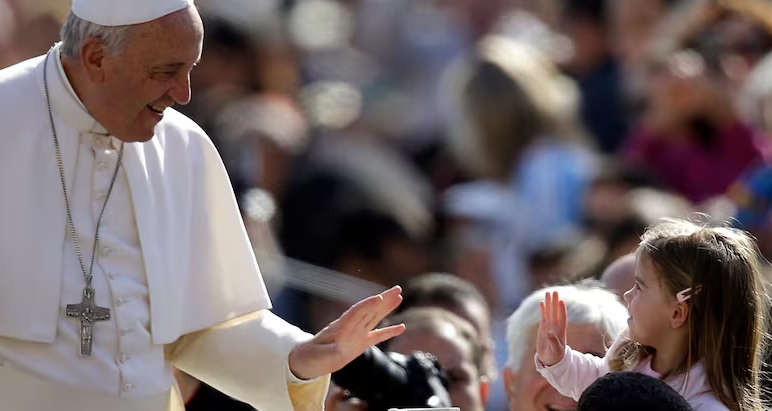
Prior to becoming pope, he was Jorge Mario Bergoglio, archbishop of Buenos Aires, and was the first person from the Americas to be elected to the papacy. He was also the first pope to choose Francis as his name, thus honoring St. Francis of Assisi, a 13th-century mystic whose love for nature and the poor have inspired Catholics and non-Catholics alike.
Pope Francis chose not to wear the elaborate clothing, like red shoes or silk vestments, associated with other popes. As a scholar of global Catholicism, however, I would argue that the changes Francis brought to the papacy were more than skin deep. He opened the church to the outside world in ways none of his predecessors had done before.
Care for the marginalized
Pope Francis reached out personally to the poor. For example, he turned a Vatican plaza into a refuge for the homeless, whom he called “nobles of the street.”
He washed the feet of migrants and prisoners during the traditional foot-washing ceremony on the Thursday before Easter. In an unprecedented act for a pope, he also washed the feet of non-Christians.
He encouraged a more welcoming attitude toward gay and lesbian Catholics and invited transgender people to meet with him at the Vatican.
On other contentious issues, Francis reaffirmed official Catholic positions. He labeled homosexual behavior a “sin,” although he also stated that it should not be considered a crime. Francis criticized gender theory for “blurring” differences between men and women.
While he maintained the church’s position that all priests should be male, he made far-reaching changes that opened various leadership roles to women. Francis was the first pope to appoint a woman to head an administrative office at the Vatican. Also for the first time, women were included in the 70-member body that selects bishops and the 15-member council that oversees Vatican finances. He appointed an Italian nun, Sister Raffaella Petrini, as President of the Vatican City.
Not shy of controversy
Some of Francis’ positions led to opposition in some Catholic circles.
One such issue was related to Francis’ embrace of religious diversity. Delivering an address at the Seventh Congress of Leaders of World and Traditional Religions in Kazakhstan in 2022, he said that members of the world’s different religions were “children of the same heaven.”
While in Morocco, he spoke out against conversion as a mission, saying to the Catholic community that they should live “in brotherhood with other faiths.” To some of his critics, however, such statements undermined the unique truth of Christianity.
During his tenure, the pope called for “synodality,” a more democratic approach to decision making. For example, synod meetings in November 2023 included laypeople and women as voting members. But the synod was resisted by some bishops who feared it would lessen the importance of priests as teachers and leaders.
In a significant move that will influence the choosing of his successor, Pope Francis appointed more cardinals from the Global South. But not all Catholic leaders in the Global South followed his lead on doctrine. For example, African bishops publicly criticized Pope Francis’ December 2023 ruling that allowed blessings of individuals in same sex couples.
His most controversial move was limiting the celebration of the Mass in the older form that uses Latin. This reversed a decision made by Benedict XVI that allowed the Latin Mass to be more widely practiced.
Traditionalists argued that the Latin Mass was an important – and beautiful – part of the Catholic tradition. But Francis believed that it had divided Catholics into separate groups who worshiped differently.
This concern for Catholic unity also led him to discipline two American critics of his reforms, Bishop Joseph Strickland of Tyler, Texas, and Cardinal Raymond Burke. Most significantly, Carlo Maria Viganò, the former Vatican ambassador, or nuncio, to the United States was excommunicated during Francis’ tenure for promoting “schism.”
Recently, Pope Francis also criticized the Trump administration’s efforts to deport migrants. In a letter to US Bishops, he recalled that Jesus, Mary and Joseph had been emigrants and refugees in Egypt. Pope Francis also argued that migrants who enter a country illegally should not be treated as criminals because they are in need and have dignity as human beings.
Writings on ‘the common good’
In his official papal letters, called encyclicals, Francis echoed his public actions by emphasizing the “common good,” or the rights and responsibilities necessary for human flourishing.
His first encyclical in 2013, Lumen Fidei, or “The Light of Faith,” sets out to show how faith can unite people everywhere.
In his next encyclical, Laudato Si’, or “Praise Be to You,” Francis addressed the environmental crisis, including pollution and climate change. He also called attention to unequal distribution of wealth and called for an “integral ecology” that respects both human beings and the environment.
His third encyclical in 2020, Fratelli Tutti, or “Brothers All,” criticized a “throwaway culture” that discards human beings, especially the poor, the unborn and the elderly. In a significant act for the head of the Catholic Church, Francis concluded by speaking of non-Catholics who have inspired him: Martin Luther King Jr., Desmond Tutu and Mahatma Gandhi.
In his last encyclical, Dilexit Nos, or “He Loved Us,” he reflected on God’s Love through meditating on the symbol of the Sacred Heart that depicts flames of love coming from Jesus’ wounded heart that was pierced during the crucifixion.
Francis also proclaimed a special “year of mercy” in 2015-16. The pope consistently argued for a culture of mercy that reflects the love of Jesus Christ, calling him “the face of God’s mercy.”
A historic papacy
Francis’ papacy has been historic. He embraced the marginalized in ways that no pope had done before. He not only deepened the Catholic Church’s commitment to the poor in its religious life but also expanded who is included in its decision making.
The pope did have his critics who thought he went too far, too fast. And whether his reforms take root depends on his successor. Among many things, Francis will be remembered for how his pontificate represented a shift in power in the Catholic Church away from Western Europe to the Global South, where the majority of Catholics now live.The Conversation
(Mathew Schmalz is Professor of Religious Studies at the College of the Holy Cross. Courtesy: The Conversation, an Australia-based nonprofit, independent global news organization dedicated to unlocking the knowledge of experts for the public good.)
❈ ❈ ❈
Pope Francis’s Lesson of Love and Peace
Kathy Kelly
In 2022, Pope Francis created a will expressing his desire that just one word be inscribed on the stone marking his burial place: Franciscus.
Franciscus, Latin for Francis, is the name Jorge Mario Bergoglio chose when, twelve years ago, cardinals elected him to become the Bishop of Rome. He sought union with Saint Francis, known as one who lived on the margins, who discarded his worldly clothes, and who kissed the lepers. Pope Francis longed for “a church that is poor and is for the poor.” He recognized, as Bishop Robert McElroy once expressed it, that “too much money is in the hands of too few, while the vast majority struggle to get by.”
As the spiritual leader of the world’s 1.4 billion Catholics, Pope Francis unified people of different generations. He encouraged genuine love for humans—“Todo, todo, todo.” Or, as the Reverend Martin Luther King Jr.’s personal physician, the late beloved Chicagoan Dr. Quentin Young would often say, “Everybody in, nobody out.”
Pope Francis exhorted people to set aside the futility of war and to always care for those who bear the worst brunt of war, particularly the children. His were the words of a man whose heart aches for children who are being punished to death, sacrificed by powerful people whose lust for greed and power overcomes their capacity for compassion.
“Yesterday, children were bombed,” Pope Francis said in his final Christmas message last December. “Children. This is cruelty, this is not war.” He added, touching the cross he wore around his neck, “I want to say this, because it touches my heart.”
Pope Francis was speaking about the children of Gaza, who have been orphaned, maimed, sickened, starved, forcibly displaced, traumatized, and buried under fire and rubble. In excerpts from the book Hope Never Disappoints. Pilgrims Towards a Better World, published in November 2024, he was blunt about Israel’s accountability, writing: “What is happening in Gaza has the characteristics of a genocide. It should be investigated to determine whether it meets the definition formulated by jurists and international bodies.”
On Easter, the day before his death, Pope Francis expressed in a written message: “I appeal to the warring parties: Call a ceasefire, release the hostages, and come to the aid of a starving people that aspire to a future of peace!”
+++
During the current war, beginning in 2023, Pope Francis developed a strong relationship with parishioners of the Church of the Holy Family in Gaza. By holding virtual gatherings with the hundreds of people sheltering in the church, he was able to stay in daily touch with the realities they faced under Israel’s siege and bombardment. On days when he learned that the bombing was particularly heavy, Pope Francis would call to check in on them as many as five times a day.
Pope Francis carried his antiwar message to the seats of power in places around the world. In September 2015, exasperated by the superpowers’ desire to control others through militarism, he posed a simple question to the U.S. Congress: “Why,” he asked, “would anyone give weapons to people who use them for war? . . . The answer is money, and the money is drenched in blood.”
Pope Francis emphasized the stewardship so vitally needed for future generations to have a habitable planet, sounding an alarm about the need to address climate change. “The world in which we live is collapsing and may be nearing the breaking point,” he stated in a magisterial document released in October 2023. “Despite all attempts to deny, conceal, gloss over, or relativise the issue, the signs of climate change are here and increasingly evident.”
The Pontiff likewise denounced the use of atomic energy for the purposes of war, and declared possession of nuclear weapons to be immoral, asking: “How can we speak of peace even as we build terrifying new weapons of war?”
In accordance with his wishes, Pope Francis will be buried in a basilica dedicated to the Virgin Mary, a place he went to pray before and after each of his forty-seven “apostolic missions.” The Basilica of Saint Mary Major is located in one of Rome’s poorer neighborhoods, a church in a neighborhood with refugees. Francis has entrusted himself to the protection of Mary, the mother of Jesus.
I’d like to think that those words, “Todo, todo, todo,” will break down the barriers creating illusory divisions between us, leading us toward true egalitarianism, embracing Earth and one another, grateful always for the chance to “choose life, so that you and your descendants can live.”
Beloved Franciscus, “Oremus.” Let us pray.
[Kathy Kelly, Board President of World BEYOND War, co-coordinates the November 2023 Merchants of Death War Crimes Tribunal. She is the author of Other Lands Have Dreams, published by CounterPunch/AK Press. Courtesy: CounterPunch, an online magazine based in the United States that covers politics in a manner its editors describe as “muckraking with a radical attitude”. It is edited by Jeffrey St. Clair and Joshua Frank.]
❈ ❈ ❈
Pope Francis: a Loss for Humanity
Eve Ottenberg
We should have seen it coming – pope Francis had been sick, old and frail for some time. But still his death was a shock, reminding those who care of the lugubrious truth that there really are very few people of world renown standing up for the homeless, the destitute, the immigrant, the Gazan, the stranger, and of course, that splendrous panorama of life and beauty called the natural world, deathly imperiled by late capitalism’s arrogance and hubris, burning fossil fuels with abandon and thus warming and wrecking Earth.
Francis was not your average pope. He lent hope for the world to plenty of people who are not Roman Catholic, and he wasn’t shy about his papally unconventional views, as he led a very hidebound global institution with 1.4 billion adherents toward recognizing that things are not as they should be, are even, in some cases, abominations not only to the divine but to any living human conscience.
On the verge of nuclear Armageddon, Francis noted that Europe and the U.S. provoked the crisis with Russia, a far from popular perspective in the west. He never stopped advocating for peace between Israelis and Palestinians, meeting with former Israeli hostages and talking by phone regularly with Gazan Christians under bombardment. He loved the humble and did so without a scintilla of cloying false modesty. It always seemed that given the choice between a meal with a world ruler and an indigent Syrian immigrant, Francis would prefer the latter, though he certainly regarded the former as an opportunity to bend power toward justice.
So now one cannot help wondering who will replace this profoundly good man? There have been ferociously anti-communist popes, popes who collaborated with Nazis and no pope, aside from Francis, who cared about the Great Mistake of humanity’s desecration of the natural world. Will the pendulum swing back to a cardinal with right-wing bona fides taking the helm? Though not a Roman Catholic, I can’t help remarking that this is not what our species needs now. The hard right rules much of the globe, just as it assiduously ignored Francis, regarding him as some kind of outdated hippie gadfly rather than God’s emissary, a role popes are cast for but which, in Francis’ case, offended secular power. The powerful and the wicked ignored him, even as they conferred with him in the Vatican, taking absolutely nothing he said to heart.
Francis brought to mind the Latin American heroes of liberation theology, heroes so ferociously extirpated by that infamous institutional evil called the CIA. Though not explicitly a liberation theologian, he shared the zeitgeist that produced that noble, doomed experiment and made it seem that maybe it wasn’t so doomed after all. Because if someone like Jorge Bergoglio could ascend to the papacy, then those priests, down among the people, who made peasants’ struggles their struggles, who make peasants’ liberation their fight and were killed for it, well, in some sense they won.
It may seem that Francis was a once-in-a-century pope, but maybe not, maybe there are enough cardinals satisfied with how he managed things to balk at electing someone who would seek to undo it all. Because never underestimate the late pope’s agility when it came to navigating church politics. He packed the conclave of cardinals with his own people and survived a dozen years of internecine attempts, some spearheaded by very conservative American churchmen, to undo his work. And don’t forget the skill involved in becoming pope in the first place. No one knew better than Francis how reactionary some church factions could be. But he slipped past them, they couldn’t trip him up, and he thus managed to serve truth and justice like no pope before. His death is a huge loss for all people of good will.
[Eve Ottenberg is a novelist and journalist. Her latest novel is Booby Prize. Courtesy: CounterPunch, an online magazine based in the United States that covers politics in a manner its editors describe as “muckraking with a radical attitude”. It is edited by Jeffrey St. Clair and Joshua Frank.]
❈ ❈ ❈
James North, in an article ‘Mainstream Obituaries are Erasing Pope Francis’s Deep Concern for Palestine’, published by Mondoweiss, writes (extract):
Significantly absent in the long obituaries for Pope Francis in both the New York Times and the Washington Post were mentions of his deep concern for the suffering of the Palestinian people in Gaza. In Francis’s last public message on Easter Sunday, just hours before he died, he had called for a ceasefire in Gaza, and condemned the “deplorable humanitarian situation” there.
The obits also failed to note that Pope Francis had personally telephoned the Holy Family Church in Gaza just about every evening since Israel invaded the territory in October 2023–including the Saturday night before Easter. The church’s pastor, Rev. Gabriel Romanelli, remembered: “He said he was praying for us, he blessed us, and he thanked us for our prayers.” Other church members said that the Pope “would make sure to speak not only to the priest but to everyone else in the room.”
Pope Francis’s concern for Gaza and Palestine did not start in October 2023. Rev. Munther Isaac, a Palestinian Christian theologian and Lutheran pastor, told Democracy Now:
I think no Palestinian will ever forget when Pope Francis, in 2014, stopped his car, went down, stepped down and prayed at the separation wall separating Jerusalem from Bethlehem–a moment that touched all of us and continued to speak to us for years.
Of course, there was plenty in the life of this remarkable 88-year-old man to include in those obituaries. But the pontiff’s ongoing concern for Gaza surely should have been part of the record in America’s leading newspapers. Those nightly telephone calls were exactly the kind of detail that brings a story to life. Instead, part of Pope Francis’s message is being erased.
(Mondoweiss is an independent website devoted to informing readers about developments in Israel/Palestine and related US foreign policy.)