❈ ❈ ❈
Stopping Francesca Orsini from Entering India is an Insult to the Very Concept and Culture of Knowledge
Yogesh Pratap Shekhar
The morning after the festival of lights, Diwali, came news of darkness. Francesca Orsini, a renowned scholar of Hindi, was turned back from Delhi Airport despite having a valid visa. Orsini is a scholar of Hindi, respected worldwide, and has devoted her entire life to the study of the Hindi language and literature. She is a respected Professor Emerita at the ‘SOAS’ (School of Oriental and African Studies), University of London, where she has served for many years.
It is worth asking – when Orsini had a valid visa, then why was she stopped from entering India? Orsini is possibly the fourth scholar who has been denied entry into India despite holding a valid visa. The question is – who feels threatened by Orsini’s arrival in India? If one pauses to think, it becomes clear that the present BJP government has constructed an imaginary narrative.
That narrative is that foreign people write all sorts of nonsense about India, which tarnishes the great image of the country. Clearly, since no restriction can be imposed on their writing, a ban is being placed instead on their entry into India. However, Orsini’s writings have never led to any kind of political or academic controversy.
On the other hand, it is also clear that during this government’s tenure, almost every central university has been issued a circular aimed at controlling universities. The circular states that before inviting speakers to any academic event, the list of speakers must be checked and approved by the respective university administration.
From both these things, it is evident that this government is deeply anxious about its image and its imaginary narrative. To ensure that no question is raised about this imagined image and narrative, the government has resorted to repression and control. Orsini being denied entry into India appears to be the next step in this very sequence.
How ironic and ridiculous it is that at precisely this time, the clamour about India being a “Vishwaguru” is spreading all around! The reality is that we are losing even the ability to become humble students in the context of vast world of knowledge which knows no national boundaries.
Why else would a world-renowned scholar of the very Hindi language that is promoted as the “national language” be stopped from entering India? What should have happened is this: even if she did not have a valid visa or other required documents (which, in fact, she did have), her contributions should have ensured that a visa and all formalities were completed right there at the airport.
After all, will there be any difference in our treatment of a scholar and of a suspicious individual – or will everyone be driven with the same stick? Orsini has produced standard-setting work on modern and medieval Hindi literature. Her being barred from entering India is also proof of how grave a threat currently looms over the country’s academic culture.
It is equally absurd that, on one hand, this government is allowing foreign universities to establish campuses in India and to conduct teaching and research here, while on the other hand, it is insulting scholars in this manner. It is strange but painful that people outside India are doing extensive work on Indian languages and literatures, whereas within our country, neither is an environment created for such high-quality work nor are any facilities provided.
Even if we think from the so-called “nationalist” perspective, it is shameful that the ability to search meanings of words in Indian language dictionaries online became possible only because of the Digital Dictionaries of South Asia project at the University of Chicago in the United States. There are many such examples before us today. In any case, knowledge cannot be policed, nor can it be imprisoned within the borders of a nation.
What happened to Orsini may appear, on the surface, to be an ordinary incident, but the signs it carries are deeply frightening. One can imagine the terrible impact this incident will have on those foreign scholars who dedicate their life, time, and money to working seriously on India’s languages and literatures. Before coming to India, how fearful each one of them will feel! Because of this fear, those talents who wish to work on India with enthusiasm, dedication, and commitment will begin to feel an unnecessary pressure and anxiety – the long-term effect of which may be that their interest itself begins to fade away.
This loss will be borne by Indian languages and literatures. For centuries, foreign scholars have been working on India’s languages and literatures. It may be that at times we disagree with their methods or perspectives, but their labour, dedication, and standards cannot be doubted. The Bharatiya Janata Party (BJP), which is the ruling party at the Centre, makes grand claims about India’s past – one of those claims being that the Vedic age was highly advanced and great. But is there not, in that very Rigveda, the verse “ā no bhadrāḥ kratavo yantu viśvataḥ (Let noble thoughts come to us from every direction)? Is stopping Orsini in harmony with this Rigvedic verse? Not at all – absolutely not.
Barring Orsini’s entry into India is, in both literal and figurative senses, an insult to this verse. In the field of knowledge, generosity holds a place of great importance. It is through generosity that the environment is created in which new, superior, and benevolent ideas arrive before us from many directions. This incident has proved that our claim of considering the whole world as one family is hollow. Stopping Orsini from entering India is an insult to the very concept and culture of knowledge.
[The author teaches Hindi at the Central University of South Bihar. Courtesy: The Wire, an Indian nonprofit news and opinion website. It was founded in 2015 by Siddharth Varadarajan, Sidharth Bhatia and M. K. Venu.]
❈ ❈ ❈
How Hindi Scholar Francesca Orsini’s Work Illuminates India’s Language Politics – Past and Present
Prachi Gupta
Few studies have shaped our understanding of modern Hindi and its deep entanglement with politics and culture as profoundly as Francesca Orsini’s The Hindi Public Sphere, 1920-1940: Language and Literature in the Age of Nationalism.
The book, published in 2009, is widely regarded as a landmark work. So it is understandably shocking to learn that the distinguished professor at London’s School of Oriental and African Studies was deported from New Delhi airport on Monday. Unidentified government sources claimed to journalists that she had conducted research on previous trips despite only having a tourist visa.
The strength of Orsini’s scholarship on the understanding and the development of the field of Hindi literary discourse stems from the vast canvas, filled with thick contextual details, that she paints of the modern Hindi language and literature in the two crucial decades (1920-1940) of the national movement.
The “public sphere” of Hindi is constituted of the intersections of literary and political movements, institutional and ideological spaces, and an expansive print culture marked by increasing diversity of journals, newsletters, pamphlets, books and magazines spearheaded by editors, political leaders and writers with overlapping roles. The result is a panoramic view that helps us understand not just the past, but the present politics of language in India.
At a time when Hindi, heavy with Sanskrit vocabulary, has been tied to a narrow, exclusionary nationalism, Orsini reminds us that the Hindi public sphere was once far more diverse. Her research traces how Hindi took on certain dominant forms and how those forms became aligned with hegemonic cultural and political ideologies. Yet, she also uncovers the other, less-heard voices that challenged this dominance.
The concept of “public sphere” in her work borrows from German philosopher, Jurgen Habermas’ influential idea of how people come together to discuss, critique and influence political action. By reimagining it in the context of Hindi language, Orsini limits the narratives of standardisation, uniformisation and Sanskritisation of Hindi to just one part of the public sphere.
In this particular space, the norms of the “public” are conceived in the imaginaries of “Indian” and “national” expressed in terms such as “lok”, “jati”, “sarvsadharan” that defied any display of differences and conflicts of caste, region, religion or other interests. The language and literature- style, content and form were increasingly subordinated to this perspective of lok, the public that remained abstract and devoid of particularities.
Writers and editors of the time pushed for a purified Hindi, stripped of colloquial and regional elements. This, they believed, would serve the idea of a unified national culture.
However, Orsini highlights the challenges, critique and reformulation that constituted another significant part of the Hindi public sphere. In her meticulous work on magazines and journals circulated for women, she notes the challenges that are posed to this abstract ideal of the nation through questions around gender roles, and the caste and regional diversity around the societal and customary laws concerning women.
The discussion of the plight of widows, intimate stories of domestic violence along with the news about women participation in the national movement placed the women’s issues in society as central to the nationalist concern. Such a critique punctured the projection of the political community as neutral and abstract.
Further, this understanding of the public also reformulated and expanded the ideas of justice, and equality through the discussion of marginalised voices.
Amidst the calls for a standardised Hindi from editors and literary critics, traditional Braj poetry, folk tales, and experimental writing continued to flourish. Magazines that featured the voices of workers and peasants gave rise to a more “popular” sense of the public, one that challenged elite control and included the spoken varieties of Hindi.
Orsini also examines how “Hindi intellectuals” came to dominate educational institutions, shaping curricula, textbooks, and examinations that effectively institutionalised a certain version of Hindi as the national language. She notes that the cultural diversity is also eluded among the political leadership who she refers to as “Hindi politicians”, arguing that despite their differences on the ideological spectrum, they agreed about the cultural and civilisational importance of the specific form of Hindi to the Indian nation.
This is where I believe her argument invites further debate, as it risks overstating the consensus among these figures. I have attempted to offer a critique of this argument here.
Nevertheless, Francesca Orsini’s scholarship remains essential to anyone seeking a deeper understanding of India’s cultural and political landscape. Through her work on the literary and linguistic expanse of the varieties of Hindi language, she has complicated the attempts at hegemonic portrayals of cultural nationalism. Her scholarship stands steadfast amidst the intolerant and exclusivist pressures of the present political discourse.
[Prachi Gupta teaches political theory at IILM University, Gurugram. Courtesy: Scroll.in, an Indian digital news publication, whose English edition is edited by Naresh Fernandes.]
❈ ❈ ❈
What does Francesca Orsini’s Scholarly Work Say? Five Former Students Explain What They Have Learnt
Aakriti Mandhwani, Priyanka Basu, Raahi Adhya, Chinmay Sharma & Kanupriya Dhingra
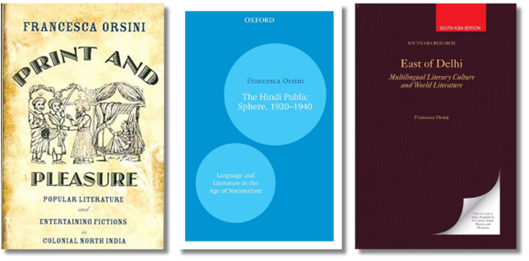
Hindi scholar Francesca Orsini’s work over the past three decades has been so expansive that it has proved to be difficult to present a neat introduction to her work. Contributors to this essay below offer several entry points into her scholarship through a discussion of her monographs –The Hindi Public Sphere: 1920-1940. Language and Literature in the Age of Nationalism (2002), Hindi translation (2010); Print and Pleasure: Popular Literature and Entertaining Fictions in Colonial North India (2009); East of Delhi: Multilingual Literary Culture and World Literature (2023) – and several collaborative projects. All contributors to this piece have been Orsini’s students, and teach literature, literary history, comparative literature, and performance studies in India and around the world.
● ● ●
‘A Remarkable Engagement with Primary Sources’
Aakriti Mandhwani
It is impossible for any student of literary and print history in North India to form an informed view of the field without engaging with Francesca Orsini’s defining work on the early Hindi public sphere and popular fiction. Her wide-ranging book on the Hindi public sphere is remarkable because of its sheer engagement with primary sources – periodicals being chief among them, many of them now buried in forgotten archives. Hindi periodicals in the early 20th century literally shaped the story and image of Hindi as we know it today, as evidenced by the fact that an entire epoch of Hindi literature is named after Mahavir Prasad Dwivedi, who edited the iconic periodical Saraswati for the first two decades of the 20th century.
Another of Orsini’s major contributions is a thorough and sensitive close reading and attention to form. For instance, she writes the history of Chand, a very popular Hindi periodical of the 1920s, and how it expanded the space for women to exist in the public sphere through generic interventions such as the mode of the confessional.
Her expertise and close attention to historical and literary critical methods have persisted throughout her career in her numerous writings on periodicals big and small, literary and not so literary, popular and esoteric, and their expansive role in the formation of literary cultures and sensibilities. Orsini’s work on the periodical – an ephemeral, fleeting, yet robust form – has directed the attention of numerous scholars of print history toward study it.
Her pioneering work on the significance of popular genres, Print and Pleasure: Popular Literature and Entertaining Fictions in Colonial North India, draws attention to the overwhelming popularity of print in North India. Lithography, a form of print technology that made possible the appearance of many languages and scripts cheaply and easily, found its real home in North Indian popular publishing. Following the introduction of print and publishing by colonial and missionary authorities, regional publishers were quick to spot a viable market in it. Uncovering this history, Orsini provides us with the expansive breadth of multilingual reading cultures of North India.
● ● ●
‘A More Versatile Map of North India’
Priyanka Basu
Francesca Orsini’s abiding interest in the circulation of literary texts in north India can perhaps be best understood through what she herself calls “tellings and texts”, ie, a continued dialogic relationship between literature and performance. Over the course of the past two decades (and even more), her scholarship on the oral performative genres of the katha, barahmasa, dhrupad, bishnupad, qissa, Bhojpuri songs and others has illuminated the enigmatic world of early modern north India in India and beyond, such as in Mauritius.
Her sustained investment in excavating the social history of a genre like the katha (or stories) only goes on to show what a “thick” reading of text(s) can allow us to see. Her long trajectory of scholarship on the oral-literate genres devotes space to and rigorously explains early modern texts such as Malik Muhammad Jayasi’s Kānhavat, Mir ‘Abdul Wahid Bilgrami’s Haqā’iq-i Hindī, Isardas’s Satyavatī Katha, Lalach’s Harikathā, among numerous others. Her skill in reading texts across languages such as early Hindi, Urdu, Persian, Arabic, and Brajbhasha helps us understand the rich multilingual and multi-performative local worlds across north India.
Orsini’s scrutiny of the katha texts and genres in print and performance highlights the possibilities of multiple readings in the multi-religious worlds of north India, such as that of the Sufis and Bhakti saints. Her close textual readings of the oral-literate genres go beyond the discipline of Literary Studies or Literary Histories, helping scholars and enthusiasts of theatre and performance to focus beyond the event or “live”ness of performances themselves to keep looking into their multiple archives, their spaces and modes of circulation, as well as their contexts of censorship.
Her assessment of Bhojpuri songs of India and the Mauritius as world literature – what she veritably calls “fluid texts” – takes us deeper into the rich world of Bhojpuri song orature (including Chutney music) contributed to by migrant coolies, traders, travellers, etc. As academic interest in trade/travel routes, Creole languages, and performative cultures of the Indian Ocean world continues to grow, the range and depth of such scholarly intervention remain invaluable.
As Orsini has shown time and again through her scholarship, texts enliven both past and contemporary worlds for us, as we understand them through their multiple transmitters beyond the divisions of region, religion, language and culture. Her scholarship helps us imagine a more versatile map of north India, where different aesthetic tastes in literature and performances were created, sustained and transformed over time. It challenges an easy and convenient one-dimensional historiography to enliven texts and contemplate what they still have to offer through their tellings and re-tellings. For her many students, now strewn around the world, Orsini’s scholarship is a life-long training in remaining forever enthusiastic and inquisitive about texts beyond their words, through verses, songs, inflexions and sounds.
● ● ●
‘Multiple Worlds Into Conversation’
Raahi Adhya
Francesca Orsini is best known for her seminal work on the Hindi public sphere, but what has always inspired me is how her scholarship opens up much wider conversations about language, form, and the ways stories move. In her work on the kathā tradition, she follows stories as they travel through performance, music, and print, getting “inflected” each time. The range of traditions she draws on – spanning Sufi, epic-Puranic, and Shastric literatures – is itself extraordinary. What is remarkable is how she brings these multiple worlds into conversation: she traces broad intertextual and generic patterns across centuries and languages, while also offering the most attentive close readings of themes, motifs, and images. Her work opens up a way of thinking about literature that refuses boundaries and instead treats genres as living, circulating forms – structures that operate at once on narrative, discursive, and socio-political levels, always connecting the local to the larger world.
As someone who works on Bengali roopkatha – tales that crystallised as nationalist and children’s literature – I have found Francesca Orsini’s insights into the multilingual and multiscalar lives of genres profoundly shaping my approach. Her work taught me to see the “local” not as something sealed off or pure, but as a space alive with other languages and influences. It was through Orsini’s scholarly lens that I began to notice the traces of overlapping worlds even in this genre recognised as “authentically Bengali” – for a range of South Asian oral and performative traditions that crossed multiple linguistic lines, translations of European fairy tales, and colonial print networks had shot through them. Her work, therefore, crucially reminds us that narratives are always full of crossings, echoes, and afterlives – and that this entanglement, rather than purity, is precisely where their vitality lies.
● ● ●
‘Multilingualism is Not a Problem, But a Rich Cultural Tapestry’
Chinmay Sharma
A few years ago, Francesca Orsini secured a prestigious grant from the European Research Council (ERC) for the Multiple Local and Significant Geography (MULOSIGE) project at SOAS. Collaborating with academics working on North India, the Horn of Africa, and the Maghreb, the project focused on “three time periods: colonial consolidation, decolonisation and the current globalising moment” to provide a more “modest, honest, and accurate” account of world literature that moved beyond the Anglophone and the novel.
This effort resulted in multiple essays, journal special editions, collected volumes, and, recently, in her monograph East of Delhi (2023). Engagingly written, the book is a tour de force that articulates an understanding of world literature not just as a market for globalised capital flows anchored in the Global North, but rather as “a tapestry of crisscrossing significant geographies…that never becomes a single totality.” Focusing on an unlikely corpus of sant texts from early modern Awadh, Orsini makes a strong case for approaching multilingualism not as a problem, but as a rich cultural tapestry of linguistic, literary, and genre circulation, inter-textuality and transmutation. The book invites its readers to rethink their assumptions about linguistic cultures, world literature, and rooted cosmopolitanism by considering early modern Awadh as a space that could produce literature of and for the world, without needing to make grandiose claims of global heft or universality.
● ● ●
Books by Francesa Orsini.
● ● ●
‘Print Cultures are Living, Dynamic Worlds’
Kanupriya Dhingra
Francesca Orsini has been a first window into book history for many of us, not only as a field of methods and questions, but as a way of thinking about the life of texts and the people who make, circulate, and read them. Her scholarship reveals that print cultures are not static repositories of words; they are living, dynamic worlds where meanings, emotions, and economies constantly intersect. Through her work, she has expanded the vocabulary of print history, showing how literary and non-literary materials alike participate in the making of social life.
Her edited volume Love in South Asia: A Cultural History remains foundational for anyone studying the emotional and cultural life of texts. A decade after its publication, when I was tracing the history and use of love-letter manuals in Delhi: small, unassuming booklets that taught readers how to write to their beloveds, I did not yet know that this modest pursuit was part of a much larger conversation that Orsini had already helped shape.
By tracing how ideas of love – prem, ishq, shringara, mohabbat – travel across languages, genres, and media, Orsini, along with her collaborators, demonstrates how affect, morality, and form are historically and linguistically entangled. The book’s introduction, in particular, offers a conceptual map for understanding how emotions circulate through words and images, how idioms of intimacy are shaped by their material and linguistic environments, and how print mediates feeling itself.
Read alongside Print and Pleasure, her work invites scholars to see the “popular” not as the opposite of the literary but as its companion; a space where readers and writers negotiate pleasure, aspiration, and access. In this sense, she has transformed how we approach everyday print: not as marginal or trivial, but as central to the story of reading in modern South Asia.
Many of the field’s conceptual frameworks bear the imprint of Orsini’s intellectual generosity. Yet what distinguishes her legacy most deeply is the example she sets as a mentor: rigorous but unfailingly kind, generous with her time and attention, and genuinely invested in the intellectual and emotional growth of others. Francesca Orsini continues to offer quiet assurance that empathy and critical thought can coexist, and that the study of texts can remain, at its heart, a profoundly human endeavour.
[Aakriti Mandhwani specialises in book and magazine history, South Asian and Hindi literary history, and the history of reading spaces in North India. She is the author of Everyday Reading: Middlebrow Magazines and Book Publishing in Post-Independence India (UMass, Speaking Tiger, 2024), and co-editor, Indian Genre fiction: Past and Future Histories (Routledge, 2019).
Priyanka Basu is a Theatre and Performance Studies scholar working on cultural histories of folk performances in South Asia. She is the author of The Poet’s Song: ‘Folk’ and its Cultural Politics in South Asia (Routledge, 2024), and co-editor of ‘Performing’ Nature: Ecology and the Arts in South Asia (Routledge, 2025).
Raahi Adhya researches and teaches narrative cultures and childhood studies. She has written on the gendered and aged tellers, listeners, and characters who have historically defined folkloric traditions in South Asia.
Chinmay Sharma specialises in print, performance and visual cultures in Hindi and English in post-Independence India, with expertise in cultural studies, performance and media studies, postcolonial theories and literature, comparative literature and world literature.
Kanupriya Dhingra researches the history of the book and print cultures with an ethnographic focus on Delhi. Her first monograph, Old Delhi’s Parallel Book Bazaar, was published by Cambridge University Press.
Courtesy: Scroll.in, an Indian digital news publication, whose English edition is edited by Naresh Fernandes.]