India’s dominant Hindutva ideology and its advocates do more than support Israel. They study it, absorb it and increasingly seek to reproduce Israel’s logic at home in India.
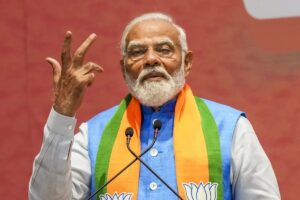
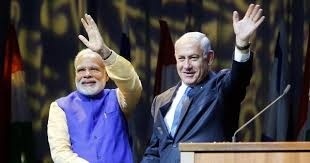
On February 25, Prime Minister Narendra Modi will arrive in Tel Aviv for a two-day state visit during which he will hold talks with his Israeli counterpart Benjamin Netanyahu.
Israel is a friend in a hostile world but also a state that has already answered the questions Hindutva is asking: how to rule a population that is imagined as permanently disloyal, how to make exclusion look like governance, how to normalise extraordinary violence without suspending democracy and how to turn fear into a stable political system.
This is evident from how Gaza is perceived in India, through mockery and jokes about bombed homes, open admiration for the flattening neighbourhoods, and dead children. It reflects a political culture that has already learned to enjoy punishment and sees in Israel a confirmation that such actions can be sustained and defended without consequence.
Gaza’s health ministry estimates that as of February 16, the total death toll is 72,063 since the start of Israel’s assault on the Gaza Strip on October 10, 2023. Two years later, as of October, children made up at least 20,000 of the dead.
At the heart of Hindutva and its support base’s admiration for Israel is the settler logic, the belief that land must be secured before people can be managed, and that once the space is “purified”, politics will follow.
In India, this has been evident through the series of experiments carried out across states ruled by the Bharatiya Janata Party, testing how much dispossession can be normalised. Bulldozers demolitions in Uttar Pradesh wrecked Muslim homes, broadcasting the warning repeatedly until it ceased to be shocking.
In Uttarakhand, exclusion has been woven into everyday administration. The Association for Protection of Civil Rights and national newspapers have documented a pattern of targeted policing, sealing of mosques, action against madrassas, harassment of Muslim traders, and the encouragement of vigilante intimidation, all justified in the language of cultural protection and public order.
The presence of Muslims has been recast as a blemish, an impurity even, in an Uttarakhand which is being imagined as a religiously pure terrain. A Muslim running a shop or naming a business with a name deemed to be Hindu becomes suspect.
In Odisha, vendors have been beaten and forced to chant religious slogans. In Jharkhand, a Muslim worker was found dead, allegedly after he was called a “Bangladeshi”. In Madhya Pradesh, Muslim families have been subjected to social boycotts, destroying the lives and livelihoods of long-time residents.
The videos of many such similar incidents have been circulated on social media, and reported by the news media. Yet, this violence passes by, as if it is regrettable but understandable, like being Muslim is itself the crime.
At the same time, Indian citizenship is being redefined, by hollowing it out.
The Citizenship Amendment Act, 2019, the National Register of Citizens in Assam and mechanisms such as the Special Intensive Revision of voter lists have demanded that Muslims, especially, repeatedly prove their belonging even as others inherit it unquestioned.
Names disappear from rolls while documents are endlessly scrutinised, and exclusion is presented as a technical error rather than deliberate attempts to remove the names of Muslim voters.
In the Palestinian territories, the administration similarly operates through so-called neutral permits, registries and verification systems, which United Nations experts – one as recently as January – have described as apartheid-like.
In India, this is most explicit in Assam. Chief Minister Himanta Biswa Sarma speaks openly about harassing, discriminating against and forcing Miya Muslims, of Bengali origin, out of India. Sarma’s rhetoric has normalised the idea that at least in Assam, Muslims are not equal citizens of India. Once again, his statements are digested with ease rather than being condemned as incitement.
The Israel model
Israel demonstrates that a state can treat a minority as an internal enemy while retaining international legitimacy, that it can operate under a permanent emergency without declaring one, that courts can function, elections can continue and global alliances can deepen even as an entire population is managed through force, surveillance and bureaucratic delay.
This is the lesson Hindutva finds most compelling: that democracy need not be dismantled to be hollowed out. The mockery of Gaza fits seamlessly into India’s continuum in which lynching videos are shared proudly, bulldozer demolitions are celebrated publicly and rape threats are issued as political warnings.
In Rwanda, radio stations broadcast hate speech, mocking the Tutsi minority as “cockroaches” to be exterminated, and an “infestation”. In Nazi Germany, anti-semitic cartoons preceded the legal ghettoisation and social and economic boycott of Jews.
India is now deep in this phase.
What makes this moment dangerous is that India will continue becoming what it claims it is not, proceeding slowly enough until each step feels defensible, each injustice is procedural and every silence is reasonable.
The assault on Gaza shows how such systems can be perfected and made to function like normal. Hindutva’s interest in Israel is in learning this method. Once normalised, time will do the rest.
[Ismail Salahuddin is a researcher and columnist based in Delhi and Kolkata. His work explores Muslim identity, communal politics, caste and the politics of knowledge. He studies social exclusion and inclusive policy at Jamia Millia Islamia. Courtesy: Scroll.in, an Indian digital news publication, whose English edition is edited by Naresh Fernandes.]