Europe Explodes with Rage After Israel Intercepts Global Sumud Flotilla
Rima Najjar
Author’s Note: This essay traces the October 2025 mobilizations — the mass demonstrations that erupted and surged across Madrid, Rome, Berlin, Paris, Amsterdam, and London following Israel’s interception of the Global Sumud Flotilla and Minister Ben Gvir’s public accusation of the activists involved as “terrorists.” Each city’s response builds on its own history of pro-Palestine and anti-zionist activism: migrant-led coalitions, legal defense campaigns, and cultural resistance. Though slow, these inroads have become sustained. The mobilizations mark a shift from symbolic protest to strategic refusal, where memory and infrastructure confront Zionism as state doctrine.
I. Introduction
“The moment Israel definitively lost Europe was when Minister Ben Gvir stood before the detained passengers of the Flotilla and branded them ‘terrorists.’ Europe erupted in a rage from which there is no return.”
— Sani Meo, Facebook
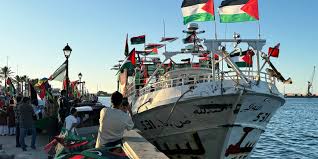
The weekend of October 4, 2025, marked a political rupture. In response to Israel’s interception of the Global Sumud Flotilla — a humanitarian convoy bound for Gaza — tens of thousands mobilized across Europe in a coordinated wave of outrage. The detention of activists from 44 countries in international waters was a catalyst, but it was Israeli Minister Itamar Ben Gvir’s public accusation that the passengers were “terrorists” that detonated long-simmering tensions. However, to dismiss these demonstrations as mere reactions to a single event would be to misunderstand them entirely. They represented the latest, most potent articulation of a deep and enduring infrastructure of resistance: a strategic indictment built on years of organizing against Israeli apartheid, Zionist militarism, and the global normalization of Jewish supremacy as state doctrine.
From Madrid to Marseille, Berlin to Birmingham, these mobilizations affirmed a collective commitment not only to Palestinian liberation but also to confronting a central contradiction in European politics: governments that symbolically condemn civilian casualties abroad simultaneously criminalize meaningful solidarity at home. This bifurcation is structural, designed to ensure that support for Palestine remains a permissible symbol but never becomes a threat to trade, arms, or diplomatic alignment.
This activist foothold, evident in the major cities of Madrid, Paris, Berlin, London, Amsterdam, and Rome, did not emerge overnight. It is the product of decades of groundwork, rooted in migrant solidarity networks, anti-colonial movements, and leftist student organizing. Through early opposition to the Oslo Accords, mass protests during the 2008–2009 Gaza War, and the persistent work of community centers, legal defense networks, and boycott campaigns, these movements have chipped away at the normalization of Israeli impunity. What appeared to be a sudden awakening was, in fact, a culmination — the moment when years of testimony, memory, and strategic refusal coalesced into a visible rupture.
The stark silence in the United States that same weekend, despite the presence of American citizens on the flotilla, underscores the precarity of this kind of dissent and throws Europe’s assertive response into sharper relief. In the face of intense repression and criminalization, European pro-Palestine and anti-Zionist activism is gaining ground not as a fleeting spectacle, but as a resilient political infrastructure. The ground is shifting. The detained flotilla has become a node of transnational testimony, and the archive of resistance is expanding.
II. Spain
The weekend of Oct 4, 2025: Over 70,000 people marched in Barcelona, with parallel actions erupting in Madrid and Valencia. The scale and coordination of these demonstrations reflect a long-standing tradition of pro-Palestine activism in Spain, rooted in the country’s post-Franco democratic transition.
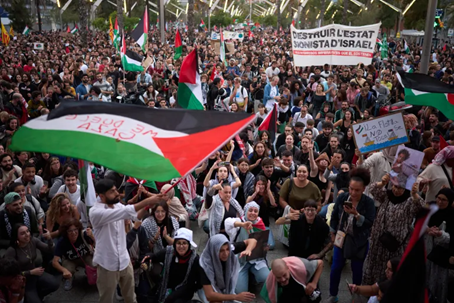
Pro-Palestinian demonstration in Spain after Israel intercepted the Global Sumud Flotilla
The mobilizations did not emerge from a vacuum. They are the latest expression of a decades-long infrastructure of solidarity, built through student coalitions, migrant-led organizing, and postcolonial memory work. From the anti-Iraq War protests of 2003 to the cultural boycotts of Israeli institutions in the 2010s, Spanish cities have served as key nodes in the European pro-Palestine landscape. Barcelona’s municipal government, for instance, suspended institutional ties with Israel in 2023, citing apartheid conditions — a move shaped by years of pressure from local BDS chapters and migrant coalitions. Madrid’s activist networks have long foregrounded the intersection of Palestinian liberation with anti-fascist and anti-austerity struggles, linking the siege of Gaza to the carceral logics of Spain’s own border regime.
The presence of Spanish parliamentarians aboard the Global Sumud Flotilla was not anomalous — it was the result of sustained lobbying, cultural work, and testimonial amplification. Activists like Jaldía Abubakra — who would later join a segment of the Global Sumud Flotilla’s journey — have not only resisted criminalization but have helped shape the language of solidarity itself, insisting on the right to name zionism as a structure of violence and to treat Palestine not as a humanitarian crisis but as a political cause. The demonstrations of October 4, 2025 — massive, coordinated, and defiant — are testament to this slow, strategic buildup. They mark not just a rupture, but a reckoning: the moment when symbolic solidarity gave way to infrastructural refusal.
Yet these ethical stances are routinely contradicted by state practice. Repression of antizionist and pro-Palestine activism is not incidental; it is structural. In 2024, Palestinian activist Jaldía Abubakra and organizer Miriam Ojeda were summoned before Spain’s National Court after the far-right party VOX accused them of “glorifying terrorism” for statements made during a solidarity conference in the Spanish Congress. While Ojeda’s case was dismissed, Abubakra remains under investigation — a move widely condemned as lawfare, designed to chill dissent and isolate Palestinian voices.
The flotilla, carrying humanitarian aid to Gaza, included 47 Spanish passengers, among them doctors, journalists, and members of parliament. When Israeli forces intercepted the vessel in international waters and detained the passengers, outrage erupted across Spain. Civil society groups, including Solidaridad con Palestina and Red Solidaria contra la Ocupación de Palestina, demanded diplomatic accountability, while opposition parties called for sanctions. The incident catalyzed renewed mobilization, with protesters citing the flotilla’s seizure as emblematic of both Israeli impunity and Spanish governmental passivity.
On October 4, 2025, Spanish police responded to mass mobilizations in Barcelona and Madrid by deploying riot units and detaining several organizers from Solidaridad con Palestina. The Interior Ministry later named the group in a press release, accusing it of “inciting unrest” — a rhetorical maneuver that echoes the language used to criminalize Abubakra and others. These actions are enabled by Spain’s still-active “Gag Law” (Ley Mordaza), which grants police broad powers to penalize protest and restrict the dissemination of images of law enforcement.
In this context, the criminalization of activists like Abubakra signals more than censorship; it marks a judicial turn toward political disciplining, where solidarity is tolerated only when it is symbolic, and punished when it is strategic. Spain’s dual posture — ethical abroad, punitive at home — reveals the limits of European liberalism when confronted with sustained, intersectional resistance.
III. Italy
On the same weekend, Italy witnessed one of the largest coordinated pro-Palestine mobilizations in its recent history, with over two million people participating in strikes and demonstrations across more than 100 cities — from Palermo to Turin, Milan to Rome. The protests, organized under the banner Blocchiamo tutto (“Let’s block everything”), were catalyzed by Israel’s interception of the Global Sumud Flotilla, which included 47 Italian activists and four opposition parliamentarians. The flotilla, carrying humanitarian aid to Gaza, was boarded in international waters by Israeli forces; the Italians were detained and later deported, prompting widespread outrage. In response, dockworkers shut down ports in Livorno, Genoa, Trieste, and Venice, echoing historic refusals to load arms for Israel in 2014. Highways were blocked near Pisa, Bologna, and Milan, and over 80,000 marched through Milan alone, waving Palestinian flags and chanting “Free Palestine, Stop the War Machine.”
Despite the scale of dissent, Prime Minister Giorgia Meloni dismissed the mobilizations as opportunistic, suggesting strikers were exploiting the moment for a “long weekend.” Her government has refused to recognize Palestinian statehood unless Hamas is excluded from governance and Israeli hostages are released — a conditional stance that contrasts sharply with the unconditional recognition adopted by Spain, Ireland, and other EU states. Meloni’s coalition partner, Matteo Salvini, denounced the strike as “illegal chaos” and called for punitive measures against unions. Yet the protests have forced a reckoning: polling show broad public support for the flotilla activists, and EU officials suggest that mounting domestic pressure could push Italy to endorse trade sanctions against Israel over human rights violations.
This contradiction — between public solidarity and governmental alignment with Israel — has deep historical roots. Italy’s pro-Palestine activism emerged from post-1968 leftist networks, labor unions, and anti-imperialist brigades that hosted PLO representatives and sent medical teams to Lebanon and Gaza. Today, groups like Assopace Palestina, Rete dei Comunisti, and the Palestinian Student Movement continue that legacy, often facing repression. In 2023, Sapienza University students were violently dispersed for protesting an Israeli ambassador’s visit; in 2024, the Ministry of Interior investigated leftist organizations for “subversive propaganda.” The criminalization of dockworker unions in 2025 — accused of obstructing national infrastructure — marks a securitization of labor solidarity.
Amid this landscape, UN Special Rapporteur Francesca Albanese remains a pivotal figure. An Italian jurist and international law expert, Albanese has consistently condemned Israel’s actions in Gaza as violations of international law and apartheid. Her reports have been cited by Italian activists and unions to legitimize calls for sanctions and boycott. Though Meloni’s government has distanced itself from Albanese’s findings, her voice continues to galvanize civil society. In recent weeks, banners reading “Albanese is right” have appeared at protests, and her work has been featured in teach-ins across Italian universities.
Italy’s pro-Palestine mobilizations this weekend did not erupt spontaneously — they are the culmination of decades of infrastructural resistance. From the post-1968 brigades to the dockworker militancy of 2014, Italian solidarity has long operated at the intersection of labor, law, and internationalism. The mobilizations of October 2025 — massive, militant, and multisectoral — mark a strategic escalation. They are not merely symbolic; they are infrastructural refusals that disrupt ports, highways, and the rhetorical monopoly of the state. Italy’s rupture, like Spain’s, is not a break from history — it is its continuation.
IV. France
This same weekend, tens of thousands across France mobilized in solidarity with Palestine, with major demonstrations in Paris, Marseille, Lyon, and Toulouse. In Paris, over 60,000 gathered at Place de la République, where chants of “Palestine vivra, Palestine vaincra” echoed through the square. The mobilizations were catalyzed in part by Israel’s interception of the Global Sumud Flotilla, which included 38 French passengers — among them doctors, journalists, and members of the Union Juive Française pour la Paix (UJFP). The flotilla’s seizure in international waters and the detention of French nationals sparked outrage: opposition parties demanded diplomatic accountability, and civil society groups accused the Macron government of “complicity through silence.” Activist Olivia Zémor, president of CAPJPO-EuroPalestine, who helped coordinate the French delegation, called the incident “a test of France’s moral sovereignty.”
France’s pro-Palestine activism is deeply rooted in postcolonial and anti-racist organizing. Since the 1970s, groups like Comité Palestine, UJFP, and Collectif 69 have foregrounded testimonial advocacy, linking Palestinian liberation to struggles against French imperialism and police violence. In 2009, France became one of the first European countries to criminalize BDS activism, with courts prosecuting activists under anti-discrimination laws. This repression intensified in 2020, when Interior Minister Gérald Darmanin attempted to ban pro-Palestine demonstrations following Israel’s annexation threats. In 2023, student organizers at Sciences Po Paris faced disciplinary hearings for hosting teach-ins on zionism and settler colonialism. And in 2024, the government dissolved Collectif Palestine Vaincra, citing “incitement to hatred” — a move condemned by Amnesty International as politically motivated.
Despite this repressive climate, French activists continue to force institutional rupture. In 2025, the city councils of Saint-Denis, Ivry-sur-Seine, and Montreuil passed resolutions declaring themselves “apartheid-free zones,” committing to boycott companies complicit in Israeli occupation. The Confédération Générale du Travail (CGT), France’s largest labor union, endorsed the Global Sumud Flotilla and called for an arms embargo. Cultural institutions like the Institut du Monde Arabe have hosted Palestinian artists and filmmakers censored elsewhere in Europe, while student assemblies at the University of Grenoble and Toulouse have voted to sever academic ties with Israeli institutions.
France’s contradiction is stark: while President Emmanuel Macron has condemned Israeli strikes on civilian infrastructure and called for humanitarian access to Gaza, his government continues to criminalize antizionist speech and suppress mobilization. This bifurcation — ethical abroad, punitive at home — reflects a broader tension between France’s republican universalism and its colonial legacy.
France’s mobilizations on this weekend in October are not an anomaly — they are the latest expression of a long and defiant trajectory of pro-Palestine activism. From the migrant-led coalitions of the 1970s to the post-Charlie Hebdo anti-racist alliances, French solidarity with Palestine has been forged in the crucible of postcolonial reckoning and urban resistance. The mobilizations of October 2025 are not reactive — they are the culmination of years of groundwork, where testimony, memory, and refusal have coalesced into rupture.
V. United Kingdom
This same weekend, tens of thousands across the UK mobilized in solidarity with Palestine, with major demonstrations in London, Manchester, Glasgow, and Birmingham. In London, over 100,000 gathered in Trafalgar Square and along Whitehall, where chants of “From the river to the sea” were met with heavy police presence and surveillance drones. The mobilizations were intensified by Israel’s interception of the Global Sumud Flotilla, which included 29 British passengers — among them doctors, trade unionists, and members of Parliament. The flotilla’s seizure in international waters and the detention of British nationals sparked outrage: Palestine Solidarity Campaign (PSC), Friends of Al-Aqsa, and Jewish Voice for Labour issued joint statements demanding diplomatic action, while Labour MPs like Zarah Sultana and Apsana Begum condemned the government’s silence. The Foreign Office’s tepid response — expressing “concern” but refusing to censure Israel — was widely criticized as a betrayal of British citizens and international law.
The UK’s pro-Palestine activism is rooted in decades of anti-imperialist and anti-racist organizing. From the 1982 protests against Israel’s invasion of Lebanon to the 2009 mobilizations during Operation Cast Lead, British civil society has consistently foregrounded Palestinian testimony. Groups like PSC, Stop the War Coalition, and War on Want have built enduring coalitions across labor, student, and faith communities. In 2014, the National Union of Students endorsed BDS, and in 2021, the University and College Union (UCU) reaffirmed its support for academic boycott. Yet repression has escalated: in 2023, the UK government passed the Economic Activity of Public Bodies (Overseas Matters) Bill, designed to ban public institutions from boycotting Israeli goods — a move condemned by Amnesty International and Human Rights Watch as an attack on ethical procurement.
In 2024, police arrested student organizers at SOAS and the University of Manchester for “unauthorized protest,” and the Charity Commission launched investigations into Muslim-led organizations accused of “political bias.” The government’s Prevent strategy — nominally aimed at countering extremism — has been used to surveil and discipline pro-Palestine educators and students, with whistleblowers revealing that schoolchildren were questioned for wearing keffiyehs or expressing solidarity online.
Despite this repressive apparatus, UK activists continue to achieve tangible victories. In 2025, the Trades Union Congress (TUC) passed a resolution calling for an arms embargo on Israel and endorsing the Global Sumud Flotilla. Local councils in Tower Hamlets, Lambeth, and Glasgow passed motions condemning Israeli apartheid and committing to divestment. Cultural institutions like the Palestine Film Festival and Shubbak have foregrounded censored voices, while grassroots campaigns have pressured retailers to drop contracts with companies complicit in settlement infrastructure.
The UK’s contradiction is sharp: while Foreign Secretary David Lammy has condemned civilian casualties in Gaza and called for humanitarian access, his government continues to criminalize antizionist speech and suppress mobilization. This bifurcation — ethical abroad, punitive at home — mirrors the colonial logic that underpins British foreign policy: solidarity is permitted only when it is symbolic, and punished when it is strategic.
Yet activists persist. By foregrounding testimony, obstructing complicity, and refusing erasure, they are not merely protesting — they are reconfiguring Britain’s political terrain.
VI. Germany
This same weekend, tens of thousands across Germany mobilized in solidarity with Palestine, with major demonstrations in Berlin, Hamburg, Frankfurt, and Cologne. In Berlin, over 50,000 gathered at Alexander Platz, where chants of “Freiheit für Palästina” and “zionismus ist kein Schutzschild” echoed through the square. The mobilizations were catalyzed by Israel’s interception of the Global Sumud Flotilla, which included 26 German passengers — among them doctors, legal scholars, and members of Jewish Bund and Palästina Spricht. The flotilla’s seizure in international waters and the detention of German nationals sparked outrage. Die Linke and members of the Green Party demanded diplomatic accountability, while civil society groups accused the Scholz government of “moral cowardice.” Jewish Bund organizer Judith Bernstein, who helped coordinate the German delegation, called the incident “a test of Germany’s post-Holocaust ethics.”
Germany’s pro-Palestine activism is shaped by a complex terrain of memory, repression, and testimonial resistance. Since the 1970s, migrant-led coalitions — particularly from Turkish, Arab, and Kurdish communities — have foregrounded Palestine as a site of anti-imperialist struggle. Groups like Palästina Spricht, Jüdische Stimme für gerechten Frieden, and BIPoC Berlin have built infrastructures of resistance through teach-ins, cultural festivals, and archival initiatives. Yet repression has intensified: in 2020, Berlin police banned Nakba Day demonstrations, citing “security concerns.” In 2023, the Bundestag reaffirmed its 2019 resolution equating BDS with antisemitism, despite widespread criticism from Jewish and human rights organizations. In 2024, Palestinian-German journalist Hebh Jamal was barred from speaking at a university panel, and in 2025, the Interior Ministry launched investigations into migrant-led organizations accused of “delegitimizing Israel.”
Germany’s repression of Palestinian solidarity activism has particularly targeted figures associated with Samidoun, a prisoner solidarity network banned in Germany for alleged ties to the Popular Front for the Liberation of Palestine (PFLP). Among the most emblematic cases is that of Charlotte Kates, an American lawyer and international coordinator of Samidoun, and Khaled Barakat, a Palestinian writer and political organizer. Both have been barred from entering Germany and the broader European Union due to their affiliations and public statements.
Despite this repressive climate, German activists continue to force institutional rupture. In 2025, the city councils of Neukölln and Kreuzberg passed resolutions condemning Israeli apartheid and committing to boycott companies complicit in settlement infrastructure. Jewish Bund and Jüdische Stimme have foregrounded post-Holocaust ethics to challenge the state’s weaponization of memory, insisting that “Never Again” must include Palestinians. Cultural institutions like Oyoun and the Maxim Gorki Theater have hosted censored Palestinian voices, while archival projects like the Nakba Archive Berlin have documented intergenerational testimony from displaced families. Student assemblies at Humboldt and Freie Universität have voted to sever academic ties with Israeli institutions, despite administrative pushback.
Germany’s contradiction is acute: while Chancellor Olaf Scholz has condemned civilian casualties in Gaza and called for humanitarian access, his government continues to criminalize antizionist speech and suppress mobilization. This bifurcation — ethical abroad, punitive at home — is rooted in Germany’s post-Holocaust identity politics, where support for Israel is treated as moral obligation, and Palestinian solidarity as historical transgression. In this context, the criminalization of groups like Palästina Spricht and the silence surrounding the flotilla’s seizure signal a state logic that tolerates solidarity only when it is abstract, and punishes it when it is embodied.
Yet activists persist.
VII. The Netherlands
On October 4, Amsterdam erupted — not in chaos, but in clarity. An estimated 250,000 demonstrators flooded Museumplein and its surrounding streets, forming a crimson tide of dissent against the Dutch government’s complicity in Israeli violence. Dressed in red to mark the “red line” they say has been crossed, protesters carried placards reading “No peace without justice,” “Your silence is violence,” and “Ashamed of the government.” The chants — “Free Palestine,” “Stop the genocide,” — echoed through PC Hooftstraat, where luxury storefronts stood in mute contrast to the moral urgency outside.
This was the third “Red Line” protest in six months, following earlier mass mobilizations in The Hague. But October 4 marked a turning point: not just in scale, but in tone. Families with children, elders in red scarves, students with hand-painted signs — all converged to demand rupture. The Netherlands, long a staunch supporter of Israel, now faced internal fracture. Jewish groups joined the protest, rejecting the conflation of Zionism with Jewish identity. Protesters invoked the Gaza Sumud Flotilla, intercepted days earlier, and demanded the release of Dutch detainees held in Israel’s Ketziot Prison.
The timing was strategic. Less than four weeks before national elections, the crowd pressed for policy — not platitudes. Foreign Minister David van Weel, under pressure from both the Supreme Court and public opinion, signaled a shift: travel bans on far-right Israeli ministers, a proposed halt to settlement-produced imports, and hesitation over F-35 fighter jet parts. But the demonstrators were not appeased. As one protester declared, “We’re here because our government refuses to draw a red line. So we’ll draw it for them.”
The Netherlands has long styled itself as a bastion of liberal democracy and resistance. Its underground press and partisan networks during World War II are held up as emblems of moral courage. The Dutch resistance sheltered Jews, sabotaged Nazi infrastructure, and defied occupation. But this legacy, invoked often in national mythmaking, has not extended to Palestine.
Since 1948, successive Dutch governments have offered near-unconditional support to Israel — militarily, diplomatically, and economically. The Hague, home to the International Criminal Court, has paradoxically shielded Israeli officials from prosecution while prosecuting Palestinian resistance as terrorism. Dutch arms exports have included components for Israeli drones and F-35 fighter jets used in Gaza. In 2021, the Netherlands cut funding to Palestinian NGOs based on unsubstantiated Israeli claims of “terrorist ties” — a move later condemned by EU legal experts.
Dutch universities have partnered with Israeli institutions involved in settlement expansion and surveillance technologies. Protesters demanding divestment have faced disciplinary action, police violence, and media vilification. In 2023, the University of Amsterdam suspended students for staging a sit-in against Elbit Systems, an Israeli weapons manufacturer. The repression was swift, but the resistance persisted.
What October 4 revealed is not a rupture from Dutch history, but a confrontation with its contradictions. The same country that celebrates Anne Frank has criminalized Palestinian solidarity. The same government that funds Holocaust education has refused to name the Nakba. The crowd on Museumplein did not forget this. They carried signs that read “From Amsterdam to Gaza: Never Again Means Now.”
The Netherlands is not neutral. It is a site of contestation—between myth and memory, complicity and clarity. And on October 4, the crowd chose clarity. The demonstration was organized by a coalition of groups including The Rights Forum, DocP (Dutch Coalition for Palestine), Palestine House, Students for Justice in Palestine NL, and Jewish Voice for Peace Netherlands. Their coordination was not just logistical—it was ideological. They refused euphemism, rejected false equivalence, and demanded rupture. As their joint statement declared: “We do not protest for balance. We protest for liberation.”
VIII. Synthesis: From Local Refusals to Transnational Testimony
The mobilizations of October 4, 2025 are not isolated eruptions — they are coordinated refusals, rooted in decades of infrastructural resistance. From Barcelona’s migrant coalitions to Milan’s dockworker strikes, Paris’s municipal boycotts to Berlin’s archival insurgencies, London’s union-led divestments to Rome’s legal indictments, each city carries its own historical burdens and strategic capacities. And yet, a shared grammar emerges: solidarity that refuses to be symbolic, testimony that refuses erasure, and mobilization that refuses to be criminalized.
The Global Sumud Flotilla’s interception has become a flashpoint, its passengers a chorus of transnational indictment. The flotilla did not merely carry aid; it carried memory, strategy, and refusal. Its seizure in international waters exposed the impunity of Israeli militarism and the complicity of European governments. But it also activated a network of resistance that had been building quietly, persistently, across borders and generations.
These demonstrations were not reactive — they were the latest articulation of a global movement that treats Palestine not as a humanitarian crisis but as a political cause. They foreground the right to name zionism as a structure of violence, to confront Jewish supremacy as state doctrine, and to demand Palestinian liberation not as charity but as justice. They expose the bifurcation of liberal democracies: ethical abroad, punitive at home. And they insist that solidarity must be infrastructural — not permitted when abstract, but defended when embodied.
Across Europe, activists are redrawing the ethical map. They are building testimonial archives, disrupting trade routes, severing institutional ties, and foregrounding censored voices. They are not merely protesting, they are reconfiguring the terrain of possibility. The flotilla, though intercepted, continues to sail: in memory, in mobilization, and in the refusal to be silenced.
[Rima Najjar is a Palestinian whose father’s side of the family comes from the forcibly depopulated village of Lifta on the western outskirts of Jerusalem and whose mother’s side of the family is from Ijzim, south of Haifa. She is an activist, researcher, and retired professor of English literature, Al-Quds University, occupied West Bank. Courtesy: Global Research, the website of Centre for Research on Globalization (CRG), an independent research and media organization based in Montreal.]
❈ ❈ ❈
Italy In Revolt: Mass Protests Spread Throughout Europe and the Genocide in Gaza Continues
Michael Leonardi
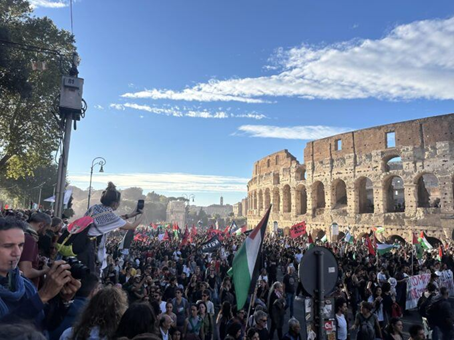
After the general strike on the 22nd of September, the mass uprising for an end to the genocide in Gaza, for an end to the Italian government’s complicity in this genocide, and for a free Palestine has only continued to grow across Italy. As of this writing a large demonstration of thousands has taken to the streets of the northern Italian city of Torino despite an attempted ban on Palestinian solidarity protests on October 7th. A demonstration was also held on October 7th in Bologna where the US sanctioned United Nation’s Special Rapporteur on the occupied Palestinian territories, Francesca Albanese, was just awarded honorary citizenship. This comes on the heels of a week that included spontaneous demonstrations across the country that continued to block ports and transportation services leading to a second general strike on the 3rd of October, this time with the support of the country’s largest 5 million strong labour Union, CGIL.
Friday’s strike saw millions take to the streets all over the country shutting down business as usual for the second time in just 10 days. Led again by the Palestinian community and the Unions from below, students and teachers walked out of schools and transport workers walked off their jobs as ports, trains stations and business activities of all kinds were shut down. The largest labour union reported that 65% of their 5 million workers adhered to the call to strike joining with the masses of students and teachers and common citizens in blocking major highways, train stations and ports for hours from north to south and brining the country to a virtual standstill. It is a mobilization the likes of which Italians say they have not seen for decades. Many are comparing this to the uprisings of 1968 and the massive demonstrations against capitalism, imperialism and the Vietnam war.
On Saturday the 4th a national demonstration was held in Roma that, once again, saw an incredible sea of humanity with more than a million participants from all over the country converging on the eternal city. It was a massive showing of people of all ages and backgrounds – students, workers, grandparents, immigrants, teachers, old school communists and partisans along with the leaders of the major opposition political parties and people from all walks of life. Many participating in these demonstrations are doing so for the first time in their lives and there is education and conversation happening on the streets about colonialism, the differences between antisemitism and antizionism, US imperialism, what defines genocide and more. It’s a populace rising and educating themselves as they rise in a way that is awe inspiring and momentous.
Many that have been on the streets since the beginning of this Genocide 2 years ago have felt waves of emotion and have found themselves crying with a mix of joy and grief, repeatedly, as this surge of humanity continues to grow in the face of the brutality of a genocide that has only been intensifying. The Palestinian communities both in Italy and in occupied Palestine have been given new hope as they witness and see the scenes of this movement from near and far. The decades of sharing of the Palestinian culture and talking about the Palestinian struggle by those in the diaspora here in Italy planted the seeds of this unprecedented resistance that is now spreading across Europe as massive demonstrations are beginning to spread all over the continent and a general strike has been called in Spain for the 15th of October.
While this mass uprising of the people continues to grow it is being met by a defensive contempt and derision from the neo fascist Meloni government that is entrenched in its partnerships with Israel and subservience to Trump’s dictates, just as it was subservient to the genocidal Biden administration before the changing of the Imperial guard. Investigations have exposed that Italy is currently the 3rd largest weapons supplier to Israel in the world behind the United States and Germany and replaced Spain as the largest supplier of the ammonium nitrate used to explode and demolish buildings in Gaza. Spain has placed a progressive arms embargo on weapons to Israel since the beginning of 2024 and refuses to allow arms to be shipped from their ports, while the Italian government continues to collaborate with the zionist regime and has stepped in to replace some of the exports that Spain has halted. Along with ammonium nitrate, detonating cords and tritium are among the materials Italy’s far-right government has been illegally supplying to the genocidal Israeli regime.
While the Italian government’s complicity in this genocide is well documented, they continue to blatantly lie and attempt to deceive the public about their continued collaboration with Israel and are able to do so through a zionist dominated media apparatus in Italy that attempts to deny that the genocide is happening and mystify and obfuscate the well documented international legal framework that has meticulously documented Israel’s genocidal intent and actions. Italy’s own Francesca Albanese is constantly derided and attacked in the media and the zionist controlled Jewish Communities of Italy are systematically spreading propaganda with an effectiveness that would make Goebbels proud. Just as the Bush administrations “you are either with us or against us” line to build support for the “war on terror”, Israel through all its embassies and community based affiliated zionist organizations states: “You are either with us or with Hamas”.
Blatant lies are spread through fake news linking Hamas to anyone opposing the genocide from Francesca Albanese to the Global Sumud Flotilla or anyone that opposes the messianic zionist insanity that defines the Israeli agenda of today. These lies are propagated and enhanced through a web of normalized relations realized through a zionist owned media and high tech cyber security apparatus dominated by Israeli or zionist owned companies that operate throughout Europe and North America, allowing Israel to act with impunity and hold the governments of the western world hostage — keeping them impotent and complicit in the face of the most brutal genocide of modern times. Some of these companies include the Elkann media Group in Italy, Paragon, Hera, Wiz, and Ramot, and Italy collaborates directly with the Israel Innovation Authority to create partnerships in the high-tech economy.
Just this week a case has been brought to the US sanctioned International Criminal Court charging Meloni, the foreign minister, Antonio Tajani, the defence minister, Guido Crosetto, and the head of the public/private defence group Leonardo, Roberto Cingolani, ,with complicity in genocide. This strikes a new path in legal resistance to the zionist project from within Europe and could be used in England and Germany as well.
As Francesca Albanese and noted Israeli historian Ilan Pappè pointed out this week at a forum in Rome, Israel has always acted with complete impunity and in total illegality and disregard for the framework of international law. The ruling of the International Court of Justice that Israel is likely committing genocide and that the occupation of Palestinian territories is illegal required that Israel to withdraw from all illegally occupied territories, including Gaza, and required that member states intervene to take all possible actions to enforce the law and hold Israel to account. As we have witnessed for decades but especially since Israel’s genocidal intent was declared on October 9th 2023, the member states continue to do nothing concretely to stop them other than some nice speeches and in rare cases like Spain and Ireland.
As this international movement for Palestine continues to grow, western European countries are joining with the United States in attempting to criminalize criticism of Israel and zionism and working to codify this repression into law. This is being done in Italy, Germany, the UK and France where criticizing zionism will become a criminal offense. For many the question is what is to be done? And in the face of this complete disregard for international law and rising draconianism throughout the western world as it clings desperately to its enthocentric, white European and colonial identity the only way forward is to continue to resist as long as we exist like our lives and our common humanity depend on it. We can take the leadership of the Palestinians in Gaza that have shown us that their very existence is resistance.
[Michael Leonardi lives in Italy. Courtesy: CounterPunch, an online magazine based in the United States that covers politics in a manner its editors describe as “muckraking with a radical attitude”. It is edited by Jeffrey St. Clair and Joshua Frank.]
❈ ❈ ❈
The Flotilla’s Glimpse into the Palestinian Condition
Rima Najjar
October 3, 2025: The Israeli naval assault on the 2025 Global Sumud Flotilla did more than intercept three civilian ships. It forcibly inserted an international cohort of activists into the physical and juridical machinery that grinds down Palestinian life. This was a deliberate, public demonstration of a system built on capture, forced confessions, and broken bodies, a system enforced by state power and designed to produce coerced silence.
I have used the word “system” throughout this essay. Let this repetition not obscure its meaning. I am describing the juridically encoded apparatus of ethnic cleansing, apartheid, and genocidal violence that constitutes the settler-colonial project of the so-called Jewish state of Israel. These are not rhetorical flourishes — they are legal realities, documented in international law, by human rights organizations, and in the lived archive of Palestinian resistance.
The Act: Piracy in International Waters
The operation began with a foundational act of state piracy. Israeli commandos intercepted the vessels Al Awda, Handala, and Ma’an approximately 70 nautical miles off the coast of Gaza, deep in international waters. They boarded masked and without warning, jamming communications, blocking distress signals, and seizing phones. This concealment was not merely tactical; it reflected a growing fear of accountability, akin to the fear provoked by initiatives like the Hind Rajab project — which archives and publicizes the identities of military personnel linked to alleged crimes to challenge Israel’s regime of impunity. The world would not witness the scene of terror, confusion, and courage that unfolded except perhaps in a future Hollywood production. The evidence was suppressed at the source.
From Seizure to Interrogation
The passengers were then processed through Israel’s detention pipeline. They were transferred to Ashdod Port and then to a network of detention centers — facilities like Ashkelon, Petah Tikva, and the notorious al-Mascobiyya in Jerusalem. These are the same sites where, as documented by Amnesty International and B’Tselem, Palestinian children and adults face torture and psychological abuse. The same interrogation rooms that processed flotilla passengers are the ones used to break Palestinian leaders like parliamentarian Khalida Jarrar, to isolate political figures like Ahmad Saadat, and to extract — through methods the International Committee of the Red Cross has condemned — the coerced confessions used to imprison parliamentarian Marwan Barghouti. This is the same Israeli occupation that daily “processes” Palestinian youth abducted from their beds at dawn. The flotilla activists were on a brutal, accelerated journey through a racist, genocidal system that Palestinians navigate for a lifetime.
Two Forms of State Violence
While the flotilla’s seizure unfolded at sea, its logic echoes across land: Israel’s overt raids and covert infiltrations in Palestine enforce the same architecture of control. Its seizure of the flotilla mobilized two interlocking forms of state violence: maritime interdiction and post-capture detention. These are enforced on Palestinians through the following complementary forms:
Overt Power: The Unmasked Raid
In the West Bank, soldiers conducting nightly raids typically operate openly, unmasked, confident in their absolute immunity. They break doors, blindfold children, and drag them from their homes with arrogant contempt — no warrant, no explanation, no accountability. Their power derives from its sheer, undisguised visibility.
Covert Power: The Deceptive Infiltration
Conversely, the al-Musta’aribeen — Israeli undercover units — operate in plainclothes, often unmasked, infiltrating protests and neighborhoods. Their purpose is not to evade accountability but to execute. They carry out extrajudicial killings of targeted Palestinians, often without warning, trial, or public record. Their power derives from deception, turning Palestinian society itself into an ambush site — as in the killing of Ahmad Jarrar in 2018, executed without trial by undercover operatives, or the shooting of Muhammad al-Kasaji in Jerusalem, closed without investigation.
Unlike the masked commandos, the al-Musta’aribeen do not announce themselves; they mimic, mislead, and kill — weaponizing resemblance to their victims to erase the line between soldier and civilian.
The Hierarchy of Suffering: Passports Versus the Weight of Occupation
The flotilla passengers — including figures like Greta Thunberg, Liam Cunningham, and Ada Colau — carried passports from 42 nations. They were civilians who chose to confront a nuclear-backed state, fortified by the moral clarity of history’s Freedom Riders and anti-apartheid activists. For them, the ordeal was a temporary, harrowing encounter. They had consular visits, media coverage, and exit routes.
Palestinian youth carry only the weight of occupation. Some hold precarious Jerusalemite IDs — revocable at whim, contingent on residency, and denied to their children. Others possess Palestinian Authority passports that hinder rather than facilitate global movement, recognized by few and respected by none. Many in refugee camps across the diaspora carry no identification at all — stateless, invisible, unrecognized. Where the flotilla passengers were processed and released, Palestinians are indexed, surveilled, and contained for life.
Palestinian youth do not arrive by sea; they are abducted from their land. They enter the same interrogation rooms, but without legal protection, without headlines, without an end date.
Their detention is not an international incident; it is routine.
Their names — Ahmad Manasra, Amal Nakhleh, Ahed Tamimi — briefly surface, while thousands more disappear into the system.
Among them:
- Mohammed El-Kurd, detained for his writing and resistance in Sheikh Jarrah.
- Janna Jihad, one of the youngest registered journalists, repeatedly harassed and surveilled.
- Shadi Farah, arrested at age 12 and held for over two years.
- Tareq Zubeidi, tortured and released without charge, his testimony a rare rupture in the silence.
- Malak al-Khatib, imprisoned at age 14 for allegedly throwing stones.
- Obaida Jawabra, shot and killed after multiple detentions, his name now etched into the archive of disappeared futures.
These youth are not anomalies — they are the statistical norm of a system that criminalizes childhood. The flotilla passengers were pirated once; Palestinian youth are subjected to neutralization for a lifetime.
The Factory Floor: Torture as Policy
Inside these rooms, the system’s purpose is laid bare. According to the Palestinian prisoner network, Samidoun, detainees, including children, can be held for up to 75 days without formal charges. Their parents are not told where they are being held and have to involve the Red Cross to find out. Legal counsel is frequently banned for weeks, even during court sessions.
The methods are systematic and documented: sleep deprivation, stress positions, beatings while shackled, and threats against family members. Released detainees have testified to being forced to kneel for hours or sing Israeli songs. The goal is humiliation and the extraction of a confession — any confession — to legitimize the process. This machinery is so entrenched that even the organizations like Addameer and Al Haq that document it are themselves raided and silenced.
Conclusion: The Microcosm and the Macro-System
The violence on the high seas and the violence in the interrogation cell are calibrated by the same logic: that any resistance to Israel’s system of control, whether from a child in Silwan or an activist on the waves, is a system error to be corrected with overwhelming and calculated force by masked commandos or undercover agents or border police or the military.
The flotilla passengers were granted a temporary, harrowing visa into this world. The violence against the flotilla is a live demonstration of the daily reality of life under occupation— calibrated, rehearsed, and deployed. It’s the daily machinery that governs Palestinian life.
[Rima Najjar is a Palestinian whose father’s side of the family comes from the forcibly depopulated village of Lifta on the western outskirts of Jerusalem and whose mother’s side of the family is from Ijzim, south of Haifa. She is an activist, researcher, and retired professor of English literature, Al-Quds University, occupied West Bank. Courtesy: Her blog at https://rimanajjar.medium.com.]