❈ ❈ ❈
Eddelu Karnataka Launches ‘Constitution Protection Force’, Vows to Protect Democracy
Countercurrents Collective
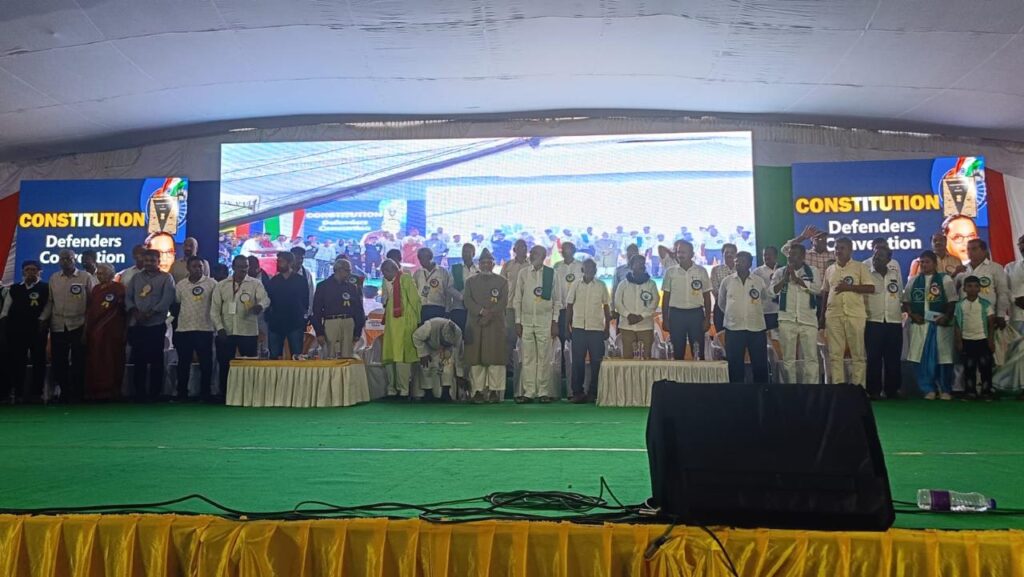
A massive crowd gathered in Davangere on April 26, under the auspices of Eddelu Karnataka (Wake Up Karnataka) and launched a campaign to protect the Constitution. The event marked the launch of a “Constitution Protection Force,” aimed at safeguarding constitutional values across the nation. About 12,000 activists from across Karnataka’s 31 districts showed up to be a part of this crucial event.
Constitution defenders marched with conviction holding multicolored flags reflecting the unity in diversity of our country. The spirit of the freedom movement had seeped in.
Leaders from a broad set of state and national level organisations were present to witness and extend their support to the initiation of this longer term grassroots work to Claim Our Democracy. They underlined the need and possibility of various ideological streams to come together in the present situation and operate in unison. The pandal was an example for it.
The day began with a massive awareness rally through Davanagere’s streets, where hundreds carried banners, placards, and copies of the Constitution’s Preamble. The public response was overwhelming.
At the convention, fiery speeches condemned the erosion of democratic values.
Senior litterateur Nadoja Baraguru Ramachandrappa said, “Those who respect the constitution, who upholds the ideals, who genuinely seek harmony in the society and the country, only they are the real patriots.” Ramachandrappa warned of the growing intellectual decay, poisoned by caste and religious divides, and called for a broader people’s movement to safeguard democracy.
Economists Parakala Prabhakar said, ” a century old enormous force has been trying to destroy our constitution. But today for the first time a strong people’s force is being built with the lofty goal of defending the constitution. It comes as big relief from a big anxiety that has been haunting me for long.”
Senior farmer’s leader Dr Sunilam said people must united holding steadfast to the constitution, the struggle should go on till the goal is reached.
Jignesh Mevani, MLA from Gujarat said, ” I trust those who take to the streets for the cause of farmers, workers, women, youth. We must defeat BJP and RSS in the elections too.”
Noor Sridhar from the Central Working group of Eddelu / Wake up Karnataka placed the concept behind the Constitution defenders force and the future proposal before the convention. Noor Sridhar, a leader of Eddelu Karnataka, criticized both the Union and Karnataka State Governments, accusing them of undermining constitutional principles. “The ruling powers find the Constitution inconvenient and want to break it. We must resist,” he said, also taking Chief Minister Siddaramaiah’s government to task for unfulfilled promises.
Senior activist Maavalli Shankar echoed the concern, noting that even defenders of the Constitution have failed to protect its spirit.
Prof. Saleem Engineer, a senior leader from Jamaat-e-Islami Hind, stressed that the Constitution is the true social contract between India’s citizens and its governance.
Dalit Sangharsh Samiti leader Guruprasad Keragodu called for unity among progressive forces, warning that fragmented struggles cannot succeed.
Speakers condemned attempts by extremist forces to undermine constitutional values, highlighting ongoing social injustices — from manual scavenging to violence against Dalits and women — as proof that constitutional promises remain unfulfilled.
In a landmark move, Eddelu Karnataka announced the formation of a structured “Constitution Protection Force” to operate at district and taluk levels. Training camps, cultural initiatives, and awareness drives are already being planned.
The convention ended with a rousing call to resist authoritarianism, communalism, and casteism — and to place the Constitution at the heart of India’s political, social, and cultural life.
The overall ideas and work plan began to unfold 9 months ago. The active work began 3 months ago, with hundreds of meetings at district and talukas to enroll Defenders of the Constitution. A youth bike rally hit the road from Vadi (Kalyana Karnataka) to Davanagere passing through 22 districts and covering around 3500 kms. A month long massive social media campaign was rolled out. Cultural teams made their own preparations for the event. Ultimately all of this culminated in an inspiring moment to begin a new chapter for Karnataka’s civil society.
As preparation for the meeting, Samvidhan yuva yan, the eleven day youth rally in different districts of Karnataka, was high spirited. It spread the message on democratic rights and the role of youth in social change. It culminated with a bang in the Davangere Convention.
(Courtesy: Countercurrents.org, an India-based news, views and analysis website, that describes itself as non-partisan and taking “the Side of the People!” It is edited by Binu Mathew.)
❈ ❈ ❈
Maharashtra: Sindhudurg to Mumbai, Protests Erupt Against ‘Repressive’ Public Safety Bill
Sabrang India
A day of resolute resistance unfolded across Maharashtra on April 22, 2025, as citizens, civil society organisations, and political parties came together for a coordinated state-wide agitation demanding the immediate withdrawal of the Maharashtra Special Public Security Bill (MSPS), 2024. With over 78 protests held across 36 districts—from remote tehsils to urban collectorates—the message was unambiguous: the people reject what they describe as a draconian and anti-democratic law.
In Sindhudurg, a formal memorandum was submitted to the District Collector by Shri Bhaskar Kasar, representing the coordinated anti-bill movement. Addressed to DM Walawalkar, the memorandum called for the scrapping of the MSPS Act, citing its unconstitutional overreach and misuse of the term ‘public security’ to suppress dissent and target marginalised communities.
In Nanded, members of the Jan Suraksha Vidhayak Virodhi Samiti staged a Satyagraha, sitting in peaceful protest under a banner demanding the immediate withdrawal of the Bill. Community leaders and activists took turns addressing the gathering, warning of the chilling implications of this law for citizens’ rights and democratic discourse.
Symbolic acts of protest also marked the day’s events. In a striking demonstration held in Goregaon (West), protesters staged a dharna to denounce what they called the “insidious intention of the State” in introducing a bill “mischievously titled” as a Jan Suraksha (Public Security) Act. One protester commented that “even canines have understood the threat to democracy,” referencing the presence of a protest dog draped in a sloganed banner—a biting visual critique of the government’s attempt to silence criticism.
At Beed district, part of the Chhatrapati Sambhaji Nagar (Aurangabad) division, a mass sit-in was held outside the Collector’s Office. People’s movements and Left front parties jointly led the action, warning that the Bill aims to usher in an era of “autocratic rule” by robbing citizens of their constitutionally guaranteed freedoms. Placards and speeches throughout the day declared: “Under the guise of Jan Suraksha, they are snatching away our right to speak, to organise, to protest. This is not security—this is suppression.”
In Raigad, parallel protests took place both at the District Collector’s Office and the Tehsildar’s Office in Uran.
While Mumbai’s Bandra Collectorate saw a gathering of progressive groups rallying under the slogan: “Awaken, progressive society of Mumbai! Join the protest against the anti-people Maharashtra Public Security Act on April 22nd at 3 PM in front of the Bandra Collector’s Office. Scrap the Jan Suraksha Act. Inquilab Zindabad!”
In Nanded, the Jan Suraksha Vidhayak Virodhi Samiti held a Satyagraha demanding the scrapping of the Maharashtra Public Security Bill 2024. Protesters gathered under a large tent bearing banners that read “Jan Suraksha Vidhayak Radd Karo”, asserting that the law was aimed at silencing dissent and eroding constitutional freedoms.
Speeches were delivered by Comrade Sanjay Nangare (Shiv Sena UBT), Adv. Avinash Magre (Congress), Dr. Amol Phadke (Congress), and Dattatray Funde (Swabhimani Shetkari Sanghatana), all sharply criticising the Bill’s provisions and the threat they pose to democracy. A memorandum was submitted to Tehsildar Prashant Sangade during the demonstration.
Key attendees included Com. Adv. Subhash Lande (CPI), Bhagwanrao Gaikwad, Babanrao Pawar, Dattatray Are, Vaibhav Shinde, Ram Lande, Vishnu Gore, Balasaheb Mhaske, Ashok Najan, Adv. Afroz Shaikh, Babulal Sayyed, Geeta Thorve, Anjali Bhujbal, Mrs. Sable, and others.
In Thane, members of the Bharat Jodo Abhiyan and the Maharashtra State Workers’ Union (Thane district) staged a protest outside the District Collector’s office, decrying the Maharashtra Public Security Bill 2024 as anti-democratic and anti-worker.
The diverse and decentralised nature of these protests reflects the intensity of opposition to the MSPS Bill across Maharashtra.
Critics of the Bill have raised serious constitutional and legal objections. The Maharashtra Special Public Security Bill, 2024 allows the state to declare any organisation “unlawful” for acting against the “security of the state” or “public order”—terms that remain undefined and dangerously vague. The Bill gives sweeping powers to the police, including warrantless searches and seizures, extended pre-trial detention, and immunity from prosecution. It also empowers the government to seize the property of those accused, even before conviction, and criminalises ‘support’ to unlawful organisations in ways that can encompass mere association, speech, or financial transactions.
Legal experts and rights defenders have warned that the legislation mirrors the most repressive features of central laws like the UAPA and the erstwhile TADA, but with weaker procedural safeguards. It also bypasses judicial scrutiny by allowing the executive to set up “Public Security Councils” to take punitive action. These measures, protestors argue, are not about ensuring safety but about consolidating power and shrinking democratic space.
As the protests continue to gather momentum and testimonies of resistance pour in from across the state, the message is clear: the people of Maharashtra are not willing to cede their rights in the name of a security paradigm that criminalises dissent.
(Courtesy: Sabrang India, an online portal dedicated to fighting the cancer of divisive politics. It is edited by Teesta Setalvad and Javed Anand.)