❈ ❈ ❈
Withdraw VB-G RAM G Bill Forthwith, Says NREGA Sangharsh Morcha
Newsclick Report
The NREGA Sangharsh Morcha (NSM) has demanded the immediate withdrawal of the proposed new avatar of the MGNREG Act or MGNREGA, brought in by the Narendra Modi government — Viksit Bharat – Guarantee For Rozgar And Ajeevika Mission (Gramin) Bill, 2025.
The Morcha, an umbrella of several grassroots organisations, in a statement, said “any attempt to repeal or fundamentally alter MGNREGA without the consent and participation of workers and their organisations is unacceptable.”
It called upon all democratic forces to resist these “unilateral and regressive proposals and to defend NREGA as a cornerstone of livelihood security for millions of rural workers,” as the scheme is being turned into supply-driven rather than demand-driven.
The proposed Bill “represents a fundamental shift from a rights-based law that provides an enforceable entitlement into a budget-constrained scheme without any accountability of the Union Government,” NSM said in a statement, adding that the government is “seeking to dismantle a historic rights-based legislation and reduce the right to work to a discretionary dole.”
It added that the Bill “violates the spirit of the Constitution, undermines the 73rd Constitutional Amendment, and strikes at the core of social and economic justice by shifting power away from workers, Gram Sabhas, and States into the hands of the Union Government.”
The full NSM statement:
The Right to Work Repealed
The NREGA Sangharsh Morcha condemns the proposed Viksit Bharat – Guarantee For Rozgar And Ajeevika Mission (Gramin) Bill, 2025 (VB-G RAM G) that seeks to repeal the Mahatma Gandhi National Rural Employment Guarantee Act, 2005 (MGNREGA). Introduced without any consultation with workers and workers-groups, the bill represents a fundamental shift from a rights-based law that provides an enforceable entitlement into a budget-constrained scheme without any accountability of the Union Government.
● Excessive Discretionary Power for the Centre: MGNREGA establishes a statutory right to work that is demand-driven and universal i.e. any person willing to do unskilled manual work in any rural area must be provided work. But under the VB-G RAM G Bill, Section 5(1) states “the State Government shall, in such rural areas in the State as notified by the Central Government, provide to every household whose adult members volunteer to do unskilled manual work, not less than 125 days of guaranteed employment.” Therefore, if a rural area is not notified by the Centre, there is no right to work for the people of that area, effectively reducing universally guaranteed employment to any other scheme run at the mercy of the Union Government.
● Demand-driven to Supply-based: MGNREGA draws its power from its demand-driven nature i.e., every rural worker must be given work within 15 days, failing which they are entitled to an unemployment allowance. 100% of labour wages are the union government’s prerogative. However, Section 4(5) of the VB-G RAM G Bill states “The Central Government shall determine the State-wise normative allocation for each financial year, based on objective parameters as may be prescribed by the Central Government,” while Section 4(6) further provides that “Any expenditure incurred by a State in excess of its normative allocation shall be borne by the State Government in such manner and by such procedure as may be prescribed by the Central Government.” This enables the Union Government to arbitrarily decide the quantum of funds to be allocated to states which, in turn, will determine how many days of employment can be provided in that state. This completely upends the logic of MGNREGA where funding follows demand to a supply-driven system where demand must conform to a pre-determined budget
● Burdening of States: Under MGNREGA, the Union Government is responsible for 100% labour wages and 75% of the material wages. In practice, this translates to a 90:10 cost share between the Centre and the States. Section 22(2) of the G-RAM-G bill provides that “the fund-sharing pattern between the Central Government and the State Governments shall be 90:10 for the North Eastern States, Himalayan States and Union territory (Uttarakhand, Himachal Pradesh and Jammu and Kashmir) and 60:40 for all other States and Union territories with legislature.” This clause not only puts a massive burden on states, but also disproportionately impacts poorer and high migrant-sending states which are more in need of rural employment. The increased financial burden will lead to states resorting to fiscal conservatives and not registering workers’ demand for work.
● Bottom-up to Top-Down: In accordance with the 73rd Constitutional Amendment, in MGNREGA, the planning of works was done through Gram Sabhas based on local needs. But this provision is overturned by Schedule 1, clause 6(4) of the VB-G RAM G Bill which states that “Viksit Bharat National Rural Infrastructure Stack shall guide States, Districts and Panchayati Raj Institutions in identifying priority infrastructure gaps, standardising work designs, and ensuring that public investments contribute measurably to saturation outcomes at the Gram Panchayat, Block and District levels.” By shifting the planning process from local to a pre-defined centralised priority system of a ‘National Rural Infrastructure Stack’ would subvert the 73rd Constitutional Amendment.
● Technocratic Monitoring and Surveillance: Workers’ organisations have repeatedly highlighted widespread exclusions resulting from the imposition of opaque, arbitrary technologies in MGNREGA like digital attendance (NMMS) and Aadhaar-based payment systems (ABPS). Despite this, the VB-G RAM G Bill seeks to introduce a framework rooted in top-down, technology-driven surveillance by mandating the use of biometric authentication for MGNREGA workers and functionaries as well as the use of geospatial technology and geo-referencing of works. Biometric authentication is fraught with problems, particularly for agricultural and manual labourers, as evidenced by numerous studies and ground reports.
● Year-round Right to work to Blackout Periods: Any rural resident can demand and get work at any time of the year in MGNREGA. Section 6(2) of VB-G RAM G bill states “The State Governments shall notify in advance, a period aggregating to sixty days in a financial year, covering the peak agricultural seasons of sowing and harvesting, during which works under this Act, shall not be undertaken.” Workers, especially women workers, in need and willing to work, will now be legally deprived of work for at least 2 months.
The VB-G RAM G Bill is not a reform but a rollback of democratic and constitutional guarantees won by workers through decades of sustained struggles. By replacing the statutory right under MGNREGA with a centrally-controlled, budget-capped and surveillance-heavy scheme, the Union Government is seeking to dismantle a historic rights-based legislation and reduce the right to work to a discretionary dole. This Bill violates the spirit of the Constitution, undermines the 73rd Constitutional Amendment, and strikes at the core of social and economic justice by shifting power away from workers, Gram Sabhas, and States into the hands of the Union Government.
The NREGA Sangharsh Morcha unequivocally rejects the VB-G RAM G Bill, 2025, and demands its immediate withdrawal. Any attempt to repeal or fundamentally alter MGNREGA without the consent and participation of workers and their organisations is unacceptable. We call upon all democratic forces to resist these unilateral and regressive proposals and to defend NREGA as a cornerstone of livelihood security for millions of rural workers.
[Courtesy: Newsclick, an Indian news website founded by Prabir Purkayastha in 2009, who also serves as the Editor-in-Chief.]
❈ ❈ ❈
End of MGNREGA Will Deepen Poverty
Shirin Akhter
The debate around renaming MGNREGA (the national rural employment guarantee Act) is the debate around the idea that the Indian State owes its rural working poor a right to work, a protection against hunger, and a minimum floor of dignity when the labour market offers only insecurity. MGNREGA mattered because it was not framed as charity. It was framed as a legal entitlement. It turned “poverty relief” into a claim that could be placed before the State. For a rural household living on the edge of subsistence, that difference is not philosophical; it is material. It shapes whether the worker is compelled to accept whatever wage a contractor dictates, whether a woman has any option beyond coercive farm labour, whether a family can buy medicines when illness arrives, whether a child stays in school or is pulled into work.
End of MGNREGA
Let us begin with the simplest fact of our political economy; India remains a country where mass vulnerability is normalised. If around 80 crore people still depend on the Public Distribution System (PDS) for basic food security, it is an admission that wages, livelihoods, and employment stability have not kept pace with the rhetoric of growth. PDS prevents starvation, but it does not pay for vegetables, cooking fuel, medicines, transport, rent, school fees, notebooks, data packs, or the interest on accumulated debt. Food transfers can keep a household alive; they cannot keep it secure.
This is exactly where MGNREGA historically functioned as a critical bridge. The scheme did not make people prosperous. It protected them from sliding into destitution. That protection becomes even clearer when one recalls the scale: about 12.5 crore workers are enrolled under MGNREGA. This is not a small beneficiary base. It is a vast segment of working India, landless labourers, marginal farmers, women balancing paid work with unpaid care, Dalits and adivasis historically locked out of secure employment, elderly workers with failing bodies but no pension, migrants who return when urban work collapses, households that are one illness away from hunger.
When the job guarantee is weakened or replaced by a framework that no longer guarantees work on demand, the consequence is not simply “less employment”. The consequence is more poverty; deeper, harsher, and more coercive.
First Structural Shift: From Right on Demand to Allocation on Permission
MGNREGA’s core promise was demand-driven employment: the household could demand work as a matter of right. It was not supposed to be contingent upon whether the State happened to “open work” in that region at that time, or whether budgetary headroom existed in the moment.
What is being proposed now, in substance, is a reversal, employment becomes dependent on centrally determined allocations, administrative notifications, and fiscal ceilings. Now demand has to fit the budget envelope, now work exists only if it is “sanctioned” within an annual cap and now the right to work turns into a rationed programme. It becomes a benefit one may or may not receive, rather than a claim one can insist upon.
The Second Shift: Unequal Citizenship
Another deeply troubling movement is toward geographically selective coverage through notified rural areas. The moment a programme becomes notification-based, it becomes politically and administratively discretionary. Some regions will remain covered, others will be partially covered, and some may be excluded through procedural convenience. A job guarantee that is not universal is not a guarantee. It becomes, a targeted scheme, vulnerable to:
- uneven state capacity,
- political favouritism,
- bureaucratic delay,
- and the gradual shrinking of coverage without legislative confrontation.
The poorest and most marginal regions are often the ones with the least administrative capacity and the weakest political leverage. They are also the regions that need the guarantee the most, and they are the ones that will be excluded most often.
The Third Shift: Unequal Implementation
When cost-sharing is altered in a way that increases State burden, the practical consequence is predictable, states with weaker revenues and greater distress will be forced to ration work, delay payments, or quietly reduce employment guarantee. This creates a cruel geography of protection: the states with the greatest need will be least able to fund the scheme robustly.
In a country like India, the labour market is not a level field. Fiscal federalism is not neutral. When the Centre withdraws responsibility and asks states to carry a larger load, it is not cooperative federalism, it is outsourcing poverty to the weakest institutions.
The Fourth Shift: ‘Mission-Mode Development’
MGNREGA was meant to secure livelihoods through locally relevant, labour-intensive work, rooted in local priorities. Reframing the programme as a development mission, emphasising “asset creation”, “convergence”, “infrastructure outcomes”, “targets”, changes the moral centre of the programme.
The problem is not that assets are unimportant. The problem is that when the logic becomes mission-mode, the worker’s need for employment ceases to be the organising principle. The State begins to prioritise what is auditable, visible, and centrally legible over what is locally necessary and livelihood-protecting.
In mission-mode governance, the programme’s success is measured by dashboards, photographs, geo-tags, and completion certificates, while the worker’s most basic questions of work and wages remain unanswered.
The Fifth Shift: Exclusion by Design
Digital systems are presented as instruments of transparency, while in practice, they frequently become instruments of denial. Mandatory biometric attendance, Aadhaar-linked payments, app-based monitoring, and increasing dependence on digital compliance can convert the right to work into a fight to get authenticated.
Most poor households do not have access to stable digital infrastructures. Connectivity fails. Biometrics fail. Linking errors happen. Mapping errors persist. Women often do not control phones. Elderly workers have worn fingerprints. Migrant households face documentation mismatches. The poorest are the least able to navigate grievance redressal.
When wages are delayed, it is not just a line-item in an audit report. It is an empty kitchen. When a payment is denied due to a technical mismatch, it is not “efficiency”; it is hunger, debt, humiliation. When the scheme becomes technology-gated, exclusion becomes structural and poverty deepens quietly.
Most Economically Revealing Change: 60-Day “No Work” and Wage Suppression
The mandatory 60 days of no work during peak agricultural seasons is perhaps the clearest signal of what is being redesigned. It should be analysed not only as an administrative clause but as a direct intervention in rural wage formation.
MGNREGA historically operated as a competing employer. Its presence in the rural labour market strengthened workers’ bargaining power and set a minimum outside option. Even when MGNREGA wages were modest, the existence of an alternative mattered. It meant a worker could refuse the most exploitative terms, or at least negotiate.
When the State legally suspends public employment during the period when agricultural labour demand peaks, the rural workers lose the bargaining power that would have arisen due to high demand. Workers are pushed back into the agricultural labour market in larger numbers, expanding labour supply at the critical moment. This moderates peak-season wage increases and restores employer dominance.
Thus, the clause functions as a wage-disciplining tool. It does not merely “avoid labour shortages”, it ensures that labour remains available to private employers on terms shaped by employer power, not worker choice.
Who Bears the Wage Shock?
Landless labourers bear the shock immediately, they have fewer options, lower bargaining power, and higher pressure to accept whatever wage is offered.
Women workers bear it even more harshly: MGNREGA has been one of the few work options that is relatively local and predictable, and somewhat compatible with care responsibilities. Peak-season agricultural work is often more coercive, mediated by contractors, with longer hours, delayed payments, and intensified labour. When public employment is withdrawn, women are either pushed into more exploitative farm work or pushed out of paid work altogether, deepening the discouraged-worker effect and reinforcing gendered dependency.
The clause also risks producing a vicious cycle. Once peak season ends, labour demand drops. Workers then face an even more slack labour market. Unless public employment restarts smoothly and in sufficient volume, rural wages face downward pressure even after harvest. In many parts of India, cropping patterns are staggered and regional peaks vary; rigid “no work” blocks can create arbitrary periods of income collapse.
Wage Compression and Poverty
This rural wage suppression should not be read in isolation. It is part of a wider political economy that is compressing wages from both ends.
Public-sector wage ladders that once offered stability and dignity to skilled and semi-skilled workers have been weakened through contractualisation, rationalisation, and an ideology that treats wage growth as a fiscal burden rather than an investment in social stability. Skilled workers experience stagnation despite qualifications, while job security is eroded and employment becomes precarious.
Dismantling MGNREGA’s effective guarantee erodes the wage floor for unskilled and casual labour. It removes a crucial outside option, suppresses agricultural wages through seasonal shutdowns, and deepens dependency on informal, coercive labour markets.
What emerges is a labour market squeezed from both ends:
- skilled workers face stagnation and insecurity despite education and experience,
- unskilled workers lose the last institutional buffer that prevented wages from collapsing altogether.
This is not accidental drift. It is a coherent policy orientation. When MGNREGA ends as a real guarantee and survives only as a rationed, notified, technology-gated programme, poverty will rise, even if PDS continues.
Poverty is not only hunger. Poverty is the inability to withstand shocks. It is debt. It is untreated illness. It is kids withdrawn from school. It is malnutrition masked by cereal consumption. It is families selling assets, migrating under coercion, and accepting humiliating work terms because there is no fallback.
MGNREGA wages often fund what PDS cannot, healthcare costs (especially catastrophic out-of-pocket spending), transport to hospitals and schools, essential non-cereal nutrition (milk, eggs, vegetables), educational expenses, repayment of informal debt, basic dignity expenses that keep households functioning.
Remove that income support and households slide into deeper vulnerability. And once households fall, the fall is not smooth. It is steep. The first shock triggers the second, debt leads to distress migration; migration leads to family fragmentation; fragmentation leads to school discontinuation; discontinuation leads to generational reproduction of poverty.
The Hardest Hit
The vulnerable and minor sections will be hit hardest not because they are inherently vulnerable, but because the economy and society have made them so through landlessness, discrimination, exclusion from stable jobs, and weaker access to state power.
- Dalit and adivasi households: more likely to be land-poor or landless, more likely to face labour market discrimination, more dependent on public employment as a protective floor.
- Women-headed households: more fragile income structures, heavier care burdens, fewer bargaining resources.
- Elderly and disabled workers: limited ability to migrate, greater reliance on local work options.
- Muslim artisans and rural workers in communally polarised regions: often constrained in labour markets by discrimination and insecurity, making State-backed work options even more crucial.
- Migrant workers: the first to lose urban income during downturns, the first to return to villages, and among the most dependent on a functioning job guarantee when the city collapses.
In each case, the loss of a guarantee does not simply reduce income. It increases coercion. It increases dependency. It strengthens the informal power of contractors and local elites. It turns the worker’s body into the last remaining asset.
The Policy Reversal
This is why renaming matters. It is not a sentimental attachment to a title. It is the cultural face of a deeper institutional retreat, away from rights, away from decentralised social protection, away from labour dignity.
When a State withdraws from being an employer of last resort while 80 crore people remain dependent on food support, it is not moving toward Viksit Bharat. It is moving toward a model where survival is stabilised at the level of ration grain while wages are disciplined, employment is made uncertain, and poverty is managed rather than confronted.
In policy debates, the worker is often reduced to a statistic — 12.5 crore enrolled, so many person days generated, so many assets created. But the lived truth is quieter and harsher. For millions of households, MGNREGA is the difference between negotiating with the labour market and being crushed by it. It is the difference between paying for medicine and postponing treatment. Between keeping a child in school and pulling them into work. Between eating only grain and eating something resembling a meal.
Ending MGNREGA as a genuine guarantee will not create better jobs. It will push people into deeper poverty, greater debt, and more coercive labour relations. And the hardest hit will be those who have always borne the weight of India’s inequality: the landless, the marginalised, the minorities, and women whose labour is extracted both inside and outside the home.
[Shirin Akhter is Associate Professor at Zakir Husain Delhi College, University of Delhi. Courtesy: Newsclick, an Indian news website founded by Prabir Purkayastha in 2009, who also serves as the Editor-in-Chief.]
❈ ❈ ❈
Low Funds, Pending Dues, No Work: How Govt Crippled MGNREGA Before Renaming It
Aakriti Handa
Two days after the Narendra Modi-led government introduced the Viksit Bharat- Guarantee for Rozgar and Ajeevika Mission (Gramin) or the G RAM G Bill, 2025, it was passed in the Lok Sabha on Thursday, 18 December as the Opposition staged a walkout. The G RAM G Bill proposes to replace the Mahatma Gandhi National Rural Employment Guarantee Act (MGNREGA), which provides a livelihood source to millions of rural Indians.
The proposal drew sharp criticism from the Congress, whose UPA government had enacted the Bill two decades ago under the leadership of then prime minister Dr Manmohan Singh. MGNREGA was enacted to provide a legal guarantee of salaried employment to rural households so that they can be active participants in creating rural infrastructure instead of passive dole recipients.
Moments after it was passed, Congress MP Priyanka Gandhi told media persons that the G RAM G Bill will be the “death of MGNREGA.” Earlier, she questioned the intention behind removing Mahatma Gandhi’s name, while the party’s general secretary KC Venugopal labelled it a “cosmetic exercise to paper over the deliberate neglect being meted out to this scheme.” Venugopal pointed out that MGNREGA workers have been demanding higher wages even as arrears remain unpaid.
Apart from the nomenclature, the Modi government has proposed other changes, including increasing the number of mandated workdays from 100 to 125. However, official data shows that the government couldn’t provide more than 50 days of employment under the scheme in 2024-25; and that the average wages earned by the workers was Rs 250 per day.
This story examines the gaps in the implementation of MGNREGA to see if a rebranding exercise can solve the problem of high rural unemployment in the country.
Insufficient Budget Allocation for MGNREGA
The mandate of MGNREGA is to provide at least 100 days of unskilled manual work in a year as guaranteed employment to every household in rural areas as per demand. This employment should result in the creation of productive assets of prescribed quality and durability. Other than strengthening the livelihood resources of the poor, the core objective of the Act is to ensure social inclusion.
As per the Act, the Central government bears the cost of wages, material and administrative expenses, with a small contribution from some states. Every year, the allocation to MGNREGA is declared in the Union Budget, and the Centre releases funds to states based on demand projections. If the demand for work is higher than the Budget allocation, the Centre may release additional funds during the year.
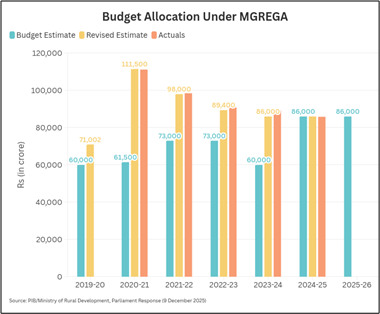
Data from the Ministry of Rural Development shows that the Centre has had to revise the budget estimates mid-year to cope with the high demand of work. In other words, the allocation of funds to the scheme has been lower than the actual requirement.
Made with Flourish • Create a chart
The spike in demand in the years 2020-21 and 2021-22 may be attributed to the reverse migration during the Covid-19 pandemic—when migrant workers returned en masse to their native villages and depended on livelihood opportunities there till the nation-wide lockdown lifted.
Modi Govt Proposes 125 Workdays; Provides Only 50
However, despite the high demand and funds released in those years, the average number of days for which employment was provided hovered around 50 days, or half the mandate.
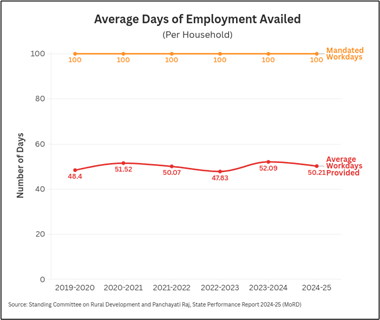
The new bill proposes to increase the number of guaranteed employment days to 125—a welcome step that would mean nothing when the Modi government has consistently been falling short on the 100-workdays mandate.
According to a Parliament response, there were 8.6 crore active (who have worked in the last three financial years) jobseekers under MGNREGA as of 4 December. The same response shows that the programme generated 163.29 crore person days in 2025-26.
Simple math indicates that each active worker got an average of 19 days of employment this year.
Persondays are calculated by multiplying the total number of workers with the number of days each person worked. Now, data from a Parliament Response shows that the number of workers provided employment under MGNREGA have decreased over the years:
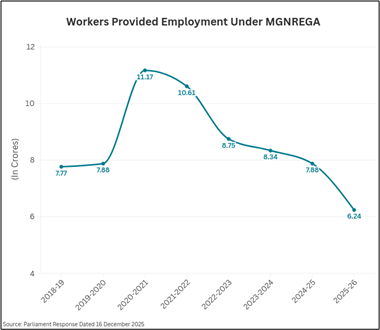
Does this mean that fewer workers are working for a greater number of days? Unfortunately, no (since the average number of days each person worked remains around 50 days).
Data shows that the number of persondays has also fallen over the last six years.
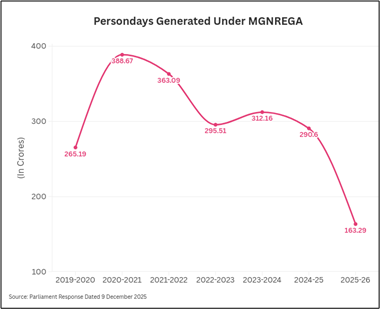
Fewer workers, fewer workdays per worker, and fewer persondays generated, all point to one thing— the overall employment generated under the scheme has declined.
1.4% Households Under MGREGA Completed 100 Days of Work
More than 27 crore rural workers (in over 16 crore households) were registered under MGNREGA as on 16 December, i.e. nearly 18.5 percent of India’s population.
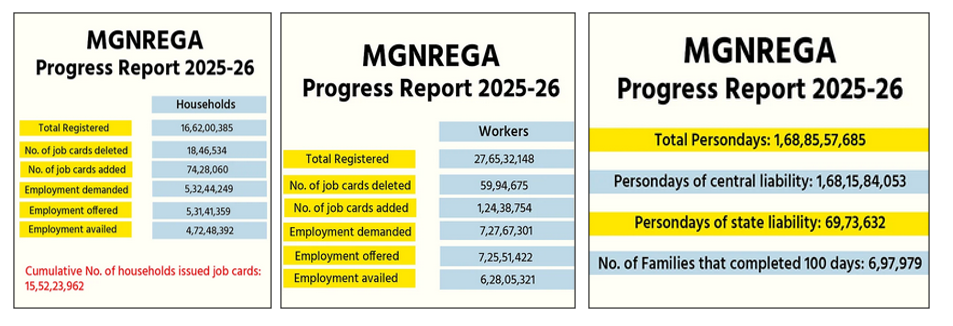
The data also states that 6.97 lakh families—or 1.4 percent of the households that availed employment under MGREGA—completed 100 days of work.
Another interesting data point is the ratio of persondays generated using central vs state funds. The latest progress report shows that 99.5 percent of the persondays are created using funds from the Centre.
The Modi government has now proposed that this ratio be modified to a 60:40 arrangement, where the Centre bears 60 percent of the total cost and respective state governments are responsible for the remaining 40 percent cost.
This, Priyanka Gandhi claimed, will lead to “the end of MGNREGA in the coming months.” She told media persons, “Shifting the financial burden to states will slowly dismantle the scheme. Most states—especially those that need MGNREGA the most—simply do not have the resources. MGNREGA has been a lifeline for the poorest Indians, including during the Covid-19 pandemic. We will strongly oppose this Bill.”
MGNREGA Workers Paid Less Than Notified Wage Rate
Again, official data from the rural development ministry’s website shows that of the 12.15 crore rural workers registered in 2025-26, bank and post office accounts were opened for 11.87 crore workers, leaving over 27.2 lakh registered workers without any accounts. It also shows that the central government disbursed Rs 45,499 crore in wages to these workers—which implies the average wage earned by the worker for 2025-26 was Rs 3,800.
This brings us to the issue of wages.
Official data shows that the average wage paid for the years 2025-26 is Rs 271 per day. Besides, the average wage paid is less than the notified wage rate in almost all states barring a few states in Northeast which have parity.
A report, tabled by the Standing Committee on Rural Development and Panchayati Raj in Parliament in December last year, raised the issue of MGNREGA wages rates being “inadequate and not in consonance with the rising cost of living” and attributed it to workers opting out of MGNREGA.
Official data for the year 2025-26 from MGREGA’s website shows that nearly one crore (99,61,980) workers who demanded work could not avail it.
“Workers are often discouraged by the nominal nature of the wages, sometimes coupled with delayed payment, which propels them to migrate and seek work in areas giving better remuneration,” the Standing Committee stated. It recommended revising the base year and base rate to bring in an appreciable hike in the wages so that they are not less than the notified minimum wages.
Dues Worth Rs 9,440 Crore Pending on Centre
According to a Parliament response, the Centre owes states pending wages amounting to Rs 1,286 crore and material costs amounting to Rs 8,153 crore as of 3 December 2025. This number does not include pending dues for West Bengal as release of funds to the state was stopped in March 2022 because of non-compliance.
The response states that as of 8 March 2022, the pending liability pertaining to West Bengal stood at Rs 3,082 crore—Rs 1,457 in wages; Rs 1,607 crore in material costs; and Rs 17.62 crore in administrative expenses.
In another response, the government stated that as of 3 December it has released an amount of Rs 69,972.95 crore to various states/Union Territories, which includes Rs 58,990 crore for wage component and an amount of Rs 10,982.80 crore for material and admin components. In addition, it stated that all due and admissible pending wage liabilities up to FY 2024-25 have already been cleared (except West Bengal).
[Aakriti has been a journalist for over nine years and is based out of Delhi. She writes on livelihood, civic issues, labour, gig economy, higher education and caste, among other things. She specialises in data stories and is involved with Google News Initiative Data Lab programme. Courtesy: The Quint, an Indian digital news and views platform.]
❈ ❈ ❈
In another article published in The Wire, The Aadhaar e-KYC Has Led to the Silent Shrinking of India’s Rural Workforce, Chakradhar Buddha and Venkateswarlu Kuruva write (extract):
Union rural development minister Shivraj Singh Chouhan informed the Lok Sabha on Tuesday (December 9) that 4.57 crore MGNREGS job cards were deleted across the country between 2019–20 and 2024–25, even as 6.54 crore new job cards were added in the same period.
A deletion wave like no other
In just one month, over 27 lakh workers disappeared from India’s Mahatma Gandhi National Rural Employment Guarantee Act (MGNREGA) rolls. This is one of the sharpest contractions in the programme’s history – not due to falling demand or budget cuts, but because of a compressed and inflexible digital mandate.
The Ministry of Rural Development (MoRD) made Aadhaar-based e-KYC mandatory for all workers from November 1, 2025. Each worker had to register on the National Mobile Monitoring System (NMMS) attendance app, which captures a live photo and matches it with their Aadhaar image. In effect, nearly 27.6 crore registered workers were told to complete this process immediately.
MoRD has described e-KYC as “simple, reliable, accurate and efficient” – a one-minute task meant to reduce duplication and ensure that “genuine workers” continue receiving wage employment “without disruption”.
But what unfolded on the ground was very different.
MoRD’s own circulars show how sharply the timeline was compressed. On September 10, states were informed that e-KYC was now mandatory for job-card renewal. A second circular on September 26 extended the mandate to all workers, instructing states to begin registration immediately.
Let us look at the timelines for Aadhar based e-KYC in MGNREGA.
September 2025
A pilot for Aadhaar-based e-KYC begins in all the states of the country.
October 2025
Registration takes place across the country. Workers must complete face authentication by October 31.
A 31-day window
From October 1-31, the entire rural workforce effectively had just 31 days to comply.
From November 1
NMMS attendance becomes accessible only to workers who completed e-KYC. Those without e-KYC are automatically locked out of work.
This meant millions of workers had to perform digital face authentication during peak migration season, in regions with weak connectivity, using an app notorious for authentication failures.
Exclusions were immediate and widespread.
In response to a report on The Hindu highlighting the deletions, the MoRD issued a public statement on November 21 describing e-KYC as merely “facilitative.” However, the ministry’s own September circulars had clearly made e-KYC mandatory and directly linked it to marking attendance.
Not the first instance
A deletion wave of this magnitude has only one precedent: the 2022-23 Aadhaar-Based Payment System (ABPS) transition, when crores of workers were removed without due process.
Deletions rose 247% that year compared to the previous year.
The pattern is identical:
- a new Aadhaar-linked condition
- a tight deadline
- a deletion spike
The timing is too precise to be dismissed as coincidence. A detailed analysis of how the ABPS-linked deletions unfolded is available in an earlier article published in The Wire.
The scale of exclusion
Of 27.6 crore registered workers:
- 10.6 crore completed e-KYC
- 17 crore did not
Among 12.1 crore active workers:
- 7.3 crore completed e-KYC
- Nearly 40% risk exclusion
The sheer scale of non-completion shows the barrier was structural, not personal.
Between October 10-November 12, 27 lakh workers were deleted across India. States with the highest e-KYC completion – Andhra Pradesh, Karnataka, and Telangana – saw the highest deletions, while states with lower completion, like Maharashtra, recorded fewer deletions.
States with the highest e-KYC completion also saw the highest deletions because completion and deletion moved in tandem as compliance tools. In these states, frontline officials faced the strongest pressure to finish e-KYC within the 31-day window, and deletion became the quickest way to reduce pending cases and raise completion percentages. States that moved more slowly, like Maharashtra, showed lower deletions simply because they were not racing to demonstrate full compliance.
Although there are exceptions to this pattern, the overall alignment suggests that deletions functioned as an administrative tool to raise compliance figures rather than as a genuine clean-up of records.
The NMMS has quietly evolved from a photo-uploading app into a system that decides who can be marked present. When e-KYC is pending, attendance cannot be taken.
This means access to work hinges less on being physically present at the worksite and more on passing repeated digital checks – often impossible for workers in low-connectivity regions, or with outdated Aadhaar photos.
This shift has tightened the link between failed authentication and exclusion.
How the deletions actually happened
To understand the 2025 deletions, one must revisit the 2022-23 ABPS transition. Frontline officials faced complex Aadhaar compliance requirements and heavy pressure to show rapid progress.
Many chose the easiest option: Delete workers with unresolved Aadhaar issues as every deletion instantly raised the district’s compliance percentage.
The same pattern appears in 2025, but under even greater pressure. In 2022-23, officials had nearly a full year to meet ABPS targets. In 2025, they had just one month to complete e-KYC for the entire active workforce.
Under these conditions, frontline officials once again resorted to the mechanism that works fastest in MIS dashboards: Delete the workers who cannot complete e-KYC in time.
Deletion became an administrative shortcut instead of a verification tool. These shortcuts were supposed to become impossible after the 2025 standard operating procedure (SOP) introduced formal safeguards against arbitrary deletions.
Why the SOP failed
The January 2025 SOP was created only after sustained CSO pressure, since the deletion process had never been clearly articulated or aligned with MIS workflows, leading to arbitrary and opaque removals in 2022–23 and 2023–24. Despite these safeguards, the same pattern has returned during the e-KYC rollout.
MoRD’s SOP on job card deletion mandates:
- a draft deletion list published 30 days in advance
- individual notices
- an objection window
- Gram Sabha scrutiny
- settlement of pending liabilities
- a 90-day appeal period
This is a 45-60 day-long process at the minimum. None of this is compatible with a 30-day e-KYC timeline, especially when NMMS attendance is blocked immediately for workers whose e-KYC is incomplete.
The SOP was effectively impossible to follow, and its safeguards collapsed.
SOP Violations and MoRD’s Silence
For the first six months of 2025-26, additions outnumbered deletions – indicating that the January SOP was functioning as intended. According to LibTech India’s national tracker on MGNREGA, while 11.2 lakh workers were deleted between April and September 2025, nearly 90 lakh workers were added to the rolls. The net increase during this period was 78.8 lakh workers.
But once the e-KYC drive began, deletions surged and the protection offered by the SOP effectively disappeared.
As The Wire has previously reported, the Union government has said that the responsibility for deletions lies with state governments. The ministry has also reiterated that “job card updation is routine.” The same explanation has now been extended to the e-KYC–linked deletions as well.
But routine updating cannot explain lakhs of deletions that align so closely with new digital mandates. The silence around these spikes suggests an administrative acceptance – even expectation – of deletion-driven compliance.
The MGNREGS used to be a statutory guarantee — not a conditional privilege. Yet, the Aadhaar e-KYC rollout triggered one of the most exclusionary episodes in the programme’s history.
This is not a routine update. It reflects a system where administrative compliance has overtaken legal rights. If India’s digital systems are to support such a scheme, they must be rooted in field realities, due process, and the constitutional promise of dignity and inclusion – not in authentication failures and deletion-driven compliance. Otherwise, technology will continue to quietly shrink India’s rural workforce, undermining the very guarantee the law was created to uphold.
[Venkateswarlu Kuruva and Chakradhar Buddha are affiliated to LibTech India, a centre in CORD. Courtesy: The Wire, an Indian nonprofit news and opinion website. It was founded in 2015 by Siddharth Varadarajan, Sidharth Bhatia and M. K. Venu.]