India’s GDP growth in the second quarter of 2025-26 (8.2 per cent) was greeted with the familiar ritual of celebration. A Bloomberg columnist described it as “growth that the world envies.” It did not matter that, nearly simultaneously, tucked away as Appendix VII of its Article IV report (the annual health check) for India, the International Monetary Fund gave India’s GDP estimation process a C grade. Translation: Indian GDP is poorly measured. Yet, the IMF—without a hint of irony and with no reference to its own data critique—stipulates in the main body of the report: “Real GDP growth has remained robust following a strong post-pandemic recovery.”
We have a problem, one that is systemic and corrosive. This is no longer just about GDP; it is about an India dominated by elite power, reinforced by resurgent nationalism and a media that has subordinated itself to an assertive official vision of the country. Global elites have their own geopolitical reasons for applauding the Indian narrative.
All of India’s macroeconomic data—GDP, employment, and prices—are seriously flawed. India scores a C in all categories the IMF covers, except trade data, which are difficult to fudge or spin. Curated use of flawed data feeds a seductive storyline: India, soon a developed nation; a superpower, perhaps.
Even these flawed data, read carefully, reveal a consistently sobering reality. The GDP data bear a clear signature of the breathtaking lifestyles of India’s rich—driving a surge of import-intensive consumption. The flip side is weak consumption of mass consumer goods, echoed in waning domestic investment. The reason for this suppressed demand is also clear: much-publicised low unemployment rates and understated inflation conceal the scarcity of dignified jobs and the daily struggles of ordinary people. Meanwhile, the narrative of a glorious India flatters elite vanity while leaving both the economy and democracy exposed to peril.
In the US, too, elite power has increasingly captured economic discourse. The historian Heather Cox Richardson asked the economist Paul Krugman how one corrects the record. “We must keep chipping away at the coalface,” Krugman replied. This essay is another attempt to do precisely that—chip away at the great India story. In what follows, I show how GDP measurement, misleading unemployment statistics, and understated inflation work together to flatter those at the top while obscuring mass economic distress.
Through the GDP mirror
The economist Arun Kumar has given a master class on all that is wrong with Indian GDP measurement. First, even if the data were correctly gathered, the national income (value-added or the difference between production and inputs used) is mismeasured for no good reason. To correct for inflation, a producer price index must deflate the total value of production and a proxy for input prices should deflate the value of inputs. Instead, Indian authorities deflate both with wholesale prices, which arguably are irrelevant to both production and inputs.
The more serious, indeed crippling, problem is that India does not gather data on the vast non-agricultural unorganised sector, about 30 per cent of the economy. Instead, the unorganised sector’s output is measured using a series of “faux proxies”, mainly the performance of the organised corporate sector. But, as Kumar emphasises, the unorganised sector’s performance is poorly correlated with that of Indian corporates, especially (but not only) in times of distress.
For example, around the time of demonetisation and COVID, the unorganised sector collapsed all too evidently but the income data barely reflected that. The problem persists today because the US tariffs have hurt the unorganised especially grievously. If, Kumar says, the non-agricultural unorganised output is exaggerated in such periods by 10-12 per cent, the last decade’s average growth would crumble to 2.5-3 per cent per year.
Even without delving deep into the data-gathering, a persistent inconsistency in published data becomes more acute whenever an eye-poppingly high growth rate is reported. I first noted this inconsistency in September 2023, about when the G20 guests were arriving in a cosmetically spruced-up New Delhi. The statistical principle is simple: the income generated in the economy must equal the expenditure on the goods produced. Instead, while the reported income growth on the eve of the G20 meeting was an impressive 7.8 per cent, the growth in expenditure was only 1.4 per cent. In statistical systems around the world, a small discrepancy exists between income and expenditure. Only India seems to have such huge discrepancies that materially influence the economy’s growth rate.
Since then, I have been looking at the discrepancies when growth rates are too high to be plausible. And that instinct has never failed me. Consider the latest data, which shows 8 per cent growth in the first half of 2025-26 (7.8 per cent in the first quarter and 8.2 per cent in the second). As is the Indian convention, this is the estimated income growth. But in the same period, expenditure grew by only 5 per cent. The reporting convention matters: in the US, growth would be reported as 5 per cent—and there would be an uproar over the discrepancy.
Because large discrepancies favouring income cumulate, the average Indian growth rate over time is also overstated. We have a black hole. What lies there? Who knows.
One thing we do know is that, at home or abroad, buyers have slowed down their purchases of Indian goods. Exports of goods other than petroleum products have struggled in recent years. And domestic consumption of Indian products has been weak. For this reason, the latest data present an interesting puzzle. The reported consumption growth is high: 7.5 per cent. The puzzle leads to a telling resolution.
Indians who can afford to spend—and are powering consumption growth—are increasingly buying import-intensive goods! Imports grew in the same period by 11.8 per cent. An array of striking examples helps illustrate the surge in imports:
Reuters reported earlier this year: “Lamborghini and Mercedes-Maybach plan to expand in India as a growing tribe of young, rich Indians splurge on super luxury cars, driving their sales to record levels.” While sales of two-wheelers and non-SUV passenger cars have stagnated or barely increased, sales of SUVs, especially premium models, have boomed. And the higher up in the premiumisation ladder, the higher the import content (arising from electronics and advanced transmission systems). About 15-20 per cent of a compact SUV’s value is imported; for fancier cars, the imported share rises to half or significantly more.
The same story repeats for consumer goods. Sales of staples such as biscuits, soaps, and shampoos have been growing slowly, if at all. Mid-tier and high-premium products are selling faster—and the more premium the product, the higher its import content (reflecting higher-end ingredients). This is especially visible in high-growth premium and niche categories: imported chocolates such as Ferrero Rocher and Lindt; specialty foods such as organic oats (e.g., Bob’s Red Mill); avocados; international skincare brands like The Body Shop and L’Occitane; gourmet cheeses, premium olive oils, and astronomically priced weight-loss drugs (Eli Lilly’s Mounjaro and Novo Nordisk’s Wegovy). These products are illustrative rather than exhaustive, but they capture the broader pattern: buoyant consumption at the top has become a status statement increasingly decoupled from domestic manufacturing.
The toxic air is causing another divide. The demand for air-quality monitors and purifiers is driven by affluent urban households that buy premium global brands with high import content, such as Dyson, IQAir, Blueair, Coway, and Philips—rather than basic domestic models. Some even live in bespoke “air bubbles,” creating an “air of exclusivity” that relies on imported advanced sensors, activated carbon, or electronics.
Out for lunch at a South Delhi mall with a senior policymaker, I asked who bought the $400 Adidas shoes and Swiss watches on display. He shrugged and said that he, too, would like to know.
Policy is bolstering these trends. In the recent trade agreement with the UK, India granted tariff exemption to luxury cars and premium whiskeys. A proposed trade agreement with the European Free Trade Association will lower tariffs on Swiss watches.
From this illustrative list, a simple macroeconomic bottom line emerges. As rich Indians assert their privilege through distinctive consumption, they, in effect, demand specialised inputs. These inputs account for a large fraction of the product’s price even when the product’s final assembly is in India. Import intensity remains high because each luxury product is produced in quantities too small to justify domestic manufacturing of sophisticated electronics and material inputs—these are made in gigantic factories abroad, at scales that India cannot match.
The macroeconomic effect stems from the fact that the very rich command such a large share of income—the top 10 per cent earn nearly three-fifths and own two-thirds of the wealth—so their voracious but import-heavy consumption generates limited domestic income and wealth.
Persistent inequalities have extended the enclave logic to consumption patterns. For years, rich Indians have lived in gated communities, sent their children abroad to study, vacationed in exotic international locales, and shopped in Singapore, Dubai, Milan, and Zurich. Now, from air-bubbles at home, they step into cars with air-quality monitors, and from there into climate-controlled workplaces—while hundreds of millions breathe air that shortens their lives. The Lamborghinis and weight-loss products of the rich are almost entirely imported in content. India might eventually produce more avocados, but nearly all of the surging demand for it in India is still met from abroad.
Two implications follow: First, in their bid to lead first-world lives—with the bonus of maids and chauffeurs—rich Indians, aided by policy, are driving an ever-larger structural trade deficit.
Second, and more seriously, the much-touted 1.4 billion consumers is a myth. Recognising that, businesses have had a diminishing appetite to invest in India. Earlier this year, I had highlighted the steady fall in net foreign investment into India to miniscule levels in 2024-25; in the calendar year 2025, net foreign investment was down to nearly zero. Indeed, in September and October, large outflows occurred. While foreign investors continue to repatriate their earnings in small but steady amounts, the big story of 2025 is a rush of Indian investments abroad.
The bleak investment story is mirrored in Indian corporate investment trends. Nikhil Gupta and Adarsh Agarwal, the only analysts who estimate private corporate investment consistent with national income data (because the Indian authorities do not publish this data on a regular basis), recently reported that corporate investment as a share of GDP has fallen to 14 per cent, from a high of 19 per cent in the first half of 2016. Only at the height of COVID was corporate investment marginally lower at 13.7 per cent. Again, the question arises: why, if growth is so blazingly high, are Indian investors almost as pessimistic today as in the middle of COVID?
The answer lies not in a meaningless GDP growth number but in jobs and wages.
The elusive dignity of jobs
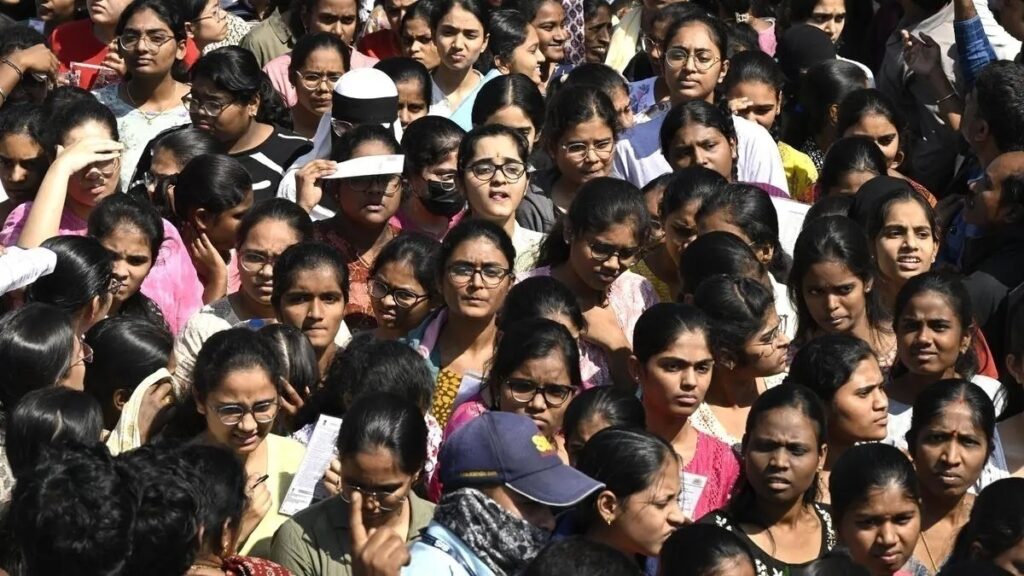
In November 2025, when the Indian Railways called for job applicants, as many as 12 million candidates applied for 8,868 openings. Stated more directly, 1,370 persons applied for every job, and some job categories saw 2,000 applicants per position. Even by the standards of the Railways, which is a huge draw for job seekers, this was unusual. Earlier, in September, 2.5 million job seekers applied for 53,000 peons’ positions in Jaipur. That is 47 applicants for each vacancy, with many of the applicants possessing college degrees, including Ph.Ds. Nearly simultaneously, in Sambalpur, 8,000 candidates applied for 187 Home Guard positions—about 50 people for each job. So large was the number of candidates—many of them with college degrees—that they had to sit on an airstrip to take the testfor a position that required just a primary-school-level qualification.
The mainstream media no longer covers such news. While all the newspapers reported the latest GDP growth estimate, with the tag “fastest growing major economy”, the desperate scramble of jobs does not make news even in the so-called progressive press. If the press does report on the jobs situation, it is to cite the latest unemployment rate, which currently hovers between 5 and 6 per cent of a labour force of about 600 million people; that implies between 30 and 35 million Indians unemployed. This ultra-low number of those unemployed is never juxtaposed against the jarring reality of frantic job searchers.
Elite India, which now includes the media, has no time to dwell on people’s lived reality. The simple truth is that very few Indians can afford to be unemployed. The unemployment rate is no gauge of the country’s job market.
According to the ILO, a person is employed if he/she works just one hour in a week. And it is true that a lot of people will find an hour’s work in a week. What is more important though is that almost all of them want to work many more hours. India’s problem is vast underemployment: people work too few hours, in very low-productivity work, and some just drop out of the labour force and stop looking for work in frustration. India has a mass of surplus labour, a term economists use to describe people looking for more work that is also more productive.
Surplus labour exists in agriculture, which has low productivity relative to the rest of the economy and cannot employ people through the year; surplus labour exists in mom-and-pop kirana stores and, indeed, across the vast unorganised sector; surplus labour exists in colleges and universities, where students attempting their luck at public service exams acquire one degree after another to avoid facing the world.
Economists and practitioners have struggled for decades to measure underemployment. The ILO has proposed an imperfect but useful concept, “underutilisation”, which includes (in addition to the conventionally unemployed, those who want to work more hours and those who might be induced to give up their pessimism about finding work). The Organisation for Economic Cooperation and Development, comprising mainly advanced economies, finds a high level of underutilisation even in those economies. In late 2024, Italy had an unemployment rate of 7 per cent but underutilisation of nearly 20 per cent.
How do we assess India’s underutilisation rate? The key thing to focus on is the size of the informal sector, where the bulk of the underemployment is. India’s informal sector—the safety net for those who have no options for full-time productive work—harbours 90 per cent of the country’s labour force. As a benchmark, Turkey, with 26 per cent of the jobs in the informal sector, has a labour underutilisation rate (the proxy for underemployment) of nearly 25 per cent. This surely does not mean that India has an underutilisation rate of 90 per cent, but it is a warning that India has a daunting underemployment problem.
By my estimate, extending the seminal work of the late economist Ajit Kumar Ghose, about 200 million Indians would be without a job if we eliminate underemployment. As Ghose noted, the essence of underemployment is that a number of people share a job that one person can do. If that sharing disappeared, a huge number of people would have no work. And this number keeps going up as new job seekers continuously exceed the jobs created. That is the source of the desperation.
And that is reflected in the appropriate gauge: low-to-nonexistent growth of real wage rates (wages adjusted for inflation) in the last decade. At last, here we are at a point where there is consensus. Economist Jean Dreze and colleagues, frequent critics of the government, find that rural wages have grown at an annual rate of 0.1 per cent since 2015-16, and urban wages at 0.8 per cent. The government’s Economic Survey splits wage growth into many categories. It finds that regular, salaried workers have experienced a sharp fall in real wages since 2017-18; only casual workers experienced a rise after 2017-18, but their wages have stagnated since 2021-22, the period of high GDP growth rates. They too find that rural real wages have not grown.
Even these real wage growth estimates may be overstated since the inflation index does a poor job of accounting for the costs of renting a home. The statistical agency samples only a small number of homes, and making matters infinitely worse, many of those homes are government quarters, for which the house rent foregone plus a small licence fee is computed as rent. Of course, this increase is no reflection of market-supply demand forces, which have been pushing rents up rapidly. Also, the rise in rents (rental inflation) is evident only when a new contract is signed, so sampling households who are locked in contracts gives no sense of the inflationary pressures.
As is well-known, house rent is no less than Rs. 5,000-7,000 a month for a family of four, which eats up one-third or more of the about Rs. 15,000 earned by an urban construction worker, driver, security guard, gig worker, and others in the informal sector. Once house rental inflation is properly accounted for, urban poverty rates are much higher than official estimates suggest.
India has never attempted to house its vast informal labour force. As inequalities have increased—allowing some to pay sky-high prices and rents—informal sector workers, with only slow-rising nominal wages, must either squeeze all other expenses to live in proximity to work or spend unaffordable time and money on commuting. All other expenditure is squeezed. India’s housing crisis is an inequality crisis, and, no, you will not see it in the data.
So, we have a resolution. If you want the true Indian story, ignore GDP growth rates. Focus instead on the persistent inequality that has induced the rich to exit the Indian economy. Focus especially on the severe unemployment of the mass of Indians—which prevents real wages from rising. The Indian market for mass consumer goods is small, and while investors often talk big to impress authorities, they have no incentive to walk their talk.
The government is entrenching the status quo. Just as tariff breaks for the consumption of the rich and corporate tax cuts fatten the rich, changes to the former Mahatma Gandhi National Rural Employment Guarantee Act and the new Labour Codes will weaken workers’ bargaining power.
Data and democratic failure
As Indian inequality has ballooned over the past quarter century, the presentation of macroeconomic data has adapted to downplay the hardships and struggles of the poor and vulnerable. Instead, the data highlights and proclaims an emergent India, a story that the Indian elite, its global counterparts, and a compliant media are anxious to tell.
When statistics don’t reflect lived reality, they cannot discipline power. Governments can proclaim high growth, low inflation, and low unemployment even as jobs are scarce, wages stagnate, and rents soar. Citizens, stripped of reliable mirrors of their own experience, are left with anger but little clarity to demand change. The media must stand up: it must—in the words of journalist Margaret Sullivan—“give a voice to the voiceless and hold powerful people and institutions accountable.” If the media does not correct the narrative, who will?
The same process is visible in both India and the US, though at different stages. In India, the narrative fixates on dubious GDP growth, uses an irrelevant metric for assessing jobs deprivation, understates sky-high home rental costs, and fails to draw the line from mass stress to weak private investment. Politics is inevitably insulated from people’s true needs.
In the US, data remain abundant but are increasingly distrusted, weaponised, or drowned in noise. “Alternative facts” proliferate, fuelling polarisation rather than accountability. The American media is still stronger than India’s in critiquing policy, but the slide towards aligning with official narratives—or letting them persist—is unmistakable.
Data has broken free of its traditional moorings and now serves oligopolistic capitalism and nationalist pretensions. The space for informed democratic choice has shrunk. Symbols and spectacle have displaced reasoned debate. Power has hijacked policy. Restoring democracy requires data rooted in lived experience. Only then will citizens regain their voice and agency.
Sadly though, in both India and the US, a bad equilibrium has set in: a moral cul-de-sac. The elites are insulated and the media has chosen not to contest—and in fact to implicitly justify—the elitist policy drift. Who can break this equilibrium? With the media unlikely to play its role, only the elite have the power to influence change. But this equilibrium suits them all too well. Herein lies the peril.
[Ashoka Mody recently retired from Princeton University. He previously worked for the World Bank and the International Monetary Fund. He is the author of India is Broken: A People Betrayed, Independence to Today (2023). Courtesy: Frontline magazine, a fortnightly English language magazine published by The Hindu Group of publications headquartered in Chennai, India.]