Crudely Speaking: Why the Modi Govt Is Responsible for Indian Oil Prices
The Wire Staff
As oil prices shoot up sharply in the global market, early today, “oil prices rose 18% in just 18 minutes”. Indian prices of oil, LPG and LNG will be affected. LPG cylinder prices went up by Rs 60 over the weekend already.
Vivek Y. Kelkar, researcher and analyst working at the intersection of geo-economics and sustainability, said, “With nearly 90% import dependence, every $10 per barrel rise increases the annual import bill by about $13-14 billion, widening the current account deficit, pressuring the rupee and adding to inflation.”
India imports 90% of its crude needs. The rupee is at an all-time low. The current account deficit is widening. Nomura, ADB and Moody’s Ratings have pointed to India (with extensive oil needs) being potentially among the worst affected in the world if the West Asia war and crisis was to be long-drawn.
But can it all be laid at the door of ‘global reasons’?
Here is why the answer is a resounding no.
1. Strategic petroleum reserves mismanaged?
The Hindustan Times reported on March 7 that India allocated Rs 5,876 crore for this financial year to fill and expand its strategic petroleum reserves (SPR), but is expected to spend only Rs 1,039 crore of it.” Strategic petroleum reserves are kept for precisely these eventualities. India has budgeted only “Rs.200 crore for next year – leaving emergency stockpiles partially empty and expansion plans stalled, budget documents show.” Business Standard reports that Mangalore SPR is less than 50% full. Padur SPR, the largest, is just 82% full (capacity of 18.3 million barrels).
2. Ceding energy choices
The Modi government has consistently ceded energy choices, making them subservient to the US’s whims and adjusting to its priorities rather than its people’s needs and welfare. China and a few other large countries have continued to buy Iranian oil and Russian oil at cheaper prices, not allowing themselves to be subjected to the US’s strategic map. India’s story of subjugating itself to the US’s plans began before Trump’s executive order made it fully transparent. Issued on February 6, the order sets up a committee of American officials to ‘monitor’ Indian imports. India has surrendered to the order.
When it came to stopping purchases of Iranian oil (deemed to be the sweetest crude, something that our refineries were attuned to), the Modi government surrendered and shifted suppliers. In 2019, when Trump 1.0 ended the six-month waivers from sanctions on oil imported from Iran by six countries, the Modi government readily gave in. This is clear in 2019, from the data and memoirs of John Bolton and Mike Pompeo. The Trump administration’s “maximum pressure” campaign on Iran forced India into a major strategic shift. Despite India’s initial reluctance due to its reliance on discounted Iranian crude, Prime Minister Narendra Modi ultimately conceded to the Trump’s demand to “zero out” oil imports. Bolton was the hawk pushing hardest to end the waivers and Pompeo executed it while maintaining warmer rhetoric about India as a strategic partner, while Trump applied pressure bluntly to which Modi yielded.
In The Room Where It Happened, Bolton describes a White House that was increasingly impatient with India’s “understandable but incomprehensible” arguments for cheaper oil. Bolton notes that India was buying Iranian crude at prices well below the global market because Tehran was desperate.
Bolton highlights a sharp divide: while State Department bureaucrats were sympathetic to India’s arguments, Trump and the “hawks” were not. “In a phone call with Pompeo, Trump had not been sympathetic to Indian Prime Minister Narendra Modi, saying, ‘He’ll be okay.’”
Courtesy: tradingeconomics.com
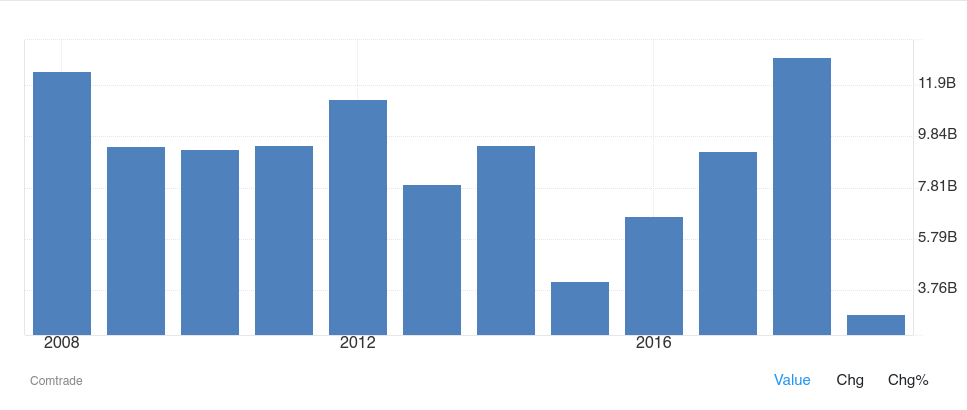
Before the 2019 sanctions on it, India was a major buyer of Venezuelan crude. But India then acceded to stopping the purchase of oil from Venezuela, before their head of state, Nicolas Maduro, was abducted by the US. India then resumed supplies, when US took control of Venezuela’s oil. This information was first given by Trump on February 1, 2026, not by India. “India is coming in, and they’re going to be buying Venezuelan oil as opposed to buying it from Iran. So, we’ve already made that deal, the concept of the deal,” Trump told reporters on board Air Force One.
On Russian oil, the buckling under has been sharp with the Executive Order and then with the US “allowing” India to resume some purchases “to ease up the pressure on oil prices” as per US diktats. Treasury Secretary Scott Bessent made that clear in a public interview.
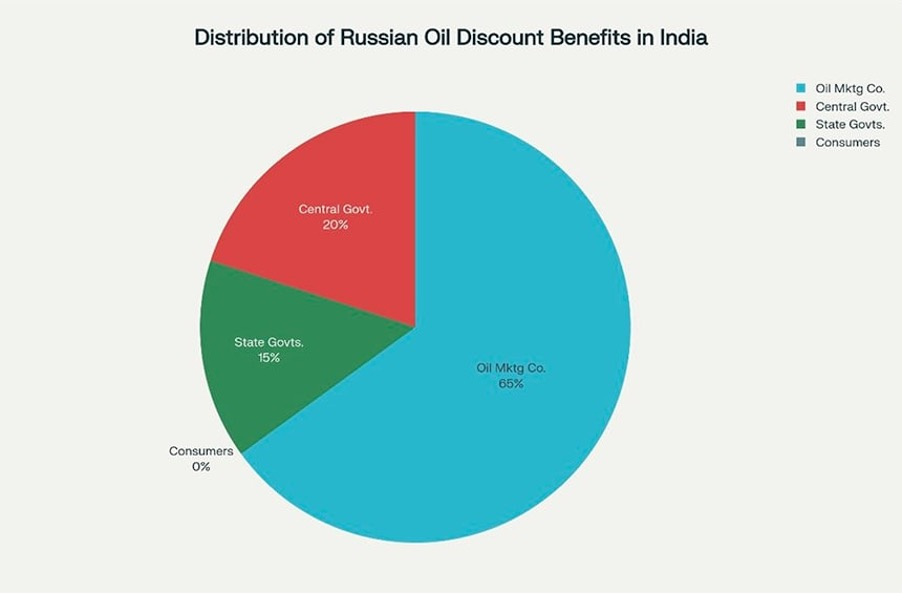
3. India imported Russian oil at a steep discount. But the Indian consumer did not gain.
India’s public sector units made profits from cheaper Russian oil, but private companies benefited much more. Reliance killed it with a sharp rise in profits as India bought Russian crude from 2022, after Russia’s invasion of Ukraine. Moneylife wrote that Reliance Industries Ltd (RIL) “recorded refining margins exceeding US$12.5 per barrel, while Rosneft-backed Nayara Energy reported margins of US$15.2 per barrel. These margins, multiplied over millions of barrels daily, translated into tens of thousands of crores in windfall profits.” There was a windfall tax levied, but there was no reduction in the price the Indian public paid for oil.
Courtesy: Moneylife
4. Taxing oil
The Indian government makes Rs 2.7 lakh crore annually from fuel excise duties. Current levies, Moneylife reports, “are at Rs13 per litre of petrol and Rs10 per litre of diesel. In April 2025, excise was hiked by Rs2 per litre, generating an additional Rs32,000 crore in revenue.” This has been on for years now. Modi since 2014 broadly inherited low oil prices internationally but prices were never brought down in proportion to what the government made. In fact token price falls were affected before elections in states periodically, earning the ire of opposition parties. The charge was that oil process were used as political devices. For example, oil prices in September 2024 were “nearly 40% lower than in June 2022, but petrol & diesel prices have barely been reduced.” A longer analysis showed “a strong link between price cuts and election dates”.
5. The ethanol mix
Ethanol was mixed in petrol to be dispensed as petrol stations, compulsorily. It was 10% in 2022 and the mix rose to 20% in 2025. Yet, there were no price reduction. Ethanol, a sugarcane derivative is much cheaper than oil.
6. Why no clean energy plan developed?
A 90% dependency on imported crude, with a worsening global environment over some time, the war in Ukraine and the attack on Gaza should have got an Amritkaal government, if interested in the wellbeing and welfare of its people to plan a transition to renewables. This would have been a win-win, as it would have helped ease the killer-pollution situation in north and western India as well, which is among the worst in the world. But there has been no thinking or journey towards that.
As reported earlier by The Wire, in an increasingly volatile West Asian landscape, the wisdom of accelerating our clean energy ambitions becomes even more apparent for India’s energy security, noted Aarti Khosla, director at Climate Trends.
“Reducing dependence on imported conventional energy sources, i.e. oil and gas, through rapid deployment of clean technologies is no longer just a climate imperative but a strategic necessity,” she said in a statement.
“The timing of our recent FTAs [free trade agreements] has also strengthened trade diversification and supply resilience. In this fractured geopolitical order, India must deepen the momentum toward clean energy transition and technological self-reliance to insulate its growth trajectory from external shocks.”
The Zero Carbon Analytics report has also recommended this.
In sum, unlike other countries aspiring to emerge as winners in the new multipolar world, India, the largest country in the world, has not only surrendered its energy choices to the US’s plans and whims, without bringing any material gains to its people, it also has consistently not passed on any benefits from earlier lower oil prices to citizens, nor planned actively to keep its strategic petroleum reserves up nor a transition to clean energy.
[Courtesy: The Wire, an Indian nonprofit news and opinion website. It was founded in 2015 by Siddharth Varadarajan, Sidharth Bhatia and M. K. Venu.]
❈ ❈ ❈
In another published on Counterfire, “Modi: ‘India Stands with Israel’ – Iran Briefing”, Chris Bambery adds (extract):
Immediately after the outbreak of the Iran war, with the US and Israeli attacks including the assassination of the Supreme Leader, Ali Khamenei, Indian Prime Minister Narendra Modi condemned Iran’s retaliatory strikes, phoning the rulers of the United Arab Emirates, Saudi Arabia, Bahrain and Jordan to express his solidarity with them.
In doing so, Modi firmly positioned India with the US-Israeli side. That, however, comes at a cost.
India is the third-largest oil importer and consumer in the world.
The International Energy Agency (IEA) projects that India will be the largest source of global oil demand growth this decade, adding roughly 1-1.2 million barrels per day of demand by 2030 and accounting for more than 35 per cent of net global growth. India is seen as a crucial global growth driver, but that depends on its accessing oil.
Until last year, much of India’s oil came from Russia, the Russians having shifted sales eastwards after their invasion of Ukraine. Moscow offered India the oil at a discount, but last year the White House slapped 50 per cent tariffs on Indian goods – half of them to directly punish New Delhi for its Russian oil purchase. Under pressure, India switched to buying Middle Eastern oil. These have now been disrupted by the Iran war.
India’s crude imports amount to 2.5 – 2.7 million barrels per day, from Iraq, Saudi Arabia, Kuwait and the United Arab Emirates. These come to India through the Straits of Hormuz.
After Trump agreed with Modi on a 30-day waiver on some US sanctions, India has purchased 30 million barrels of oil from Russia. The state-backed Indian Oil Corporation and Reliance have bought up all unsold cargoes of Russian crude. These were bought at premiums of $2 to $8 per barrel over the price at London’s Dated Brent, costing India a great deal more.
India is also concerned about its natural gas and cooking gas supplies. It is the fourth-largest liquefied natural gas (LNG) buyer, and second-largest buyer of liquefied petroleum gas (LPG), such as that used for cooking, much of which is imported from the Middle East.
On Tuesday, it ordered tighter controls on the distribution of liquefied natural gas (LNG), requiring supplies to be prioritised for households, transport sectors and the production of LPG:
‘That would mean other sectors, including fertiliser plants, tea industries, ceramics and tile firms and restaurants and hotels would need to brace for uncertainty and potential disruptions.’
Another hit has been taken by Indian airlines. On Wednesday, Reuters reported:
“The country’s biggest international carriers, Air India and IndiGo, did not operate 64 per cent of their 1,230 scheduled flights to the Middle East, Europe and North America in the last 10 days. Pakistan has banned Indian carriers from its airspace since last April following military tensions between the two neighbours.”
The danger for India is higher inflation due to higher energy and transportation costs. That in turn could lead to further depreciation of the rupee. India has strong foreign exchange reserves and is thus protected from any such desperate situation, but these have been accumulated from foreign loans and foreign investments in India, and these liabilities are now bigger than the foreign exchange reserves, meaning that India is now in danger from any shifts in the international markets.
[Courtesy: Counterfire, a British socialist online publication and activist platform. Founded by members of the British left, it aims to provide radical, anti-capitalist analysis of politics, economics, and global events.]