❈ ❈ ❈
Corruption Festers in India, But No Outrage in Modi Raj
Mathew John
Like Trump’s hollow “Make America Great Again” rallying chant, the two most beguiling slogans coined by our Vishwaguru – “Sabka Saath Sabka Vikas” and “Na Khaunga Na Khaane Doonga” – are today a standing rebuke and indictment of all that the “non-biological being” and his camp followers have wrought in our land over the last decade.
What is one to make of a regime that has fostered the most heinous form of societal corruption – hate, division and discrimination; that is nurturing even children to be messengers for Hindu exclusivity and tribalism – the latest outrage the officially-sponsored recitation of the RSS anthem instead of the national anthem at the recent inauguration of the Ernakulam-Bangalore Vande Bharat train?
We have travelled a long way from the days of relative innocence when financial misdemeanours and corruption by individuals were the problem. Today all-pervasive systemic corruption – economic, social, racial, institutional, judicial, environmental and electoral – poses a monstrous existential threat to the nation and its ideals of justice, liberty, fraternity and equality, which now lie in tatters. This regime has craftily exploited the fault lines in our society to wrest complete control and power to do as it pleases, how it conducted elections in Bihar the latest example.
Where does one even begin to chronicle the avalanche of misconduct and corruption in every sphere of public functioning in the last decade? It would require weighty volumes to unravel, a job best left to a commission à la the Shah Commission (1977-79) that inquired into the corruption, abuse of power and other excesses during the Emergency. My limited purpose here is to give a whiff of the stench of corruption in our midst, spreading without the nation missing a heartbeat.
Take India’s purchase of Russian crude oil. Consequent on Russia’s invasion of Ukraine in 2022 and precipitate fall in its crude prices due to sanctions, India ramped up Russian oil imports from 0.2% to 35-40% of its total imports. This resulted in huge savings of up to US $17 billion through discounted purchases. But the price paid for cocking a snook at international disapprobation was US President Donald Trump slapping an extra 25% tariff on Indian exports, seriously crippling our textiles, gems, carpets and pharmaceutical exports and rendering thousands of workers unemployed.
While the experts have been debating the pros and cons of buying Russian oil, what’s been lost sight of is that Ambani’s Reliance Industries and Russian Rosneft-operated Nayara Energy have been the preponderant beneficiaries of a policy that has done nothing to improve the lot of the common man but ended up seriously damaging exporters, who are left holding the can while Ambani and gang buy discounted Russian crude, which is then processed, not for domestic consumption but for re-export to Europe.
To put it plainly, the decision to import Russian crude oil has richly benefitted oligarchs but it has seriously damaged the interests of exporters and tens of thousands of workers who’ve lost their jobs. A textbook example of an oligarchic kleptocracy at work – but there’s no outrage.
In 2023, the Hindenburg Research report said that the Adani Group was involved in massive fraud, stock manipulation and accounting irregularities. Curiously, despite its role as a regulator getting challenged in the Hindenburg report itself, SEBI was entrusted with investigating the irregularities and recently cleared the Adani group of any wrong-doing – classic banana republic administration of justice!
In 2024, the US Department of Justice charged Gautam Adani and some of his associates with a multi-billion-dollar fraud and bribery scheme, alleging they lied to investors and paid more than US $250 million in bribes to win solar energy contracts in India. According to the latest court filings, Indian authorities have been dragging their feet on delivering the summons to Adani Group executives. So low is the credibility of the Adanis that American and European banks even considered backing off from extending new credit to the group.
It is in this context that the Washington Post’s exposé a few days back, regarding government-induced investments by LIC in the Adani Group, should have enraged all citizens for the sheer audacity of the political-corporate nexus it alleges.
The Post article alleged that in May, the Union Finance Ministry “drafted and pushed through a proposal to steer roughly [US] $3.9 billion in investments to Adani’s businesses from the LIC”. The bare-faced attempt to misuse citizens’ hard-earned savings to bail out a conglomerate of Adani’s size should have raised a storm of protests but it is already yesterday’s news.
Under this regime’s watch, our flawed once-vibrant democracy has mutated into an oligarchic kleptocracy controlled by a cabal of elites, actively facilitated by this regime to usurp the resources that belong to all. In the name of “strategic disinvestment”, the regime has been unbundling precious state enterprises to the private sector – ports, airports, Air India, Shipping Corporation of India, BEML, State Electricity Boards, et al.
Under the guise of “monetising non-core assets”, government land is being bartered away for a song. The latest outrage is the 25-year lease of 1020 acres of land in Bhagalpur at the rate of one rupee per year to the Adani Group for a power plant.
Then there’s the recent Cobrapost forensic investigation, aptly titled “Lootwallahs: How Indian Business is Robbing Indians”, that dissects the Rs 28,874 crore heist pulled off by Reliance ADA Group companies owned by Anil Ambani. (This article is published below – Editor.) But who cares?
The corporate-owned media and its lapdogs have been complicit in bolstering the crony capitalist-government nexus. Not the mainstream media, but the All India Bank Employees Association recently brought to light the stunning fact that Mukesh Ambani’s wealth has increased from Rs 1.50 lakh crores in 2014 to Rs 9.50 lakh crores in 2024 and Gautam Adani’s wealth has grown from Rs 57,000 crores in 2014 to Rs 9.30 lakh crores in 2024. This obscene wealth increase has been juxtaposed with India’s Hunger Index rank, which has slipped from 55 in 2014 to an abysmal 102 in 2025.
The Oxfam report of 2023 titled “Survival of the Richest: The India Story” shows how wealth and caste privilege have shaped power and exacerbated inequality. Modi has been trumpeting the fact that India is poised to become the third largest economy in the world while avoiding the more pertinent statistic that the top 10% own more than 80% of the nation’s wealth and India is ranked 144th out of 196 nations in GDP per capita at US $2878.
Corruption on an unimaginable scale stalks the land, but it has been normalised by sleight of hand of those controlling the wheels of power over the years. At the heart of this gigantic subterfuge is the intimidatory environment of “shock and awe” that has virtually terrorised individuals and institutions to toe the government line. It’s an ecosystem where loyalty to the ruling dispensation is all that matters and not impartiality and probity.
This has had a terrible effect on the fight against corruption. In such an environment, the organisations specially assigned to combat corruption have been defanged and reduced to mere ciphers. Take the calculated diminution of the Lokpal, which was conceived as an all-powerful ombudsman but now functions as a malleable advocate of the government. The only major verdict of national import passed since its setting up in 2019 is the cock-eyed order dismissing complaints against former SEBI chairperson, Madhabi Buch, as “unjustified and solely politically motivated”.
Most disturbing is the government’s systematic undermining of the RTI law by not filling posts, encouraging government outfits to refuse to divulge information and the recently passed DPDP Act that threatens to completely destroy the powers of the RTI in the name of protecting “privacy” and “personal information”.
Meanwhile, a pliable media, obsequious institutions stacked with loyalists and millions of blind bhakts swearing fealty to the king have amplified the public image and personal integrity of Modi to the extent that it has even muted criticism of corruption in his government. I nearly burst a blood vessel when Modi compared his connection with Adani to the Mahatma’s friendship with G.D. Birla!
We are today a morally depraved society whose governing class has forgotten ordinary humanity. What we are witnessing is the desecration of the Mahatma’s idea of India – unchecked financial corruption, institutional breakdown, elitist concerns, a partisan witch-hunt of the regime’s opponents and, worst of all, the policy of hate and division bolstered by lynching, bulldozers and allegations of love jihad.
But there is no outrage! Romain Rolland believed that France fell to Germany in World War II because “there was corruption without indignation”! What further price will we pay for our indifference?
[The writer is a former civil servant. Courtesy: The Wire, an Indian nonprofit news and opinion website. It was founded in 2015 by Siddharth Varadarajan, Sidharth Bhatia and M. K. Venu.]
❈ ❈ ❈
As Major Foreign Banks Hesitated, Modi Govt Oversaw Plan to Steer Billions from LIC to Adani: Report
The Wire Staff
25 October 2025: A Washington Post investigation details how the Modi government quietly devised a $3.9 billion plan to rescue Gautam Adani’s debt-laden conglomerate by directing money from the state-owned Life Insurance Corporation of India (LIC).
Internal documents accessed by the Post show that in May 2025, the Union finance ministry, its Department of Financial Services (DFS), LIC, and the policy think tank NITI Aayog coordinated an investment strategy that funnelled billions into Adani Group bonds and equity. The plan involved a $585-million bond issue for Adani Ports that LIC financed alone.
“The plan came to fruition the same month that Adani’s ports subsidiary needed to raise roughly $585 million in a bond issue to refinance existing debt. On May 30, Adani Group announced that the whole bond had been financed by a single investor — LIC — in a deal immediately decried by critics as a misuse of public funds,” the report notes.
The proposal’s stated goals included “signaling confidence” in Adani and attracting other investors, despite the conglomerate’s 20% debt increase over the previous year and the ongoing US corruption and fraud charges. The US Department of Justice and Securities and Exchange Commission have charged Adani and his associates of a multibillion-dollar bribery and fraud scheme involving false statements and $250 million in illegal payments to win energy contracts. Adani has denied wrongdoing, calling the charges “baseless.” This October, the SEC said that Indian authorities have failed to act on its requests to serve summons and complaints to Adani Group executives.
The report also notes that the 2023 report by the US short-seller Hindenburg accused the Adani Group of stock manipulation and financial irregularities. An investigation by the Securities and Exchange Board of India (SEBI), dismissed two of the allegations in September, this year. While Hindenburg has since shut shop, the fallout was palpable in other ways. The Post report says that several major American and European banks that Adani had looked to for loans were hesitant to help under these circumstances.
Along came Indian officials who in the DFS documents accessed by the Post described Adani as a “visionary entrepreneur,” viewing his businesses spanning ports, energy, and infrastructure as vital to national economic goals. Analysts whom the reporters of the Post spoke to warned that LIC, which insures millions of Indians – many of them low income – faces high risk by investing heavily in a politically connected private group already under global scrutiny.
Hemindra Hazari, an independent analyst quoted in the report said that it seemed “abnormal” for LIC to invest such large sums of money in a private corporate entity. “If anything happens to LIC … it’s only the government that can bail it out,” he added.
Modi’s close ties to Adani, have been at the heart of charges from many quarters, including Opposition leaders and members of civil society. The Adani group has termed such charges as a ‘conspiracy against India.’
According to the Washington Post, observers see the bailout as evidence of India’s deepening corporate-state nexus, where Adani’s fortunes mirror the government’s economic ambitions and taxpayers ultimately bear the financial risk of sustaining one of Modi’s most powerful allies.
In a series of tweets on Friday, Trinamool Congress MP Mahua Moitra tore into the Modi government and the conglomerate. “All patriots out there & all media houses – how about some attention & coverage on how ₹30,000 crores of Indian tax payer money used as Adani’s piggybank courtesy @FinMinIndia? … “Modi government keeps funding @gautam_adani & the Indian people have to keep bailing him out.”
Early on October 25, Congress leader Jairam Ramesh also posted on X about the revelations.
“The costs of throwing public money at crony firms became clear when LIC suffered a staggering $7,850 crore loss in just four hours of trading on 21 September 2024, following the indictment of Gautam Adani and seven of his associates in the United States. Adani has been accused of orchestrating a Z2,000 crore bribery scheme to secure high-priced solar power contracts in India. The Modi government has refused, for nearly a year, to serve a US SEC summons to the Prime Minister’s most favoured business conglomerate,” Ramesh said.
He added that the alleged “Modani MegaScam” includes misuse of agencies to coerce asset sales, rigged privatisations, inflated coal imports, and politically motivated contracts.
In the afternoon of October 25, LIC released a statement saying that the allegations levelled by the Washington Post “that the investment decisions of LIC are influenced by external factors are false, baseless, and far from the truth.”
“No such document or plan as alleged in the article has ever been prepared by LIC, which creates a roadmap for infusing funds by LIC into Adani group of companies. The investment decisions are taken by LIC independently as per Board approved policies after detailed due diligence,” LIC said, claiming that the DFS or any other body does not have any role in such decisions.
“LIC has ensured highest standards of due diligence and all its investment decisions have been undertaken in compliance with extant policies, provisions in the Acts and regulatory guidelines, in the best interest of all its stakeholders. These purported statements in the article appear to have been made with the intentions to prejudice the well settled decision-making process of LIC and also to tarnish the reputation and image of LIC and the strong financial sector foundations in India,” it said.
Responding to the LIC statement, Moitra wrote on X on Saturday afternoon: “Sorry @LICIndiaForever what exactly is false? That you used Rs 30,000 crores of tax payer money to bail out Adani? Or that you asked @FinMinIndia to hurry up with approvals?”
Journalist Ravi Nair shared a document on X that showed details of LIC’s proposal to invest Rs. 25,000-30,000 crore in Adani Group bonds and wrote, “Is it okay to mislead the general public @LICIndiaForever? Is this “false, baseless, and far from (the) truth”?”
Meanwhile, in a statement to the newspaper, the Adani Group “categorically denied” any role in the government’s decision, calling suggestions of political favoritism “unfounded” and insisting its rise “predates Modi’s national leadership”.
The report notes at the end that Ravi Nair, the independent investigative journalist who co-wrote the piece, was slapped with a defamation suit by the Adani Group in September this year over a piece he co-wrote for Frontline magazine, as well as online interviews and social media posts where he discussed his reporting for the Guardian.
[Courtesy: The Wire, an Indian nonprofit news and opinion website. It was founded in 2015 by Siddharth Varadarajan, Sidharth Bhatia and M. K. Venu.]
❈ ❈ ❈
Narendra Modi’s Mammoth Bank Heist Over the Last 10 Years
Jawhar Sircar
23/Dec/2024: Now that the minister of state for finance has finally confirmed, in reply to one of the last letters written as MP before I resigned, that the Indian banking system has written off Rs 16.11 lakh crore during Prime Minister Narendra Modi’s first 10 years – we have the full picture for the first time.
One has been tracking this sector for several years and has been vexed with cryptic and partial information, often concealing more than revealing.
In comparison, the United Progressive Alliance regime that began this rot, may, at the most, have wiped out Rs 2 lakh crore (or even less) – which is just one-eighth of this gargantuan Rs 16.11 lakh crore of write-off under NDA 1 and 2.
Come to think of it, the UPA 2 government was declared ‘intolerably corrupt’ by an orchestrated campaign, but now it is really time to wake up. Never before have frauds, cronies and oligarchs played havoc with our money while the lying lama smiled.
To put this vanished amount of Rs 16.11 lakh crore in perspective, one may compare it with the last pan-India farm loan waiver of only Rs 60,000 crore done by the UPA government in 2008, which the opposition and the pink economic newspapers had castigated as populist profligacy.
This time, however, the beneficiaries were not lakhs of burdened farmers, but big capital and fraudsters, several of whom were known to be close to Modi.
We could also compare the Rs 16.11 lakh crore that disappeared over ten years with the Union government budgets for education, where the total expenditure was 40% less than this, and for health, where it was less than half.
So, when such a massive amount is just written (wiped) off bank accounts to accommodate fraudsters and scheming cronies, it hurts.
But who gets hurt? Not the government, except in token bits when it recapitalises some banks in small doses – and that too, with public money, our money. Nor the banks, as they are basically money managers – though their balance sheets may look a little sad for a few years.
It is we, the customers of banks and depositors, who lose this money – without knowing it or being informed about the erosion of the bank’s funds.
To make up for this lost money, banks charge higher and higher user charges for every little ‘service’, often through obfuscating notifications and more often, quite surreptitiously. The rates for loans go up because banks have suffered at the hands of frauds and fund siphoning.
All this happens with complete impunity, and the criminal activities of fraudsters and fund-siphoning industrialists are just written off – as explained in my three earlier articles.
The short point is that bankers are bound by the existing rules that normalise and legitimise deliberate losses, even when they are through loot and scoot tactics and by pauperising industries through financial jugglery and then cannibalising them.
It is, indeed, strange that the same PM who probably holds the world record for passing Bills and amending Acts in rapid-fire minutes and has repealed some 1,600 laws in the last ten or so years never considered amending or reconsidering the provisions that lead to automatic write-off – to criminalise cozy plunder.
Even the slew of amendments to banking laws that are being rushed through parliament right now do not focus on tackling these. Bankers are/were directed to concentrate on “keeping their books clean” by writing off loans, rather than go after those who filched their (and depositors’) money in a systematic manner, and there is no war-room or central monitoring cell.
The finance ministry’s statement (Annex 1 below) confirming that Rs 16.11 lakh crore were written off in Modi’s ten years also eliminates speculation and belies exaggerated news and headlines like “RTI by Activist Discloses Rs 25 Lakh Crore Loan Write-offs by NDA”. It was published recently in a well-known newspaper and is based on the erroneous double-counting of data.
Let us now discuss hard facts.
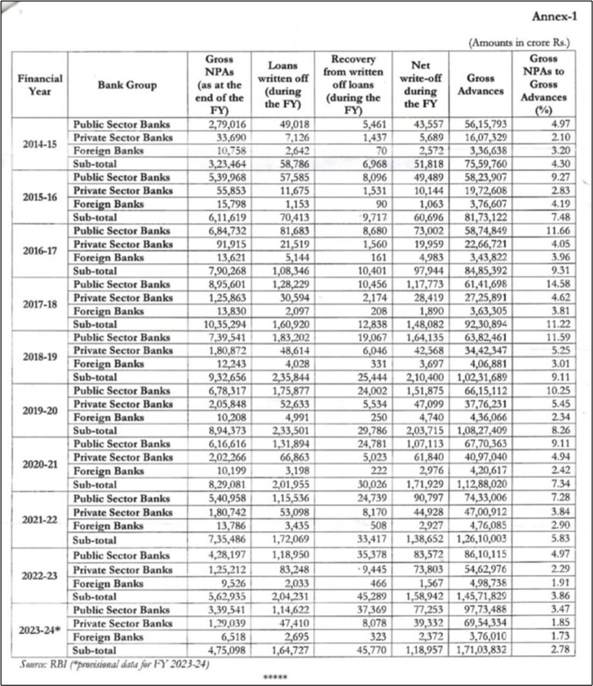
Data provided by the finance minister of state on loans given and written off by the Indian banking system since 2014-15.
India’s scandalous gross NPAs-to-total advances ratio
If these write-offs are all legitimate and part of normal banking practices, why are we getting hyper about them? To understand the enormity of India’s non-performing asset (NPA) game, we need to compare it with global standards of bank losses, i.e., percentages of gross NPAs to total advances.
This percentage represents how much of the total bank loans (advances) became bad/irretrievable and are classed as NPAs. The IMF has cited transparent (non-wheeling-dealing) economies as the ideal – where bad loans account for anywhere between 0.5% to 2% of the total bank loans. This percentage of irretrievable loans appears unavoidable, for many unforeseen reasons.
A compilation made by the IMF on the basis of available bank performance records (that ranged from five to seven years old to over fifteen years old) of different countries showed South Korea, the Scandinavian nations and Canada at below 0.3%, i.e., that this tiny percentage of loans turned bad, as NPAs.
Switzerland, the USA, Australia and Hong Kong had NPAs below 1.0%, while Germany and Japan were at 1.25%. Most European countries were below 2% (Italy was a shame at 2.8%), while China had 1.66%, Malaysia 1.72%, Indonesia 2.15%, Vietnam 2.32%, Brazil 2.64% and Thailand at 2.84%.
Then come the ‘bad economies’, where either the supervision of banks is poor (or politically influenced) or lenders are ‘user-friendly’ for a price. These are usually African, Latin American and Eastern European ones, and somewhere down this gallery is India, with close to 5%.
But this is not the truth, as the years covered for India in the IMF study are between 2005 and 2022. If we knock off the UPA years till 2014, and focus only on the Modi regime, i.e., 2014-22 (given in the minister of state’s statement), then India’s gross NPAs as a percentage of ‘total advances’ comes to a scandalous 7.85%. Details of year-wise percentages may be seen in the last column of the minister of state’s statement.
This 7.85% is not only the highest percentage of bad bank loans among big and medium economies in the world, but also indicates that the Indian regime has misused the standard banking practice of writing off most irretrievable losses – to enrich friends and dupe depositors. And, the latter still had no clue.
One uses the past tense ‘had’, because after the eighth year of Modi’s rule, the quantum of NPAs started coming down, as the cat was getting out of the bag. There were numerous alarms and eruptions in parliament, and international financial and investment agencies also raised embarrassing questions. And, anyway, by 2022, whoever had to loot and scoot had already gone – and had bought atrociously expensive mansions in London and elsewhere.
As the statement reveals, gross NPAs came down from the high of Rs 10.35 lakh crore in 2017-18 to Rs 4.75 lakh crore in 2023-2024. If we move from the first eight years to Modi’s first ten, NPAs tot up to an incredible high of Rs 72 lakh crore – which is 6.53% of the total loans given.
No respectable country in the world can match this record. In India, where as per provisional data for 2023-24 bank advances totalled to Rs 171 lakh crore, a 1% rise or fall in this figure means Rs 1.71 lakh crore – which is more than the annual budget of many states put together.
The fact that corrupt ruling elites have bled Bangladesh and the Maldives explains why their NPA-to-advance ratios dance around a dangerous 9%. In India, the domesticated media (including the wise pink papers) kept mum about all this and fell for the narrative of “oh, but, this is what it should be!”
When one grilled the most aggressive finance minister in our history about India’s poor NPA-to-advance ratio, she became even more belligerent than usual, as she was caught on the wrong foot.
Banks, lenders forced to take ridiculous haircuts
One has indicated in earlier articles that frauds and corporate losses (or siphoning out) account for the lion’s share of these NPA and write-off numbers. To one’s pointed question of how much of the NPAs (and write-offs that follow in most cases) are due to the corporate sector, the minister has given the year-wise amounts of loans written off for “large industries and services”. This accounts for a staggering Rs 9.25 lakh crore out of the Rs 16.11 lakh crore of the total write-off.
Though a part of this is surely due to market factors, even a child knows how most unscrupulous businesses in third world countries under-invoice receipts and over-invoice expenses and purchases from ‘day one’ – as probity, transparency and checks or punishments are low or non-existent.
Besides, bank officials and politicians have to be rewarded for helping obtain the loans, and these ‘skimmings’ are necessary for such payments. This huge heist has surely strengthened the political setup in the past decade – ever so quietly and effectively, under the radar.
There are other killings that are made through another route, namely, the insolvency process, where enterprises are bled to death, or almost so.
While Modi-Jaitley’s insolvency resolution process is better than the old route through the Board for Industrial and Financial Reconstruction, it stinks of collusion. There is excessive leniency towards resolution professionals, many of whom are highly questionable. Banks and lenders are made to take ridiculous haircuts (sacrifices) by forgoing almost everything, just to close the chapter.
These have been explained earlier and recently, the Congress said that data from the All India Bank Employees Association exposed how public banks were made to accept Rs 16,000 crore from ten financially stressed companies after they were taken over by Adani, against their claim of Rs 62,000 crore.
Banks lost 74% of their dues in this case – comprising our money – through this very legitimate ‘transaction’.
There are dozens of such largesse given to people close to the regime – at the industrial morgue, through this post-mortem path.
We have cited earlier of how ‘friend’ Anil Agarwal of Vedanta bought Videocon by paying 6% of its claim-burden of Rs 46,000 crore and how ABG Shipyard was taken over at 5% of its Rs 22,800 crore debt. Anil Ambani’s Reliance Communications owed Rs 49,000 crore to 53 banks, but the National Company Law Tribunal admitted only Rs 47,000 crore and settled for just Rs 455 crore – which is a ridiculous 0.92% of the total debt.
This insolvency process not only forces banks to accept anything from 5% to 25-30% of their claims and get out, but, as we have seen, somehow the ailing units go to the companies close to the regime.
This is how certain corporates gained immensely under the existing (unchanged) laws and rules – all while the banks were impoverished, our deposits squandered and our self righteous FM raves, rants and almost hurls invectives at whoever dares raise any question.
Fraud and write-offs for ‘large industries and services’ account for at least Rs 12 lakh crore
The other major query one asked of the finance minister was about frauds who have fleeced the banks. To this, the minister was cagey and gave a bland statement, the sum and substance of which is that frauds accounted for Rs 92,193 crore of losses in ten years “based on the date of reporting”.
This is obviously an understatement, hiding under banking terminology, as the combined loot of Modi’s former associates, Nirav Modi, Mehul Choksi, Nishant Modi, Ami Modi, Neeshal Modi, Lalit Modi, Jatin Mehta, Chetan and Nitin Sandesara and Gujarat-based ABG Shipyard would be larger than this amount.
Then, there are historic frauds carried out by Vijay Mallya, DHFL, Yes Bank, PMC Bank and so many other cheats.
On July 10, 2023, Moneycontrol reported that the RBI had responded to an RTI query saying that banks had lost Rs 4.69 lakh crore on account of frauds between June 1, 2014 and March 31, 2023. This report was sent to the finance minister to confirm or rebut, but an otherwise verbose FM went silent. She did not even clarify whether there is any overlap between ‘corporate losses’ and ‘frauds’ – which, one suspects, there is.
Overlap or no, frauds and corporate sharks together frittered away at least Rs 12 lakh crore of the Rs 16.11 lakh crore written off.
One comes to the Rs 12 lakh crore ballpark figure by adding the amount banks lost to fraud between June 2014 and March 2023 (Rs 4.69 lakh crore) to 80% of the amount that banks have written off for “large industries and services” in the Modi government’s first ten years (80% of Rs 9.25 lakh crore, i.e. Rs 7.45 lakh crore).
It is assumed that 20% of the Rs 9.25 lakh crore was lost due to genuine reasons.
If the FM or the RBI contest this Rs 12 lakh crore estimate, let them submit hard facts.
The minister of state’s statement also gives the ‘recovery’ figure, which is around Rs 2.5 lakh crore, and thus the actual hit (net NPA) by the banks would come down to Rs 13.62 lakh crore. We have no idea how much of the recovery was from cases that were being pursued or relate to those that are already ‘written off’. What is lost matters the most to us, as it is our money.
Apart from not changing the rules to stop this legitimate loot of bank funds, viz, our money (the government does not compensate) and allowing fugitives to escape to better climes (by not issuing lookout notices), this regime has not seized properties made from ill-gotten gains, unless they are company properties.
The UPA sent Satyam’s Ramalinga Raju to jail, but which rogue has been jailed by Modi to stop this plunder, though he has sent to prison countless political opponents?
The stupefying increase in the wealth of the favoured five top-most cronies through favours, rule-tweaking and the low-value sale of high-value national assets during Modi’s rule has been discussed extensively.
But this estimated Rs 12 lakh crore wipeout by banks may help us understand how the next tier of cronies and beneficiaries gained from the regime. After all, our money in banks did not really disappear – they just hopped on to line the pockets of those who knew their way around in very complex and corrupt times.
[Jawhar Sircar is a former Rajya Sabha MP of the Trinamool Congress. He was earlier Secretary, Government of India, and CEO of Prasar Bharati. Courtesy: The Wire, an Indian nonprofit news and opinion website. It was founded in 2015 by Siddharth Varadarajan, Sidharth Bhatia and M. K. Venu.]
❈ ❈ ❈
Cobrapost Alleges Rs 28,874-crore ‘Fraud’ by Anil Ambani’s Reliance ADA Group
Atul Howale
30 October 2025: Investigative news organisation Cobrapost held a press conference on Thursday (October 30) at the Press Club of India in New Delhi, in which it claimed to have unearthed a massive banking fraud of Rs 28,874 crore committed by the Anil Ambani-owned Reliance Anil Dhirubhai Ambani Group (Reliance ADAG), apart from other allegedly illegal transactions.
The Cobrapost investigation, according to its editor Aniruddha Bahal, shows Reliance ADAG raised loans from public and private sector banks, and through initial public offerings (IPOs) and bonds, then allegedly diverted these funds through shell companies and offshore entities to promoter group companies.
“What we found is not just mismanagement but clear fraud,” Bahal told journalists. “From the start, when Anil Ambani raised money from IPOs, bonds or public sector banks, the funds were diverted to shell companies and then routed back to his own holding firms. This shows a deliberate plan to cheat his own companies and make personal gains,” he said.
“A forensic analysis reveals how a fraud worth about Rs. 28,874 crore was pulled off by Reliance ADA Group companies owned by Anil Ambani. They committed the fraud by siphoning off funds borrowed from public sector banks and investors and diverting them to promoter-group companies,” the report, which Bahal cited at the press conference, says.
With Bahal were Supreme Court senior advocate Prashant Bhushan, senior investigative journalist Paranjoy Guha Thakurta, Newslaundry co-founder Abhinandan Sekhri and journalist Ushinor Majumdar.
In response to Cobrapost‘s report, Reliance ADAG has issued a statement strongly denying all the allegations, and calling the claims “malicious, baseless and motivated”.
Published under Bahal’s name, the report cites its numerous sources of information: “Our investigation is based on a thorough analysis of multiple official and public third-party sources. These include statutory orders, regulatory filings and documents published by the Ministry of Corporate Affairs, the Securities and Exchange Board of India (SEBI), the National Company Law Tribunal (NCLT), and the Reserve Bank of India; court orders; documents filed in foreign jurisdiction; and information available in public domain. We have been as meticulous and diligent as possible in extracting, collating, interpreting and verifying the data from all these sources.”
Bahal told the media, “We [Cobrapost] are starting a series of investigations on big Indian business houses, calling them the “lootwalas” – those who loot their own people. The first investigation focuses on the Anil Ambani-led Reliance ADA Group.”
He alleged that ADAG caused heavy losses to investors and banks, according to the findings of his investigation, and delivered a presentation on how the group allegedly carried out what he called a “massive fraud” and “misused taxpayers’ money”.
Bahal added, “This pattern is visible in all ADA Group companies. Because of this, Anil Ambani’s group caused a total public money loss of about Rs 3.38 lakh crore through unpaid bank loans and a fall in market value. It was a simple but damaging process – borrow money, move it through fake companies, bring it back to yourself and then stop paying the banks.”
The Cobrapost report says, “According to the data provided by the NCLT, nine companies of the ADA Group had an outstanding of Rs. 1,78,491 crore in unpaid loans, or admitted claims in banking parlance, when they were put under the hammer. If we put together Rs. 1,78,491 crore in unpaid loans and Rs. 1,59,721 crore that lakhs of investors of these companies have lost since 2008, a staggering sum of Rs. 3,38,212 crore of public money has vanished in thin air….”
After Bahal’s presentation, the other speakers raised the question of how the alleged financial irregularities uncovered by Cobrapost could continue despite the Enforcement Directorate (ED) and the Central Bureau of Investigation (CBI), which were set up to probe money laundering and other forms of financial frauds.
Addressing reporters, Bhushan strongly criticised the ruling government and the financial regulatory bodies for allowing “illegal financial activities“. He said, “This country is being allowed to be systematically looted and plundered by giant corporates like [that of] Anil Ambani. The modus operandi broadly was that they used to take large amounts of loans from the banks.”
“It was the banks’ job to keep track of how the funds were being distributed and spent. What were they doing for more than 15 years? Were they soft-pedalling this because of pressure from the ruling government? This fellow [Anil Ambani], who has so transparently siphoned out Rs 40,000 crore, is roaming around freely and not being arrested by the CBI or the ED,” Bhushan said. He added, “Obviously, there is a reason for the government to be protecting him. What does he have on the government or the prime minister? Why is this happening?”
In response, Reliance ADAG claimed that the Cobrapost investigation was funded by its “corporate rivals”, who are seeking to crash its stock and acquire assets at throwaway rates. The group also said the Cobrapost report recycles old, publicly available information, already examined by agencies like the CBI, the ED and the securities regulator, SEBI. The group said in a statement that it has already complained to SEBI and sought a probe into suspicious trading activity.
Guha Thakurta said at the press conference, “Until last evening [October 29], when the legal notice was sent to Aniruddha Bahal, I had no idea the group under investigation was the Anil Dhirubhai Ambani Group. It is now up to the government’s investigative agencies – the ED, the CBI, SEBI and others – to verify whether the information presented is accurate. If it is false, action should be taken, but branding a journalist as an extortionist or blackmailer is unacceptable.”
Thakurta said, “Defamation laws are being misused to intimidate and silence reporters. The modus operandi of such corporates – shell companies, tax havens, constant name changes and circular fund transfers – has continued unchecked for years. If the ruling government is serious about tackling corporate fraud, it must act on these findings instead of waiting for Cobrapost journalists like Bahal to expose them.”
According to its report, Cobrapost examined six Reliance ADAG companies, all of whom, it claims, are “in the red” and allegedly managed to “siphon off” Rs 28,874.07 crore – even as lakhs of crores were “routed to India in a dodgy manner”. It alleges: “In addition [to the Rs28,874.07 crore] funds to the tune of around US$ 1.53 billion landed from abroad in his companies in a dubious manner.”
[Atul Howale is a documentary filmmaker and multimedia correspondent at The Wire. Courtesy: The Wire, an Indian nonprofit news and opinion website. It was founded in 2015 by Siddharth Varadarajan, Sidharth Bhatia and M. K. Venu.]
❈ ❈ ❈
Surely, the General Doth Protest Too Much
Harish Khare
19 November 2025: Last Friday, according to a front-page story in the Times of India, our Chief of Defence Staff, General Anil Chauhan, had made a few rather critical observations about the Indian corporate entities dabbling in producing weapons and ammunition for defence forces. The good general was upset that the domestic industries were making misleading claims about their indigenous capabilities and were indulging in “profit-driven endeavours”.
And, rather assertively, the CDS observed that the armed forces expected “a bit of nationalism and patriotism” from these entrepreneurs. Harsh words. Necessary words. Correct words.
General Chauhan, it be noted, is no dissident general. As everyone knows in our Naya Bharat, no disgruntled or disloyal soul gets tapped on the shoulder, however crucial or insignificant the job may be. He has not displayed any hint of the contrived flamboyance of a General Bipin Rawat. If anything, many purists have been disappointed that he has often departed from the protocol of professional aloofness and equanimity expected of a soldier. Nor is he a flaming radical, who may have an ideological knife out for private industry.
Yet it is difficult to recall when another serving officer felt so persuaded as did General Chauhan to call a spade a spade. It will be useful to remember that one of the major grouses Indian corporate entities had with the Manmohan Singh regime was that the United Progressive Alliance government did not allow desi entrepreneurs a free run of the extremely lucrative defence industry (a sector in which no questions are asked because “secrecy” is sacred and necessary.)
The doors got unlocked after 2014; as the Modi crowd deepened its mutually dependent ties with (mostly) crony capitalism. The Make in India policy regime became the profiteers’ dream come true.
Arguably, wars and armed conflicts have always been a time for profits and fortune-making; but capability and efficiency were still needed.
Why should the general be surprised at this gimcrackery? Has not cheating and short-changing been elevated as a working proposition for the entire ruling class?
Cheating, false claims, plain and deliberate dishonesty have been deeply embedded in almost all walks of life. Old-fashioned honesty and integrity are deemed to be signs of weakness and infirmities. Exaggeration, wild and wilful, was celebrated and valued as signs of strong leadership. Over-selling and under-performing are serenaded as “chankaya niti”.
Even places of worship do not seem to be beyond this national malady. Take, for instance, the so-called laddoo scandal atop the Tirupati hills, one of the holiest of all sites in this ancient land. The trail of adulterated ghee, procured for making the prasadam, stretches all the way from Tirupati to Uttarakhand. To be sure, the gods get no exemption from the profiteer’s greed.
Even more soul-scalding is the organised way the real-estate tycoons are working overtime to make moolah in the newly consecrated land of Ayodhya. The nation was told that the consecration of the Ram temple was the beginning of our collective moral and spiritual renewal; instead, it has been reduced to a profit-making enterprise by the real estate moguls, with politicians and priests as the junior partners.
It can perhaps be safely asserted that there is no area of national endeavour that has remained untouched by institutionalised falseness. The partisan politician protects crooks in his corner – and the rival defends thieves in his party. We have lost the capacity to tell what is right from what is wrong. We are complacently content to reject any international standard; the far and few in-between Indian achievements in the global arena are invariably stories of personal dreams, ambitions and perseverance. A sort of inward-lookingness has corroded whatever little quest we had for global excellence.
The Indian businessman has prospered under benign protectionism. The allure of a vast Indian market itself keeps him away from pitting his products and wares in the global arena. The old neta-businessman nexus of the licence raj days has now been revived with a vengeance. We read about the kind of trouble industrialist Anil Ambani is having with the Enforcement Directorate. It is the same business that was involved in the deal of the century – the purchase of Rafale aircraft from France.
So, the crucial question that needs to be addressed is why is the good general protesting? The good general could not be unaware that, over the years, particularly after 2014, the virtuous ‘nationalism’ has been over-invoked – blatantly and cynically – by a host of voices, from shabby politicians to cement manufactures, to sell their shoddy wares.
The nobility of “nationalism” or patriotism has been vastly devalued as the partisan policeman flings the anti-national charge at anyone and everyone who dares to displease the Sultan and his Pashas. On the other hand, so many unappetising politicians and other public figures have wrapped themselves up in the colours of patriotism that it has ceased to be a virtue – or its lack a failing. Demagogues and their henchmen have reduced nationalism to a mere legal “offence”, to be deployed not to preserve the nation but to be exploited for base electoral calculations.
It also needs to be noted that the CDS spoke with the authority of a general basking in the glow of public acclaim, aided and abetted expediently by a calculating political crowd in the wake of the Operation Sindoor, with all its exaggerations. There was an edge to the general’s indignation. In this age of the war-making and war-mongering, it is difficult to challenge a soldier’s formulations. Patriotism has its obligations.
[Harish Khare was editor of The Tribune. Courtesy: The Wire, an Indian nonprofit news and opinion website. It was founded in 2015 by Siddharth Varadarajan, Sidharth Bhatia and M. K. Venu.]