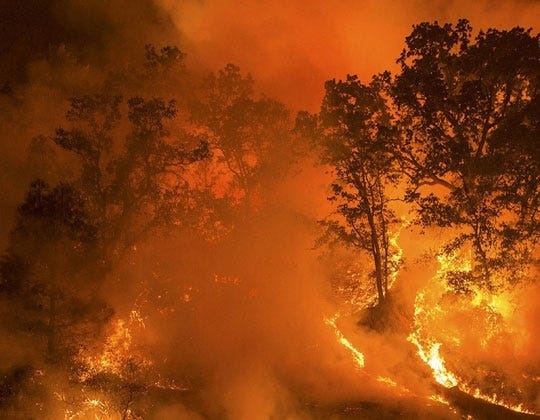
Earth is warming faster than at any point in recorded human history. Carbon dioxide in the atmosphere has risen from ~280 parts per million pre-industrialization to over 420 parts per million today. The most recent IPCC assessment concludes that human influence has unequivocally warmed the atmosphere, ocean, and land, and that global surface temperatures have already reached approximately 1.1–1.2°C above late 19th-century levels (IPCC 2023).
We are told this is a tragic side effect of progress. But climate collapse is no accident. This catastrophe is deeply entwined with the historical development of a system organized around competitive accumulation, structural growth, and incentivized abandonment of ecological responsibility.
To comprehend the scale of the crisis we face, we must move beyond the idea that climate change is merely the result of individual consumption. The overwhelming majority of historical emissions are concentrated in industrialized economies. Further, over 75% of cumulative carbon dioxide emissions have occurred since 1950 — a period called “The Great Acceleration” (Steffen et al. 2015). This period also coincides with the globalization of capitalism post-WWII: geopolitics dominated by oil, mass consumption, suburbanization, and financialized growth through predatory loan systems.
Since 1950, global Gross Domestic Product (GDP) — a vulgar measure of prosperity — has grown at an average rate of ~3% per annum. An economy growing at the average GDP rate should double in size roughly every 23 years. This growth is being driven by continuously expanding material extraction operations that, while benefitting few nations, harms the planet, and therefore harms us. Extraction rates have gone from 27 billion tons in 1970 to over 100 billion today (UNEP 2019).
Karl Marx described capitalism as a system driven by competitive accumulation: money invested in production in order to generate more money. Businesses that do not expand lose market share. Capital that does not reaccumulate itself is redistributed. Growth is the functioning logic of competition. Contemporary ecological Marxists argue that this imperative generates what Marx called a metabolic rift: a rupture between production and the regenerative cycles of nature (Foster 1999; Foster, Clark, and York 2010).
Under capitalism ecological limits are treated as costs that can be displaced onto communities, future generations, and the atmosphere itself.
Capitalism and fossil fuels, though historically intertwined, did not form a relationship out of necessity. In Fossil Capital, historian Andreas Malm argues that British industrialists adopted coal-powered steam engines because it allowed factory owners to concentrate production in the cities, weaken unions, and operate independently of sites dependent on water power (Malm 2016). Fossil energy provided capitalists flexibility and workers labor discipline.
From that point, fossil fuels became inseparable from imperial expansion. Industrialization in Britain relied on cotton grown by enslaved labor in North America. Colonial extraction in the Global South supplied bountiful raw materials to European factories. Scholars argue that modern capitalism developed through interconnected systems of exploitation, empire, and resource appropriation (Robinson 1983; Moore 2015). The global economy, dominated by hydrocarbons, emerged from these structures of uneven development.
We cannot ignore that this expansion continued even after climate scientists clarified the risks. Investigative research shows that Exxon’s internal scientists accurately modeled global warming trends as early as the 1970s and 80s, projecting increases in temperatures that closely aligned with observed outcomes (Supran and Oreskes 2017; Supran, Rahmstorf, and Oreskes 2023). Rather than pivot away from fossil fuels and begin phasing in safer alternatives, the corporation funded campaigns that intentionally misled the public and castigated scientific facts.
This is not irrational behavior within capitalism, within a system dictated by shareholder value and competitive pressure. Fossil energy is profitable; why would a corporation in direct competition with other fuel firms for dominance over the market abandon their most fruitful reserves? As Marx said, capital, by design, prioritizes accumulation.
Defenders of “green growth” argue that technological innovation and market mechanisms can decouple economic expansion from environmental harm. Yet empirical research questions whether absolute, global decoupling at the speed and scale required is occurring. A comprehensive review for the European Environmental Bureau concluded that there is no empirical evidence that absolute decoupling from resource use can be achieved on a global scale amidst a backdrop of continuous economic expansion (Parrique et al. 2019).
In a similar tune, Hickel and Kallis argue that even though relative decoupling occurs in some regions, evidence for sustained absolute decoupling consistently hitting climate targets remains sparse (Hickel and Kallis 2020).
Meanwhile, climate inequality is evidence that responsibility is unevenly distributed. The wealthiest 10% of people on Earth are responsible for roughly half of all global emissions, while the poorest 50% account for about only 10% (Oxfam 2023). The crisis is structured through class, wealth, and power.
Capitalism has proven extraordinarily dynamic, innovative, and adaptive, but it has never functioned without continued growth. Continued growth, measured materially, requires energy and throughput. Infinite accumulation, the credo of capitalism, cannot take place on a finite planet.
Climate collapse is a systemic issue. Understanding that history is an important first step toward coming to the conclusion that fundamental change is the solution.
The Growth Imperative
If this catastrophe was merely the result of poor policy, miscalculation, or technological failure, then reform would be straightforward: adjust incentives, subsidize renewable sources, etc. But the evidence suggests that economic growth remains tightly connected to resource extraction and energy use, and capitalism is uniquely dependent on growth as a condition of survival.
Modern capitalism operates under systemic competitive pressure. Publicly traded corporations are legally and structurally oriented toward maximizing shareholder value. Governments, on the other hand, rely on growth to stabilize employment rates, tax revenues, and debt servicing. With stagnation follows crisis.
The growth imperative also shapes political constraints. Governments compete for investment and capital flows. Policies that significantly restrict profit accumulation risk capital flight, unemployment, and financial instability. Fossil fuel reserves are embedded in financial assets, pension funds, and sovereign wealth funds.
The IPCC is clear that rapid, sustained emission reductions are absolutely necessary across all sectors to stabilize the climate (IPCC 2023). Yet the global economy remains organized around expansion of output, trade, and investment. Even climate policy itself is framed in terms of so-called “green growth,” emphasizing penetration of new markets, new industries, and new frontiers for endless accumulation.
This is the contradiction at the heart of the crisis: a system that depends on increasing material throughput confronting planetary systems that require stabilization. Capitalism, on top of producing goods, produces growth. When growth slows, crisis follows. The ecological question, therefore, cannot be separated from the economic one.
If emissions reductions of the necessary scale have historically coincided with economic contraction (Le Quéré et al. 2020), and if sustained global absolute decoupling remains unproven (Parrique et al. 2019), then the problem is systemic design.
Who Is Responsible?
Climate change is often framed as a crisis caused by humanity. The language is telling: we are emitting too much; we must reduce our carbon footprint; our lifestyles are unsustainable. But the data tell a radically unequal story.
Oxfam’s 2023 analysis finds that the richest 1% alone account for more carbon pollution than the poorest two-thirds of humanity combined (Oxfam 2023).
High-income households consume more energy-intensive goods: larger homes, more flights, private vehicles, luxury goods. Beyond personal consumption, wealth concentration translates into ownership of carbon-intensive assets. The ultra-wealthy are disproportionately invested in fossil fuels, aviation, real estate, and heavy industry. Financial portfolios drive up emissions indirectly through unsustainable capital allocation.
Research in Nature Climate Change finds that the carbon footprint associated with direct lifestyle emissions for high net-worth individuals is the biggest contributor to climate extremes (Nature Climate Change 2025).
This matters because capitalism distributes power over production. Decisions about energy infrastructure, extraction projects, supply chains, trade deals, and industrial expansion are not made democratically by the global population. They are made by corporate boards, investors, and state officials operating within competitive market constraints.
Many countries most vulnerable to climate impacts, including small island states and parts of sub-Saharan Africa, have contributed minimally to cumulative emissions (IPCC AR6 WGII 2022). This evidences how the crisis is structured through a history of colonialism and global inequality.
This inequality extends and operates within. In the United States, Black and low-income communities are disproportionately exposed to air pollution and climate hazards, reflecting longstanding patterns of environmental racism (Tessum et al. 2019). The poorest populations face higher climate risk while possessing fewer resources to combat the crisis. Those who contribute the least to the problem suffer the most.
Fossil capital remains concentrated in a relatively small number of corporations. Research tracing industrial emissions shows that just 90 fossil fuel producers are linked to over two-thirds of global industrial greenhouse gas emissions since 1854 (Heede 2014). These “carbon majors” include state-owned and investor-owned firms whose production decisions shape the global energy system.
Even the language of the “carbon footprint” emerged from corporate public relations campaigns. British Petroleum popularized the concept in the early 2000s as a way of emphasizing individual responsibility over systemic production.
The inequality data complicate the narrative that climate change is driven by population growth or generalized human activity. Global population has increased, but emissions growth is far more strongly correlated with income concentration and industrial expansion than with sheer demographic numbers (Raupach et al. 2007).
The richest strata of global society could reduce emissions dramatically without threatening basic human well-being. By contrast, billions of people require increased energy access for healthcare, housing, sanitation, and food security. The IPCC explicitly notes that eradicating extreme poverty would have minimal impact on global emissions compared to luxury consumption in high-income groups (IPCC AR6 WGIII 2022).
If responsibility is unequal, then so too must be accountability.
Fossil Finance and Stranded Assets
If the science is clear and renewable technologies are expanding, why does fossil fuel production continue to grow? The answer lies in financial architecture.
Fossil fuels are not just energy resources, they are financial assets. The modern global economy is deeply entangled with the valuation of coal, oil, and gas reserves. This creates a structural trap.
To limit warming to 1.5 degrees Celsius, the IPCC estimates that a limited “carbon budget” remains, roughly 250-400 gigatons of carbon dioxide (IPCC AR6 WGIII 2022). Yet proven fossil fuel reserves contain several times this amount.
A landmark study in Nature found that to meet a 2 degree Celsius target, roughly one-third of oil reserves, half of gas reserves, and over four-fifths of coal reserves must remain unburned (McGlade and Ekins 2015).
If governments were to enforce climate targets consistent with the Paris Agreement, large volumes of fossil reserves would become economically unviable. These would become “stranded assets” — investments that lose value before the end of their anticipated life.
Research in Nature Climate Change estimates that climate-driven write-downs of fossil assets could amount to trillions of dollars, with systemic implications for financial markets (Mercure et al. 2018). Fossil fuel companies derive a substantial portion of their market valuation from reserves that, under climate-constrained scenarios, cannot be extracted.
Carbon Tracker, a financial think tank analyzing fossil capital risk, has repeatedly warned that continued investment in new fossil infrastructure is incompatible with Paris-aligned pathways and risks creating a “carbon bubble” (Carbon Tracker Initiative 2020).
The entanglement goes far beyond energy companies themselves.
Banks continue to finance fossil expansion at scale. A comprehensive review by the Rainforest Action Network found that since the Paris Agreement in 2015, major global banks have provided trillions of dollars in fossil fuel financing (Banking on Climate Chaos Report 2023). Despite net-zero pledges, capital flows toward oil and gas expansion persist.
Pension funds and institutional investors also hold significant fossil assets. Because retirement systems are tied to stock market performance, abrupt devaluation of fossil firms poses political and financial risks. Governments are therefore structurally cautious about rapid phase-outs.
Research shows that fossil fuel companies and trade associations have spent billions on lobbying and political influence campaigns over decades (Brulle 2014). The political influence of carbon-intensive sectors delays regulation, weakens climate policy, and preserves subsidy structures.
Globally, fossil fuel subsidies remain substantial. The International Monetary Fund estimates that explicit and implicit fossil fuel subsidies amount to trillions of dollars annually when accounting for environmental externalities (IMF 2023).
Fossil capital thus operates not merely as an energy provider but as a political-economic bloc, integrated into state revenue, financial stability, employment, and geopolitical strategy.
Financial regulators are increasingly aware of climate-related systemic risk. Central banks and supervisory bodies warn that delayed transition could trigger abrupt asset repricing, destabilizing markets (NGFS 2022). But gradual transition threatens current valuations; while rapid transition threatens financial shock.
Governments often pursue incremental decarbonization while continuing to license new fossil projects. According to the UN Environment Programme’s Production Gap Report, planned fossil fuel production remains far above levels consistent with 1.5°C pathways (UNEP 2023).
Trillions of dollars in assets depend on continued fossil extraction. Corporate valuations, shareholder wealth, and financial stability are tied to carbon-intensive infrastructure. Under capitalism, devaluing these assets means confronting concentrated economic power.
The longer transition is postponed, the greater the eventual disruption, both ecological and financial. Yet immediate, decisive action would impose concentrated losses on powerful actors.
This explains why climate policy often stalls despite overwhelming scientific consensus. The barrier is asset protection. Fossil fuels are profitable not only because they generate energy, but because they generate financial claims on the future. And those claims are woven into the architecture of global capitalism.
To confront climate collapse, one must confront fossil finance. As long as trillions of dollars depend on continued extraction, the political system will bend toward protecting those assets even at planetary cost.
Reform Repeatedly Stalls
In capitalist economies, private investment drives employment, production, and tax revenue. Governments depend on capital accumulation to maintain economic stability. This gives investors structural leverage over public policy.
Political sociologist Fred Block described this as the “structural power of capital” — the capacity of firms and investors to influence state behavior because governments rely on their continued investment decisions (Block 1977). If firms anticipate declining profitability due to regulation, they can reduce investment, relocate operations, or trigger financial instability.
This dynamic constrains ambitious climate policy. Rapid fossil phase-outs threaten employment in carbon-intensive sectors. Aggressive regulation risks capital flight. Governments, especially in competitive global markets, moderate reforms to preserve investment confidence.
Modern states are growth-dependent. Economic expansion stabilizes employment, wages, and tax revenues. Recessions generate political backlash.
Research in ecological macroeconomics shows that under current institutional arrangements, declining GDP tends to correlate with rising unemployment and fiscal stress (Jackson 2017). Because deep emissions reductions have historically coincided with economic contraction (e.g. 2008, 2020), policymakers fear that rapid decarbonization could trigger recession-like dynamics (Le Quéré et al. 2020).
If one country imposes strict carbon regulations while others do not, energy-intensive industries may relocate, a phenomenon known as carbon leakage (Peters et al. 2011). Governments therefore hesitate to act unilaterally at scale.
This competitive dynamic undermines international agreements. The Paris Agreement relies on nationally determined contributions rather than binding enforcement mechanisms. As the UN Environment Programme’s Emissions Gap Report repeatedly documents, current national pledges remain insufficient to meet 1.5 degrees Celsius targets (UNEP 2023).
Fossil fuel companies and allied industries exert significant influence over policy design. Robert Brulle’s analysis of climate lobbying documents extensive funding networks that shape U.S. climate discourse and regulatory outcomes (Brulle 2014).
The IPCC emphasizes that incremental policies are insufficient to meet climate stabilization targets (IPCC AR6 Synthesis Report 2023). Yet transformative reforms, such as rapid public ownership of energy systems or large-scale planned contraction of fossil sectors, challenge core capitalist institutions.
Climate reform stalls not because evidence is weak, but because structural incentives are strong.
- Governments depend on growth.
- Growth depends on capital.
- Capital depends on profitability.
- Fossil profitability remains embedded in financial systems.
- Competition discourages unilateral action.
- Infrastructure locks in emissions.
Each attempt at reform collides with these structural constraints.
Beyond Capitalism
A post-capitalist climate transition does not mean abolishing coordination, innovation, or production. It means reorganizing them around ecological stability and human need rather than profit maximization.
The IPCC itself acknowledges that limiting global warming requires “rapid, far-reaching and unprecedented changes in all aspects of society” (IPCC AR6 Synthesis Report 2023). The question is institutional: what kind of economic system can deliver such changes?
Energy is the backbone of decarbonization. Under capitalism, energy infrastructure is largely controlled by private firms whose fiduciary duty is to maximize returns. Yet rapid fossil phase-out requires coordinated planning and asset retirement that conflicts with shareholder interests.
Research in Energy Research & Social Science suggests that public ownership models can accelerate renewable deployment by aligning investment with long-term planning goals rather than short-term returns (Hall et al. 2013). Publicly owned utilities in several regions have historically invested heavily in renewables and grid modernization.
McGlade & Ekins’ analysis in Nature demonstrates that most fossil reserves must remain unextracted to meet climate targets (McGlade and Ekins 2015). Yet private firms continue expanding exploration because future extraction underpins valuation.
The concept of a “just transition” is supported in IPCC mitigation pathways, which emphasize social equity in decarbonization (IPCC AR6 WGIII 2022).
Many scholars argue that absolute decoupling at required scales is unlikely under continued GDP expansion.
Hickel and Kallis argue that high-income countries must reduce material throughput while improving social outcomes, a strategy often termed “degrowth” (Hickel and Kallis 2020). The European Environmental Bureau’s comprehensive review similarly finds no empirical evidence for sustained global decoupling at necessary speed (Parrique et al. 2019).
Degrowth implies planned downscaling of resource-intensive sectors (e.g., fossil fuels, luxury aviation, advertising) while expanding low-carbon sectors (e.g., healthcare, education, care work, public transit).
Research shows that social well-being can improve independently of GDP growth beyond certain income thresholds (Jackson 2017). High-income countries could reduce energy demand through infrastructure redesign, shorter workdays, and redistribution.
Capitalism treats housing, energy, food, and healthcare as commodities. Yet climate resilience depends on universal access to these goods independent of purchasing power. Research on social provisioning models suggests that universal public services reduce inequality while lowering material throughput (Gough 2017).
Perhaps the deepest shift required is conceptual.
Capitalism measures success in GDP growth. Yet GDP does not account for ecological degradation or unpaid care work. The IPCC and ecological economists increasingly emphasize alternative metrics of well-being and sustainability (IPCC AR6 WGIII 2022).
A post-capitalist transition would redefine prosperity around ecological stability, health and life expectancy, democratic participation, and social equality. This reframing aligns economic activity within the scope of sustainable planetary possibilities.
The central question of our time is whether democratic societies can reorganize production, finance, and distribution fast enough to respect ecological boundaries, or whether adherence to profit-driven growth will foreclose that possibility.
The Choice Before Us
The evidence is not ambiguous. The IPCC makes clear that limiting warming requires immediate, rapid, and sustained emissions reductions across every sector of the global economy (IPCC AR6 Synthesis Report 2023). The remaining carbon budget is finite and the timeline is narrow.
At the same time, fossil fuel production continues to expand beyond levels consistent with climate targets (UNEP Production Gap Report 2023). Financial markets still price in future extraction that must not occur. Wealth remains concentrated among those responsible for a disproportionate share of emissions (Chancel et al. 2022). And global economic policy continues to prioritize GDP growth above ecological stability.
Throughout this century, climate negotiations have operated on the assumption that capitalism can be nudged toward sustainability, that carbon can be priced, markets adjusted, and innovation accelerated without altering the underlying logic of accumulation.
If stabilizing the climate requires leaving the majority of fossil reserves underground (McGlade & Ekins, 2015), but corporate balance sheets depend on extracting them; if deep emissions reductions have historically coincided with economic contraction (Le Quéré et al. 2020); if global absolute decoupling at required scale remains unsupported by empirical evidence (Parrique et al. 2019); then the conflict is systemic.
We face a fundamental contradiction: a system organized around infinite accumulation confronting a planet with finite limits.
We can continue attempting incremental reform while protecting fossil assets and preserving growth at all costs — a path that risks pushing the Earth system toward tipping points that scientists warn could become self-reinforcing (Lenton et al. 2019). Or we can confront the deeper architecture of the crisis: ownership, accumulation, and the growth imperative itself.
The debate is often framed as radical versus realistic, but realism must begin with physical limits. It must acknowledge that 3-4 degree warming is incompatible with stable food systems, coastal infrastructure, and geopolitical order. It must recognize that adaptation has limits. It must admit that delaying structural change increases both ecological and economic disruption.
A post-capitalist transition framework is an attempt to align economic organization with ecological reality. Public ownership of energy, managed fossil decline, redistribution of carbon-intensive wealth, decommodification of essential goods, and democratic planning are not utopian fantasies; they are institutional tools with historical precedent.
Climate collapse is often described as a tragedy of human nature. But the data proves this false. Emissions are structured through inequality; extraction is driven by profitability; delay is sustained by financial incentives. The crisis reflects specific institutional arrangements, not an innate flaw of humanity.
We can preserve a system that treats the Earth as an input and the atmosphere as a waste sink, and accept escalating instability as the cost of doing business, or we can reorganize production, finance, and distribution around sufficiency, equity, and planetary boundaries.
What we decide in the upcoming few decades will determine not just economic outcomes, but the habitability of the planet itself.
References
Block, Fred. 1977. “The Ruling Class Does Not Rule: Notes on the Marxist Theory of the State.” Politics & Society 7 (1): 6–28.
Brulle, Robert J. 2014. “Institutionalizing Delay: Foundation Funding and the Creation of U.S. Climate Change Counter-Movement Organizations.” Climatic Change 122 (4): 681–694.
Chancel, Lucas, Thomas Piketty, Emmanuel Saez, and Gabriel Zucman. 2022. World Inequality Report 2022. Paris: World Inequality Lab.
Foster, John Bellamy. 1999. “Marx’s Theory of Metabolic Rift: Classical Foundations for Environmental Sociology.” American Journal of Sociology 105 (2): 366–405.
Foster, John Bellamy, Brett Clark, and Richard York. 2010. The Ecological Rift: Capitalism’s War on the Earth. New York: Monthly Review Press.
Gough, Ian. 2017. Heat, Greed and Human Need: Climate Change, Capitalism and Sustainable Wellbeing. Cheltenham, UK: Edward Elgar Publishing.
Hall, David, Emanuele Lobina, and Robin de la Motte. 2013. “Remunicipalisation in the Early Twenty-First Century.” Energy Research & Social Science 2: 1–13.
Heede, Richard. 2014. “Tracing Anthropogenic Carbon Dioxide and Methane Emissions to Fossil Fuel and Cement Producers, 1854–2010.” Climatic Change 122 (1–2): 229–241.
Hickel, Jason, and Giorgos Kallis. 2020. “Is Green Growth Possible?” New Political Economy 25 (4): 469–486.
IMF (International Monetary Fund). 2023. Global Fossil Fuel Subsidies Remain Large: An Update Based on Country-Level Estimates. Washington, DC: International Monetary Fund.
IPCC (Intergovernmental Panel on Climate Change). 2022a. Climate Change 2022: Impacts, Adaptation, and Vulnerability. Contribution of Working Group II to the Sixth Assessment Report. Cambridge: Cambridge University Press.
IPCC (Intergovernmental Panel on Climate Change). 2022b. Climate Change 2022: Mitigation of Climate Change. Contribution of Working Group III to the Sixth Assessment Report. Cambridge: Cambridge University Press.
IPCC (Intergovernmental Panel on Climate Change). 2023. Climate Change 2023: Synthesis Report. Geneva: IPCC.
Jackson, Tim. 2017. Prosperity Without Growth: Foundations for the Economy of Tomorrow. 2nd ed. London: Routledge.
Le Quéré, Corinne, et al. 2020. “Temporary Reduction in Daily Global CO₂ Emissions During the COVID-19 Forced Confinement.” Nature Climate Change 10: 647–653.
Lenton, Timothy M., et al. 2019. “Climate Tipping Points — Too Risky to Bet Against.” Nature 575: 592–595.
Malm, Andreas. 2016. Fossil Capital: The Rise of Steam Power and the Roots of Global Warming. London: Verso.
McGlade, Christophe, and Paul Ekins. 2015. “The Geographical Distribution of Fossil Fuels Unused When Limiting Global Warming to 2°C.” Nature 517: 187–190.
Mercure, Jean-Francois, et al. 2018. “Macroeconomic Impact of Stranded Fossil Fuel Assets.” Nature Climate Change 8: 588–593.
Moore, Jason W. 2015. Capitalism in the Web of Life: Ecology and the Accumulation of Capital. London: Verso.
Oxfam. 2023. Climate Equality: A Planet for the 99%. Oxford: Oxfam International.
Parrique, Timothée, et al. 2019. Decoupling Debunked: Evidence and Arguments Against Green Growth. Brussels: European Environmental Bureau.
Peters, Glen P., Jan C. Minx, Christopher L. Weber, and Ottmar Edenhofer. 2011. “Growth in Emission Transfers via International Trade from 1990 to 2008.” Proceedings of the National Academy of Sciences 108 (21): 8903–8908.
Rainforest Action Network. 2023. Banking on Climate Chaos 2023. San Francisco: Rainforest Action Network.
Raupach, Michael R., et al. 2007. “Global and Regional Drivers of Accelerating CO₂ Emissions.” Proceedings of the National Academy of Sciences 104 (24): 10288–10293.
Robinson, Cedric J. 1983. Black Marxism: The Making of the Black Radical Tradition. Chapel Hill: University of North Carolina Press.
Schöngart, Sebastian, Zebedee Nicholls, Robert Hoffmann, et al. 2025. “High-Income Groups Disproportionately Contribute to Climate Extremes Worldwide.” Nature Climate Change 15: 627–633.
Steffen, Will, et al. 2015. “The Trajectory of the Anthropocene: The Great Acceleration.” The Anthropocene Review 2 (1): 81–98.
Supran, Geoffrey, and Naomi Oreskes. 2017. “Assessing ExxonMobil’s Climate Change Communications (1977–2014).” Environmental Research Letters 12 (8): 084019.
Supran, Geoffrey, Stefan Rahmstorf, and Naomi Oreskes. 2023. “Assessing ExxonMobil’s Global Warming Projections.” Science 379.
UNEP (United Nations Environment Programme). 2019. Global Resources Outlook 2019: Natural Resources for the Future We Want. Nairobi: UNEP.
UNEP (United Nations Environment Programme). 2023. Production Gap Report 2023. Nairobi: UNEP.
[A.J. Horn is a Marxist-Leninist writer and commentator who publishes Simplifying Socialism, a Substack devoted to explaining socialist ideas in clear, accessible language. Courtesy: Simplifying Socialism.]