Mumbai’s public bus transport, the Brihanmumbai Electric Supply and Transport (BEST), once considered a model for bus services in the country, is now a complete shambles. Yet this situation was foreseen and was publicly warned against more than seven years ago, when the authorities took the fatal decision to privatise BEST’s core operations.
In 2018 BEST started outsourcing its operations through ‘wet-leasing’ – a system whereby private contractors supply buses and the drivers, and maintain the buses; BEST merely pays the contractors on the basis of the kilometres they complete.
At the time, a citizens’ forum, ‘Aamchi Mumbai Aamchi BEST’ (AMAB), held a series of protests and press conferences to warn that this policy would destroy an established and trusted mode of public transport, and lead to a worsening of services for the citizens. The then Municipal Commissioner, however, claimed that “The tenders suggest that acquiring of buses through private players is far cheaper than the present prices. I am willing to subsidise the BEST system as long as I’m not subsidising the inefficiencies.”[1] The BEST asserted that “Private Sector has inherent advantages of low overheads and closer supervision.”[2]
Findings of a study
It was against this background that RUPE analysed one of the first contracts between BEST and a wet-lease operator. We compared the wet-lease terms with BEST’s own existing operations, on the basis of available data. We published a short study spelling out several implications. Let us take just the first two findings here.
(1) The study projected that nearly three-fourths of the amount ‘saved’ by private contractors would come from drastically slashing the wage bill. In fact, the Municipal Commissioner’s supposed greater ‘efficiency’ of outsourcing amounted to contractors engaging sweated contract labour in place of BEST’s decently-paid, experienced workers.
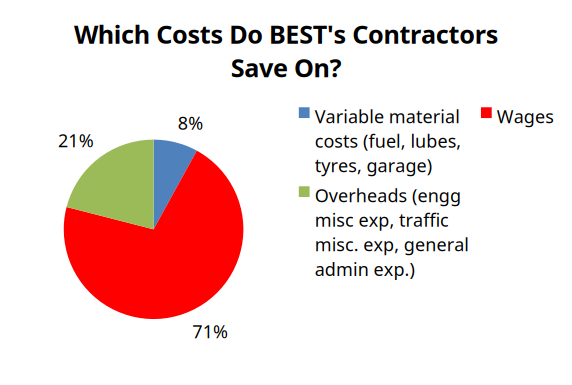
Source:RUPE, 2018.
(2) Even after making such ‘savings’, the winning bid would leave too small a profit margin to be attractive to any private investor. We estimated that the profit margin would be just 6.6 per cent, or lower than the interest on a bank fixed deposit; whereas any private investor would expect a minimum 20 per cent rate of profit.
Those who bid for contracts would have made careful cost calculations; why then would they make such bids? This implies that, in order to make adequate profits, contractors planned to underspend, either by depressing wages still further, or by skimping on maintenance costs – at the cost of the safety, reliability, and comfort of services. After winning the contract on the basis of an unsustainably low bid, a private firm might default on the expected quality of services, default altogether on providing services, or demand a revision in rates.
Unfortunately, these predictions have been borne out completely in the period since then. Our own exercise was based on the limited information we could obtain from BEST union contacts, but the BEST authorities had access to all the relevant data, and had an experienced engineering and planning staff. Thus the authorities would have known perfectly well what lay in store.[3] Why then did they choose to go down this path? RUPE claimed in its note that this was not a mere re-structuring of BEST; rather, “the actual policy package being implemented… is for a shrinking of BEST.” At the end, we will suggest the possible motive for this policy of shrinking.
Let us briefly list some of the main developments of the period of wet-leasing: poor maintenance leading to breakdowns; a steep rise in accidents; wage depression, wage theft and labour unrest; disruption of supply of buses, dislocation of services, and the shrinking of BEST.
1. Poor maintenance, breakdowns
The BEST maintained a Transport Engineering division to provide regular maintenance to its vehicles. It also kept rescue vehicles on standby for any breakdown. Contractors do not undertake such expenditures, as doing so would eat into their profits.
Thus, from the very outset of wet-leasing, there has been a steep rise in breakdowns, due to poor maintenance. We have it from the horse’s mouth. A BEST survey of five depots found that, between October 2021 and June 2022, the number of defects per month in one contractor’s buses rose 73 per cent, and the number of failures of turnout of buses from the depot rose by 90 times. BEST wrote to the firm (M.P. Enterprises) saying “you have defaulted [on] all the norms of service level.”[4]
That contractor was later terminated, but the problem has refused to go away. BEST officials admitted to Mumbai Mirror that the rate of breakdowns of wet-lease buses is three times that of BEST’s own buses.[5] Now that more than 90 per cent of the fleet consists of wet-lease buses, the higher breakdown rate results in large-scale disruptions. Stalled wet-lease buses are a common sight on Mumbai roads, as are crowds of stranded commuters waiting futilely for a replacement bus. Mumbai Mirror reports:
The core difference… lies in the maintenance model. For BEST-owned buses, the undertaking maintains its own century-old setup. The driver reports a fault, and mechanics attend promptly, often bringing the bus back into service within an hour. “With wet-lease buses, they are taken care of by the operators, any issues be it with tyre, mechanical, and electrical are taken care of by them,” said a BEST source…. More worryingly, records show instances of bus fires, allegedly caused by faulty batteries or electrical equipment, intensifying safety concerns.[6]
While BEST’s permanent workers refuse to operate a bus with defects, an AMAB survey found that contractor employees get penalised with heavy fines by their employers if they refuse to do so.[7]
2. Steep rise in accidents
BEST’s own staff are relatively experienced, and have received systematic and periodic training in safety. Over the years this has led to a steady decline in the rate of accidents to a low level (1 or less accidents per 10,000 km).
However, wet-lease operators’ model is based on low wages and low overheads; they neither hire experienced and qualified drivers, nor do they invest in training them properly. The BEST General Manager in 2023 admitted that “Most drivers of wet lease buses in BEST do not have the mandatory two-year driving experience”, and that this was “endangering life and property of commuters besides other motorists and pedestrians.”[8] Yet, three years later, the situation has not improved, indeed accidents are rising, and Sonia Sethi, the present General Manager now says that she has “directed staffers to have three weeks of compulsory on-road training and road safety training for all drivers.”[9]
In the absence of decent wages or job security, wet-lease drivers too have little incentive to exercise care or upgrade their skills. On the contrary, as an AMAB survey of contract workers found, contract drivers are under pressure to complete more trips, since the contractors get paid on the basis of kilometres completed.[10] As a result, contract drivers tend to drive recklessly.
Ms Sethi says “We have zero tolerance for bus fatalities”. But the outcome is not determined by “tolerance” levels, but by the policy. Between 2023-24 and 2024-25, injuries rose 53 per cent and a fatalities rose 43 per cent.[11] This included the notorious December 2024 incident in Kurla in which 9 pedestrians were mowed down by a wet-lease driver.
3. Wage depression, wage theft and labour unrest
BEST’s regular workforce had job security, decent wages, medical facilities, sick leave, casual leave, canteen and rest facilities at the bus stations and depots. Thus hardly any workers left BEST for better jobs elsewhere. They had a stake in the organisation; they gathered experience; they passed on their knowledge to new cohorts; and all this shaped the culture of the organisation and its relation with the public. This is not to idealise BEST workers – as with any other set of people, there were better and worse individuals among them. Rather, it is to bring out the material conditions and relationships behind the standard of service they provided. But it was precisely these material conditions and relationships that the Municipal Commissioner considered to be “subsidising inefficiency”.
As a result of wet-lease operators’ low wages and abominable labour practices, BEST experienced continuous labour unrest from the very outset. BEST wrote to M.P. Enterprses listing 10 strikes in different depots between April 2022 and July 2022. BEST warned: “despite regular payments made [to M.P. Enterprises] by the undertaking, the salary payments to your staff (PF, ESIC, etc) is not done regularly which may result in labour unrest and may ultimately affect the bus operation causing inconvenience to BEST commuters.”
Non-payment of the dues of workers was, in effect, part of the contractors’ business model. AMAB found that while salaries of surveyed workers were Rs 16,200-19,000 per month, (i.e., around half the salary of regular workers), penalties were systematically levied on workers for various reasons, with deductions ranging from Rs 2,000 to Rs 5,500 in a single month. Nine out of ten workers reported facing disciplinary action for various reasons. Wet-lease workers were denied canteen or rest facilities, medical facilities, and even bus passes(!).
This is not a story of bad contractors as such. As can be seen from the study, such conduct of the contractors is built into the very model being implemented by BEST.
Spontaneous strikes of wet-lease workers broke out in a number of depots during 2022-23. They culminated in a massive week-long strike of wet-lease drivers in most depots in August 2023, demanding parity in treatment with BEST’s own workers: wages, bus passes, medical facilities, and facilities for canteen and rest at depots. More than 80 per cent of buses went off the roads, resulting in massive commuter hardship. The strike was finally called off after some verbal assurances were given by the Chief Minister.
Nothing came of these assurances, and February 2025 saw another one-day strike by a section of wet-lease workers. In an August 2025 ballot of wet-lease workers, 98 per cent voted in support of a strike. In November the union announced an agitational programme, beginning with a hunger strike by the union leader. Discontent continues to simmer.
A different type of silent labour resistance is taking place too: workers are refusing to join wet-lease firms at the salaries on offer. “We definitely have a dearth of drivers,” said an official from Olectra Greentech, a wet-lease operator and bus manufacturer.[12] Olectra thus engages a labour supply firm to supply it drivers, thereby adding yet another layer between the worker and BEST.
Wet-lease firms are also hiring drivers from BEST by paying BEST Rs 1,200 a day per worker (the money goes to BEST, not the driver). These drivers are available because BEST has scrapped its fleet faster than it can retire its workers, and so it has a large contingent of idle drivers. Such is the bankruptcy of the entire policy.
4. Disruption of supply of buses, dislocation of services, shrinking of BEST
BEST’s earlier model for supply of buses was simplicity itself: BEST acquired buses from two major suppliers; it owned them and maintained them in its own dedicated engineering workshops; and it scrapped them after 15 years, to replace them with new buses.
BEST now instead awards contracts to private parties to supply electric buses on a wet-lease basis. That means the buses are owned by the private parties; thus if a private party fails to supply buses, or if it withdraws buses from operation, or if BEST terminates the contract, the fleet shrinks and BEST can do nothing about it.
BEST at present has a patchwork quilt of contractors: Olectra and Evey Trans; Maruti Travels; Tata Motors; Mateshwari Urban Transport; and Switch Mobility. Two types of problems which are inherent to the wet-lease mode tend to dislocate the entire bus system.
(i) The first is simple non-supply of buses on schedule. In May 2022, BEST gave Olectra/Evey an order for the supply of 2,100 buses by August 2023, to be operated for 12 years. This was perhaps the largest-ever order for electric buses in India. (Coincidentally, Olectra and Evey are subsidiaries of Megha Engineering, the single largest donor of electoral bonds to the BJP.) However, by July 2024 – almost a year after the deadline – Olectra had supplied less than 10 per cent of the order, pleading that it depended wholly on China for crucial parts such as the battery and the powertrain.
Just as it has a “zero tolerance” policy towards fatal bus accidents, BEST has a policy of “zero tolerance” toward delays in deliveries by private contractors, with similarly zero practical implication. In practice, BEST does not penalise firms for late supply or non-supply. Indeed, far from levying any penalty or terminating Olectra’s unfulfilled contract, BEST rewarded Olectra with an additional massive order of 2,400 buses in 2024.
By August 2025 Olectra had fulfilled just 30 per cent of the first order and 2 per cent of the second order. It is anyone’s guess when, and whether, the order will be fulfilled. But for BEST to cancel Olectra now would mean cancelling the bulk of its future fleet.
(ii) The second problem arises when, due to flagrant and persistent violations by the contractor, BEST is compelled to terminate the contract of specific wet-lease operators. This leads to a sudden withdrawal of buses, and thus a shrinking of the fleet.
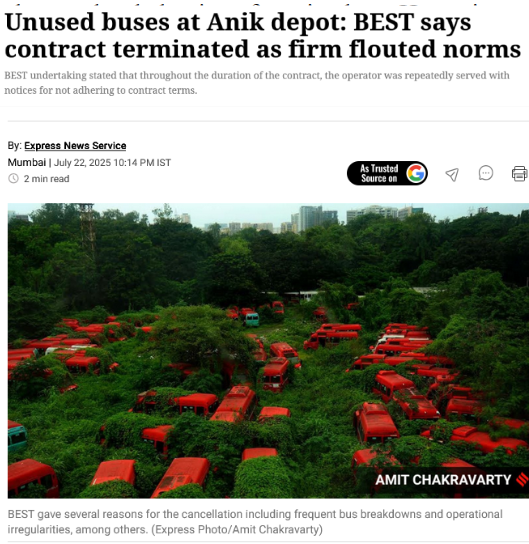
- In 2022 BEST terminated M.P. Enterprises due to frequent bus breakdowns, operational irregularities, failure to meet the service level agreement and Provident Fund contribution defaults; out went 285 buses from the system. The operator had ceased operating even prior to the formal cancellation of the contract, but then proceeded to file for insolvency. The National Company Law Tribunal appointed an Interim Resolution Professional (IRP), and the M.P. buses stationed at Anik depot are under the IRP’s control. The Indian Express published a photograph of the buses covered in lush vegetation (below), adding a whole new meaning to ‘green mobility.’[13]
- The Hansa Group’s performance was similarly so abysmal that the BEST was forced to make regular deductions from its dues. Hansa in turn terminated the contract in October 2025 over Rs 90 crore of unpaid dues, and demanded that BEST return its 280 buses. In November 2025 the Bombay High Court ruled in favour of Hansa, and forced the BMC to relinquish control of Hansa’s buses. Out went another 10 per cent of the fleet.
Thus the entire acquisition model of wet-leasing is unstable. One of the city’s two public transport lifelines (i.e., the suburban train system and the BEST) can simply be held hostage by private operators.
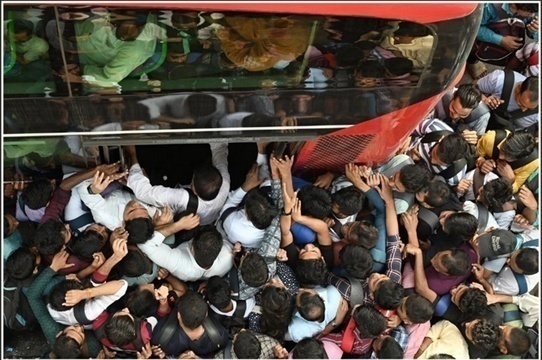
In December 2025 the wet-lease fleet was 2,494, and BEST’s own fleet was 249. However, since most of the wet-lease buses are smaller than BEST’s own buses, the present carrying capacity would likely be less than half that of 2011. The number of passengers per bus per day has now risen to over 1000.[14] In June 2025, a spot check by Times of India at various locations found that the frequency of bus service routinely dropped to 45 minutes.[15] Despite this, there are lakhs of commuters who take the bus, because they have no other option. This has led to unbearable crowding in many buses, captured by Satej Shinde’s prize-winning photo in Midday.
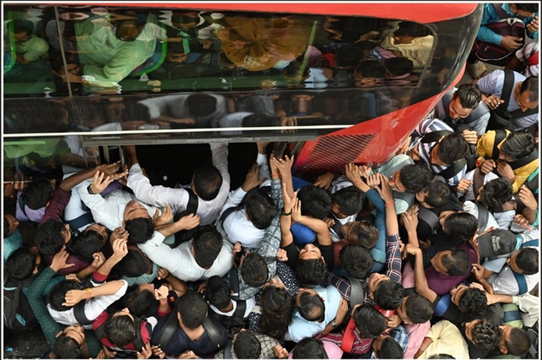
Satej Shinde, Midday.
BEST’s response to overcrowding has been ‘route rationalisation’ – the scrapping of routes with lower occupancy, in order to shift the reduced fleet towards the routes with higher occupancy. The General Manager said bluntly in June 2025 that “It is important to focus on profit-making routes and shut down loss-making routes.”[16]
Method in the madness
What we have been watching unfold in the period since 2018 appears on the surface sheer madness. BEST General Managers are changed every year or even after a few months; there are spells during which no officer is assigned the role, or it is assigned as an additional charge. Contracts are bungled, breakdowns and accidents mount, buses periodically go up in flames, services deteriorate. Routes are relentlessly ‘rationalised’, old ones are scrapped, new, truncated routes are introduced, bus numbers are changed to the point where experienced commuters are lost. Fares are doubled overnight, thereby pushing 7 lakh commuters (22 per cent of riders) out of the system at a stroke.[17] The BEST-owned fleet is set to sink to zero even as the wet-leased fleet itself is shrinking. Thousands of capable BEST workers are kept idle for lack of BEST buses.
“Though this be madness, yet there is method in ’t”, observed Polonius in Hamlet, and indeed the method here is not hard to find. The BEST bus division owns 312 acres of land in the form of depots, bus stations, and staff quarters, most of it in prime locations. All this land was once needed to park BEST buses, maintain and repair them, house the staff, and provide for future needs. However, if BEST no longer has a fleet of its own, no workshops of its own, and virtually no staff of its own, the land on which its depots, bus stations, and staff quarters sits becomes available for redevelopment or sale. The scale of the potential bonanza for builders is staggering.
Past exercises at redevelopment of BEST land such as the Mahim, Kurla and Oshiwara depots were no doubt profitable for builders, but BEST is yet to recover the promised Rs 300 crore revenue it was meant to receive from these projects. Those redevelopments were carried out in a manner which left hardly any space for buses; but as buses themselves disappear so too will that problem. Past redevelopment fiascos have not deterred BEST from tying up with the World Bank’s International Finance Corporation (IFC) as an advisor for redeveloping its depots, and in April 2025 the Maharashtra Chief Minister approved the redevelopment of bus depots at Bandra, Deonar and Dindoshi.
As Aamchi Mumbai Aamchi BEST has argued, one of the principal drivers of the entire project of destroying BEST is the desire to grab its land for private developers.[18] There are vast fortunes to be made on the grave of Mumbai’s once-loved public bus system.
The question is whether Mumbai’s citizens, in particular the millions who actually need to travel by bus and who suffer the consequences of these policies, will decide to resist, and find ways to do so.
Notes
1. Cited in RUPE, “BEST’s Decision to Contract-Out Bus Services Will Not Save Money, and is Harmful,” March 6, 2019, https://rupeindia.wordpress.com/2018/10/
2. Ibid.
3. The owner of one of the firms bidding for the contract contacted us after reading the study. In a telephone conversation, he conceded the facts and arguments advanced in the article, but nevertheless requested a meeting to persuade us of the benefits of the Public Private Partnership model.
4. Letter from BEST Chief Manager (Traffic) to M.P. Enterprises, September 2, 2022.
5. Aditi Thakur and N. Ganesh, “Wet-lease woes”, Mumbai Mirror, December 15, 2025.
6. Ibid.
7. AMAB Survey of Contract Workers, 2022-23, summarized in https://amchibest.wordpress.com/2024/11/19/privatization-of-best-an-unqualified-fiasco/
8. TNN, “Mumbai: Most wet-lease drivers in BEST lack required 2-year experience”, Times of India, July 7, 2023.
9. TNN, “Mumbai: Rash driving, contractual drivers blamed as BEST bus deaths rise 43% in a year”, Times of India, November 1, 2025.
10. AMAB Survey of Contract Workers.
11. TNN, “Mumbai: Rash driving”.
12. Shashank Rao, “BEST loans its excess drivers to wet-lease operators facing a shortage”, Hindustan Times, June 3, 2025.
13. Express News Service, “Vegetation covers unused BEST buses at Wadala depot”, Indian Express, July 21, 2025.
14. Somit Sen, “Challenge for BEST buses in Mumbai: Swelling crowds of 1K+ riders per bus”, Times of India, August 18, 2024.
15. Somit Sen, “TOI spot check reveals frequency of bus service can routinely drop to 45 minutes”, Times of India, June 16, 2025.
16. “BEST’s roadmap shows growth on services near Metro, rly stns” Times of India, June 3, 2025.
17. “BEST Earnings Go Up by a Crore Daily; Ridership Drops to 25 Lakh”, Times of India, August 12, 2025.
18. In fact an alliance of powerful interests shapes Mumbai’s transport planning. These include, apart from real estate developers, the automobile industry, the infrastructure industry, international and domestic consultancy firms, and political leaders tied to these interests. (See, for example, https://hussaindorewala.substack.com/p/the-real-estate-infrastructure-complex, https://hussaindorewala.substack.com/p/how-expert-consultants-justify-megaprojects, and https://countercurrents.org/2019/02/government-and-automobile-lobby-are-in-a-cosy-affair-while-public-transport-is-treated-like-filth/ .) However, this needs a separate discussion.
[Courtesy: Research Unit for Political Economy (RUPE), a Mumbai based trust that analyses economic issues for the common people in simple language.]