❈ ❈ ❈
Burkina Faso’s Government of Change Confronts Imperialism
W.T. Whitney
Captain Ibrahim Traoré, 34 years old, became the provisional head of Burkina Faso’s government after a military coup in September 2022. His government seeks to finish off the remnants of French colonial power, build economic independence, develop infrastructure, satisfy some of the population’s basic needs, and ward off U.S. intervention.
The lesson to be taken from happenings there is that in the Global South, national independence must be achieved before meaningful social change of aprogressive nature can take place.
There was mention of Traoré at an April 3 hearing in Washington held by the Senate Committee on Armed Services. Senator Roger Wicker commented on “the ruling elite of a country [in Africa] receiving gratuities on the side.” Responding, General Michael Langley, head of the U.S. Africa Command (AFRICOM), stated that, for “Captain Traore in Burkina Faso … gold reserves … are just in exchange to protect the Junta [sic] regime.”
Burkina Faso does envision other purposes for its gold. Langley’s remark provoked a wave of criticism in Africa and the United States.
AFRICOM’s Operation Flintlock involving 500 troops from 30 African nations took place in Ivory Coast from April 24, when General Langley was on hand, to May 14. On April 22 authorities there foiled a “major plot” to assassinate Traoré – one of many such attempts. Ivory Coast and Burkina Faso are not on friendly terms.
Traoré was in Moscow on May 10 for the 80th anniversary of the Soviet Union’s victory over Nazi Germany. He arrived on a Russian plane sent to Burkina Faso to bring him. At a meeting attended by high Russian officials, President Vladimir Putin assured Traoré of Russia’s cooperation in fighting terrorism, “restoring the rule of law,” strengthening trade, and educating Burkina Faso youth. Traoré spoke of defending against imperialism, providing science education and developing “our own production, industry, and engineering.”
Traoré studied geology at Burkina Faso’s University of Ouagadougou. He joined a Marxist student association. As a military officer he joined a United Nations peacekeeping force intervening in a civil war in Mali. He later led troops fighting Jihadist insurgents in Burkina Faso.
Traoré takes inspiration from Thomas Sankara, Burkina Faso’s coup-installed president from 1983 until his assassination in 1987. Marxist-oriented Sankara aligned with revolutionary Cuba and Nicaragua. His government advanced healthcare, education, literacy, agrarian reform, women’s equality and more.
Apollinaire Kyélem de Tambèla, a pan-Africanist with ties to communist and left-wing organizations, served as Traoré’s prime minister until his dismissal in December 2024. He had collaborated with Sankara in pursuing international solidarity.
Faso is located in Africa’s Sahel region, a band of semi-arid land south of the Sahara extending from the Atlantic to Eritrea on the Red Sea. France colonized all states in the region, except for Sudan and Eritrea. Their independence, granted in 1960, was flawed.
France maintained military bases in the Sahel and the CFA franc (franc of the French colonies in Africa) remains as the region’s currency.
France requires the various countries to deposit 50% of their currency reserves in the French treasury. Because the currency’s value is pegged to the Euro, individual countries cannot adjust exchange rates to stimulate industrial development. French overvaluation of the CFA franc makes for low purchase prices for exported goods and higher prices for whatever is imported. As a result, Burkina Faso supports its economy by exporting commodities derived from natural resources rather than by selling manufactured products or providing services.
Burkina Faso’s most bountiful exports are gold and raw cotton. The world’s 13th largest producer of gold, and the fourth largest in Africa, the country also exports copper, manganese, and zinc.
Beginning in 2013, The French military joined regional forces in fighting Jihadist insurgents. But, says one observer, “military assistance [to the French] discouraged African elites from pursuing reform or sharing power, while failing to halt rebel attacks.” U.S. military forces participate as “advisors.”
Meanwhile, military coups in Chad, Niger, Mali, and Burkina Faso hastened the departure of the French military. French troops will leave Senegal by the end of 2025. To strengthen mutual defense, Burkina Faso, Mali, and Niger formed the Alliance of Sahel States in September 2023. Four months later, the three nations broke away from the U.S.-inspired Economic Community of West African States. Traoré took a lead role in these transitions.
French oppression is one burden for Burkina Faso; stunted development of human potential is another. Life expectancy at birth is 61 years; expected schooling is 2.3 years. In most of Burkina Faso, 10% of children suffer from acute malnutrition. Infant mortality in 2022 was 50.1 deaths per 1000 live births; the world average that year was 28 deaths. The Human Development Index of the United Nations puts Burkina Faso at number 186 on its list of 193 countries.
The government has accomplished much since Traoré came into power. Observer Nicolas Jones, writing under the heading of “Nkrumah’s Africa”, summarizes:
He continued with his army salary and arranged for a 30% pay cut for government ministers and a 50% increase for civil servants.
Having expelled French troops fighting the Jihadists, Traoré mobilized the already-established Volunteers for the Defense of the Homeland, an auxiliary military force. Recruitment far exceeded expectations.
Burkina Faso has built a plant for producing generic drugs, a new cement plant, a new flour mill, and two tomato and two cotton processing plants. An “iconic” and inactive textile factory has been revived.
The government has distributed seeds, fertilizer and equipment to farmers; wheat production is expanding. Another report says mobile clinics are appearing throughout the country.
The government is building and repairing highways and is constructing the new “Thomas Sankara” airport near the capitol city Ouagadougou.
The government no longer takes loans from the World Bank and the International Monetary Fund.
According to intellinews.com, gold has been Burkina Faso’s top export since 2009, accounting in 2023 for 80% of the country’s export income and 22% of government revenues. Foreign companies formally owned and operated all of the country’s gold mines, allowing Burkina Faso a 10% equity share in each one. But Traoré’s government nationalized three of them and, collaborating with an outside mining company, began construction in 2023 of a gold refinery to capture additional income from gold.
A report states that the government, “clearly distancing itself from the West, has strengthened economic and security ties with Russia … and with China, a country that has made many investments in Burkina Faso.” According to Jones, Traoré attended a Russia-Africa summit meeting in 2023 and afterwards declared that the people of Burkina Faso support Russia and that Russia’s embassy would soon reopen. Russia will be building a nuclear plant in Burkina Faso.
A pattern appears. Burkina Faso first achieves and defends national independence and then pursues development and social justice. A similar two-stage process played out as Cuba, China, Vietnam, Laos, and North Korea made their socialist revolutions with communist parties. The sequence looks to be characteristic of social change in the Global South, to which these nations are assigned. (North Korea’s climate does not fit, but other features suggest an affinity).
After all, in the industrialized countries, principally Russia and the Eastern European countries, independent nationhood had existed so long as to not impinge on struggles for socialism. Those revolutions did not survive. Maybe the two-stage process, with the insertion of an independence struggle, improves chances that a socialist revolution will last, and maybe even that it happens in the first place.
Developments in Burkina Faso of course are far removed from advance toward a socialist society. But that kind of progression, quite improbable in Burkina Faso, surely registers with the imperialist powers watching over the country and will influence their course of action.
[W.T. Whitney Jr. is a retired pediatrician and political journalist living in Maine. Courtesy: CounterPunch, an online magazine based in the United States that covers politics in a manner its editors describe as “muckraking with a radical attitude”. It is edited by Jeffrey St. Clair and Joshua Frank.]
❈ ❈ ❈
In another article ‘Cpt. Ibrahim Traoré and the AES, Chapter 1: A Pan-African Rebirth’, Nicholas Jones adds (extract):
The Alliance of Sahel States is the new confederation in West Africa, made up of three nation states that are the modern-day successors to the once golden Malian Empire; Mali, Burkina Faso and Niger. They have the mandate to restore security to the region, a region terrorized by proxy extremist groups acting on behalf of the western powers that formerly claimed to be defeating them. Now, with sovereignty over their borders intact and facing the enormous challenge of providing security to an area that reaches around 2,760,000 km2 (making it the largest African country by area, 8th in the world); they can defeat terrorism with a united military backed by Russia, can take back their national resources and begin to industrialize the nation and can claim their position as a new visionary leader on the continent.
With these achievements in hand, they are influencing other African nations to join, them including the likes of potential new coastal member, Togo, or the recent cooperation of Nigeria (a massive turnaround for Tinubu), or the wonderful scenes of Ghana’s cooperation in pretty much all areas; Mahama seems to have a particular liking for Traoré. There are talks between the AES and Sudanese military, while Tanzania and Morocco are looking to get in on the action too with offers of cooperation in trade, agriculture, mining, education, health, etc. Morocco signed a regional agreement with AES so they could secure access to the Atlantic Ocean; essential given that they are all landlocked nations, while Tanzania, has brought a very specific proposal to the table, in terms of South-South knowledge transfer; the area of Cardiology. The Tanzanian Heart Institute is a world-leading institute and they are offering to train cardiologists for the provision of high quality healthcare back in Burkina Faso and the wider AES by default!
Map of West Africa and the AES
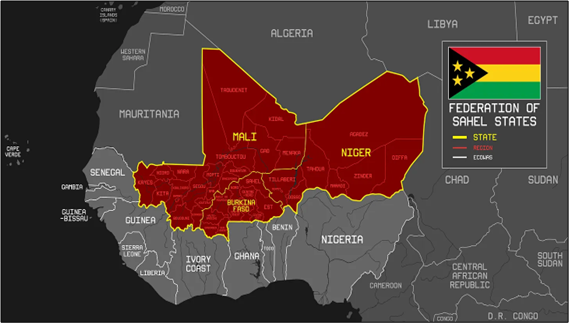
The AES is also implementing a plan for national development of the three countries. The AES have announced together, the creation of a single AES currency, a unified AES passport, a unified AES Flag and a collective AES military.
Here is a summary of the new initiatives taken by these countries, from another article by Nicholas Jones, ‘Cpt. Ibrahim Traoré and the AES, Chapter 2: The People, Industry and Economy’:
Mali, under General Assimi Goïta’s reign:
- Mali has cleared its national debt, signaling a new era of financial independence for the West African nation. It has become the first African nation to be debt free.
- Basic public services and key infrastructures have been restored in several cities of Mali.
- It has opened a new university, the Sikasso university, that recently welcomed its first students. Work is ongoing so that the universities of Kayes, Gao, Tombouctou, and Badiagara can be operational again.
- When General Assimi Goïta took over, he sold all the assets belonging to the corrupt elites & sent them to jail including former president’s son & Ministers.
- New plants are being set up in the country. A new Lithium Plant has been set up with the help of China, confirming Mali as a strategic player in the global lithium market.
- The government has renationalized a formerly privatized state owned firm – COMATEX, a textile manufacturer; it has restored cotton processing plant, and cotton production and processing is on the rise once again in Mali, allowing the country to reclaim the title of the biggest African producer of cotton.
- Several solar power plants are being set up across the country.
- The new government has arrested foreign gold smugglers and has dismantled illegal mining sites. His government is making a state owned mine for gold exploration as well, and the state will take ownership stakes in mines that foreign firms are operating in. Barrick Gold of Canada was recently bought out of their mining operations in Mali. Under the terms of the deal, Barrick Gold agreed to pay about $438 million to Mali. Barrick’s Mali mine shutdown follows gold confiscation worth $318 million.
Burkina Faso, under Captain Ibrahim Traoré:
- Unprecedented anti-corruption reforms have been implemented in the administration.
- Several new industries have been set up to aid agriculture by processing agricultural produce, such as a Cashew Processing Plant and Cotton Processing Plant, a Tomato processing factory, milk processing plants, and wheat flour factory.
- Several steps have been taken to yield agricultural output, such as setting up a company to manufacture fertiliers, procurement of agricultural machinery – all these have helped significantly increase agricultural output, with farmers now getting more value for their crops due to increase in domestic processing facilities.
- Local textile mill has been set up. Till now, even childrens’ uniforms were imported, now a wide range of textiles are being made in the country.
- Cement factory has been set up, and road construction has accelerated in the country – aiming to build 5000 kms of paved roads per year. It’s worth noting that the entire country had only 3000+ kms of paved roads since independence up to the present day (more than 60 years).
- New public transportation buses are being procured; a new company has been set up, called Faso Rail, for the manufacturing of train rails.
- Hospitals and medical centres are being set up in rural areas. A Polytechnic University is being built.
- A new airport is being built. The main stadium in Burkina Faso was shut down for almost 5 years; it has been renovated and reopened.
- A big and modern business center is under construction, in the national capital.
- An electric car company is coming up in the private sector.
- The state company distributing fuel in Burkina has been revamped and its storage capacity has been significantly increased by building new facilities.
- Gold mines have been nationalised and Burkina Faso’s first Gold refinery is under construction.
- The army has been restructured and is being modernised.
Niger, under President Abdourahamane Tchiani:
- The government has nationalised the uranium mines, previously controlled by French company Orano. Before the 2023 military coup, Niger earned just about $1 billion USD annually from its vast uranium reserves, despite being one of the world’s top suppliers. Most of the profits went to foreign companies, especially French-owned Orano, under long-standing contracts dating back to colonial times. As a result of these changes, Niger reportedly stands to earn over $300 billion from its uranium sector in the coming years—a massive economic transformation.
- Niger has signed an agreement with Suvarna Royal Gold Trading LLC, an Emirati company, to establish the country’s first gold refinery and gemstone processing units in Niamey. This partnership will result in the construction of a gold refinery, jewelery manufacturing unit, and gemstone cutting and polishing center in Niger.
- A total trade ban has been imposed on export of sheep, goats, cattle, and camels. This is to support domestic food prices.
- A new 2,000 km oil pipeline has been constructed with Chinese help, linking Niger’s southeastern oilfields to the port in Benin. Oil exports could eventually account for 25% of Niger’s GDP and contribute half of the country’s tax revenues.
- Due to all these economic changes, in under two years, over 260,000 Nigeriens have risen out of poverty.
- Niger has also begun manufacturing its own military vehicles.
(Courtesy: Nicholas Jones’ substack on African geopolitics and Pan-African history, Nkrumah’s Africa.)