❈ ❈ ❈
India’s Budget 2026-2027 Overlooks Poor and Jobless, Instead Has Sops for Private Sector
Prabhat Patnaik
Since even the highest bourgeois oracle, the IMF, has cast doubts on the veracity of India’s GDP estimates, the precise budget figures based on the assumptions of a certain level, and growth rate, in nominal GDP, mean very little; in fact, the current budget, while announcing several tax measures, has not even bothered to give estimates of how much revenue loss or gain they would cause. Nonetheless, from the budget figures one can get a sense of the strategic direction of the budget; and, this, not surprisingly, is a totally perverse one in the context of the current state of the Indian economy.
The most pressing problems of the Indian economy at present are: the phenomenal rise in economic inequality, whose magnitude now is higher than at any time during the last one hundred years; the massive increase in absolute poverty as initially defined by the Planning Commission by taking into account a daily calorie-intake norm; and the enormous increase in unemployment which now even afflicts a vast chunk of the country’s educated youth. The one common solution to these problems is to put large amounts of purchasing power in the hands of the common people, which, if the fiscal deficit percentage in the GDP is not to increase, can be achieved only through a significant tax-mobilisation effort at the expense on the rich. This would raise the level of aggregate demand in the economy via a rise in consumption demand, and that too for more employment-intensive commodities, leading to greater output and employment and also to an amelioration of poverty; it would also reduce income inequality since the share of post-tax incomes of the rich would be lower than otherwise.
The perversity of the budgetary strategy however lies in its taking a direction that is exactly the opposite of this. The total tax revenue as a percentage of GDP, far from showing any increase, shows a marginal decline from 11.5 in 2023-24 and 2024-25 and 11.4 in 2025-26 (RE) to 11.2 in 2026-27. And this is supposed to be accompanied by a reduction in the fiscal deficit from 4.8 percent in 2024-25 and 4.4 percent in 2025-26 (RE) to 4.3 percent. Within the total expenditure that is so constrained, by the government’s refusal to either levy heavier taxes on the rich or to raise the fiscal deficit, there is a rise in capital expenditure whose percentage in GDP has gone up from 4.0 in 2024-25 and 3.9 in 2025-26 (RE) to 4.4 in 2026-27.
Even this rise in capital expenditure however is illusory. The central government’s own capital expenditure which was 3.2 percent of GDP in 2023- 24 and 2024-25 and fell marginally to 3.1 percent in 2025-26 (RE) is supposed to remain at 3.1 percent in 2026-27; what is supposed to increase is Grant-in-Aid for the Creation of Capital Assets, from 0.8 percent in 2024-25 and 0.9 percent in 2025-26 (RE) to 1.3 percent in 2026-27. But this last item includes allocation under the MGNREGS, whose funding has now to be shared between the central and state governments on a 60:40 basis, instead of the 90:10 earlier; this means that if the state governments which are starved of funds cannot raise the required resources, which would be difficult for them, then the centre will not have to spend the amount it had originally earmarked. It will then not have to undertake the expenditure that it shows in the budget and will at the same time shift the blame conveniently on to the state governments for the collapse of the programme, even though the state governments were not a party to the 60:40 decision in the first place; this decision was unilaterally and entirely arbitrarily taken by the centre and simply imposed upon them.
This indeed is what the pretentious term “cooperative federalism” has come to mean. The centre unilaterally decides on the resources of the state governments and their responsibilities, and uses this fact to play favourites among states, being partial, needless to say, to the BJP-ruled ones, squeezing the non-BJP-ruled ones, and blaming the latter for their alleged “non-performance”. The 14th Finance Commission chaired by Y V Reddy had recommended that the share of state governments in the divisible pool should be raised from 32 to 42 percent by 2020. But the central government resorted to cesses and surcharges, which are not shared with the states, rather than to taxes proper, which are shared, in order to ensure that the share of states in total tax revenue (including cesses and surcharges) is no more than 34 percent; this is an illicit act of effectively centralizing resources.
Even with such duplicity however the central government’s expenditure is slated to remain constant (if Aid for Creating Capital Assets remains lower than budgeted for reasons already mentioned), or rise somewhat, as a share of GDP. This however is totally incapable of overcoming the three immediate crises of the Indian economy mentioned earlier. In fact, on the whole, capital expenditure by the Centre is less employment-generating than transfers to the people. This is because the wage component in infrastructure expenditure, which is at the core of capital expenditure, is just a fraction of the total, while the entire amount of the transfer to the people is analogous in its effect to a de facto wage payment; and of course if the resources devoted to infrastructure investment are spent instead on employing teachers in schools, colleges and universities, which are currently grossly understaffed, or in increasing the staff of government healthcare facilities, then the direct effect on employment and the second round multiplier effects because of the demand created by those newly-employed, would be far more significant.
The budget therefore not only does nothing to reverse the trend towards increasing unemployment and poverty, but it actually does the very opposite: by providing tax concessions to the private sector (including to multinationals in order to attract direct foreign investment) on the one hand, and raising further the weight of infrastructure expenditure at the expense of directly employment-generating expenditure (such as teachers’ salaries) and transfers to the people.
The simple fact that the government appears unaware of is that private investment occurs only in response to growing demand. No amount of tax concessions will induce capitalists to invest if the capacity created by such investment is likely to remain unutilized. This incidentally is why despite all previous tax concessions, including even such massive ones like the lowering of the corporate tax rate in 2019, private investment continues to remain sluggish. Likewise, in a period in which the world economy has slowed down, and with it investment in general, to expect that direct foreign investment will flow into the Indian economy if only the multinationals have to pay lower taxes is absurd; and to believe this when Trump is raising tariffs to prevent investment outflow from the US is even more so.
Matters are going to become worse for the people for two additional reasons: the first is the coming to an end of the 5 kg of foodgrains per person per month in 2027. This has been a life-support in rural India and its end will bring great misery. The second is the trade agreements being signed, including now even with the U.S. This latter agreement, if reports are to be believed, will allow the U.S. to impose 18 percent tariffs on Indian goods while India allows duty-free imports to American goods; such an “unequal treaty” will cause great hardship to Indian agriculture, especially the dairy sector. But a fascistic government is more concerned with projecting an image of benignity to the people than with actually improving their condition.
The difference between 1930s fascism and the current fascistic governments is underscored by this budget. In the 1930s, there was a massive increase in fiscal deficit in the fascist countries to boost military expenditure, which increased greatly the level of aggregate demand and got those countries out of the Great Depression; in addition, this increase in government spending was not confined to infrastructure investment such as building autobahns and purchasing military hardware, but also encompassed an increase in the size of the armed forces, which directly increased employment.
Contemporary fascistic governments like our BJP-led one, neither can enlarge the fiscal deficit to increase aggregate demand, nor have any appetite for increasing direct recruitment of people, or making transfers to them, as distinct from merely spending more on infrastructure. They fail on both counts as far as enlarging employment is concerned. Their resort to “hatred-mongering” therefore is likely to increase many-fold in the months to come.
[Prabhat Patnaik is Professor Emeritus at the Centre for Economic Studies and Planning, Jawaharlal Nehru University, New Delhi. Courtesy: Mainstream Weekly, a current affairs weekly published from New Delhi. It was founded in 1962 by the doyen of Indian journalism, Nikhil Chakravartty, who played an exceptional role in defence of press freedom through the columns of this journal. It is now an online weekly edited by Sumit Chakravartty along with Harsh Kapoor, the Executive Editor.]
❈ ❈ ❈
Union Budget 2026-27: A Road to Nowhere
Arun Kumar
The finance minister’s longish speech after the longest Economic Survey 2026 is puzzling to say the least. The Economic Survey after arguing that the economy is in a Goldilocks moment flagged the many challenges that it faces. These are little different from what the critics have been pointing to for the last many months. In a sense there is consensus as to the challenges that need to be addressed.
The Union Budget was the right vehicle for addressing them. That is what a budget is supposed to do. Take care of the problems plaguing the economy currently and provide solution to challenges that may develop. But the current budget does neither. It is long on promises but not on action that is needed. Why does the budget miss this opportunity? Is it because of a lack of clarity or a deliberate choice to let things drift?
The issues facing the economy are both external and internal. Not only world trade is disturbed, capital flows into India have declined thereby weakening the balance of payments and devaluing the rupee vis-a-vis the dollar. This raises the inflationary pressure. And, the uncertainty that has followed has further weakened the investment sentiment of Indian investors. The problems with exports threatened by Trump’s protectionist tariffs have aggravated the demand problem in the economy which was causing a slowdown of private investment.
Inadequate demand has been caused by the rising inequality which in turn is a result of the growing gap between the organised and the unorganised sectors of the economy. The little growth in the economy is largely cornered by the organised sector and the well-off in the country leaving hardly anything for the marginalised sections – farmers, workers, women and educated youth.
The Union Budget had a clear choice – continue on the path being followed or change the policy of boosting the organised sector to promoting employment generation in the unorganised sector. That would raise incomes of the marginals and demand in the economy would pick up.
Given that in the present global scenario exports and foreign investment are uncertain, the focus needs to shift to the internal market. That would require government helping enhance demand and pursuing more equitable policies.
Demand issue
For boosting demand the budget should have increased expenditure as a share of the GDP. But, this is estimated to be 13.6% in 2026-27 compared to 14.2% planned in 2025-26 and 14.3% in 2024-25. The next item for boosting demand is the primary deficit which is also slated to decline to 0.7% compared to 0.8% in 2025-26 and 1.4% in 2024-25. So, no additional boost from either of these.
Agriculture is the largest employer and where the largest number of poor are located. It needed a boost. In the current year, expenditure on agriculture and allied activities has been cut from an estimated Rs 1,58,838 crore to Rs 1,51,853 crore. For the next year it is increased only by about 2% which barely covers inflation. For rural development, Rs 2,65,817 crore was planned but expenditure is likely to be Rs 2,12,750 crore – 20% less. For next year it is raised to Rs 2,73,108 crore – 3% more.
These cuts also reflect in specific schemes. For instance, in the Jal Jeevan scheme instead of Rs 67,000 crore only Rs 17,000 crore is to be spent. For housing scheme (PMAY) instead of Rs 54,832 crore, Rs 32,500 crore is being spent. Like this, for dozens of centrally sponsored schemes and major central sector schemes, allocations are made but expenditures are less. Then again for presenting a glowing picture of the government, provisions are increased but not spent.
All this reflects in lower allocations for the unorganised sector and that is where employment and incomes are lacking and which leads to demand shortage in the economy. Clearly, this sector is accorded a low priority. This is the case in this budget also, in spite of the mention of MSME and support for the micro sector.
Promises not backed by allocations
The budget speech began with self-praise that the economy is doing well. If that is accepted then nothing new or dramatic needs to be done. That is what is visible in the budget. Lots of pronouncements and promises but little action.
There is talk of Atmanirbharta, Yuva Shakti and three Kartavya. This is said to require a supportive ecosystem consisting of ‘momentum of structural reforms, robust and resilient financial sector and cutting-edge technologies, including AI applications’.
But what do all these fine sounding clauses and terms imply. What changes are being made and how much of resources are being allocated to them. This budget is short of funds so for many schemes no resource allocation is mentioned. Like for five university townships, setting up of girls’ hostels, Bharat-VISTAAR scheme or the SHE-Marts.
Mindset change needed
The details of these new schemes are not available. For instance, setting up of universities is a good idea to boost our woeful R&D. But, when the ruling party is destroying our existing good universities through systematic interference in their functioning and starving them of funds for research then can one believe that the new universities will be treated better.
Similarly, given our attitude towards women and girl child, would SHE-Marts help. A mindset change is needed for these schemes to be transformative. How is this mindset change to occur? Not by budgetary announcements. A social change is required but we are moving in a contrary direction.
Paucity of data in the speech is reflected in lack of numbers in part B of the speech also. Taxation proposals are given without numbers. The implications of the large number of tax proposals is not given. How much revenue will be gained or lost is usually given but not in this budget speech.
Plan for high speed rail corridors has been announced. Our bullet train has been languishing for close to 10 years. The announcement reflects the skewed priorities and mindset. These will be very expensive travel modes like the Vande Bharat sleeper trains whose fares are close to air fares and which can only be afforded by a few per cent of the population.
Presently the general trains transport millions in atrocious conditions. Many more of these general trains are needed but instead elite trains are being proposed for a few. High speed corridors will also make markets in the hinterland accessible to the organised sectors, further damaging the unorganised sectors.
In brief, the Union Budget 2026-27 lacks a clear vision which will neither resolve the current problems faced by the economy nor will it help meet the global challenge ahead.
[Arun Kumar is a retired professor of economics and the author of Indian Economy’s Greatest Crisis: Impact of the Coronavirus and the Road Ahead. 2020. Courtesy: The Wire, an Indian nonprofit news and opinion website. It was founded in 2015 by Siddharth Varadarajan, Sidharth Bhatia and M. K. Venu.]
❈ ❈ ❈
Union Government Is Still Taxing Individuals More Than Corporations
The Wire Staff
The share of government revenue from income tax (tax on individuals) is once again higher – at 21% – compared to that from corporations – at 18%. This reflects the trend in the last decade where India’s tax regime has tilted in favour of corporates and indirect taxes.
In 2019, the government had reduced corporation tax rates to 22% for existing domestic companies and 15% for new manufacturing companies.
The Budget at a Glance document shows that while the budget estimate for corporation tax for 2026-27 is Rs 12,31,000 crore, that of taxes on income is Rs 14,66,000 crore.
In comparison, the budget estimate for corporation tax in 2025-26 was Rs 10,82,000 crore against that of taxes on income at Rs 14,38,000 crore. The revised estimate for corporation tax in 2025-26 was Rs 11,09,000 crore while that of taxes on income was Rs 13,12,000 crore.
An analysis by PRS Legislative Research shows that between 2000-01 and 2023-24, corporation tax grew at an annualised rate of 15% and personal income tax at the annualised rate of 16%. The contribution of income tax to the total direct tax increased during this period. In 2023-24, it constituted 53% of total direct taxes, up from 47% in 2000-01.
The key highlights of the 2026-2027 Union budget show that borrowings and liabilities make up the highest share of the government’s income at 24%, followed by income tax at 21%.
Corporation tax contributes 18%, GST and other taxes contribute 15%, followed by non-tax revenues (10%), Union excise duties (6%), customs (4%) and non-debt capital receipts (2%).
The government’s expenditure share on the other hand shows that states’ share of taxes constitutes 22%, followed by interest payments (20%), central sector schemes (17%), defence (11%), other expenditures as well as finance commission & other transfers at 7% each, followed by major subsidies (6%).
Over the last decade, India’s tax regime has favoured corporates and indirect taxes. Corporate tax rates fell from 30% to 22% for domestic firms and to 15% for new manufacturers, yet collections declined from 3.5% to 2.8% of the GDP. Meanwhile, GST revenue more than doubled from Rs 4.4 lakh crore to Rs 22.08 lakh crore in the last five years, with a year-on-year growth of 9.4%.
This skewed taxation regime has led to widening inequality. The World Inequality Report 2026 shows that India is one of the most unequal countries in the world. “The top 10% of earners capture about 58% of national income, while the bottom 50% receive only 15%. Wealth inequality is even greater, with the richest 10% holding around 65% of total wealth and the top 1% about 40%,” the report says.
[Courtesy: The Wire, an Indian nonprofit news and opinion website. It was founded in 2015 by Siddharth Varadarajan, Sidharth Bhatia and M. K. Venu.]
❈ ❈ ❈
Budget 2026-27: Four Key Ministries That Shape Jobs, Health and Education in India
Pragya Singh
Going by the allocations announced by finance minister Nirmala Sitharaman in Budget 2026-27, India is running to stay where it is. Across employment-intensive sectors such as agriculture and textiles and core services like health and education, the latest budget shows little reform or push for meanigful expansion in capacity or productivity. Instead, for the most part, the funding seen in FY 2024-25 is only restored by the latest numbers – two years down the line.
Ministry of agriculture
Actual expenditure on agriculture in 2024-25 was Rs 1,29,933 crore, while budget 2026-27 allocates Rs 1,30,561 crore. That is a gross increase of only around Rs 628 crore – a 0.5% nominal growth, marked over two full years.
Once inflation is factored in, the 2026-27 spending will effectively remain flat or lower in real terms compared to 2024-25. In other words, the budget for agriculture is barely crawling back to levels seen two years ago, not rising meaningfully.
This is almost certainly a real-term decline once inflation will be factored in.
Core farm spending
Core spending is down and there is a pullback in direct farmer income. The flagship PM-KISAN scheme and the key crop insurance scheme have both been cut back. The allocation for PM-KISAN is down from Rs 66,121 crore to Rs 63,500 crore, an over Rs 2,600 crore cut over two years, though unchanged from the previous year.
Crop insurance (PMFBY) allocation is also down, from Rs 14,473 crore to Rs 12,200 crore, another Rs 2,200-plus cut over two years – and a Rs 200 crore cut over the last budget.
There are increases in funding for items within the agriculture ministry, but they are targeted and relatively small compared to the big cuts. For instance, total capital outlay is up from Rs 75 crore to Rs 110 crore, a 46% hike, but tiny in absolute terms.
The Rs 5,600 hike in the Krishionnati Yojana (it provides extension services, seeds, soil health, mechanisation, plant protection and so on), a significant addition, along with the symbolic capital outlay hike, make for a total increase in state-level schemes for 2026-27 to Rs 7,748 crore.
Agriculture research
The actual expenditure in 2024-25 on agricultural research, which was about Rs 9,811 crore in 2024-25, has been elevated to just over Rs 9,967 crore in 2026-27, or by about Rs 156 crore over two years. That is a 1.6% nominal growth, again implying a real-term decline.
Altogether, agricultural research and development stands cut by Rs 519 crore. The budget of premier agriculture research body ICAR has been cut by Rs 94 crore for 2026-27. But central agricultural universities have been given an additional Rs 132 crore .
There is a strong indication that money is being moved around within the sector rather than being added.
Where is the expansion from?
Relative to the revised estimates in FY 2025-26, the 2026-27 budget does expand agriculture expenditure. However, most of the increases are primarily due to the earlier mentioned Krishionnati Yojana. PM-AASHA is also up from Rs 6,941 to Rs 7,200 crore, an increase of roughly Rs 560 crore in a year and about Rs 1,763 crore since 2024-25.
But elsewhere, there is either stagnancy or cuts: PM-KISAN is flat at Rs 63,500 crore, crop Insurance (PMFBY) is slightly cut and crop husbandry has made a marginal recovery from Rs 75,387 to Rs 76,387 crore (but still below 2024-25 levels).
Why this matters: Agriculture
Agriculture supports around around 15 crore farming households in India, accounting for livelihoods of roughly 50 crore people (close to 45% of the workforce), even though the sector contributes only about 15% of national GDP. In other words, a small share of the national income supports a big section of the population, which is why agriculture is politically sensitive, quite apart from the fact that food is produced on farms, as is raw material for many industrial sectors.
The average monthly income of an agricultural household is estimated at about Rs 10,000-12,000, derived from cultivation, livestock, wages and non-farm activities. This figure is what the small and marginal farmers – who constitute more than 85% of holdings – make in India.
It is for this reason that the government had found massive support for its direct income support schemes such as PM-KISAN, which were meant to provide Rs 6,000 per year per farmer (below a threshold of land holding and income). It is an income stabiliser, though still a small share of annual farmer household earnings.
Ministry of Health
Unlike agriculture, health shows a clear nominal expansion in budget 2026-27 – but largely in terms of the headline numbers. Compared with FY 2025-26 (Revised Estimates), health spending has increased by about Rs 8,800 crore. Compared with FY 2024-25 actuals, the increase is about Rs 14,400 crore.
The National Health Mission allocation has gone up from about Rs 37,100 crore to Rs 39,390 crore in the latest budget – after a dip in actual expenditure last year. Overall, Centrally Sponsored Schemes have risen from about Rs 50,468 crore to Rs 55,305 crore, an addition of roughly Rs 4,800 crore.
The Ayushman Bharat PMJAY allocation has been increased from about Rs 9,000 crore to Rs 9,500 crore, a modest increase of just over Rs 500 crore over a year and of just over Rs 2,000 crore over two years. Similarly, the National Health Mission increases from about Rs 37,100 crore to Rs 39,390 crore, adding around Rs 2,300 crore – a correction after a dip in actuals over the last financial year.
Capital spending allocation also recovers in 2026-27 after dipping in the RE year, especially in medical and public health infrastructure.
However, even with the overall increases, the allocation for the Family Welfare department within the ministry of health remains below its 2024-25 level. Some central schemes fluctuate or stay flat rather than rise steadily.
Allocation for the department of family welfare within the ministry is also subdued, at about Rs 1,525 crore, still below its FY 2024-25 level and only marginally higher than the RE.
Health research
The Department of Health Research remains a very small component of public spending, even in the current Budget. Net expenditure has risen from about Rs 3,384 crore in 2024-25 (actual) to Rs 3,928 crore in 2025-26 (Revised Estimate) and then to Rs 4,821 crore in 2026-27 (Budget Estimate).
In absolute terms, this is an increase of roughly Rs 1,440 crore over two years, and about Rs 890 crore over the RE year, very modest for India’s size and disease burden.
Most of this increase is concentrated in grants to the Indian Council of Medical Research (ICMR), which move from about Rs 3,150 crore in 2025-26 to Rs 4,000 crore in 2026-27. While this looks significant within the department, it still leaves India’s premier public health research body operating at a scale that is small relative to national needs and international comparators.
Why this matters: Health
Public health spending matters because health outcomes directly shape labour productivity, household savings and inequality. Even modest illnesses push lakhs of Indians into debt each year, while weak primary and preventive care raises long-term fiscal and social costs.
Ministry of textiles
The Ministry of Textiles budget does not show a steady expansion – the allocations are well below what would be expected for a sector positioned as a mass employment engine that faces global headwinds as well as local (regional) competition.
Allocations grew for the sector from about Rs 2,938 crore in 2024-25 (actual) to Rs 5,767 crore in 2025-26 (Revised Estimates). This falls back in the latest budget to about Rs 5,279 crore. Spending might increase as the year goes on, but this makes the current budget a partial pullback from the RE year.
The flagship initiatives such as the allocation for Performance-Linked Incentive scheme (PLI) for textiles is roughly flat at about Rs 405 crore, far below its initial peak of Rs 1,148 crore in 2025-26 (Budget Estimate), which then dropped to Rs 400 crore in 2025-26 (Revised Estimate).
PM-MITRA – a scheme to set up large, integrated textile parks – has been restored to Rs 300 crore after a dip to Rs 200 crore in the revised estimates for the previous year.
Why this matters: Textiles
Textiles matter because they are among India’s most labour-intensive manufacturing sectors and one of the few with the potential to absorb workers leaving agriculture, particularly women and semi-skilled workers. As global supply chains diversify and competition from countries like Vietnam and Bangladesh intensifies, policy and fiscal support is critical, but virtually absent.
Ministry of education
Most big heads in school education had cuts or slowdowns in 2025-26 and the 2026-27 budget simply brings them back to where they were supposed to be. Samagra Shiksha, PM-POSHAN and PM-SHRI all flagship schemes, show this dip-and-rebound trend.
The Department of School Education and Literacy budget has been increased to about Rs 83,562 crore in 2026-27 (Budget Estimate). This is a net rise of roughly Rs 18,400 crore over two years and of about Rs 13,000 crore over the previous financial year.
Samagra Shiksha, the largest programme under the ministry, falls in the RE year (from about Rs 41,250 crore to about Rs 38,000 crore) and then rebounds to about Rs 42,100 crore in 2026-27. Again, this only brings it back to its earlier trajectory rather than breaking new ground.
PM-POSHAN follows a slightly different pattern, rising from Rs 10,600 crore in the RE year to Rs 12,750 crore. (Its actual expenditure in 2024-25 was Rs 9,903 crore.)
However, the allocation is still modest considering the scale of the malnutrition crisis in India.
Higher education
On higher education, the spending has risen but a signal that meaninfgul change is underway is not to be seen or heard. The net expenditure increased from about Rs 45,576 crore in 2024-25 (actual) to Rs 51,382 crore in 2025-26 (RE) and Rs 55,727 crore in 2026-27 (BE).
This is a gain of roughly Rs 10,150 crore over two years – and just about Rs 4,000 crore over the previous year. Most of this hike goes to central institutions like central universities, IITs, NITs and IIEST.
Research-related spending increases from a very low base, with allocations rising to about Rs 418 crore, very marginal relative to the overall higher education outlay.
Why this matters: Education
Education spending matters for long-term productivity and India’s ability to convert its demographic profile into economic gain, especially as learning outcomes come under pressure and malnutrition, dropouts and skill mismatches rise.
[Courtesy: The Wire, an Indian nonprofit news and opinion website. It was founded in 2015 by Siddharth Varadarajan, Sidharth Bhatia and M. K. Venu.]
❈ ❈ ❈
Budget 2026-27: If India Borrows More to Spend, Why Does It Deliver Less Welfare?
Deepanshu Mohan
Union Budget 2026-27, which the government claims is anchored in a formidable macroeconomic stance, estimates total government expenditure at Rs 53.5 lakh crore and capital expenditure at Rs 12.2 lakh crore. It signals a delicate balancing act – a gradual fiscal deficit reduction to 4.3% of GDP alongside a proposed marginal improvement in the debt-to-GDP ratio of 55.6% – though that looks like a long shot.
An even larger question persists: How much of this ambitious game of projection will translate into actual developmental and welfare spending with measurable progressive social outcomes?
Fiscal anatomy of welfare expansion
A closer reading of the budget, shifting away from headline allocations towards fiscal realism, is warranted in this context. The new Budget Estimate (BE) for FY 2027 places education at Rs 1.39 lakh crore, health at Rs 1.05 lakh crore, agriculture and allied activities at Rs 1.63 lakh crore, social welfare at Rs 62,326 crore and rural development at Rs 2.73 lakh crore.
When read against the persistent adjustments of the Revised Estimates (RE) over the BE in previous years, these figures highlight a familiar pattern – visible nominal increases are made in the budget, but they do not always translate into commensurate expenditure – or developmental gains.
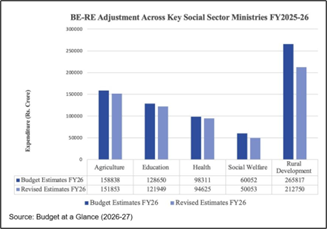
Across major welfare ministries, revised estimates have been falling short of budget estimates – less is being spent than the government has been allocating. This indicates that budget formulation is consistently more ambitious than the annual revenues and cash balances allow the government to be.
In FY 2026, rural development contracted from a budget estimate of Rs 2.65 lakh crore to a revised estimate of Rs 2.12 lakh crore, a 20% adjustment. Social welfare declined from Rs 60,052 crore to Rs 50,053 crore, education from Rs 1.29 lakh crore to Rs 1.22 lakh crore, health from Rs 98,311 crore to Rs 94,625 crore and agriculture from Rs 1.59 lakh crore to Rs 1.51 lakh crore.
This closely replicates a pattern in the two previous financial years, 2025 and 2024, when mid-year rationalisations reduced allocations across these sectors.
This is an indication of expenditure realism that takes over between the political signaling – allocations made in the budget – and the actual expenditure at the level of schemes. For instance, the allocation for MGNREGS rose to Rs 86,000 crore in the revised estimates of FY 2024 but, despite rural stress, it remained unchanged at Rs 86,000 crore in both the BE and RE of FY 2025 – no growth despite sustained demand.
In FY 2027, MGNREGS has been subsumed under the Viksit Bharat Gramin programme, for which the budget estimate is Rs 95,692 crore. While the headline allocation appears higher, the shift in programme architecture makes year-on-year comparison difficult. The apparent hike does not indicate a substantive expansion in rural employment guarantees.
The macro context reinforces this situation. In FY 2026, inflation moderated sharply to 1.7% (April-December), but in the preceding years, inflation was materially higher – at 6.7% in FY 2023, 5.4% in FY 2024 and 4.8% in FY 2025. However, because nominal allocations for major schemes did not rise correspondingly, the real value of support has thinned over time, even if the current inflation environment has turned favourable.
In other words, the government did not increase budget allocations enough to keep up with rising prices. Therefore, the real buying power of welfare spending quietly shrank over time.
Meanwhile, welfare spending is being squeezed because a growing share of the budget is already locked into unavoidable expenses such as interest payments, leaving little room to expand support. Interest payments alone increased from Rs 11.37 lakh crore in FY 2025 (RE) to Rs 12.76 lakh crore in FY 2026 (BE), absorbing a significant share of revenue expenditure and limiting room for discretionary welfare expenditure.
According to the Economic Survey, 2026, GST collections remained historically high in absolute terms – Rs 22.1 lakh crore in FY 2025 (April to March). However, but growth moderated from 11.7% in FY 2024 to 9.1% in FY 2025 and further to 6.7% in FY 2026 (April to December).
This GST growth now closely tracks nominal GDP, reflecting formalisation but not buoyancy. That is, GST growth has slowed to roughly the same pace as the economy, which means revenues are no longer giving the government extra fiscal room. Although GST rate rationalisation may support compliance and demand over time, its fiscal effects will unfold only gradually – it will not quickly translate into more money to spend.
Spending without transformation
Against this backdrop, Budget 2026-27 signals continuity rather than transformation in welfare spending. It marks modest upticks across flagship schemes, reflecting a weakening fiscal capacity and limited scope to expand welfare.
For instance, allocation for PM-POSHAN has risen to Rs 12,500 crore (from Rs 10,000 crore in RE 2024-25), Saksham Anganwadi and Poshan 2.0 stand at Rs 20,949 crore – supporting eight crore children, one crore pregnant and lactating women and 20 lakh adolescent girls. Ayushman Bharat PM-JAY has climbed 24% to Rs 9,000 crore, while PM-KISAN holds steady at Rs 63,500 crore.
Such nominal increases will fail to reverse stagnant human development outcomes: The gap between allocations and on-ground impact, across nutrition, income support and health, will remain persistent in such a fiscal situation.
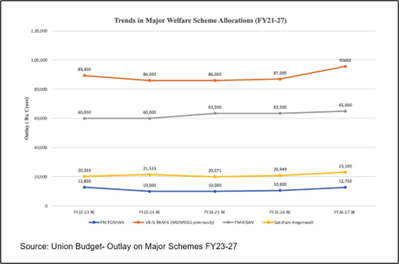
Nutrition outcomes exemplify this disconnect most starkly. Between FY 2021 and FY 2025, PM-POSHAN (including the erstwhile Integrated Child Development Scheme) received budget estimates totalling Rs 56,801 crore. The actual releases amounted to Rs 54,158 crore.
Between FY 2024 and FY 2025, even as nutritional indicators stalled, the revised estimates were reduced from Rs 11,600 crore to Rs 10,000 crore. (NFHS-5, pertaining to the years 2019 to 2021, reported marginal improvements in stunting from 38 to 36%, no change in wasting at 19% and a marked increase in anaemia from 59 to 67% among children under five and to 57% among women aged 15-49.)
There are more complications in this structure: More than 80% of the Ministry of Women and Child Development’s budget remains tied to Anganwadi operations, while state-level fiscal pressures have contributed to implementation gaps. As a result, although Rs 52,444 crore was released between FY 2022 and FY 2024, on-ground delivery remained uneven.
Income-support schemes display a similar divergence between nominal stability and real-term erosion. PM-KISAN has disbursed Rs 3.24 lakh crore, yet the fixed instalment structure has lost its real value due to cumulative inflation of 24-28% when calculated year by year.
Health outcomes reflect structural constraints as well. By October 2025, Ayushman Bharat had issued 42 crore cards and generated an estimated Rs 1.52 lakh crore in out-of-pocket savings. Yet utilisation remained uneven, particularly in poorer states, as empanelment slowed – 443 hospitals joined (got empanelled) between January and April 2025 and only 20 in May 2025 due to concerns over package rates and delayed reimbursement.
Budget 2026-27, then, attempts to preserve the projected image of a welfare state, without addressing the core problem – expanding fiscal commitments financed through tightening fiscal room, and delivered through systems that struggle to convert allocations into durable gains for citizens. Unless spending becomes more credibile and implementation improves, welfare risks becoming a system of headline allocations and transfers that offers no real mobility or sustained improvement in well-being.
[Deepanshu Mohan is Professor of Economics and Dean, O.P. Jindal Global University. He is Director for Centre for New Economics Studies (CNES) and currently Visiting Professor, London School of Economics and an Academic Research Fellow at University of Oxford. Ankur Singh is a Research Assistant with CNES and is studying economics at Jindal School of Government and Public Policy. Courtesy: The Wire, an Indian nonprofit news and opinion website. It was founded in 2015 by Siddharth Varadarajan, Sidharth Bhatia and M. K. Venu.]