❈ ❈ ❈
Part I: The BRICS are the New Defenders of Free Trade, the WTO, the IMF and the World Bank
What do the BRICS countries propose in terms of the international financial system?
The BRICS+ countries assert that the IMF should continue to be the cornerstone of the international financial system.
In the final declaration of the BRICS+ summit held in Rio de Janeiro (Brazil) in early July 2025, the following is stated in point 11:
“The International Monetary Fund (IMF) must remain adequately resourced and agile, at the centre of the global financial safety net (GFSN), to effectively support its members, particularly the most vulnerable countries.” https://dirco.gov.za/rio-de-janeiro-declaration-strengthening-global-south-cooperation-for-a-more-inclusive-and-sustainable-governance-rio-de-janeiro-brazil-6-july-2025/
They also express their support for the World Bank. In point 12 of their declaration, they indicate a desire to enhance the legitimacy of this institution. However, since their inception, both the World Bank and the IMF have implemented policies that contradict the interests of people and ecological balance.
The BRICS countries express a desire for improved representation of so-called developing countries within the IMF and the World Bank. That is all. Numerous authors, along with the CADTM have illustrated that both the World Bank, and the IMF perpetuate an anti-democratic under-representation of these developing nations. Moreover, their governance structures tend to favour the interests of the major economic powers and large private corporations.
In their final declaration, the BRICS countries fails to critique the neoliberal policies that the two Bretton Woods institutions actively promote. At no point do they question the debts that these institutions are demanding repayment from indebted countries.
This stance taken by BRICS in support of the IMF and the WB contradicts the interests of the people and the positions held social and/or anti-globalisation movements.
What is the BRICS+ position on the World Trade Organisation (WTO)?
The BRICS countries have emerged as the principal advocates of the WTO, which has been effectively paralysed by President Trump’s actions during his first term in office. In 2017, the Trump administration declined to appoint new judges to the WTO’s Appellate Body which acts as the “supreme court” of international trade, resolving disputes between states following an initial panel’s ruling. As this body has remained blocked since 2017, the WTO has been rendered inoperable.
In point 13 of the Rio Declaration of July 2025, the BRICS+ countries affirm their support for WTO rules and assert that the WTO must be at the heart of the global trading system. The BRICS+ countries state:
“We emphasise that the WTO, on its 30th anniversary, remains the only multilateral institution with the necessary mandate, expertise, universal reach and capacity to lead on the multiple dimensions of international trade discussions, including the negotiation of new trade rules.”
It should be remembered that social movements, La Via Campesina and the anti-globalisation movement (the movement against neoliberal capitalist globalisation) have systematically criticised and condemned the WTO for its detrimental role, as its actions run counter to the interests of workers, farmers, local economies and nature.
In the final declaration of the BRICS+ summit in Rio 2025, which spans approximately 40 pages and consists of 126 points, there is no reference to the suspension of patents on vaccine production. These patents, however, serve the specific interests of large private pharmaceutical companies, whose main motivation is the pursuit of maximum profits.
To understand the BRICS+ position, it is essential to recognise that China has secured an advantage over the United States and Europe regarding production and trade, both in terms of costs and productivity, and technological advantages in a number of important sectors. China has emerged as a staunch proponent of free trade, free trade agreements, WTO rules and free competition, while the United States, the EU, the UK and Canada have become increasingly protectionist [1] .
In the name of compliance with WTO rules, the BRICS+ countries denounce the protectionist measures and trade sanctions imposed by the United States and the European powers. Of course, Russia and Iran, which are directly affected by the sanctions, strongly advocate for free trade, oppose protectionism, and criticise them (refer to point 14 of the final declaration).
In addition, the governments of North America and Western Europe have abandoned the rhetoric and actions that once favoured globalisation—rhetoric they had previously championed as a path to prosperity from the 1990s to the mid-2010s, while engaging in a trade war with China. During this period, from 1997 to 2013, Russia was invited to attend meetings of the G7 (comprising the United States, Canada, Japan, Germany, France, Great Britain, and Italy). Consequently, the G7 was referred to as the G8 during this timeframe. Meanwhile, the United States regarded China as an intriguing economic and trading partner (Refer to Benjamin Bürbaumer, Chine/États-Unis, le capitalisme contre la mondialisation, La Découverte, Paris, 2024, 302 pages).
Now, the BRICS have emerged as the main advocates of capitalist globalisation, which is itself in crisis. In point 8 of the final declaration of the Rio 2025 summit, they state:
“We acknowledge that multipolarity can expand opportunities for EMDCs to develop their constructive potential and enjoy universally beneficial, inclusive and equitable economic globalization and cooperation.”
Point 43 of the declaration reads:
“We reiterate the importance of ensuring that trade and sustainable development policies are mutually supportive, and aligned with WTO rules.”
Conclusions
The expansion of the BRICS in 2024, now referred to as BRICS+, has generated expectations regarding their potential to provide an alternative to the global economic system largely dominated by traditional imperialist powers, particularly the United States. However, despite their significant demographic and economic influence — comprising nearly half of the world’s population, 40% of fossil fuel resources, 30% of global GDP, and 50% of economic growth — the BRICS+ nations do not appear to seek a departure from the existing international neoliberal framework.
On the financial front; the final declaration of the Rio summit (July 2025) reaffirms the central role of the IMF and the World Bank. The BRICS+ nations restrict themselves to advocating for better representation of developing countries without challenging the structural adjustment policies, imposed debts, or the neoliberal orientation of these institutions. Regarding trade, BRICS+ members support the World Trade Organisation (WTO), which has been effectively paralysed since the US blockade initiated by Donald Trump in 2017. They underscore its legitimacy and aim to position it at the core of the global trading system, yet fail to address its detrimental effects on local economies, social rights or the environment.
In practice, China, supported by other members, is multiplying free trade agreements and promoting capitalist globalisation based on free trade, even as the former powers of the North are now turning towards protectionism. Thus, far from representing a counter-model, the BRICS+ countries present themselves as the new defenders of a globalised capitalist system in crisis, to the detriment of social movements and alternatives based on social justice, economic sovereignty and environmental protection.
By supporting the IMF, the World Bank and the WTO, they perpetuate globalised neoliberalism instead of presenting a viable alternative. This stance illustrates their intention to enhance their influence within these dominant institutions, all the while remaining aligned, with a destructive logic detrimental to both peoples and the planet.
Far from serving as a means of emancipation for the countries of the South, the BRICS+ seem to act as collaborators in managing a crisis-ridden capitalism that has steered the planet towards ecological disaster, an escalation in armed conflicts, and a significant deterioration of crimes against humanity crimes against humanity. In light of this, it falls upon social and anti-globalisation movements to persist in advocating for alternative proposals: protection of common goods, solidarity between peoples, economic sovereignty, ecological bifurcation — a decisive break with the current destructive model — and social justice.
Footnotes
[1] There are, of course, exceptions, particularly when the EU maintains its advantage in its relations with less advanced trading partners, for example with African countries, where it remains in favour of free trade agreements.
❈ ❈ ❈
Part II: Are the New Development Bank and the BRICS Monetary Fund an alternative to the Bretton Woods institutions?
What about the BRICS Common Monetary Fund? Has it become operational?
This Fund, known as the CRA (Contingent Reserve Arrangement) and created in 2014 [1] to fulfil a role typically performed by the IMF when a member country experiences a shortage of foreign exchange reserves and requires a loan. The CRA aimed to assist BRICS member nations facing difficulties in securing foreign currency for their international payments, allowing them to draw from this fund to cover their currency shortfalls. This arrangement could potentially enable BRICS countries to bypass the conditions imposed by the IMF.
This fund holds significant importance for South Africa, a founding member, as well as for other more vulnerable BRICS+ nations, including Ethiopia and Egypt, which joined BRICS+ in 2024. These countries frequently encounter shortages of foreign currency, which compels them to seek assistance from the IMF.
However, the CRA’s founding statutes include a condition stipulating that any BRICS member country requesting assistance must adhere to IMF conditions if it seeks to access more than 30% of the total amount to which it is entitled. For example, this principle permits South Africa to borrow up to $10 billion. Should South Africa wish to borrow in excess of $3 billion from the BRICS Monetary Fund, it must demonstrate that it is implementing an IMF programme and complying with the conditions set forth by the IMF. Article 5 of the treaty establishing the BRICS Monetary Fund clearly articulates this principle. [2]
Despite its formal creation in 2014, this fund remains non-operational.
A glaring example of a missed opportunity for the BRICS Monetary Fund occurred with South Africa in mid-2020, when, instead of turning to the BRICS, Pretoria’s finance minister secured a US$4.3 billion loan from the IMF. This resulted in extreme austerity, which caused deep popular discontent with the ANC government before the president softened the finance minister’s social austerity policy.
The BRICS summit that ended on 7 July 2025 produced an evasive statement about the CRA. In point 53 [3] , the BRICS+ leaders state that the founding treaty will be revised and that new members will be able to join the BRICS Monetary Fund. However, this statement lacks concrete details.
This evidence shows that the CRA is, unfortunately, still mythical and inoperative.
Conclusion: Those asserting that the Rio summit marks a significant advancement for the BRICS Common Monetary Fund are making unfounded claims.
What about the New Development Bank (NDB)?
[Note: The NDB was officially established on 15 July 2014 at the 6th BRICS Summit held in Fortaleza, Brazil. The NDB, which is headquartered in Shanghai, granted its first loans at the end of 2016. The five founding countries each have an equal share in the Bank’s capital, and none has veto power. In addition to the five founding countries, NDB’s members include Bangladesh, the United Arab Emirates, Egypt and Algeria. The capital of the NDB currently stands at $50 billion, with plans to grow to $100 billion in the future. The New Development Bank has declared its primary focus on financing infrastructure projects, such as water distribution systems and renewable energy production systems. It emphasizes the ’green’ nature of the projects it finances, although this assertion is disputed by some authors such as Patrick Bond (see ’BRICS New Development Bank Corruption in South Africa’, 5 September 2021).]
In point 45 of the final communiqué of the Rio summit in early July 2025, the BRICS leaders stated the following about the New Development Bank (NDB), created in 2014: ’As the New Development Bank is set to embark on its second golden decade of high-quality development, we recognize and support its growing role as a robust and strategic agent of development and modernization in the Global South.’ [4]. They also stated that they were reappointing Dilma Rousseff, former president of Brazil from 2011 to 2016, to the position of president of the New Development Bank (NDB), which she has held since 2023.
BRICS leaders have announced their support for the NDB’s local currency financing; however, they do not acknowledge that the majority of the NDB’s financing is conducted in dollars through securities issued on financial markets. The NDB primarily borrows and lends in dollars. In 2023 and 2024, the NDB issued bonds that received AA+ ratings (stable outlook) from Fitch Ratings and AA ratings (stable outlook) from S&P Global Ratings. To maintain these rating levels, the NDB effectively complies with the sanctions imposed on Russia following the invasion of Ukraine at the end of February 2022, which has resulted in the NDB not granting any credit to Russia since 2021. The management of the NDB believes that continued lending to Russia could lead rating agencies and investment funds to perceive the NDB as taking on significant risks, consequently resulting in higher returns being demanded for purchasing its bonds in international markets.
The NDB’s compliance with sanctions, resulting in the cessation of new loans to Russia, is clearly outlined on the NDB website: https://www.ndb.int/projects/all-projects/. Since the beginning of 2022, the NDB has approved the financing of more than 50 different projects, none of which are located in Russia. With regard to loans to Russia, if you click here:https://www.ndb.int/projects/all-projects/?country=russia&key_area_focus=&project_status=&type_category=&pyearval=# paginated-list, you can find that the last project financially supported by the NDB in Russia dates back to September 2021. In the report presented to investors by NDB President Dilma Rousseff, it is clearly stated that the Bank has frozen lending to Russia since 2022; see page 35 of https://www.ndb.int/wp-content/uploads/2025/03/Investor-Presentation-April-2025_FINAL.pdf.
Here we present an extract from a highly critical statement about the NDB made in October 2023 at the Valdai Club, which is very close to Putin, by Paulo Nogueira Batista. Paulo Nogueira is Brazilian and was vice-president of the NDB. Although he is a staunch supporter of the BRICS, he stated:
“Why can we say that the NDB has been a disappointment so far? Here are some of the reasons. Disbursements have been surprisingly slow, projects are approved but not turned into contracts. When contracts are signed, the actual implementation of projects is slow. The results on the ground are meagre. Operations – financing and loans – are mainly conducted in US dollars, which is also the Bank’s unit of account.
How can we, as BRICS, credibly talk about de-dollarisation if our main financial initiative remains predominantly dollarised?
Don’t tell me that it is not possible to carry out operations in national currencies in our countries. The Inter-American Development Bank, the IDB, for example, has many years of considerable experience in operations in Brazilian currency. I don’t understand why the NDB has not taken advantage of this experience.’ [5]
66% of NDB borrowings are in US dollars. Is this evidence of the BRICS New Development Bank’s ongoing de-dollarisation?
The answer is no. The NDB is not becoming independent from financial markets and the dollar, despite some claims. 66% of its outstanding borrowings are in US dollars and 1% in euros and they are bonds sold on financial markets.
Only 32% of its outstanding loans are in Chinese currency, 1% are in South African currency; and 0% are in Russian, Brazilian or Indian currency. See the slideshow presented to investors in April 2025, p. 21 of https://www.ndb.int/wp-content/uploads/2025/03/Investor-Presentation-April-2025_FINAL.pdf If the NDB really wanted to, it could finance itself mainly in the currencies of its members and could do without financing itself on the financial markets. Even if part of the loans were granted in dollars, China, Russia, India and Brazil have large dollar foreign exchange reserves that could be used.
Are the New Development Bank and the BRICS Monetary Fund (CRA) an alternative to the Bretton Woods institutions, as some claim?
The answer is no, for several reasons.
Firstly, the BRICS countries themselves do not present the New Development Bank and the Monetary Fund (CRA) as an alternative. On the contrary, they affirm that the IMF and the World Bank must remain at the heart of the global financial system. The BRIC+ countries consider that the IMF must remain at the center of the international financial system.
In the final declaration of the BRICS+ summit held in Rio de Janeiro (Brazil) in early July 2025, they write in point 11:
The International Monetary Fund (IMF) must remain adequately resourced and agile, at the centre of the global financial safety net (GFSN), to effectively support its members, particularly the most vulnerable countries ’ [6]
They also express their support for the World Bank. In point 12 of their declaration, they state that they want to increase the legitimacy of this institution. However, since their foundation, the World Bank and the IMF have pursued policies that run counter to the interests of people and ecological balance.
In the final declaration, the BRICS countries express no criticism of the neoliberal policies that the two Bretton Woods institutions are actively promoting. At no point do they question the debts that these institutions are demanding from indebted countries.
Secondly, in its 10 years of existence, the BRICS Monetary Fund (CRA) has not granted any loans.
Thirdly, when granting loans, China favours the tools at its direct disposal, i.e., its public banks. Since 2015, Chinese banks have granted 20 to 30 times more loans than the New Development Bank.
Fourthly, the Chinese authorities have created another multinational bank, separate from the NDB, which a significant number of countries have joined. This is the Asian Infrastructure Investment Bank (AIIB), which is based in Beijing. The AIIB has more than 100 member countries (including 23 European countries such as Germany, France, Italy, the United Kingdom, Belgium, etc.). The United States and Japan are not members. The AIIB began operations in 2016, at almost the same time as the NDB. The AIIB’s capital amounts to $100 billion, of which approximately 30% is subscribed by China, which is the main shareholder. The voting process is similar to that of the World Bank and the IMF: it is based on the share of capital held, which gives China a de facto veto over major decisions. In conclusion, the AIIB plays a much more important role than the New Development Bank, both in terms of the number of member countries and the volume of loans it grants.
Fifthly, China, which has become the world’s largest public lender and creditor, insists that countries comply with both the IMF and the World Bank and therefore requires debtors to apply the conditions contained in the loan agreements they have signed with these institutions.
Sixthly, it should be noted that the only loans granted by the NDB in sub-Saharan Africa have been to South Africa. No other country south of the Sahara has had access to NDB credit. And in North Africa, only Egypt has received funding making this loan the sole credit granted to the entire region. In Asia, loans have been issued only to China, Bangladesh, and India. In Latin America, Brazil stands as the only recipient of NDB loans; no other country has received any.
This raises the question: how can we assert that the NDB serves as an alternative to the World Bank and the IMF when, to date, not a single one of the 26 low-income countries has received a loan from the NDB? Among the 51 lower-middle-income countries, only Bangladesh and Egypt have had access to an NDB loan? Bangladesh has received five loans, totalling just under $1 billion (see https://www.ndb.int/projects/all-projects/?country=bangladesh&key_area_focus=&project_status=&type_category=&pyearval=#paginated-list). Egypt received a single loan for $200 million. This number means that the loans granted to these two countries represent less than 4% of the total amount lent by the NDB. The rest of the loans were granted to Russia (until 2021, as loans were stopped from 2022 onwards), Brazil, China and South Africa.
Strategic and political summary and conclusion
It should be remembered that the five founding members of BRICS (Brazil, Russia, India, China, South Africa) could, if they wanted to, form a powerful bloc because they represent 40% of the global population, around 30% of world’s GDP, 20% of international exports, and 20% of global oil production. With the inclusion of the five new BRICS members – Indonesia, Iran, Ethiopia, Egypt and the United Arab Emirates – BRICS+ accounts for around 55% of the world’s population, 45% of global GDP (in terms of purchasing power parity), 25% of worldwide exports and 40-45% of global oil production. However, it must be noted that the BRICS or BRICS+ countries do not form a coherent bloc; they constitute a heterogeneous alliance whose members negotiate separately with the United States.
Ten years after their creation, the New Development Bank and the BRICS Monetary Fund (CRA) are not credible alternatives to the Bretton Woods institutions but rather their peripheral extensions. Behind the rhetoric of ’de-dollarisation’ and financial emancipation of the global South, these two instruments remain trapped in a logic of dependence on international financial markets and implicit submission to IMF discipline. The CRA, which has been inactive since 2014, symbolises this impasse: designed to protect BRICS members from IMF conditionalities, it instead refers them back to the IMF as soon as they exceed a certain borrowing threshold. The NDB, for its part, has become a semi-Westernised institution: most of its financing is denominated in dollars, its ratings depend on the major Anglo-Saxon agencies, and its lending strategy does not aim to provide credit to the countries that need it most. It should be supported in a human development strategy compatible with the balance of nature.
Beijing’s attitude is indicative of this ambiguity. In practice, China favours its own state-owned banks, and the AIIB to extend its influence, relegating the NDB to the background. This choice reflects a hierarchy among the financial instruments of the South, where multilateral cooperation remains subordinate to national power dynamics.
Politically, the BRICS+ countries are not breaking with the global financial order. By reaffirming the central role of the IMF and the World Bank in the Rio Summit Declaration (2025), they position themselves as internal reformers of the system rather than architects of an alternative. This stance reveals the founding paradox of the BRICS: wanting to embody the voice of the South without breaking with the structures of domination of the North.
Thus, ten years after the creation of the NDB and CRA in Fortaleza, the promise of a post-Western financial hub remains unfulfilled. Without a shared political will for systemic transformation, the BRICS are solidifying a hybrid model in which the rhetoric of sovereignty conceals ongoing dependencies dependencies. The genuine alternative to the Bretton Woods institutions will not emerge from a mere institutional framework but from a collective initiative centred on financial justice, South-South solidarity and the development of new, truly democratic multilateral financial institutions that prioritise the fulfilment of fundamental human rights and respect for Nature.
Footnotes
[1] The treaty establishing the CRA was signed on 15 July 2014 in Fortaleza, Brazil. The total amount available in principle is high: US$100 billion, distributed as follows: China holds 41 billion, Brazil holds 18 billion, Russia holds 18 billion, India holds 18 billion, South Africa holds 5 billion. See Article 2 of the treaty. Article 5 adds “a. The Parties shall be able to access resources subject to maximum access limits equal to a multiple of each Party’s individual commitment set forth as follows: i. China shall have a multiplier of 0.5; ii. Brazil shall have a multiplier of 1; iii. Russia shall have a multiplier of 1; iv. India shall have a multiplier of 1; v. South Africa shall have a multiplier of 2 See the Brazilian government’s official website : https://www.gov.br/mre/en/contact-us/press-area/press-releases/documents-signed-on-the-occasion-of-the-vi-brics-summit-fortaleza-july-15-2014#II Or on the University of Toronto website : http://www.brics.utoronto.ca/docs/140715-treaty.html accessed on 26 October 2025
[2] Refer to the Article 5 of the treaty, an excerpt of which is provided below: “c. A portion (the ’De-linked portion’), equal to 30 percent of the maximum access for each Party, shall be available subject only to the agreement of the Providing Parties, which shall be granted whenever the Requesting Party meets the conditions stipulated in Article 14 of this Treaty. d. A portion (the ’IMF-linked portion’), consisting of the remaining 70 per cent of the maximum access, shall be available to the Requesting Party, subject to both: i. The agreement of the Providing Parties, which shall be granted whenever the Requesting Party meets the conditions stipulated in Article 14, and; ii. Evidence of the existence of an on-track arrangement between the IMF and the Requesting Party that involves a commitment of the IMF to provide financing to the Requesting Party based on conditionality, and the compliance of the Requesting Party with the terms and conditions of the arrangement. e. Both instruments defined in Article 4 shall have IMF-linked and De-linked portions. f. If a Requesting Party has an on-track arrangement with the IMF, it shall be able to access up to 100 per cent of its maximum access limit, subject to the provisions under paragraph (d) above.” Text available on the University of Toronto websitehttp://www.brics.utoronto.ca/docs/140715-treaty.html, accessed on 26 October 2025.
[3] “53. We welcome the progress on the Contingent Reserve Arrangement (CRA), including the consensus reached by the Technical Team on the proposal for the revised Treaty and regulations. We support efforts to enhance the CRA’s flexibility and effectiveness, notably through the inclusion of eligible payment currencies and improved risk management. We also value the participation of new BRICS members who have expressed interest in joining the CRA and we are committed to onboarding them on a voluntary basis and according to country-specific circumstances.” http://www.brics.utoronto.ca/docs/250706-declaration.html accessed on 26 October 2025
[4] “We recognise and support its growing role as a robust and strategic agent of development and modernisation in the Global South.”
[5] Paulo Nogueira Batista, “BRICS Financial and Monetary Initiatives – the New Development Bank, the Contingent Reserve Arrangement, and a Possible New Currency”, 3 October 2023, https://valdaiclub.com/a/highlights/brics-financial-and-monetary-initiatives/ accessed on 26 October 2025.
[6] Engl.: 11. “The International Monetary Fund (IMF) must remain adequately resourced and agile, at the centre of the global financial safety net (GFSN), to effectively support its members, particularly the most vulnerable countries.” https://dirco.gov.za/rio-de-janeiro-declaration-strengthening-global-south-cooperation-for-a-more-inclusive-and-sustainable-governance-rio-de-janeiro-brazil-6-july-2025/]
❈ ❈ ❈
Part III: The BRICS and De-Dollarisation
Many BRICS supporters claim that the bloc is moving towards de-dollarisation. Is this really the case?
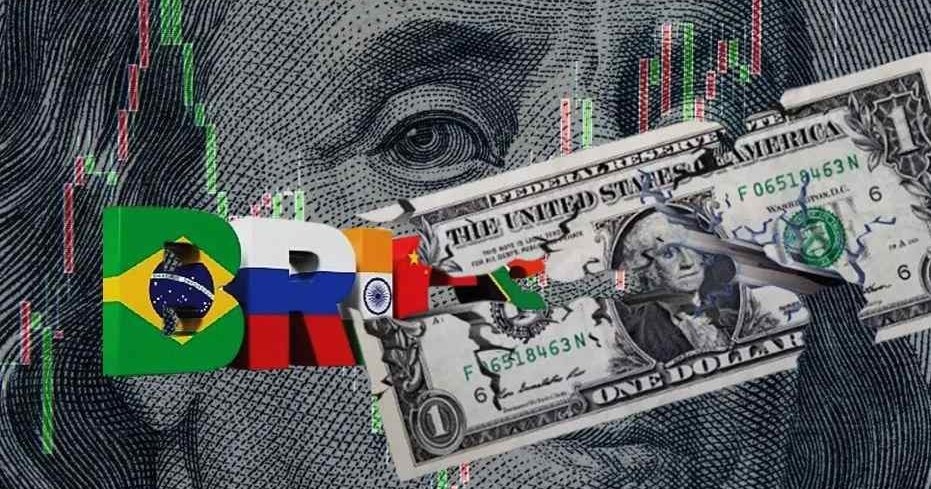
Nowhere in the 126-point Rio de Janeiro BRICS leaders’ declaration is there any mention of the term de-dollarisation. It makes no mention of initiatives to lessen the role of the dollar. It states that trade in local currencies must be encouraged, but this remains very vague and limited and has nothing to do with the creation of a common BRICS currency. The BRICS countries do not wish to adopt a common currency, and the final declaration of the Rio summit makes no mention of the creation of a common currency.
Among the leaders of the five founding BRICS countries, only Lula continues to talk about a common reserve currency, and he does so less and less frequently. Putin stopped mentioning it and explicitly stated in 2024 that it was not one of his objectives.
As proof, here is what Vladimir Putin said at an important public meeting organised by the Kremlin after the BRICS summit held in Kazan at the end of October 2024 and two days after Trump’s election:
“I have heard a lot of discussion among experts and in journalistic circles that we should think about creating a single currency. But it is too early to talk about this. And we do not have such goals among ourselves.” (Source: Valdai Discussion Club meeting: Vladimir Putin’s answers to participants’ questions).
Later in the public meeting, he added:
“We have not sought to abandon the dollar and we are not seeking to do so.”
And again:
“Our proposals are not aimed at fighting the dollar.”
Putin made these statements in November 2024 in response to Paulo Nogueira Batista, who from 2015 to 2017 was vice-president of the New Development Bank created by the BRICS. One of the questions posed by Paulo Nogueira Batista to Putin specifically concerned the creation of a new BRICS currency:
“Would you agree that payments in national currencies have certain limitations and that we will gradually, step by step, cautiously move towards a new means of payment, a new reserve currency? President Lula also mentioned this in his statement at the Kazan summit.”
It should be noted, as mentioned above, that Lula had advocated for a common currency both at the 2023 BRICS summit held in Johannesburg (South Africa) and in a remote address at the 2024 summit in Kazan (Russia). However, it is clear that Putin, who seemed to favour this prospect, has abandoned it. What is the reason for this? Besides the significant challenge of establishing a shared currency among vastly diverse economies across four continents, Putin is also attempting to placate Trump, who has made it clear that any attempt to diminish the role of the dollar would be met with intense retaliation.
In the same vein, Putin is seeking to reduce the sanctions imposed on Russia following the invasion of Ukraine and is therefore trying to reduce antagonism with Trump. Through mid-2025 (including during a meeting between Trump and Putin in Alaska in August 2025), this seemed to have worked, to a certain limited extent. I discussed the points of convergence between Trump and Putin on Ukraine concerning the grabbing of natural resources in an article published on 20 May 2025 entitled “Natural resource grabbing in Ukraine and the Democratic Republic of Congo. Imperial powers on the offensive.”
However, their relationship could deteriorate at any moment, particularly if Trump posts something controversial, as he did on September 23:
“After getting to know and fully understand the Ukraine/Russia Military and Economic situation and, after seeing the Economic trouble it is causing Russia, I think Ukraine, with the support of the European Union, is in a position to fight and WIN all of Ukraine back in its original form.”
The future of Putin-Trump relations is difficult to predict. But even if relations deteriorate significantly, the creation of a common currency will remain off the agenda because the other important members of the BRICS are not in favour of it.
Indeed, India and China, the two largest powers among the BRICS countries, for their own reasons, do not see the point of developing a common BRICS currency.
So India is opposed to a common currency?
India has repeatedly stated during internal BRICS negotiations that it does not want a common currency. Then, certainly under the threat of tariff and other reprisals from Trump, it stated its position publicly on the eve of the BRICS summit in Rio (see Republic World, an Indian television channel, close to the government: “India Not Supporting Russia in BRICS Currency Plan — Here’s Why”. Since Trump implemented his tariff threats in August 2025, the prime minister has made no statements in favour of a common currency.
Is China also not in favour of a common currency?
For its part, China considers that the renminbi is gradually but surely becoming an international currency and that there is no point in participating in the creation of a new BRICS currency. The Chinese currency is one of the five currencies recognised for IMF repayments, and China has significantly increased its foreign loans in the renminbi (see the study published by the US Federal Reserve in May 2025: “Chinese Banks’ Dollar Lending Decline”).
Nevertheless, it is widely acknowledged that if China internationalised its currency, it would lose its power to control cross-border capital movements. Due to financial speculation and the Chinese stock market crashes of the mid-2010s, maintaining and strengthening exchange controls have been essential tools for disciplining members of the ‘unpatriotic bourgeoisie’ of society who regularly engaged in illicit financial flows (IFFs). The NGO Global Financial Integrity estimated illicit financial outflows from China at $258 billion in 2013, prior to the tightening of capital controls in 2016-2017. See https://financialtransparency.org/wp-content/uploads/2015/12/IFF-Update_2015-Final.pdf Table C page 8.
What is South Africa’s position on de-dollarisation?
South Africa’s financial elite also campaigned against de-dollarisation at the 2023 BRICS summit in Johannesburg, and the SA Ambassador to the U.S., Ebrahim Rasool, also warned, in March 2025,
“We must avoid actions that cock a snoot at the USA, such as de-dollarization. Not even China is speaking about de-dollarization anymore; Russia certainly isn’t. Not only is it performative, but it’s not practical or economically viable. Even mentioning it could invoke punitive immediate measures.” https://www.youtube.com/watch?v=J1ILz1S_AdQ&t=1147s
Conclusion
There has been no collective progress by the BRICS countries as a coalition towards de-dollarisation. Behind the rhetoric of a multipolar order, national interests, dependence on international trade and fear of US retaliation are holding back the collective momentum of BRICS countries.
Lula remains isolated in his advocacy for a common currency, while Beijing, Delhi, Moscow and Pretoria, all favour national strategies. Ultimately, the BRICS of 2025 appear more like a coalition of divergent interests than a coherent bloc capable of transforming the global monetary order.
[Eric Toussaint is a historian and political scientist who completed his Ph.D. at the universities of Paris VIII and Liège, is the spokesperson of the CADTM International, and sits on the Scientific Council of ATTAC France. He is the author of several books. Courtesy: The Committee for the Abolition of Illegitimate Debt (CADTM), an international network of activists founded on 15 March 1990 in Belgium that campaigns for the cancellation of debts in developing countries and for “the creation of a world respectful of people’s fundamental rights, needs and liberties”.]