In a historic judgment, Brazil’s Supreme Court found former President Jair Bolsonaro and seven other politicians guilty of organizing a military coup. On September 11, four out of five justices voted to sentence Bolsonaro to 27 years and three months in prison. The judgment marked the first time that perpetrators of state crimes have faced accountability in Brazil, where a military dictatorship was in power from 1964 to 1985.
Since the ruling, Bolsonaro’s allies have mobilized to dispute the conviction. Last week, Brazil’s lower house of parliament voted to accelerate a bill to grant amnesty to Bolsonaro and his allies involved in the January 8, 2023 coup attempt. The lower house also approved the “PEC da Blindagem” (Shield Bill), a constitutional amendment that would have granted effective impunity to any politician accused of a crime—a move that was ultimately rejected by the Senate earlier this week. The public response to the proposed legislation was incendiary. On Sunday, tens of thousands of Brazilians marched to defend justice and accountability.
The struggle against impunity has a long history in Brazil. In 1979, the government passed the Lei da Anistia (Amnesty Law) to pardon those who had imprisoned, tortured, and disappeared political dissidents during the dictatorship. Despite assertions that it was unconstitutional, the law was retained in Brazil’s 1988 progressive democratic Constitution.
The Supreme Court’s decision holds particular weight for Filho(a)s e Neto(a)s por Memória, Verdade, e Justiça (Children and Grandchildren for Memory, Truth, and Justice), a collective made up of family members of political prisoners. Since its founding in 2014, the group has consistently drawn links between past and present authoritarian threats.
“The judgment of ex-President Jair Bolsonaro has a meaning that goes beyond the man,” said Rose Michelle Rodrigues, a lawyer in Recife and member of the collective. “It connects directly with our historical struggle.”
Against the backdrop of the Amnesty Law, many families involved in the collective have shaped their lives around advocating for truth and accountability. Bolsonaro’s conviction breaks through a wall of impunity in Brazil, but threats to democratic institutions continue.
Challenging the Inheritance of Impunity
“There is no pacification with impunity,” President Luiz Inácio Lula da Silva said at the UN General Assembly in New York on Tuesday. “A few days ago, for the first time in our 525-year history, an ex-head of state was convicted for violating the democratic rule of law,” he continued. The Supreme Court ruled that Bolsonaro led a criminal organization that tried to destroy the country’s democracy through a violent coup attempt on January 8, 2023, and conspired to assassinate Lula, Vice President Geraldo Alckmin, and Supreme Court Justice Alexandre de Moraes.
Bolsonaro’s allies argue that an amnesty bill pardoning him and other coup participants will lead to “pacification.” After losing the 2022 general election to Lula, Bolsonaro marshalled supporters to attack the Supreme Court, Congress, and presidential palace, symbols of the “three powers” of Brazilian democracy. Many Brazilians believe the call for pacification is a distortion meant to achieve impunity.
“To accept amnesty in this moment is to condone impunity and gives carte blanche for much greater horrors to take place,” warned Rosa Cantal, a São Paulo-based lawyer belonging to the Filho(a)s e Neto(a)s collective. Lula has rejected impunity for Bolsonaro, stating last Wednesday that he would veto any attempt to grant him amnesty.
While right-wing lawmakers push the amnesty bill forward, the Filho(a)s e Neto(a)s collective has petitioned the Supreme Court to revise the 1979 Amnesty Law. Rodrigues pointed out that the Inter-American Court of Human Rights already decreed the law invalid in 2010. As a signatory, Brazil is bound to uphold this ruling, but the Supreme Court has yet to act on it.
According to Cantal, the amnesty bill is crafted to deliberately blur the line between past and present legislation, hindering attempts at accountability. Still, she expressed hope that the court’s recent conviction would provide a legal precedent for reinterpreting the old law.
Rodrigues, too, emphasized that Bolsonaro’s conviction represents an opportunity to challenge Brazil’s inheritance of impunity. “This is an important step for the consolidation of our democracy,” she said. “Democracy only sustains itself when we have the courage to confront the authoritarian past and present. We cannot forget the past and allow this to happen again.”
But U.S. President Donald Trump, a close ally of Bolsonaro’s, has thrown his weight behind the disgraced leader, animating right-wing forces in Brazil. Throughout the trial, the Trump administration alternated between political pressure and threats of economic retaliation—a strategy Brazilians have termed “tarifaço.”
In his General Assembly address, Trump referenced the 50 percent tariffs he levied on Brazil, citing so-called “judicial corruption.” In a surprising turn, he also said he spoke informally with Lula and scheduled a conversation with him next week. “We had excellent chemistry,” Trump said—a remark many Brazilians view as evidence of Lula’s charisma. Lula has responded to Trump’s economic and political menaces with shrewd diplomacy and messaging, drawing admiration from broad swathes of the Brazilian public. “[Trump’s] relationship is with Bolsonaro, not Brazil,” the president previously told the BBC.
Despite the significance of Bolsonaro’s conviction, observers caution against assuming that he no longer poses a risk. “In political terms, defeats and victories are not very durable,” noted Felipe Lott, a historian and member of the Filho(as) e Neto(a)s collective in Rio de Janeiro. “Politics is a very unstable environment, so in the same way that [Bolsonaro] has now been condemned, it would not be difficult for him to revert this in the future.”
Bolsonaro’s legal team may use his recent skin cancer diagnosis to argue for a lighter penalty on medical grounds. But he faces a number of other legal cases. Last week, a regional court fined Bolsonaro R$1 million (almost $200,000) for racist speech. The Supreme Court is also set to discuss cases on his role in spreading misinformation in the lead-up to the coup attempt, and government misconduct during the Covid-19 pandemic.
The Movement Against Amnesty
The Supreme Court judgment comes amid reinvigorated conversations around historical memory of the dictatorship in Brazil. The 2024 film Ainda Estou Aqui, set during the dictatorship and focused on the family of disappeared political prisoner Rubens Paiva, broke viewership records and won both an Oscar and a Golden Globe.
“The film was a great catalyst for memory of the dictatorship,” said Rodrigues. She and other advocates argue that its success helped create the climate for Bolsonaro’s conviction. “Probably if this atmosphere did not exist, this [court] decision would not have been taken,” Lott said.
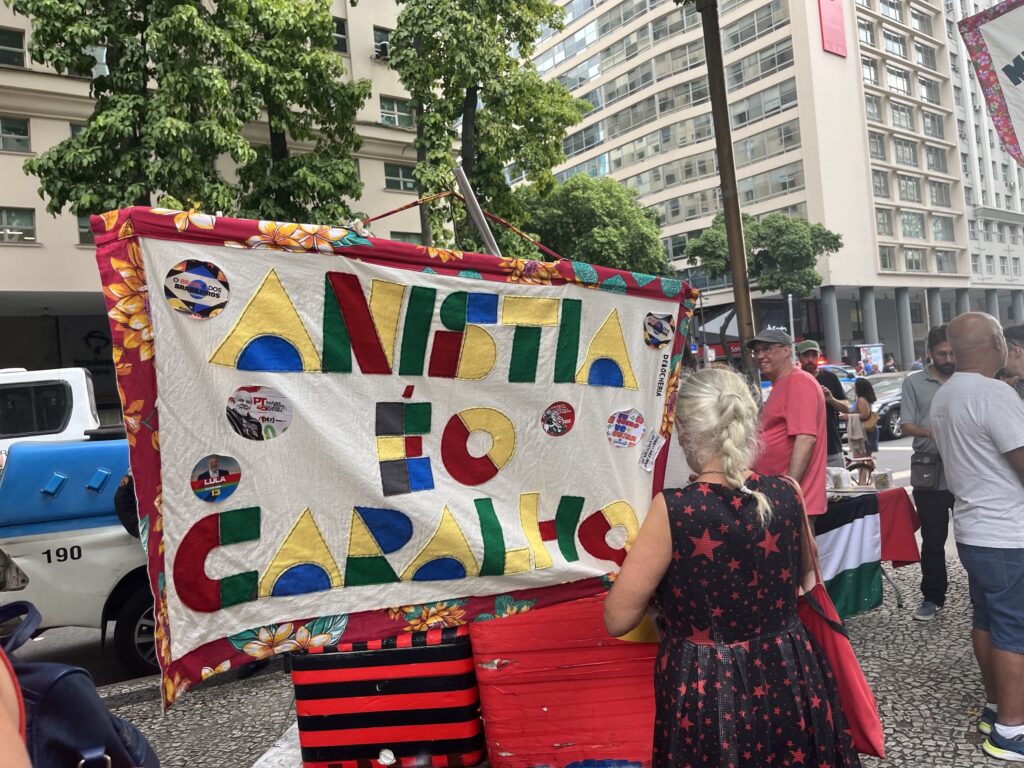
The film has also energized the “Sem Anistia” (No Amnesty) movement. Iconic Tropicalismo musicians Gilberto Gil, Caetano Veloso, and Chico Buarque headlined the protests on Sunday, performing songs that emerged out of resistance to the dictatorship. The soundtrack also included “Ô Trump,” a new funk song by D.J. Amanda Magalhães, which uses AI to remix a speech by Lula satirizing Eduardo Bolsonaro’s appeals to Trump to protect his father. Attendees called the demonstrations a “Carnaval of Democracy,” echoing the chants of “Sem Anistia” that rang out during the last Carnaval in February and March.
On social media, Lula expressed support for the demonstrators: “I am on the side of the Brazilian people. Today’s protests demonstrate that the population wants neither impunity nor amnesty.”
At the same time, Bolsonaro’s supporters have reframed the conviction as persecution and are portraying Brazil under Lula as a dictatorship—even though Bolsonaro benefited from the due process denied to victims of the dictatorship. Bolsonaristas have also tried to prevent Justice Alexandre de Moraes from presiding over the case of Mário Alves—the grandfather of collective member Léo Alves and a founder of the Revolutionary Communist Party—who was disappeared during the dictatorship. Recently, the United States sanctioned de Moraes under the Magnitsky Law, reserved for individuals accused of crimes against humanity. The accused military members’ defense seized on the sanctions, claiming the judge could not oversee the case because he faced the same accusations. “This is really a complete distortion,” said Cantal.
Rodrigues compared these tactics to the cover-up of her aunt’s assassination during the dictatorship. The government claimed that Ranuzia Alves Rodrigues, a nurse living in Rio de Janeiro, was killed in a gunfire exchange, but she was in fact the victim of a planned extrajudicial murder. “They did, as they are doing today,” Rodrigues said. “Once more, history repeats.”
Rodrigues worries that Bolsonaro’s conviction will “transform him into a victim and hero with the people that support him.” She recalled how he turned a 2018 assassination attempt into political capital before winning the election. “But the judgment could not have been different, with so much proof and the gravity of the situation,” she added.
Next Steps for Memory, Truth, and Justice
For Lott, the Supreme Court’s judgment owes a partial debt to the 2014 National Truth Commission, whose work Bolsonaro actively tried to undermine. The Commission’s final report urged Brazil to formally hold those responsible for dictatorship-era crimes accountable and honor its obligations as a signatory to the Inter-American Court of Human Rights. Members of Filho(a)s e Neto(a)s are optimistic that the conviction signals the Court’s willingness to revise the 1979 Amnesty Law at last.
Revising the law would not only recognize past victims and the intergenerational toll of torture and disappearances, but also help prevent future crimes against democratic institutions.
Motions regarding crimes of forced disappearances and secret graves are still pending in court. On September 4, Cantal visited São Paulo’s Cemitério de Perus to commemorate the 35th anniversary of the discovery of more than 1,000 unidentified corpses there. Rodrigues pointed to the discovery of mass graves near the Araguaia River, where a guerrilla movement operated during the 1960s and 70s. Forensic experts are still working to identify the bodies from these mass graves, which testify to past atrocities that have yet to see accountability.
Cantal stresses that revising the Amnesty Law is also key to addressing contemporary issues of public security. The military police—a product of the dictatorship—regularly conducts violent armed operations in favelas with impunity, denying due process to residents. “Violence in all of Brazil, in the peripheries, in the favelas, is still immense,” she said. “There is not a big difference from the time of the dictatorship, to be very frank.”
A Tenuous Victory
Brazil’s democratic institutions confront a divided population and external threats. Bolsonaro’s supporters maintain significant political influence. Yet frustration over the enduring legacy of impunity is growing. A September Datafolha poll found that 54 percent of Brazilians reject amnesty for Bolsonaro, while 39 percent support it.
“We have to be very alert and organize to try and prevent Bolsonarismo and fascism from continuing to spread,” Cantal cautioned. Given the U.S. role in financing the 1964 military coup, many wonder how far Trump’s bellicosity towards Brazil’s judiciary might go. Lott added that right-wing financiers and their allies would continue to back authoritarian projects.
On the global stage, Brazil is advancing a multilateralist agenda informed by the resilience of its democratic institutions. As right-wing extremism reshapes the international order, Brazil’s fight for accountability offers a model for other democracies confronting authoritarianism. “Brazil is still divided,” said Rodrigues. “The whole world sees what Brazilians do not: that our democracy is strong, it is beautiful, and was held up.”
Forty years after the fall of the dictatorship, the ongoing battle for truth, memory, and accountability shows that threats to democracy are not new. But these threats will continue to meet resistance—in the court and on the streets.
[Sana Khan is a journalist living in New York. A former Asian American Writers’ Workshop fellow, her writing has been nominated for Best American Essays and Best of the Net. Courtesy: The North American Congress on Latin America (NACLA) is an independent, nonprofit organization founded in 1966 to examine and critique U.S. imperialism and political, economic, and military intervention in the Western hemisphere.]