❈ ❈ ❈
Big Loss for US Empire: Ecuador Votes to Reject Foreign Military Bases
Ben Norton
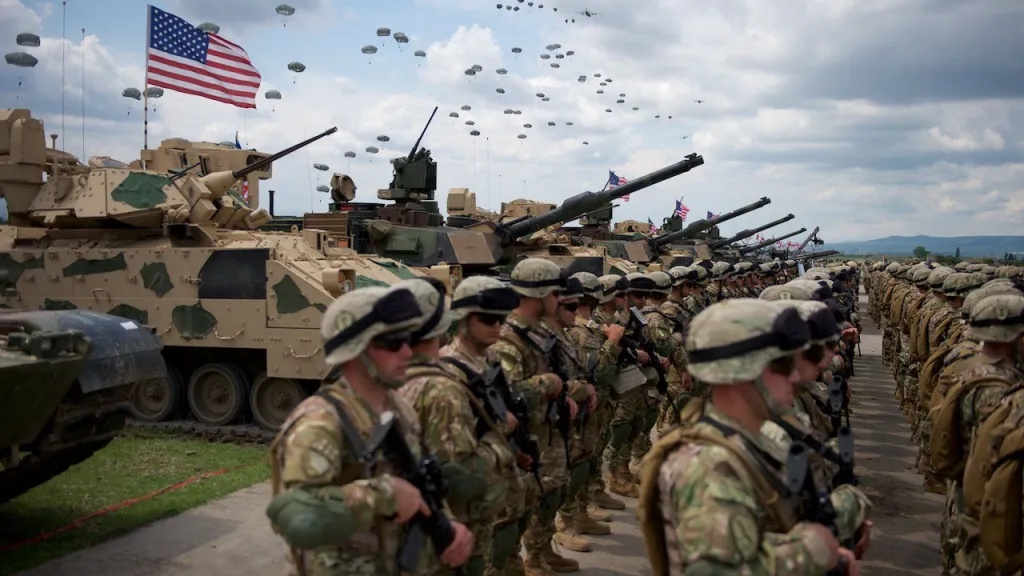
The Donald Trump administration is trying to expand the presence of the US military across Latin America, in an attempt to forcibly impose Washington’s hegemony in the region.
The people of Ecuador just delivered a major blow to Trump’s aggressive Latin America strategy.
More than three-fifths of Ecuadorians voted to reject a change to their progressive constitution, which would have allowed the Pentagon to establish US military bases in their territory.
Ecuador is currently governed by a right-wing president, Daniel Noboa, who is a key regional ally of Trump.
Noboa is the son of Ecuador’s richest billionaire oligarch, Álvaro Noboa — who ran as a presidential candidate in five different elections on a hard-line right-wing platform, but lost every time (in 1998, 2002, 2006, 2009, and 2013).
Daniel Noboa’s grandfather, Luis Noboa, was also the richest man in Ecuador in the 20th century. The family patriarch worked for the Standard Fruit Company, now known as Dole, and established a massive exporting dynasty, specializing in the export of bananas.
The Noboa family is notorious for its corruption and close links to drug trafficking and organized crime.
Daniel Noboa is the third member of the Noboa dynasty to serve as president of Ecuador.
Noboa is also a dual citizen of the United States — and his Ecuadorian critics say that is where his true loyalty lies.
Noboa was born in Miami, Florida, and he was educated in the US. In fact, just two months after he was inaugurated as president of Ecuador, Noboa returned to Miami so his wife, an Instagram influencer, could give birth to their child on US soil, guaranteeing him US citizenship.
As president, Noboa has been widely accused of dictatorial tendencies. He has publicly made fun of left-wing political prisoners, and threatened to imprison more political rivals.
Ecuadorians reject Daniel Noboa’s attempt to change the constitution
One of Noboa’s key goals has been to change Ecuador’s constitution, which is one of the most progressive in the world.
Ecuador’s constitution bans foreign countries from creating military bases in its territory.
Noboa held a referendum on 16 November to try to change the constitution to permit the US to open military bases in Ecuador.
The measure was rejected in a landslide, with 61% of Ecuadorians voting against it, according to the official results from the National Electoral Council (CNE).
In the referendum, Noboa proposed four measures. Voters rejected all of them.
The second measure sought to end public funding of political parties in Ecuador’s elections, which would have given wealthy right-wing forces like the oligarchic Noboa dynasty even more power. That measure was rejected with 58% of the votes against it.
Another measure proposed a constituent assembly to rewrite the entire constitution. That was rejected with 62% of the votes in opposition.
The war on Ecuador’s leftist former President Rafael Correa
Ecuador’s current, progressive constitution was drafted during the government of socialist former President Rafael Correa, who served from 2007 to 2017.
When Correa campaigned for president in the 2006 election, a key part of his left-wing platform was a call for a constituent assembly to write a new constitution.
A new, progressive constitution was approved in a 2008 referendum, with 64% of the votes in support, and just 28% against it.
In 2009, Correa kicked US troops out of Ecuador, and closed US military bases in his country’s territory.
Washington supported a failed right-wing coup attempt against Correa in 2010.
One of Correa’s right-wing opponents in the 2006, 2009, and 2013 elections — all of which he won by a large margin — was Álvaro Noboa, Ecuador’s richest billionaire oligarch, and the father of current President Daniel Noboa.
Correa, who has a PhD in economics, opposed neoliberalism and rejected Ecuador’s history of taking on debt from the US-dominated International Monetary Fund (IMF) and World Bank.
Correa significantly reduced poverty, inequality, and violence. He declared a “Citizens’ Revolution”, based on what he called “21st-century socialism”.
During Correa’s three terms, Ecuador formed closed ties with China. It also promoted Latin American integration, hosting the headquarters of UNASUR, the Union of South American Nations.
Under Correa, Ecuador joined the Bolivarian Alliance for the Peoples of Our America (ALBA), which promoted de-dollarization. The ALBA even created a new currency for regional trade, to challenge the dominance of the US dollar, called the Sucre.
Today, Correa is living in exile as a victim of political persecution, because right-wing, US-backed authorities in Ecuador formally charged him with the “crime” of so-called “psychic influence” over his left-wing followers.
The Trump administration revives the colonial Monroe Doctrine — and supports drug-trafficking oligarchs
While all US presidents have intervened in Latin America and violated the sovereignty of countries in the region, Donald Trump has made this a key priority of his aggressive foreign policy.
The Trump administration has proudly sought to revive the 202-year Monroe Doctrine, which treats Latin America as the colonial “backyard” of the US empire.
Trump has waged war on Venezuela, seeking to overthrow its President Nicolás Maduro. The Trump administration also imposed sanctions on Colombia’s left-wing President Gustavo Petro, and hit Nicaragua’s revolutionary Sandinista government with more unilateral sanctions.
Washington has pressured Latin American governments to allow the US military to open bases in their territory.
Argentina’s right-wing, self-declared “libertarian” President Javier Milei — one of Trump’s closest allies in the region — has pushed through executive orders that declare a constitutional exception to give the US military access to Argentine territory.
To justify its neocolonial attacks on Latin America and its meddling in the region’s internal affairs, the Trump administration has claimed that it is supposedly fighting drug trafficking.
However, the US government is allied with some of the worst drug traffickers in the region.
One of the most loyal US allies in Latin America is Colombia’s right-wing former President Álvaro Uribe. US intelligence has admitted that he is among the most “important Colombian narco-traffickers”, but he has never faced any consequences, because Washington has always supported him.
In fact, Trump’s Secretary of State and National Security Advisor Marco Rubio has publicly defended Uribe, amid widespread accusations of corruption.
Ecuador is an even clearer example of the US government’s extreme double standards on drug trafficking.
The Noboa dynasty owns private ports in Ecuador, and police documents show that Noboa family companies have used these to smuggle cocaine in banana crates.
[Ben Norton is a journalist, writer, and filmmaker. He is Editor-in-Chief of Geopolitical Economy Report. Courtesy: Geopolitical Economy Report, an independent news outlet that provides original journalism and analysis to understand the changing world.]
❈ ❈ ❈
Ecuadorian People Deal a Crushing Blow to Neoliberalism in Noboa’s Referendum
Peoples Dispatch
In a massive defeat for President Daniel Noboa’s neoliberal program, Ecuador overwhelmingly voted “No” on all four questions in the national referendum held on November 16. The result is a crushing blow for the government, who had hoped a victory would help pave the way for a structural transformation of the Ecuadorian state.
The election was organized at the request of right-wing President Noboa who called for a referendum in September of this year, hoping to achieve the economic elites’ long-awaited dream of converting Ecuador’s legal framework into a neoliberal one.
What were the referendum’s four questions?
The first question asked Ecuadorians whether foreign military bases should be allowed in Ecuador, something that is prohibited by the current constitution. Noboa appealed to the deep sense of insecurity felt by people in the country as a result of the historic crisis of violent crime, in which drug trafficking gangs are fighting over territory.
The government claimed that the installment of foreign military personnel would help reduce insecurity, although the opposition argued that it was an excuse to align the country with Washington’s geopolitical interests.
The next two questions were called “bait questions” by the opposition. They argued that the questions were less overtly ideological and employed a kind of electoral populism to exploit the widespread dissatisfaction with the political class, with the hope of garnering support for the more extreme parts of the referendum. The “bait questions” had to do with reducing the number of legislators and eliminating state funding for political parties.
The opposition, however, claimed that both measures would have benefited the ruling party, as they would have reduced the representation of small provinces and prevented political parties without wealthy contributors from running election campaigns.
Finally, the most important question had to do with the creation of a constituent assembly to draft a new neoliberal constitution, which is the great desire of the country’s economic elites.
Though the government was not particularly vocal about this, its silence about its intentions only provoked anxiety among voters, who saw this obscurity as a sign that the new constitution would reduce rights won in past decades.
The results
After the initial results were announced, several media outlets repeated the phrase “No one expected these numbers.” The latest polls had predicted that Noboa would win on all four questions, although it was known that the gap between the YES and NO votes had narrowed on the questions about military bases and the convening of a constituent assembly.
However, the president’s defeat was crushing. Not even on the so-called “bait questions” did Noboa manage to win over the majority of Ecuadorians, who clearly said “No” to the executive branch’s neoliberal project.
The presidency’s reaction
The government had prepared celebrations in Quito and Guayaquil, but the YES campaign headquarters were empty and the few Noboa supporters present were clearly shocked. Many expected the president to make statements to the press and his supporters, but Noboa did not appear.
He left only a brief message on X: “We consulted the Ecuadorian people, and they have spoken. We fulfilled our promise: to ask them directly. We respect the will of the Ecuadorian people. Our commitment remains unchanged; it is strengthened. We will continue to fight tirelessly for the country you deserve, with the tools we have.”
Thus, some analysts have claimed that Noboa is announcing his refusal to back down from his plan to neoliberalize the economy and the state, although he’s been forced to do so by other means. Currently, the ruling party has a majority in the National Assembly, but it will now be more difficult for it to carry out the reforms it proposes due to the votes of the independents who support it and who may hesitate to give their support to the government, as well as a Constitutional Court that has already put a stop to several of the president’s laws that undermine the legal structure of the state.
Why was Noboa defeated?
Several interpretations attempt to explain such a clear defeat. On the one hand, it is true that there is considerable rejection of Noboa’s government, which has failed to improve security in the country, increased taxes on all Ecuadorians, eliminated the diesel subsidy (fuel used especially by farmers and transporters), and used a heavy hand against recent demonstrations in the province of Imbabura, where several people were killed.
However, it is important to consider that if all the votes had been against the government, the results between one question and another would not have fluctuated so much. This is because there was a difference in voting, especially between questions 1 and 4, compared to questions 2 and 3. In this regard, some analysts have highlighted a flawed political communication strategy and the ruling party’s election campaign.
Questions loomed regarding, which foreign armed troops would come to the country to go where (there was much speculation that it would be in the Galapagos, one of the natural treasures most cherished by Ecuadorians). Also murky was the content of the constitution that the government wanted (Noboa literally said that the day after winning the referendum he would reveal the structure of the new constitution, not before).
However, attributing the government’s defeat solely to its communication failures is insufficient and dangerous, as it overshadows the enormous efforts of various political groups, social movements, and citizen collectives that campaigned for the NO vote.
Thus, the NO campaign had to be carried out in an almost artisanal manner. No political party (not even Correísmo) took the lead in the NO campaign, so funding was almost non-existent. The various videos on social media, discussions, interviews, etc., were produced by civil society, which did what it could with the little it had.
However, this accidental strategy proved to be fundamental, because, as it was “ordinary people” who ran the campaign, many undecided Ecuadorians felt that their “peers” were speaking directly to them, and not on behalf of a political party that would probably have been stigmatized by the ruling party.
Several government spokespeople began to suggest possible constitutional changes if the yes vote won, such as labor flexibility, the elimination of some rights of Indigenous peoples’ (such as Indigenous justice), the elimination of the rights of nature (something in which the country is a pioneer), and the elimination of free tuition for university students, among others. This, coupled with Noboa’s silence, allowed the opposition to organize a successful political campaign that appealed to an anti-neoliberal spirit that remains in the country.
Ecuador does not yield to neoliberalism: a historic struggle
In fact, for almost forty years, several leaders (León Febres Cordero, Sixto Durán Ballén, Guillermo Lasso, and now Daniel Noboa) have attempted to introduce neoliberal reforms through popular referendums, and in all cases, they have suffered crushing electoral and popular defeats.
Similarly, national workers’ strikes in the 1980s, Indigenous mobilizations in the 1990s, and in the last six years have stopped attempts to neoliberalize the country in the streets, a historical trend that continues to be confirmed today.
Faced with enormous popular rejection, the 1998 Constitution, with its clear neoliberal slant, was drafted in a military barracks, behind closed doors, with the almost exclusive participation of the Ecuadorian right.
That constitution, which opened the door to the dollarization of the country and the infamous bank holiday (in which thousands of Ecuadorians lost their savings to save the banks in crisis) was replaced by the 2008 Constitution, in which more than 150 social and political organizations went to the Assembly to demand that their claims be included.
Thus, this constitution, now clearly endorsed with full popular legitimacy, brought together a series of rights that had been demanded and won over decades by various groups of citizens. Perhaps this is why the government’s strategy of calling the current constitution “Correísta,” “Castro-Chavista,” etc., did not have the expected impact. People recognized that the country’s poor administration does not mean that the constitution is negative.
On the contrary, they saw in the ruling party’s plans something more dangerous than political antipathy toward Correísmo, which is why several people on the right and left who oppose the return of Correísmo voted NO in the 2025 referendum, which the government did not expect.
What will happen now?
For now, it remains to be seen how this sharp defeat will impact the country’s governability. Several right-wing intellectuals have called on the government to change its strategy, namely to start delivering clear results to Ecuadorians beyond advertising spots and smokescreens.
For now, changes are expected in the ministries and spokespersons of a government that, despite having been elected twice to govern, has lost in the referendums it has called and which have sought to introduce neoliberal changes.
This was the case in the 2024 referendum, also called by Noboa, in which he won on several questions to increase his power over security, but lost on the two economic questions, which sought to approve hourly work and subject Ecuador to international arbitration by international courts.
However, the defeat in 2025 is much deeper, as it implies a widespread rejection of a government that has lost much of the support of voters who trusted its administration but do not see results, which has increased mistrust. Today, the government has come to better understand sociologist Max Weber’s famous phrase: “Politics is a matter of faith and responsibility.”
(Courtesy: Peoples Dispatch, an international media organization with the mission of highlighting voices from people’s movements and organizations across the globe.)