❈ ❈ ❈
Banu Mushtaq: The Rebel Writer
Vanamala Viswanatha
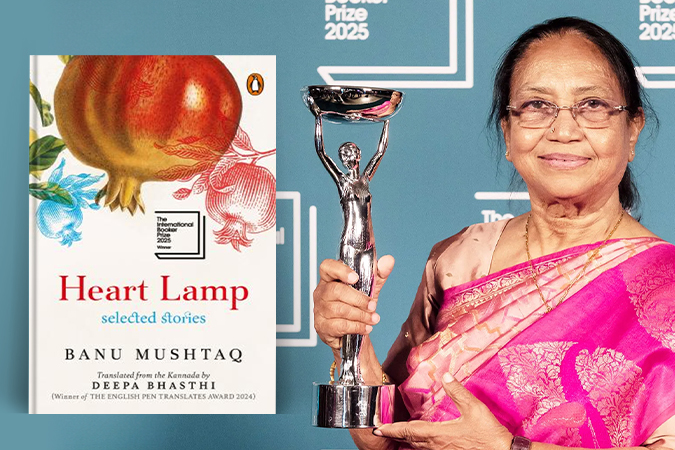
Kannada literature finds itself on the global literary map once again; this time, thanks to Banu Mushtaq, whose short story collection, Heart Lamp, translated into English by Deepa Bhasthi, is in the shortlist for the 2025 International Booker Prize. The anthology has 12 stories published in Kannada between 1990 and 2023. The other Kannada author who made it to the Booker list is U.R. Ananthamurthy, who was nominated for the Man Booker International Prize in 2013.
Mushtaq, who hails from Karnataka’s Hassan district, wears many caps. She is a practising advocate and activist who has been a part of several important social struggles. She is the author of six short story collections, a novel, an essay collection, and a collection of poems. Her short story collections are Hejje Moodida Haadi (A Path Just Visible, 1990), Benki Male (It Rained Fire, 1999), Edeya Hanate (Heart Lamp, 2004), Safeera (Safeera, 2006), Badavara Magalu Hennalla (A Poor Family’s Daughter is No Girl, 2012), and Hennu Haddina Svayamvara (The Female Eagle Chooses her Groom, 2022).
Mushtaq has won important awards for her literary works, including the Karnataka Sahitya Academy Award and the Attimabbe Award. Her short story “Haseena”, depicting the plight of a woman abandoned by her husband, was made into an award-winning film in 2004 by the eminent Kannada filmmaker Girish Kasaravalli.
A collection of her short stories titled Haseena and Other Stories, also translated by Deepa Bhasthi, won the English PEN translation award for 2024. English PEN is one of the human rights organisations fighting for freedom to read and write. This is what the jury said about Mushtaq: “A significant presence in Kannada literature, Banu Mushtaq reveals the varied realities of contemporary women with rare talent and art. Deepa Bhasthi’s rich translation captures the original’s nuances of voice, context and experience, bringing this important work into English for new readers in India and internationally.” Haseena and Other Stories was the first Kannada work to win the PEN award.
Commenting on the unique features of Mushtaq’s work, the International Booker Prize panel notes that “[i]t’s in her characters—the sparky children, the audacious grandmothers, the buffoonish maulvis and thug brothers, the oft-hapless husbands, and the mothers above all, surviving their feelings at great cost—that Mushtaq emerges as an astonishing writer and observer of human nature, building disconcerting emotional heights out of a rich spoken style”.
Literature of protest
Mushtaq started writing in the heady 1970s and 1980s, which marked the awakening of a new social consciousness in Karnataka, resulting in an efflorescence of writing in Kannada. In the Bandaya (protest) movement of the time, writing became a powerful tool to express dissent. Voices of silenced people—women, Dalits, Muslims, tribal people, peasants, and other oppressed groups—were heard for the first time, heralding a non-Brahmin era in Kannada literary culture. Writers hailing from the Muslim community—Sara Aboobacker, Fakir Mohammad Katpadi, Bolwar Mahammad Kunhi, Banu Mushtaq—started chronicling for the first time ever in Kannada, the experiences of modern educated men and women from their community. Mushtaq’s first story was published in the Kannada weekly Prajamata in 1974, and Hejje Moodida Haadi, her first collection of short stories, in 1990.
In her stories, Mushtaq delineates the everyday struggles of Muslim women with gentle humour. True to the manifesto of the Bandaya movement, which proclaimed, “May poetry be a sword, a soulmate who feels for the pain of the people”, Mushtaq transmutes her felt experience as a journalist and lawyer into heart-touchingly humane narratives. For Mushtaq, writing is a medium enabling her to express her feelings, especially when she does not agree with established practices. Much like the late Sara Aboobacker, who attracted her community’s ire for her critique of its mores, Mushtaq also went through a tough time in 2000 when she went against tradition, for instance, by supporting women’s right to offer prayer in mosques.
Double bind of Muslim women
Located in the intersection of several identities—woman, Muslim, activist, lawyer, writer— Mushtaq’s life and work present before us the entire range of possibilities and challenges faced by an educated, Muslim woman writer in these polarised times. She candidly describes the double bind faced by a Muslim woman writer who is writing in a second language (the first language of Karnataka’s Muslim community being mostly Urdu) for a majoritarian audience.
She writes in the preface to her first collection: “I gradually became aware that even when I am writing in Kannada, I can only write about the Muslim world, its people, their joys and sorrows, their interests and angularities. That very moment, I also realised that the Muslim community will surely resist such revealing narratives. Even as I was coming to terms with this resistance from inside the community, I could equally clearly see how the larger community outside was as resistant to any critique coming from me.”
Facing so many added dilemmas, problems, questions, and acerbic barbs led her at one point to ask herself whether she should write at all. She disarmingly answered her own question by saying that it was like asking, why live when there were so many problems.
D.S. Nagabhushana, a perceptive critic and publisher of Mushtaq’s first collection, wrote in 1990: “Literature can make us to see life in its entirety, thereby helping us to see the limits of religious separatism; literature can help dissolve the mutual suspicion and doubt about each other by revealing our common humanity. Banu’s writing is a step in that direction.”
Banu Mushtaq’s writing is more relevant than ever before in a world in which the divide is growing deeper by the day.
(Vanamala Viswanatha, a former professor of English studies, has translated renowned classics from the ancient, medieval, and modern Kannada into English. Courtesy: Frontline magazine, a fortnightly English language magazine published by The Hindu Group of publications headquartered in Chennai, India.)
❈ ❈ ❈
Banu Mushtaq Writes Women as They are: Tired, Resilient, and Rarely Thanked
Mridula Vijayarangakumar
What is the cost of being born a woman?
In Heart Lamp, a collection of 12 short stories, Banu Mushtaq provides various answers to the question—women pay with obedience, servitude, their bodies, and ultimately, their lives.
In the collection’s third story, “Black Cobras”, Aashraf chases after her husband Yakub, who abandons her once she gives birth to a third daughter. He remarries, dreaming that his new wife will give him a son, while Aashraf starves trying to feed the children and getting medicine for the sick infant. The mutawalli (caretaker of a waqf property) and other men in the village watch her run around, and do nothing to help even when she pleads with them.
Mushtaq’s stories show how the very notion of life is gendered, how women are valuable but not valued. Men long for sons; daughters arrive as symbols of disappointment and shame. Their presence is tolerated only because they serve a purpose: to clean, cook, and raise their siblings. They are not cherished, their labour is. Heart Lamp is an intimate portrait of the struggles, desires, and resilience of Muslim women, combining poignant storytelling with incisive social critique.
Speaking truth to power
Many of the stories are inspired by Mushtaq’s own life experiences, and the interactions she has had with other people. Written over the course of 33 years, the collection, translated by Deepa Bhasthi, has won this year’s International Booker Prize. Mushtaq is a celebrated Kannada writer, lawyer, and activist who emerged from the Bandaya Sahitya (Protest Literature) movement of the 1970s and 1980s—a progressive movement that challenged caste, class, and gender hierarchies in Karnataka. As the Booker judges note, Heart Lamp speaks “truth to power and slice[s] through the fault lines of caste, class, and religion widespread in contemporary society, exposing the rot within”—a powerful endorsement of Mushtaq’s fearless storytelling, moral clarity, and the political urgency that shapes her work.
What makes each story compelling is its complex layering and unexpected narrative turns. The stories resist simplicity—the structures are often non-linear, and the woman introduced at the beginning may not be in focus at all, but a witness to another woman’s life. It serves to underline how the lives of all women are interconnected. Above all, Mushtaq’s women are neither saints nor victims—they are just human.
In “A Decision of the Heart”, all Akhila wants is some form of control over the domestic space which she shares one wall away with her mother-in-law. But her husband, loyal to his mother, weaponises Akhila’s frustration, marrying off his mother without her consent. When Akhila realises her mistake, it is far too late.
In another story, “High-Heeled Shoe”, Naseema intentionally drives a wedge between her husband and his brother Nayaz for her own benefit, ignoring the toll it takes on her sister-in-law, Asifa, who bears the brunt of Nayaz’s crazed delusions. In Mushtaq’s stories, women fight for each other, but they also fight each other. She reveals how women are pitted against one another under patriarchy, which does not let them realise that the entire gender is are under various degrees of oppression.
Hierarchies among women
Mushtaq details how class and caste shape the hierarchies among women, granting privilege here to deny dignity there. In the story, “The Shroud”, Shaziya, an affluent woman, casually neglects the final, modest request of Yaseen Bua—a widowed domestic worker. Her callousness is telling: Bua is poor, powerless, and of no social consequence to Shaziya, who feels no need to show her the respect she would offer to someone of higher standing. Oppression flows not just from men, but also among women.
In writing about the lives of ordinary women, Mushtaq turns her gaze upon ordinary men too, showing how they do not necessarily need to beat up their wives to wield power. In many cases, their felt superiority expresses itself in just indifference. Religion comes to their aid. While Islam grants women financial rights and protection, men selectively interpret these teachings to suit their purposes. Under the display of piety lie greed, lust, and the routine denial of women’s autonomy. In stories such as “Fire Rain” and “Black Cobras”, the male protagonists are mutawallis preoccupied with maintaining a good public image, and their self-importance is fuelled by their social position, which blinds them to the emotional and material needs of their own families.
Mushtaq’s male characters, though often hurtful and dismissive, may not immediately appear monstrous—and herein lies the rub. Their indecency is so normalised and the bar is set so low for them, that it takes time for their awfulness to sink in. Entitlement, arrogance, and emotional negligence are rarely seen as forms of oppression and yet they shape the everyday lives of the women in the stories. At one striking moment, Yakub shouts at Aashraf, “Lei! If you who squats to pee has this much arrogance, how much arrogance should I, who stands to piss, have?”
Let there be daughters
This is why all the women in Mushtaq’s stories wish their daughters to be educated, independent, and empowered. Their resistance is quiet but resolute: a determination to break the cycle, not for themselves, but for their daughters. In the titular story, “Heart Lamp”, even as the “lamp in Mehrun’s heart had been extinguished a long time ago”, she still hopes through her daughter. The thread of intergenerational struggle and resilience runs through the collection; Mushtaq’s women may be battered by circumstance, but they do not surrender.
It is no accident that many of these stories do not have neat endings. Mushtaq resists resolution because the struggles of her characters are ongoing battles. Within that tension lies possibility as women continue to resist, reclaim, and imagine new futures for themselves.
Basthi’s translation beautifully captures Mushtaq’s signature dry humour and the characters’ quirky personalities. She blends English with local expressions and Kannadiga mannerisms in a way that global audiences can connect with Mushtaq’s work. Bashti avoids italics and footnotes, inviting readers to experience the text without interruption, allowing them to absorb new words naturally and immerse themselves in another language as they read.
Here, a minor niggle. Since the stories were written over decades as separate pieces, not intended to be part of a collection, they seem repetitive at times. The themes and characters seem a bit predictable after a while.
The anthology closes fittingly with “Be a Woman Once, Oh Lord!”—the title the cry of a long-suffering woman to god. Learning to empathise by getting into somebody else’s shoes is the beginning of the process of change. The woman flings the challenge at god himself: “If you were to build the world again, to create males and females again, do not be like an inexperienced potter. Come to earth as a woman, Prabhu!
“Be a woman once, Oh Lord!”
(Mridula Vijayarangakumar is sub-editor, Frontline magazine. Courtesy: Frontline magazine, a fortnightly English language magazine published by The Hindu Group of publications headquartered in Chennai, India.)